Xccelera AI Blog

Insights on Agentic AI,
Built for Enterprise Leaders

Practical thinking on multi-agent systems, AI-driven software engineering and enterprise AI transformation, from the team building the Xccelera AI Platform.

Popular topics
Latest Articles

Fresh Thinking,
Sorted by Topic

Showing 6 of 121 articles
AI ITSM agents resolving IT service desk tickets around a central AI hubAgentic Ai
10 min read

AI Agents for IT Service Management: Automating Ticket Triage and Remediation

INC-24817Resolved by agentPriority: P3Channel: Teams AI ITSM (AI in IT service management) uses AI agents to understand, triage, route and resolve IT requests and incidents, instead of leaving every ticket in a queue for a person. Xccelera AI builds these agents as a governed layer on top of the ITSM platform you already run, so…

Xccelera AIXccelera Team
AI Agents, AI Memory, Knowledge Graph, Agentic Software Delivery, Enterprise AIAgentic Ai
10 min read

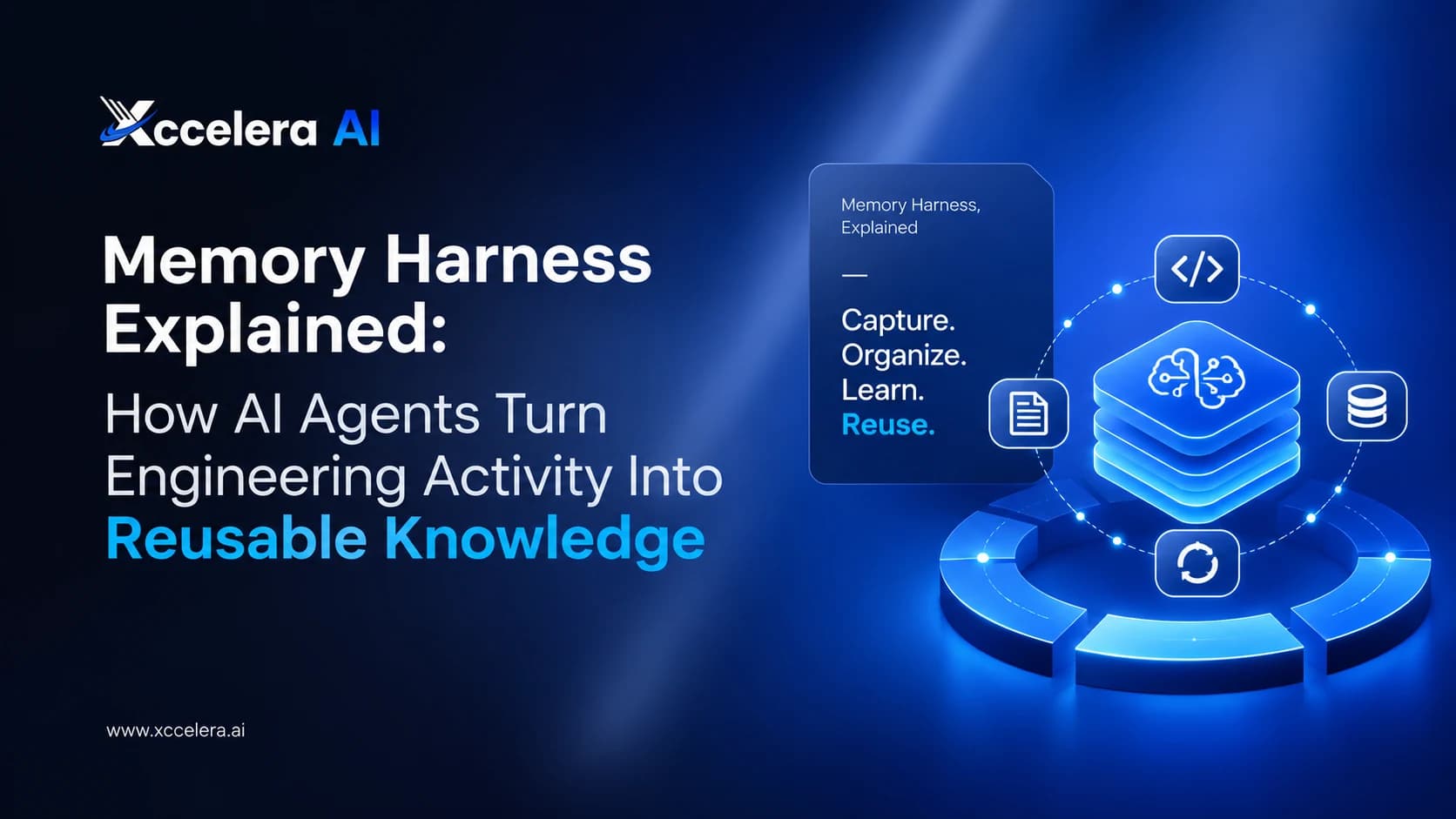
Memory Harness Explained: How AI Agents Turn Engineering Activity Into Reusable Knowledge

Quick answer AI memory for software engineering is the layer that lets AI agents remember a codebase, its decisions and its history across sessions, instead of starting from zero each time. A memory harness goes further: it captures engineering activity such as requirements, commits, tests, defects and incidents, links it in a knowledge graph, and…

Xccelera AIXccelera Team
Parallel AI agent lanes converging into a single merge stepAgentic Ai
10 min read

Parallel Multi-Agent Execution: How Running Agents Side by Side Shortens Delivery

quick-answer.md $ define parallel_multi_agent_execution Parallel multi-agent execution means running several specialized AI agents at the same time on independent parts of a task, instead of one after another. A lead agent splits the work, each agent works in its own isolated space, and a merge step combines and checks the results before release. fan-out /…

Sunil GuptaXccelera Team
Legacy Application Modernization With AI: Analyze, Convert and ValidateLegacy Application Modernization
12 min read

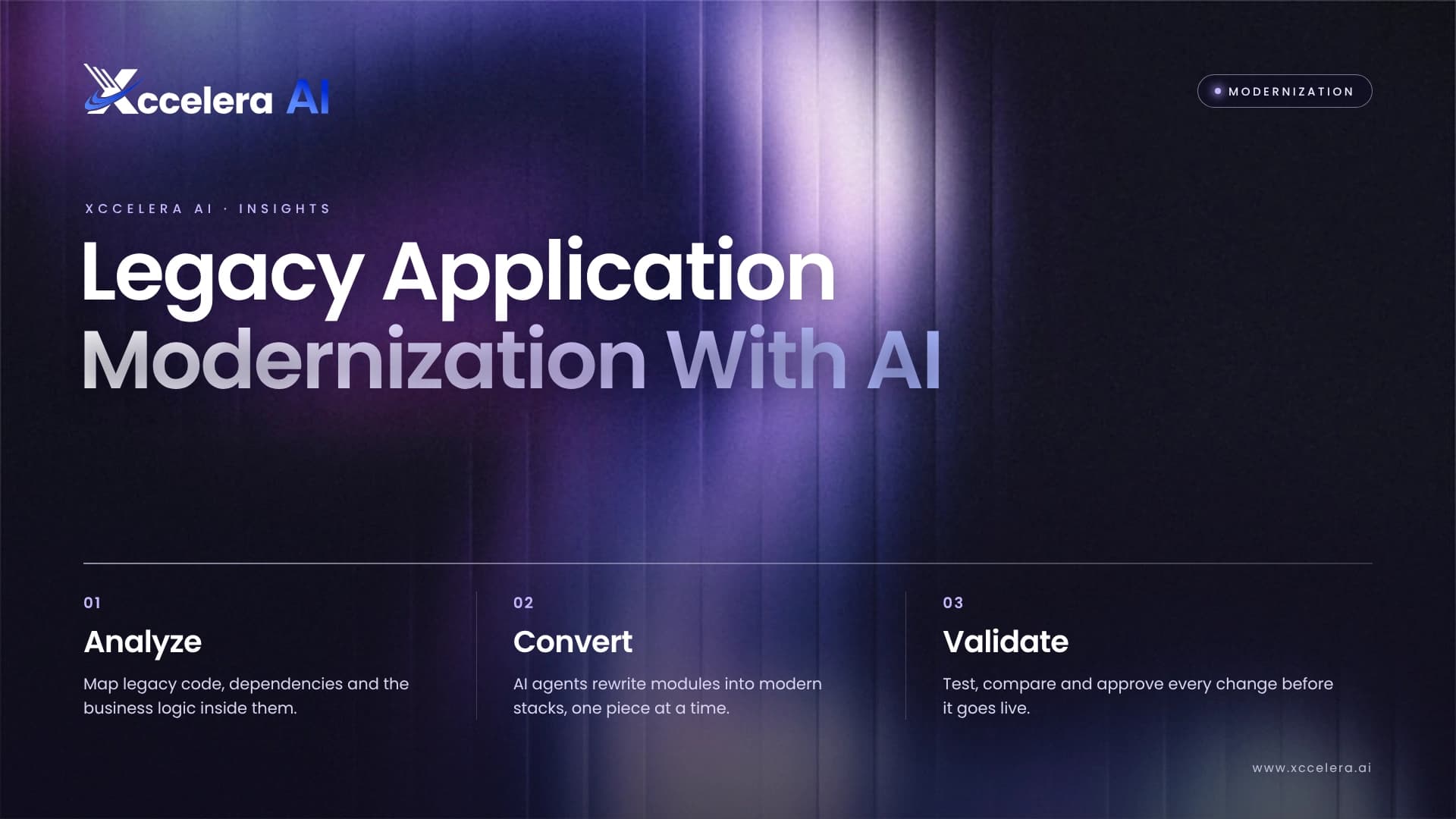
Legacy Application Modernization With AI: Analyze, Convert and Validate

Quick answer In short, legacy application modernization with AI is a three-stage process. AI first analyzes the old codebase to map its logic and dependencies. It then converts the code to a modern stack in small, reviewable batches, and finally validates that the new application behaves like the old one before cutover. First, people set…

Sunil GuptaXccelera Team
Enterprise AI Delivery Challenges: Why AI Tools Don't ScaleAgentic Ai
13 min read

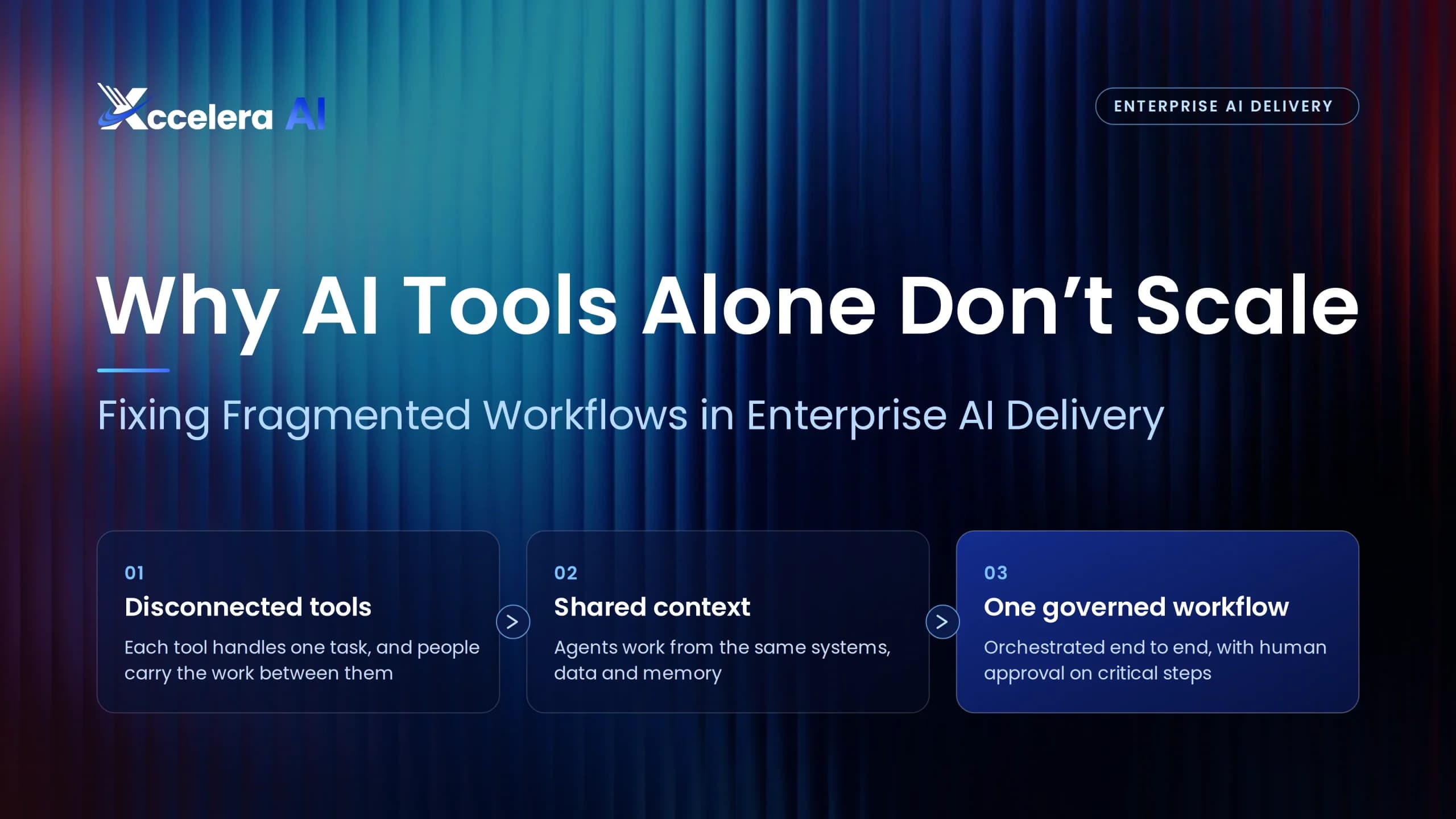
Why AI Tools Alone Don’t Scale: Fixing Fragmented Workflows in Enterprise AI Delivery

Enterprise AI delivery challenges come from the gaps between tools, not from the tools themselves. A point tool speeds up one task, but delivery speed depends on the whole flow of handoffs, context, reviews and approvals. In McKinsey’s 2026 survey, 80% said AI improved their personal productivity, yet only 37% saw any EBIT…

Sunil GuptaXccelera Team
What Is an Agentic PDLC? How AI Agents Work Across the Product Development LifecycleAgentic PDLC
17 min read

What Is an Agentic PDLC? How AI Agents Work Across the Product Development Lifecycle

Definition An agentic PDLC (agentic product development lifecycle), also called an agentic development lifecycle (ADLC), is a way of building software products in which specialized AI agents plan and carry out work at every stage, from discovery and requirements to release and post-launch learning. An orchestration layer coordinates the agents, a shared memory keeps context,…

Garima SaxenaXccelera Team
Newsletter

Get Agentic AI Insights in Your Inbox

New articles, product updates and transformation stories, sent occasionally.

No spam. Unsubscribe any time.