Why Enterprise Software Development Is Moving Toward Outcome-Driven AI
Most enterprise software teams are measuring the wrong things. For decades, success meant features shipped and sprints closed. But as agentic AI moves from pilot programs into production, that definition is breaking down – fast. The organizations pulling ahead aren’t shipping more. They’re shipping smarter, with every release tied to a business result leadership can…
Most enterprise software teams are measuring the wrong things.
For decades, success meant features shipped and sprints closed. But as agentic AI moves from pilot programs into production, that definition is breaking down – fast. The organizations pulling ahead aren’t shipping more. They’re shipping smarter, with every release tied to a business result leadership can measure, defend, and scale.
This is outcome-driven AI. And it’s quietly becoming the new standard for how CTOs, VPs of Engineering, and Directors evaluate technology investment.
From Feature Factories to Outcome-Driven Systems
For two decades, enterprise software teams measured success through output: features shipped, story points closed, uptime maintained. Outcome-driven AI reverses that logic entirely.
Instead of asking how many tickets were closed, it asks: what business result did this system produce?
- CTOs now demand that every engineering investment map to a measurable outcome – revenue growth, cost reduction, or risk mitigation.
- Product teams treat every release as a hypothesis to be measured, not a deliverable to be checked off.
- Engineering orgs are redesigning both their delivery pipelines and their success metrics.
The result? Software delivery is shifting from a cost center to a value discipline. If you’re still relying on traditional software delivery models, the gap between your team and outcome-driven competitors is already widening.
From Deliverables to Demonstrated Business Impact
Traditional roadmaps prioritized deliverables – new modules, integrations, feature bundles. Outcome-based roadmaps prioritize demonstrated impact:
- Faster claims processing
- Lower customer churn
- Fewer compliance exceptions
As a result, product and engineering leaders now sit closer to finance and operations, translating technical work into figures the board can evaluate.
Gartner projects that agentic AI will power roughly 40% of enterprise applications by the end of 2026 – up from under 5% in 2025. That trajectory only makes sense if each deployment produces a defensible business result.
How Agentic AI Turns Software Delivery Into a Continuous Value Engine
Agentic AI systems don’t simply generate code faster. They plan, execute, and adjust in response to real outcomes, creating a delivery loop that keeps optimizing after release instead of stopping at deployment.
Autonomous AI agents increasingly own the feedback loop end to end, monitoring performance signals and triggering corrective action without waiting for a human to notice a problem first.
In practice, this turns the pipeline into a standing value engine rather than a series of discrete projects. Enterprises adopting this model report average ROI above 170% across verticals – figures traditional automation rarely reaches.
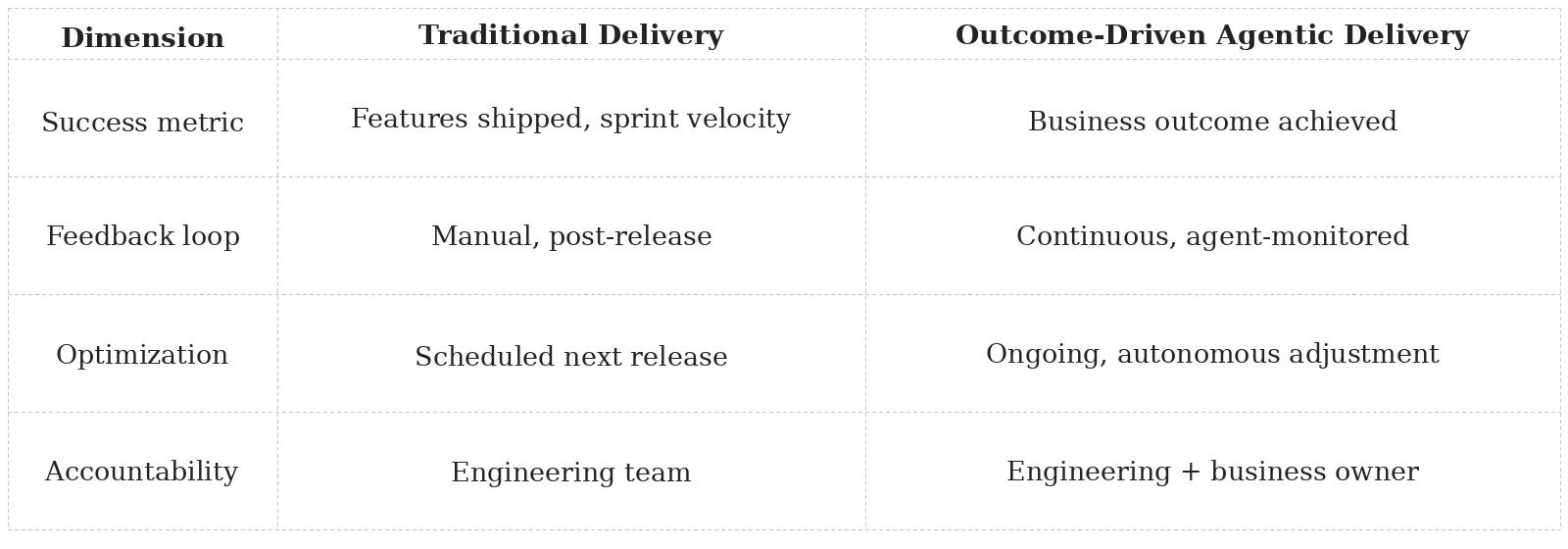
Engineering leaders who adopt this loop early gain a compounding advantage – each release teaches the system something the next release can act on immediately.
Measuring Software Success by Business Outcomes, Not Sprint Velocity
Sprint velocity tells a team how much it built. It says nothing about whether that work moved a business metric.
Outcome-driven AI replaces velocity-first reporting with outcome-first reporting, tracking indicators that finance and operations already trust. A claims-automation initiative, for example, is judged by reduction in processing time and error rate, not the number of user stories completed.
The metrics that matter to the board:
- Revenue or cost impact per release cycle
- Time-to-value from deployment to measurable result
- Error and exception rate reduction
- Customer retention or satisfaction shift tied to the change
Enterprises that adopt these metrics consistently outperform peers still reporting velocity alone. Outcome-driven AI forces every roadmap decision through a single, board-legible test: did this change move the number it was funded to move?
The Governance and Observability Layer Outcome-Driven AI Demands
Outcome ownership only works if leadership can trust what AI agents are actually doing. That trust depends on observability – logging every decision, every tool call, and every data access an agent makes across a workflow.
Without this layer, enterprises cannot:
- Prove compliance
- Explain an unexpected result
- Catch a failure before it compounds across a chain of automated tasks
Independent research found that only 21% of enterprises currently have full visibility into how their AI agents operate in production – a gap that directly limits how far outcome-driven programs can scale.
This is precisely why agentic AI governance and security now sits at the center of enterprise architecture decisions, not at the edge. Audit trails and human-in-the-loop approval gates are prerequisites for production, not optional add-ons.
Enterprise Trade-Offs: Cost, Speed, and Risk
Outcome-driven AI is not free of trade-offs. Faster delivery cycles increase the surface area for error if governance hasn’t matured alongside automation.
Leadership teams constantly weigh three variables:
- How much autonomy to grant an agent
- How quickly to scale a pilot into production
- How much oversight a given workflow actually requires
Getting this balance wrong in either direction carries cost, either through stalled adoption or unmanaged risk.
The sequencing framework that works:
- Grant limited autonomy first; expand permissions as trust builds
- Sequence pilots by time-to-value, not technical novelty
- Fund observability and audit infrastructure before scaling agent count
- Tie every expansion decision to a measurable outcome threshold
Enterprises that follow this sequence report strong first-year returns. Those that skip it often stall in pilot purgatory.
Building the Roadmap to Outcome-Driven Software Delivery
Moving from feature-based delivery to outcome-driven AI is a sequencing problem more than a technology problem. Most organizations already own the underlying AI capability. What they lack is a roadmap that ties each deployment stage to a specific, measurable business result.
Leadership teams that skip this step often end up with impressive demos and no defensible ROI story for the board.
How to sequence pilots into scaled production:
The organizations seeing the fastest returns start with a narrow, high-volume workflow, prove the outcome, then expand. Customer service and content operations tend to generate first-year returns quickly, funding harder programs like supply chain or legal automation that follow.
Median time to first value: ~5 weeks for vendor-built agents vs. ~3 months for custom builds. That gap increasingly shapes build-versus-buy decisions across the enterprise.
How Xccelera Powers Outcome-Driven Enterprise AI
Xccelera builds the orchestration, governance, and execution layers enterprises need to turn agentic AI from pilot into production outcome. Rather than bolting on another isolated tool, Xccelera connects planning, execution, and oversight into one accountable system, so every automated workflow ties back to a business result leadership can measure, defend, and scale.
For engineering and product teams under real pressure to prove ROI on AI investment, that accountability marks the clear difference between another short-lived experiment and a durable competitive advantage. Explore Xccelera’s AI-powered software development solutions to see how enterprises are operationalizing outcome-driven AI today.
The Bottom Line
The shift to outcome-driven AI isn’t coming, it’s already underway. The enterprises pulling ahead aren’t the ones with the most features or the fastest sprints. They’re the ones that have rebuilt their delivery model around results, governance, and compounding value.
The question isn’t whether to make the shift. It’s whether your organization makes it before your competitors do.
Which part of your current delivery pipeline would most benefit from an outcome-first rethink, your roadmap, your metrics, or your governance layer? Drop your answer in the comments.


