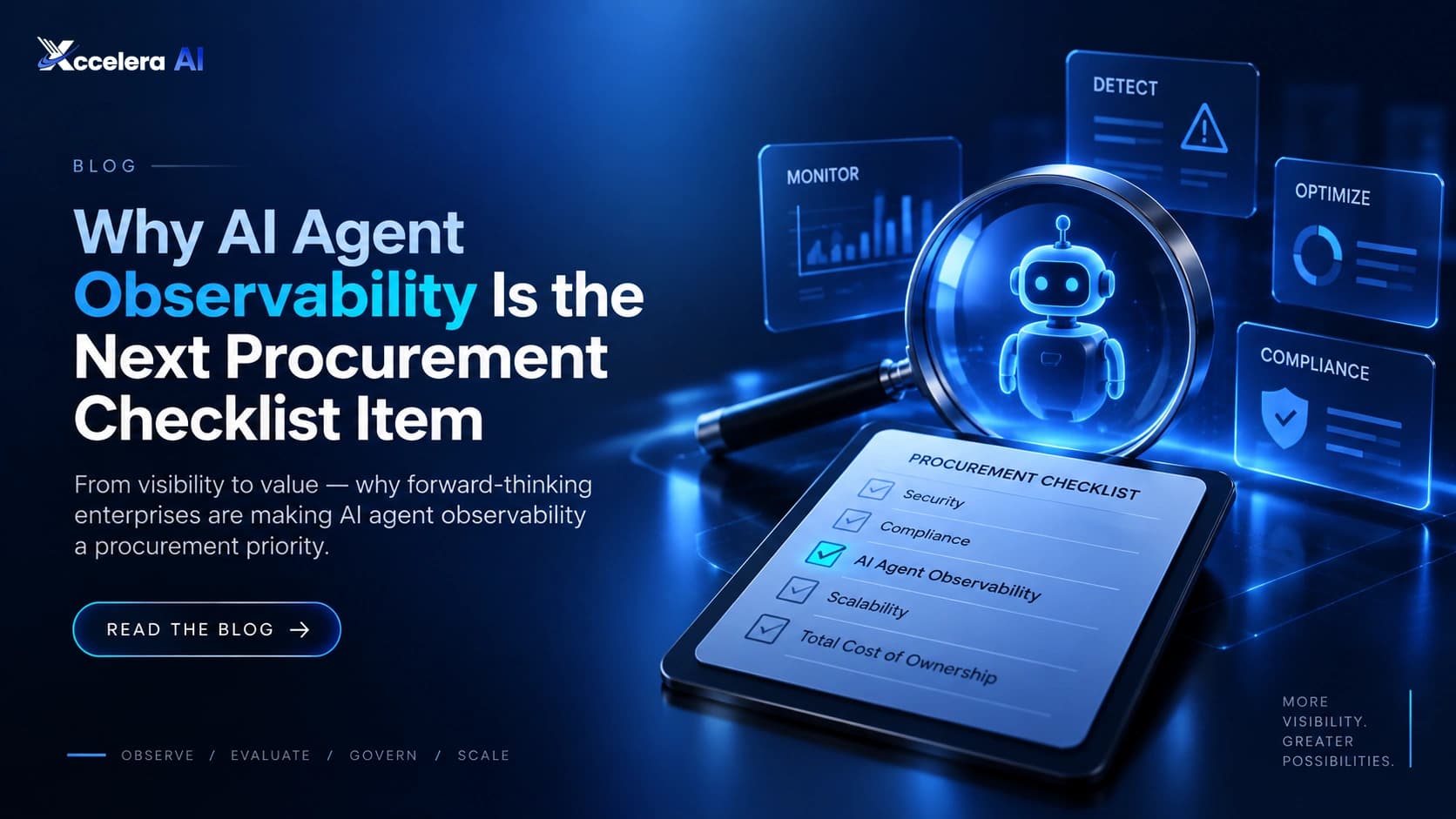
Why AI Agent Observability Is the Next Procurement Checklist Item
Picture this: your board asks a simple question about the autonomous agent your team just deployed – “How do we know it made the right decision?” If the honest answer is “we don’t have a way to check,” you already have a procurement problem, not just a technical one. That gap between deployment speed and…
Picture this: your board asks a simple question about the autonomous agent your team just deployed – “How do we know it made the right decision?” If the honest answer is “we don’t have a way to check,” you already have a procurement problem, not just a technical one.
That gap between deployment speed and visibility is exactly what’s pushing AI agent observability from a nice-to-have into a hard contractual requirement. Enterprise buyers are no longer asking vendors whether observability exists. They’re asking how deep it goes, and they’re writing the answer into the contract before anyone signs.
Autonomous Agents Have Outpaced Enterprise Visibility Controls
Enterprise adoption of autonomous agents has accelerated far faster than the monitoring infrastructure built to watch them.
Teams shipped multi-step, tool-calling systems into production before establishing consistent agent performance monitoring, and the gap is now showing up in reliability data across regulated sectors. Research from Cleanlab found that many regulated enterprises rebuild their AI agent stack every three months or faster, a clear sign of how unstable production environments remain even after initial deployment.
That instability isn’t a tooling footnote. It’s a direct signal that agentic AI monitoring hasn’t kept pace with how quickly these systems change in the field. Teams building toward long-term reliability are increasingly starting with a practical checklist for AI agent monitoring and access control rather than bolting visibility on after something breaks.
Reliability Gaps Are Concentrated in Reasoning and Tool Execution
The weakest point in most stacks isn’t the model itself. It’s what happens between decisions.
Cleanlab’s study also found that teams remain unsatisfied with their current observability and guardrail solutions, making reliability the weakest link in the broader agentic stack. Executives evaluating agentic AI contracts should treat this as a baseline expectation rather than a vendor differentiator.
If a system can’t show its reasoning path, procurement has no basis for approving it at scale.
AI Agent Observability Is Now a Non-Negotiable Procurement Requirement
Analysts now treat visibility into agent behavior as a prerequisite for enterprise deployment, not a premium feature.
Gartner projects that 40% of enterprise applications will feature task-specific AI agents by the end of 2026, up from less than 5% in 2025 – roughly eightfold growth in a single year. That growth curve is forcing buyers to formalize what they require before contracts are signed.
Four requirements now show up consistently in procurement conversations:
- Full trace-level visibility into every reasoning step, tool call, and retrieval action
- Documented evaluation metrics tied to business outcomes, not just uptime
- Real-time cost and token consumption tracking at the workflow level
- Audit-ready logs that satisfy internal compliance and external regulators
Elite AI teams that adopt purpose-built observability report 2.2 times better reliability than teams without it. Procurement leaders reading that gap correctly have stopped asking whether observability exists at all.
Blind Spots in Agentic Workflows Create Unquantified Enterprise Risk
The financial cost of skipping AI agent telemetry is already visible in project failure rates.
Industry analysis shows the average organization scraps 46% of AI proof-of-concepts before they reach production – representing roughly $30 billion in destroyed shareholder value in a single year. That figure captures projects that never made it to a board review, let alone a procurement audit.
Observability addresses the root causes behind those failures, including cost overruns, data quality issues, and unmanaged security exposure. Unlike traditional software that follows deterministic execution paths, AI agents exhibit non-deterministic behavior and can produce different results from identical inputs. That’s precisely why conventional application performance tools fall short, and why enterprise buyers who ignore this distinction inherit risk they can’t quantify, audit, or defend in a contract dispute.
Procurement Teams Now Demand Telemetry Before Signing Agentic AI Contracts
Contract negotiations increasingly open with a telemetry checklist rather than a pricing discussion, and regulatory pressure has accelerated that shift.
Prohibited AI practices under the EU AI Act became enforceable in February 2025, and general-purpose AI model obligations followed in August 2025, with penalties reaching up to €35 million or 7% of global turnover. Separate market analysis found that 49% of enterprises now run ten or more agents in production, while multi-agent adoption jumped from 23% to 72% in a single year.
The table below shows how procurement priorities have shifted as a result:
| Procurement Focus | Pre-2024 Standard | 2025-2026 Standard |
|---|---|---|
| Vendor evaluation | Uptime and SLA response time | Trace-level agent decision logs |
| Compliance basis | General data privacy terms | Auditability tied to specific regulation |
| Cost tracking | Flat licensing fee | Token-level and workflow-level cost telemetry |
| Risk ownership | Assumed by IT | Shared across IT, legal, and compliance |
Despite heavy investment, 69% of AI-powered decisions still require human verification, and only 34% of enterprises report full agentic AI deployment despite significant budget commitments. That verification burden is exactly what procurement-stage telemetry is designed to reduce, and it’s one reason enterprises are moving agentic AI from isolated pilots into real, governed systems rather than one-off proofs of concept.
Core Observability Metrics That Separate Enterprise-Ready Agents From Prototypes
Not every monitoring dashboard qualifies as enterprise-grade agentic AI risk management.
At minimum, enterprise-grade observability should provide trace-level visibility into every reasoning step, tool call, knowledge retrieval, and decision point within a session, paired with quality evaluation metrics that assess whether the agent actually solved the problem.
Buyers evaluating enterprise AI observability tools should prioritize these capabilities, in order:
- End-to-end reasoning traces – not just input and output logs
- Quality scoring that flags incorrect outcomes even when the agent responds confidently
- Cost attribution broken down by task, agent, and tool call
- Real-time alerting tied to policy violations, not just system errors
Traditional application performance monitoring tools were built for deterministic software. AI agents are non-deterministic, context-dependent, and multi-step, which means observability has to account for an entirely different set of signals. Vendors that can’t demonstrate all four capabilities in a live environment shouldn’t clear procurement review.
Governance Frameworks Are Rewriting Vendor Evaluation Criteria
Governance teams have moved from asking whether an agent works to asking whether its behavior can be explained after the fact.
Industry guidance now frames AI agent observability as the ability to see, understand, and explain what enterprise agents are doing across systems, with enough detail to debug issues, enforce guardrails, and prove compliance. That definition has become the working standard cited in vendor RFPs across financial services and healthcare procurement teams. Observability without governance is a log file. Observability connected to policy, ownership, and lineage is a compliance record a regulator can actually use.
Gartner predicts that 50% of AI agent deployment failures will cause financial or reputational loss for enterprises by 2030, framing agent risk fundamentally as a context and governance problem rather than a purely technical one. Vendor evaluation criteria are being rewritten around that prediction, with AI agent governance clauses now appearing as standard contract language rather than optional riders.
The Case for Observability-First Agentic AI Adoption
Enterprises can’t govern what they can’t see, and that reality is reshaping how agentic AI systems get evaluated, purchased, and deployed.
An AI agent lifecycle management approach addresses this gap directly by giving decision-makers continuous visibility into how autonomous agents reason, execute, and hand off work across a workflow, rather than leaving that visibility to be reconstructed after an incident.
Xccelera builds its agentic AI systems around this principle, treating observability as a foundational design requirement rather than a retrofit. Teams exploring Xccelera’s approach to agentic AI consulting will find that same philosophy running through every engagement: visibility isn’t bolted on at the end, it’s part of the architecture from day one.
The Bottom Line
For enterprise teams building their next procurement checklist, the distinction between observability-first and observability-as-afterthought determines whether an agentic AI investment scales safely or becomes another statistic in next year’s failure report.
The vendors who can show their work, trace by trace, decision by decision, are the ones who will win enterprise trust in 2026.
Where does your organization stand? Is AI agent observability already part of your procurement checklist, or is it still being treated as a nice-to-have? Drop your take in the comments.
If you’re tracking how enterprises are governing agentic AI, subscribe for more breakdowns like this one, delivered as the regulatory and vendor landscape keeps shifting.


