Why Enterprise AI Orchestration Is the New Competitive Moat in 2026
Enterprise AI orchestration is becoming the defining competitive divide of 2026. Organizations coordinating multi-agent systems, governing execution at scale, and connecting AI directly to measurable business outcomes are pulling ahead rapidly. Model-level investment alone no longer builds sustainable moats. Instead, orchestration does. The Orchestration Inflection Point: Why 2026 Is Different The boardroom conversation…
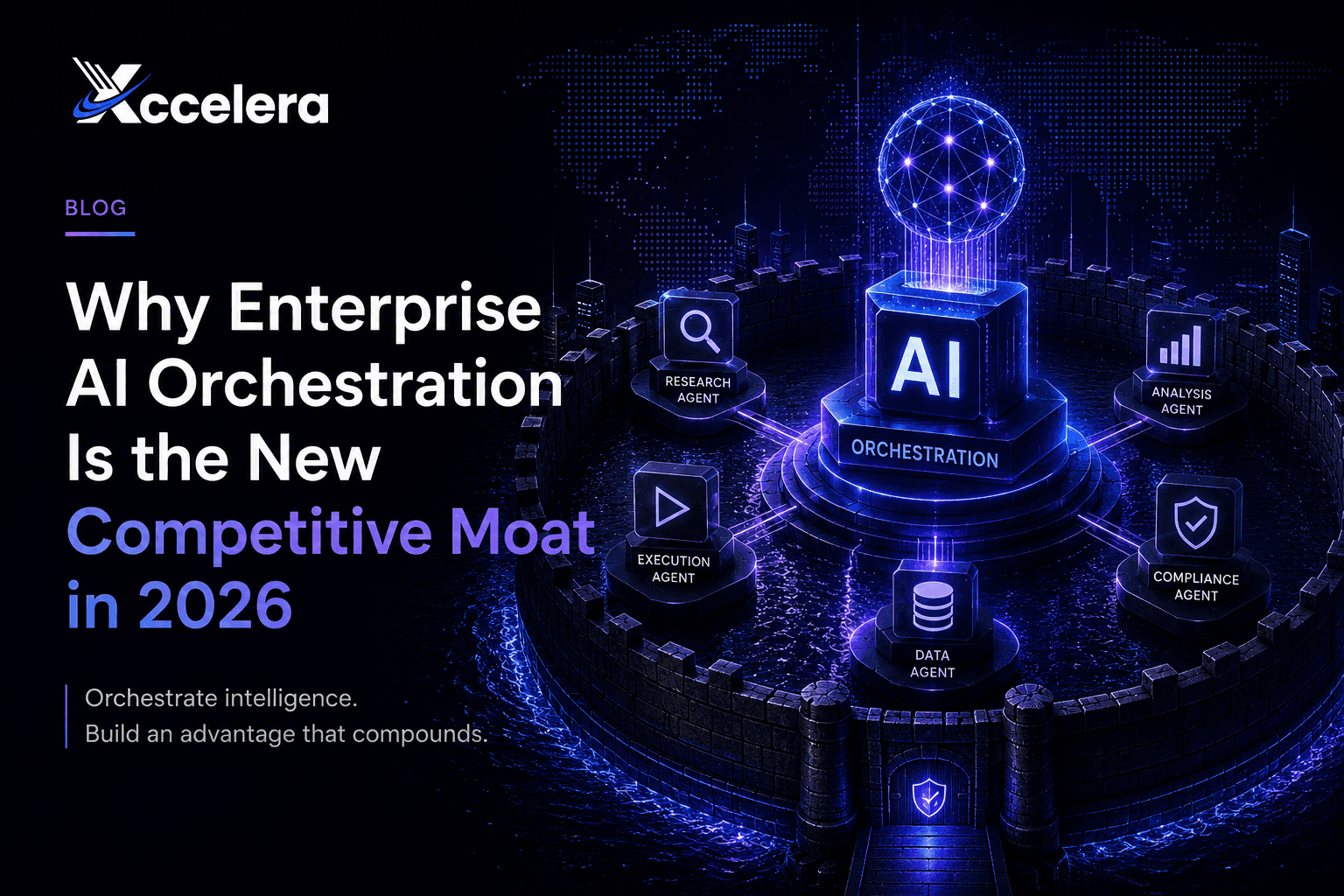
Enterprise AI orchestration is becoming the defining competitive divide of 2026. Organizations coordinating multi-agent systems, governing execution at scale, and connecting AI directly to measurable business outcomes are pulling ahead rapidly. Model-level investment alone no longer builds sustainable moats. Instead, orchestration does.
The Orchestration Inflection Point: Why 2026 Is Different
The boardroom conversation around AI has changed permanently.
In 2025, enterprise leaders were still asking whether AI was ready for production. However, in 2026, the question has become far more strategic: Is the organization’s orchestration infrastructure ready for scale?
That shift carries real consequences.
A May 2025 survey of 300 senior executives found that 88% planned to increase AI-related budgets within 12 months, with agentic systems identified as the primary driver. Nevertheless, increased spending alone does not separate leaders from laggards. Architecture does.
PwC’s 2026 enterprise AI outlook framed the situation clearly: exploratory investment is no longer enough. Every dollar committed to AI must connect to a measurable operational outcome. As a result, organizations still running disconnected pilots, isolated copilots, or model-level point solutions are no longer experimenting — they are falling behind.
At the same time, SAP’s 2026 enterprise analysis confirms another structural reality. Organizations that absorb operational complexity through orchestrated AI layers are building competitive moats that general-purpose tools cannot breach. Consequently, this is no longer just a technology trend. It is a strategic inflection point, and 2026 is where it becomes irreversible.
What Enterprise AI Orchestration Actually Means
Most organizations still conflate orchestration with automation. However, the distinction is not semantic — it is architectural, and misunderstanding it creates major scaling limitations.
Automation follows predefined rules. In contrast, orchestration reasons across systems.
For example, a chatbot may handle a customer query independently. Meanwhile, an orchestrated AI agent can receive that query, route it intelligently, pull context from multiple enterprise systems, trigger downstream workflows, validate outputs, and log every decision for audit purposes — all without human intervention. That operational difference is what separates automation from orchestration.
At its core, enterprise AI orchestration acts as a control plane. It coordinates multiple AI agents, routes tasks according to specialization, manages execution context across systems, and maintains governance throughout every interaction.
Furthermore, Cloud Wars’ 2026 analysis makes the operational mandate clear: building agents is no longer the differentiator. Scaling them, coordinating them, and aligning them with business rules is where the real enterprise value exists.
The Protocols Powering Multi-Agent Coordination
Two major protocols now define how orchestrated agents communicate at enterprise scale:
- Model Context Protocol (MCP): Standardizes how agents access tools and data sources.
- Agent-to-Agent Protocol (A2A): Backed by companies like Microsoft and Salesforce, it governs how agents hand off tasks between one another.
Together, these protocols create the interoperability foundation required for multi-agent orchestration across complex enterprise environments.
The Architecture Stack: How Production Orchestration Is Built
Production orchestration is not a single deployment layer. Instead, it is a coordinated architecture stack, and enterprises that approach it strategically consistently outperform those that treat it as a standalone deployment decision.
The Four Layers That Define Orchestration Depth
Enterprise orchestration typically operates across four interconnected layers:
1. The Reasoning Layer
This layer handles agent-level cognition, including planning, tool selection, and output generation.
2. The Routing Layer
The routing layer acts as traffic control, directing tasks toward the most appropriate specialized agent based on capability and availability.
3. The Memory Layer
This layer manages context persistence. It determines when knowledge should remain centralized for consistency and when it should stay distributed for speed.
4. The Governance Layer
Governance enforces behavioral boundaries, compliance alignment, and audit logging across every agent interaction.
Importantly, IBM’s 2026 Watsonx architecture positions governance not as an add-on, but as a mandatory agentic control plane embedded from the very beginning.
Sequential vs. Parallel Execution: Why the Choice Matters
How agents execute work is just as important as what they execute. Therefore, enterprises must carefully choose between sequential and parallel execution models.
Sequential Architectures
Sequential systems pass outputs from one agent to the next. As a result, they are highly reliable, auditable, and ideal for compliance-heavy workflows.
Parallel Architectures
Parallel systems allow specialized agents to run simultaneously. Consequently, they dramatically reduce cycle times for high-volume operational environments.
According to FifthRow’s April 2026 enterprise playbook, this execution-model decision is among the most underplanned choices in orchestration deployments. Organizations that default to one approach without aligning it to workflow requirements frequently encounter latency issues, redundant outputs, or governance blind spots.
Similarly, memory architecture choices create operational trade-offs:
- Centralized memory improves consistency but introduces latency.
- Distributed memory increases execution speed but requires synchronization safeguards to prevent context drift.
Ultimately, the correct decision depends entirely on business workflow requirements.
Multi-Agent Coordination as a Core Business Capability
Single agents prove concepts. Multi-agent systems run businesses. That distinction is now shaping some of the most important architectural decisions in enterprise AI.
Organizations using multi-agent architectures report:
- 45% faster problem resolution
- 60% more accurate outcomes
compared to equivalent single-agent deployments.
Why Specialization Matters
The performance gains come from specialization.
Instead of relying on one general-purpose agent to handle research, validation, execution, and compliance simultaneously, orchestrated systems assign each responsibility to a dedicated specialist agent. Consequently, enterprises achieve better accuracy, faster processing, and more reliable governance.
How Role-Based Specialization Works
A typical orchestrated workflow functions as a coordinated team:
- A manager agent receives the business objective.
- A data extraction agent pulls relevant records.
- A validation agent checks outputs against business rules.
- A compliance agent identifies regulatory risks.
- Finally, the manager agent consolidates results into a decision-ready output.
Because responsibilities remain clearly segmented, orchestration systems achieve far greater scalability and operational reliability.
Databricks’ 2026 State of AI Agents Report recorded a 327% surge in multi-agent adoption within just four months, highlighting how quickly enterprises are moving toward coordinated AI systems.
Why Fortune 500 Companies Are Still Leaving Value on the Table
Despite strong performance data, nearly 70% of Fortune 500 companies still rely primarily on single-agent deployments. Interestingly, the barrier is rarely technical — it is architectural readiness.
Deloitte’s 2026 analysis found that enterprises with stronger coordination layers, centralized governance, and structured handoff protocols could increase autonomous AI market value projections by 15–30% beyond baseline estimates.
In other words, every additional coordination layer compounds the ROI potential of all existing AI investments.
The ROI Case: What Orchestration Produces in Dollar Terms
The financial case for enterprise AI orchestration is no longer hypothetical. By H1 2026, production deployments were already generating measurable returns.
Organizations deploying orchestrated multi-agent systems report:
- 171% average ROI
- Achieved within 12–18 months
Implementation costs vary significantly:
- Mid-scale pilots: approximately $60,000
- Regulated production deployments: over $300,000
Notably, governance and integration alone consume up to 60% of total project budgets. Although this surprises many leadership teams focused only on model licensing costs, it accurately reflects the operational complexity of enterprise deployment.
The Highest-Performing Orchestration Use Cases
The strongest orchestration ROI is currently emerging from:
- Document processing
- Data reconciliation
- Compliance monitoring
- Invoice handling
Meanwhile, customer-facing chatbot orchestration underperformed relative to its deployment costs across many 2025 enterprise initiatives.
Furthermore, governance maturity dramatically improves outcomes. Enterprises with structured reliability frameworks achieve 3.2x faster ROI compared to organizations operating without behavioral guardrails. Consequently, governance is no longer merely a compliance expense — it is an ROI accelerator.
Governance, Compliance, and Control in Orchestrated Environments
Scale without governance is not an enterprise capability. Instead, it becomes an accumulating operational liability.
Five Frameworks Defining Enterprise AI Compliance
1. EU AI Act
Now actively enforced, requiring risk classification, conformity assessments, and transparency obligations.
2. NIST AI Risk Management Framework
The emerging US standard across regulated industries and federal procurement.
3. ISO/IEC 42001
The first internationally certifiable AI management system standard.
4. Generative AI Accountability Frameworks
Focused specifically on hallucinations, data leakage, and LLM unpredictability.
5. Cross-Border Standards Alignment Frameworks
Designed to simplify compliance across multiple regulatory jurisdictions.
Why Governance Infrastructure Matters
IBM’s Think 2026 announcements positioned Watsonx Orchestrate as a next-generation control plane specifically designed to address the largest obstacle preventing enterprises from scaling AI: the absence of embedded governance infrastructure.
Meanwhile:
- 52% of organizations are prioritizing digital sovereignty.
- 41% are adopting open frameworks to avoid proprietary lock-in.
Although governance consumes a large portion of orchestration budgets, deploying agents without behavioral safeguards and audit trails creates significantly larger long-term risks.
Where Enterprise Orchestration Fails
Most enterprise orchestration failures occur at the architecture layer rather than the model layer. Moreover, the failure patterns are becoming increasingly predictable.
Failure Mode 1: Vendor Lock-In
Between 76% and 81% of enterprises report concerns about proprietary orchestration dependencies. When orchestration tooling, memory systems, and integrations are tightly coupled to one vendor, switching costs compound rapidly.
Failure Mode 2: Agent Sprawl
Low-code platforms have made agent creation easy across departments. However, without centralized orchestration, enterprises end up with disconnected agents producing conflicting outputs and duplicated workflows.
Failure Mode 3: Unexpected Production Behavior
Deloitte’s 2025 AI Risk Assessment found that 73% of enterprises encountered unexpected agent behavior in production that never appeared during testing. Real-world environments expose far more edge cases than controlled development environments can simulate.
What Successful Enterprises Do Differently
Organizations avoiding these failure patterns typically:
- Separate orchestration from model APIs
- Build abstraction layers to reduce switching costs
- Define behavioral ranges instead of rigid outputs
- Treat governance as a deployment prerequisite
As a result, they maintain significantly greater operational flexibility and resilience.
Industry Deployments Producing Measurable Returns
By 2026, production deployments across multiple industries have already demonstrated clear orchestration value.
Financial Services and B2B Operations
Financial services remains one of the strongest orchestration environments due to highly structured workflows and measurable operational costs.
High-performing use cases include:
- Invoice processing
- Accounts payable automation
- Dispute resolution
- Account monitoring systems
These deployments are reducing manual analysis workloads while accelerating operational response times.
Healthcare, Energy, and Marketing Operations
Healthcare providers are using orchestrated agents for:
- Patient booking coordination
- Status monitoring
- Automated notifications
- Unified operational reporting
Similarly, energy companies are deploying orchestration systems for:
- Smart grid monitoring
- Predictive maintenance
- Automated outage detection
Meanwhile, marketing teams are shifting from manual weekly reporting cycles to real-time competitive intelligence monitoring.
From Pilot to Production: The Enterprise Maturity Path
Most enterprises struggling with orchestration are not struggling with AI itself. Instead, they are struggling with the transition from experimentation to operational infrastructure.
Phase One: Single-Agent Productivity
Individual agents handle isolated tasks within a single function.
Phase Two: Multi-Agent Coordination
Specialized agents begin communicating and sharing outputs.
Phase Three: Enterprise Orchestration
Control planes coordinate agents across departments while continuously optimizing workflows and resources.
The largest organizational bottleneck exists between Phase Two and Phase Three. In fact, only 23% of enterprises are successfully scaling agent systems today.
Why? Because infrastructure transformation extends far beyond model deployment.
For every dollar invested in AI technology, enterprises often spend up to ten dollars on:
- Process redesign
- Governance frameworks
- Workforce restructuring
- Operational integration
Organizations that underestimate these surrounding investments typically fail during broad deployment.
How Xccelera Architects Enterprise AI Orchestration Systems
Orchestration strategy without execution infrastructure remains theoretical. The real competitive advantage comes from turning architecture into measurable operational outcomes.
Xccelera approaches enterprise AI orchestration as an operational engineering challenge rather than a simple technology deployment. Every engagement begins with workflow mapping tied directly to business objectives. Additionally, governance frameworks are embedded during architecture design instead of being added later as compliance overlays.
Integration across enterprise systems — including legacy infrastructure — is treated as a first-order requirement from the beginning.
The competitive reality of 2026 is now unmistakable:
Organizations evolving from isolated AI deployments into coordinated, governed, outcome-driven agent ecosystems are building structural advantages that compound over time. Meanwhile, organizations delaying orchestration investment are steadily losing ground to competitors that have already committed architecturally.
Xccelera.ai helps enterprises close that gap with orchestration systems designed for production from day one.


