How ApiX Generates a Production-Ready Backend in Under 15 Minutes — No Engineer Needed
Engineering-dependent backend development is costing enterprises millions in wasted salary, delayed launches, and technical debt. Specifically, ApiX, Xccelera’s intelligent backend generator, eliminates that bottleneck. Simply fill a short form and it outputs a complete FastAPI backend with Docker, CI/CD, auth, and database schemas. Production-ready. Fully owned. Zero boilerplate. Backend Development Is Bleeding Enterprise Budgets —…
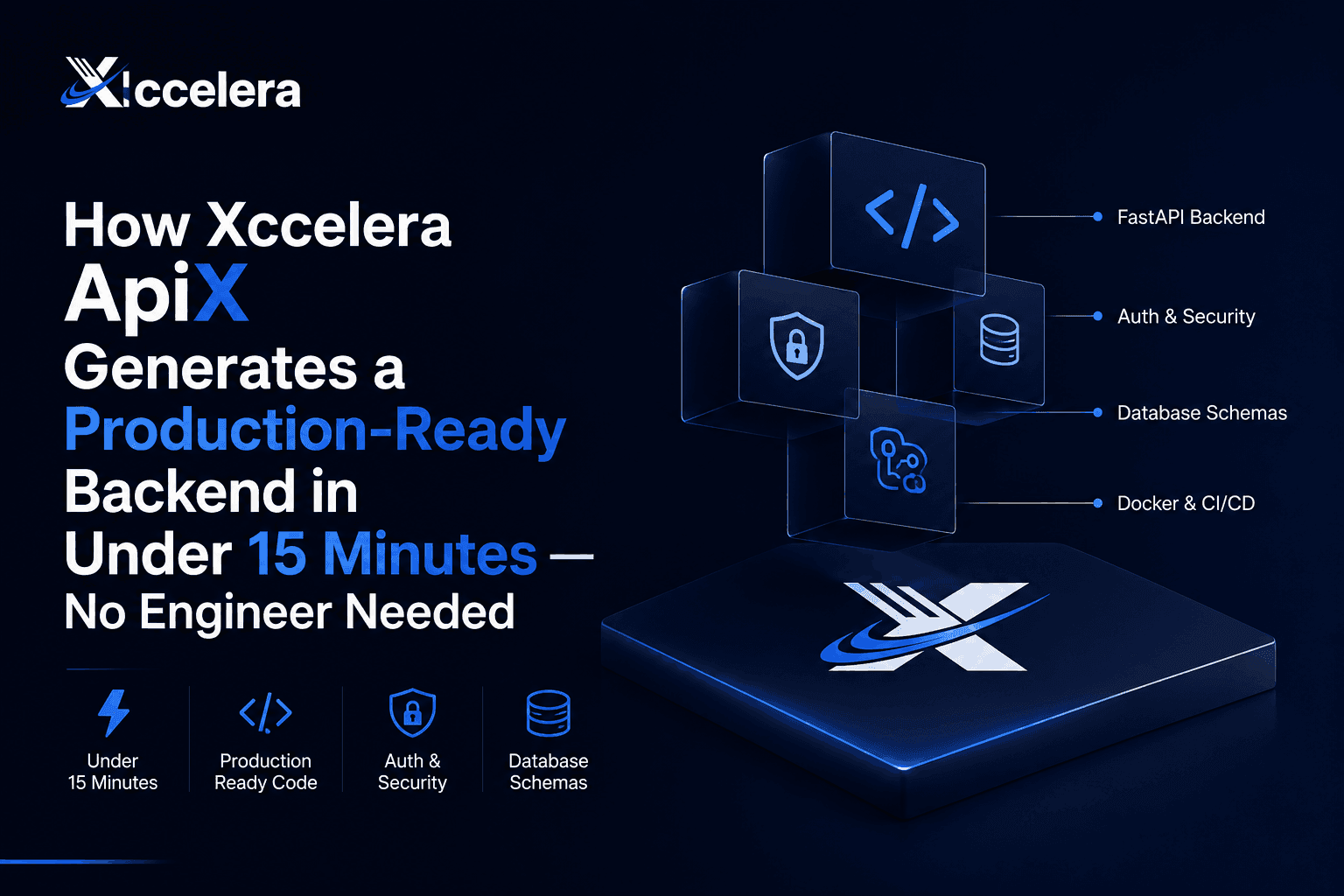
Engineering-dependent backend development is costing enterprises millions in wasted salary, delayed launches, and technical debt. Specifically, ApiX, Xccelera’s intelligent backend generator, eliminates that bottleneck. Simply fill a short form and it outputs a complete FastAPI backend with Docker, CI/CD, auth, and database schemas. Production-ready. Fully owned. Zero boilerplate.
Backend Development Is Bleeding Enterprise Budgets — The Numbers Prove It
The Hidden Cost Center
Most finance leaders classify backend engineering overhead as a fixed operational cost. It is not. In fact, the JetBrains State of Developer Ecosystem survey, covering 24,534 developers across 194 countries, confirmed that engineers burn 33% of their working time on technical debt. That is time lost to debt instead of shipping features. For a 10-person backend team earning $120,000 annually, that figure translates to $396,000 per year — producing zero forward progress.
The Trillion-Dollar Drain
The CISQ Cost of Poor Software Quality report places the aggregate damage at $1.52 trillion annually across US companies alone. To put the project-level impact in precise terms, Sonar’s analysis of over 200 real-world projects found that a codebase with one million lines of code wastes $306,000 per year. That is roughly 5,500 developer hours that could instead go toward product innovation. Meanwhile, McKinsey’s research positions technical debt at 20 to 40% of an organization’s entire technology estate value before depreciation. In short, backend setup is not a side cost. It is the primary channel through which that debt enters the system and compounds.
The Developer Shortage Has Reached Crisis Level — And It Is Getting Worse
Supply Cannot Keep Pace With Demand
The global backend developer shortage in 2026 is not a cyclical hiring challenge that better compensation will resolve. US universities produce approximately 65,000 computer science graduates annually. By contrast, the market demands 180,000 AI-capable backend engineers — a structural deficit of 115,000 positions no pipeline can absorb. Furthermore, the shortage is projected to be 40% more severe in 2026 than in 2025, with average time-to-hire extending by 46%.
What Constrained Talent Actually Costs the Business
Eighty-two percent of organizations report active difficulty hiring qualified backend engineers. As a result, developers in simultaneous interviews are pushing compensation 25 to 40% above baseline rates. A single delayed hire cascades forward: feature releases slip, customer commitments erode, and competitive windows close. In addition, three months lost in hiring routinely produces a six-month execution gap for waiting product teams. Enterprises building their delivery model around a talent base this constrained are not managing a risk — they are funding one.
Technical Debt Is Not an Engineering Problem — It Is a Business Risk
The Stakes Have Reached the Boardroom
Technical debt has migrated from engineering backlogs into executive risk registers. When 62% of organizations confirm that dead code is slowing their teams, and one-third of developers spend more than half their time managing friction in inconsistent systems, the financial exposure is no longer an IT concern. Indeed, Sonar’s cross-industry analysis places annual remediation cost at $306,000 per project per million lines of code. That figure compounds across every backend a team has shipped without architectural discipline. As a result, McKinsey estimates that debt-heavy organizations spend up to 75% of engineering time servicing liabilities rather than creating value. At those ratios, product velocity does not slow gradually. It collapses.
Where Boilerplate Begins the Cycle
A feature requiring two weeks on a clean codebase routinely takes four to six weeks on accumulated backend debt. That is a 50 to 200% cost increase per feature, per release cycle. Moreover, 51% of engineers have left — or seriously considered leaving — because of unmanaged technical debt. This compounds the talent shortage with avoidable attrition. Ultimately, boilerplate-heavy backend setup is the origin point of this cycle. Every inconsistently scaffolded project introduces architectural fragility that teams spend two years working around, converting a one-time shortcut into a recurring operational liability.
The Traditional Backend Build Model Is No Longer Fit for 2026 Delivery Demands
A Different Architecture Requirement
Modern backend systems in 2026 must serve AI agents, sustain real-time data flows, and maintain sub-second API response times from the first production commit. These are not aspirational benchmarks. Rather, they are baseline requirements that enterprise product teams specify before any architectural decisions are made. Notably, the global software market reached $823.92 billion in 2025. The infrastructure expectations embedded in that investment have outpaced what manually assembled backends can deliver at pace.
A Velocity Problem, Not a Skills Problem
Backend engineers in 2026 are evaluated on system design, AI integration, and architectural governance — not on configuring environment variables or writing CRUD scaffolding. When inconsistent internal structures create integration debt before the first feature ships, the problem is not the engineer’s competence. Rather, it is a build model that consumes expert capacity on setup that should never require expert capacity. In other words, traditional backend development does not need better engineers. It needs a different entry point.
The Solution — Meet ApiX, Xccelera’s Intelligent Backend Generator
Not a No-Code Builder. An Intelligent Generator.
The distinction is architecturally significant. No-code builders produce visual configurations that run inside a proprietary runtime the developer never fully owns. By contrast, ApiX, Xccelera’s backend accelerator, produces complete, organized source code. Simply fill out a short structured form and ApiX assembles a FastAPI backend ready to download, review, modify, and deploy anywhere. There is no runtime dependency, no black box, and no vendor lock-in. The output is a ZIP file containing every layer of the backend: schemas, authentication logic, endpoint definitions, and infrastructure configuration. What a senior engineer would spend days constructing from scratch, ApiX generates in minutes.
Built for AI-Native Workflows
ApiX is built on FastAPI, the Python framework powering production APIs at Microsoft, Netflix, and Uber. Consequently, it delivers the sub-second response times that AI agent integrations and real-time systems require as a baseline. Xccelera developed ApiX as part of its agentic accelerator portfolio specifically to close the gap between the performance modern AI applications demand and the timelines traditional workflows produce.
How ApiX Works — From Form Input to Deployed Backend in Three Steps
Stage 1: Project Foundation
The first phase establishes the architectural baseline. Teams define the project name, select their Python version, choose their database engine, and configure authentication — choosing between JWT and OAuth2 — in a single interface. Crucially, every selection propagates through the entire generated codebase automatically. This eliminates the environment variable mismatches and authentication errors that typically surface three sprints into a conventional backend build.
Stage 2: Data Architecture
In the second phase, teams define their core entities and field structures. Specifically, ApiX handles the complex mapping between data models, Pydantic schemas, and database relations using SQLAlchemy for relational databases and Motor for MongoDB. As a result, it removes the boilerplate translation layer that typically consumes days of senior engineering capacity before a single business logic function is written.
Stage 3: API and Infrastructure Assembly
The third phase produces the deployable output. Teams review auto-generated endpoints and WebSocket configurations, then ApiX assembles the complete infrastructure package: Dockerfiles, CI/CD configuration, and Pytest stubs for immediate test coverage. The final output is a ZIP file of production-standard code that teams fully own. There is no platform dependency, no proprietary runtime, and no deployment constraints.
The Architecture ApiX Produces — And Why It Meets Enterprise Standards
FastAPI as the Structural Foundation
FastAPI has become the production standard for Python backend development in 2026, surpassing Flask in GitHub adoption. It now powers APIs at Microsoft, Netflix, and Uber. Because ApiX builds entirely on this foundation, every generated backend inherits sub-second performance, native async support, and first-class compatibility with AI agent integrations and LLM tool-calling workflows out of the box.
Typed, Observable, and Immediately Testable
Pydantic v2 schema enforcement guarantees that AI agents receive strictly typed, predictable data on every API call. This eliminates the silent data integrity failures that surface weeks into production. Async database drivers and high-performance cursor pagination handle high-volume data loads without latency degradation. Additionally, ApiX auto-generates Pytest stubs at output, giving teams immediate test coverage from the first commit rather than treating QA as a post-development activity. Finally, structured logging ships with every project, making observability a built-in property rather than a post-incident retrofit.
Why Enterprise Teams Should Deploy ApiX Now — Not After the Next Sprint
Postponing backend generation standardization does not protect engineering quality. Instead, it extends the window during which manual workflows accumulate the structural debt costing US enterprises $1.52 trillion annually. Every sprint that passes is a sprint in which boilerplate overhead consumes capacity that should go toward business logic.
By contrast, competitors who standardize on generation-first infrastructure establish compounding advantages: faster release cadences, lower per-project overhead, and codebases that stay auditable as teams change. In addition, ApiX-generated code is clean, layered, and reviewable by any engineer, removing the institutional knowledge dependency that makes manually built backends fragile when senior developers leave.
For organizations deploying AI-native systems, the urgency is even more specific. AI agents require low-latency, reliably typed API infrastructure to function predictably at scale. A backend that introduces latency or schema inconsistency does not slow the agent — it breaks the workflow. Therefore, ApiX provides the foundation those systems require from day one.
The ROI Calculation — What ApiX Delivers in Measurable Business Terms
The financial case for ApiX is not directional. It is calculable across four dimensions that finance and operations leaders can model directly against current backend overhead.
Development Speed: ApiX compresses the backend build cycle from days or weeks to under 15 minutes. For organizations with multiple concurrent product initiatives, that compression multiplies across every project in the pipeline simultaneously.
Error Elimination: Environment variable mismatches, routing errors, and authentication failures account for a large share of debugging cycles that extend delivery timelines. ApiX eliminates this error category entirely at the generation stage, producing 100% structurally consistent output on every build.
Infrastructure Containment: Forty percent of total infrastructure workflow — including Dockerfiles, CI/CD pipelines, and test scaffolding — is handled in a single generation sequence. As a result, teams that previously needed DevOps for each new project can now deploy independently from the first commit.
Compounding Return: ROI does not plateau at the first deployment. Instead, each subsequent project delivers the same speed and consistency gains. Meanwhile, the cost of managing inconsistent backend architectures declines as standardization spreads across teams.
Who ApiX Is Built For — And What Changes for Each Team
ApiX delivers measurable operational change across every team that touches backend infrastructure. Notably, the nature of that change differs by role.
Developers gain enterprise-grade architectural patterns on every project — without internal debate over structure. FastAPI, Pydantic v2, async drivers, and layered architecture ship as defaults, not as outcomes of code review cycles. As a result, senior engineers stop fielding boilerplate questions and start directing capacity toward business logic that differentiates the product.
Startups and Agencies eliminate the inconsistency that builds up when different engineers set up projects differently. Every client engagement, internal product, and prototype begins from an identical, professional-grade foundation. Consequently, the cost of onboarding a new engineer drops when the architecture is predictable across every codebase the team owns.
Engineering Directors and VPs gain the governance outcome that manual workflows cannot guarantee: auditable, consistently structured code across every backend the team ships. Consequently, ApiX makes architecture a repeatable organizational standard rather than an outcome that varies by who ran the setup. Learn more about Xccelera’s agentic AI services for enterprise-scale governance.
First-time builders access a complete, production-ready backend without prior knowledge of FastAPI configuration, database relationship mapping, or CI/CD construction. In short, the learning curve shifts from infrastructure setup to business logic — which is where it should begin.
AI development teams receive the low-latency, strictly typed, WebSocket-capable backend that multi-agent workflows and LLM tool-calling pipelines require as a structural baseline. Importantly, ApiX does not require AI teams to retrofit backend performance after deployment. It ships it. Explore Xccelera’s full AI development platform to see how ApiX fits into a broader agentic stack.
Conclusion — How Xccelera Positions ApiX as Enterprise Backend Infrastructure
Infrastructure, Not Tooling
ApiX does not accelerate manual backend setup. It eliminates it. Xccelera built ApiX as infrastructure — not a developer utility. In doing so, it converts a process that consumed days of senior engineering capacity into a three-step sequence any team can execute in under 15 minutes. The backend stops being a bottleneck and becomes a repeatable, governed, scalable output.
Deloitte’s 2026 technology research identifies infrastructure readiness as the primary barrier preventing enterprises from scaling agentic AI beyond pilots. Accordingly, ApiX closes that gap directly. Its FastAPI foundation delivers the sub-second API performance autonomous agent workflows require. Its structured, typed output eliminates the schema inconsistencies that cause agent failures in production. Furthermore, its full code ownership model gives enterprise security and compliance teams complete auditability with zero third-party runtime dependency.
Organizations that standardize on ApiX now carry a compounding velocity advantage. Those that do not continue funding the structural debt that makes that advantage worth holding. Get started with ApiX on Xccelera’s platform today.


