FrontendX: The AI Agent That Converts Your Figma Design Into a Verified React App
FrontendX is an agentic AI system that reads Figma design files and outputs verified, production-ready React applications. It eliminates manual design-to-code translation, reduces engineering cycles, and enforces design system consistency at scale. Built for enterprise teams that cannot afford drift between design intent and deployed UI. Why Manual Figma-to-React Conversion Is Costing Engineering Teams Too…
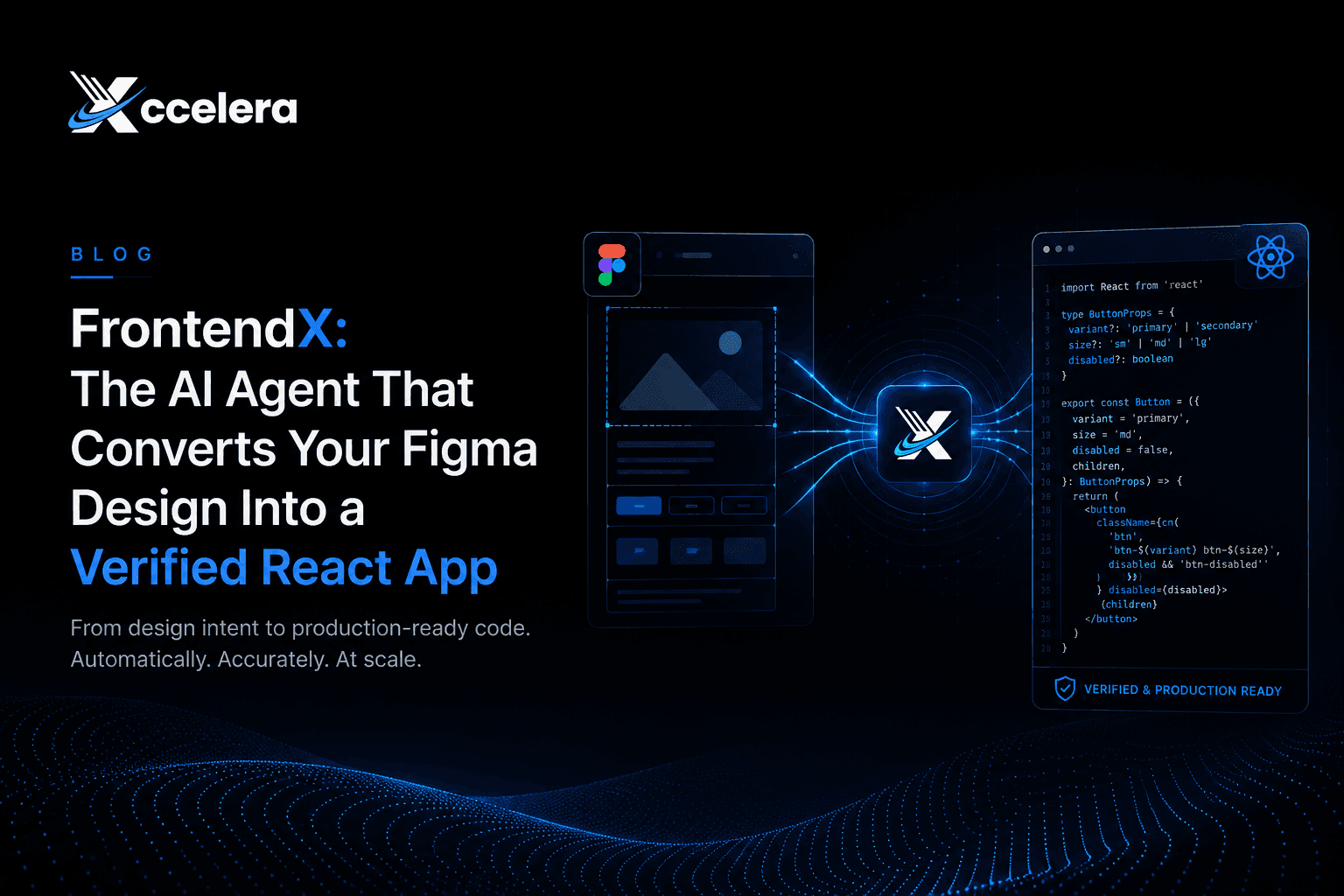
FrontendX is an agentic AI system that reads Figma design files and outputs verified, production-ready React applications. It eliminates manual design-to-code translation, reduces engineering cycles, and enforces design system consistency at scale. Built for enterprise teams that cannot afford drift between design intent and deployed UI.
Why Manual Figma-to-React Conversion Is Costing Engineering Teams Too Much
Enterprise frontend teams lose two to three engineering days translating a single Figma screen into working React code. Across a forty-screen product, that delay compounds into months of avoidable engineering drag.
The Version Drift Problem
Designers update Figma frames continuously. Each revision widens the gap between the visual source of truth and what developers have already coded. Over a six-month build cycle, teams routinely carry three parallel versions of the same UI component: one in Figma, one in the codebase, and one in a stale pull request. Manual conversion does not just slow delivery; it creates an architectural liability that grows with every sprint.
Scale Amplifies the Cost
Enterprise design-to-code handoff remains the highest-friction point in modern product pipelines. Inconsistent component implementation fragments design systems, extends QA cycles, and erodes the brand consistency that enterprise product teams cannot afford to lose. Teams investing in AI-powered software development are already addressing this bottleneck at the pipeline level, not the task level.
What FrontendX Actually Does: Agent Execution, No Code Suggestion
Most tools on the market generate code suggestions. FrontendX generates outcomes. That distinction matters in production environments where development teams cannot afford to supervise, correct, and re-prompt a system for every component they need to ship.
Agents Execute. Assistants Suggest.
AI coding assistants like Copilot and Cursor respond to developer input. An AI agent Figma to React system operates differently: it receives the design file, reasons over its structure, and delivers production-oriented output without developer prompting at each stage. The agent takes the task, not the hint.
The Execution Architecture
FrontendX connects to the Figma API using the project file key, traverses the frame hierarchy, extracts component structures and design tokens, and initiates code generation from a structured design graph. Human review enters at the output stage through a structured approval gate before any generated code reaches the repository.
How FrontendX Reads a Figma File: The Interpretation Pipeline
Before generating a single line of React, FrontendX runs a five-stage interpretation pipeline that converts a Figma file into a structured design graph the generation agent references throughout the entire output process.
1: API Connection FrontendX connects to the Figma API via the project file key, authenticates access, and retrieves the complete JSON structure of the target design file.
2: Hierarchy Traversal The agent walks the full frame tree, mapping parent-child component relationships, grouping logic, and reusable instance placements across all screens.
3: Design Token Extraction Color variables, typography scales, and spacing units are extracted and structured into a token schema the generation agent references directly during output.
4: Auto-Layout to Flexbox Mapping Figma auto-layout rules translate directly to CSS flexbox declarations, preserving responsive behavior without requiring manual media query authoring.
5: Variant and State Capture Component variants, hover states, and interaction flows are catalogued before generation begins, ensuring React output reflects the complete interactive scope of the design file.
From Design Tokens to React Components: The Translation Layer
Design tokens are the connective tissue between a Figma design system and a production React codebase. Without automated translation, token drift accumulates silently across components until a design audit surfaces inconsistencies months into the build cycle.
FrontendX maps extracted Figma tokens directly to their React equivalents. Color primitives become CSS custom properties or Tailwind CSS configuration values. Typography scales convert to typed font-size declarations. Spacing units resolve to padding and margin classes aligned to the team’s existing conventions.
Variants Become Typed Props
Figma variant components translate into React prop interfaces. A button with four Figma states produces a typed component accepting variant, size, disabled, and iconPosition props, reflecting design intent without requiring developers to reverse-engineer visual logic manually.
Styling System Compatibility
FrontendX generates output compatible with Tailwind CSS, CSS Modules, and Styled Components, calibrated to the team’s declared styling architecture without imposing framework preferences onto an existing codebase.
Code Verification: Why “Generated” Is Not Enough
Generated Code Is a Starting Point, Not a Deliverable
AI-generated React code carries real production risk without structured verification layers. A 2025 Veracode analysis found that AI-generated code introduces security vulnerabilities in 45% of deployments that bypass a structured review process. FrontendX treats verification as part of the agent loop, not a downstream step applied after output leaves the system.
Accessibility and Rendering Validation
Every component output passes through an automated accessibility audit before handoff. ESLint with JSX a11y rules flags missing ARIA attributes, improper heading hierarchies, and inadequate keyboard navigation patterns. Lighthouse scoring validates rendering performance against production thresholds.
Type Safety and Linting
TypeScript type checks run against all generated component interfaces. ESLint hooks validation confirms that state management patterns conform to React’s rules of hooks, catching the subtle lifecycle errors that manual review consistently misses under sprint pressure.
The Multi-Agent Architecture Behind FrontendX
Why Single-Agent Design Fails at Scale
Single-model tools hit a ceiling when design complexity scales. A monolithic AI system attempting to simultaneously interpret a Figma hierarchy, generate typed components, validate accessibility, and prepare a pull request produces inconsistent output that degrades under load.
FrontendX uses a coordinated multi-agent architecture. Agents operate in sequence and, where task dependencies permit, in parallel. The interpreter agent constructs the design graph. The generator agent produces component output. The validator agent runs linting, type checks, and accessibility audits. The reviewer agent formats verified output and prepares the pull request with structured change documentation.
Orchestration logic routes tasks based on dependency resolution. The generator does not initiate until the interpreter finishes the design graph. Validation runs concurrently with secondary component generation, cutting total latency without compromising output integrity. The architecture scales with design complexity rather than collapsing under it.
Where FrontendX Fits Inside Enterprise Development Pipelines
It integrates into existing enterprise development infrastructure without requiring teams to restructure their engineering process. It operates as an upstream contributor, not a replacement workflow.
Version Control Integration: FrontendX connects directly to Git-based repositories and handles the following automatically:
- Branch creation from the target design file name and timestamp
- Commit structuring with component-level change descriptions
- Pull request submission with diff summaries for team review
Framework Compatibility: Enterprise teams running varied React architectures need not standardize before adoption. FrontendX generates compatible output for:
- React with Vite or Create React App foundations
- Next.js page router and app router configurations
- Remix-based full-stack React applications
Legacy Codebase Handling: Class components and outdated hook patterns flagged during repository analysis receive modernization recommendations before generation begins through Xccelera’s legacy system modernization services, reducing the risk of introducing incompatible patterns into established codebases.
The Business Case: Velocity, Consistency, and Reduced Engineering Drag
Enterprise product teams adopting automated design-to-code workflows report recovering two to three engineering days per screen from the manual conversion process. Across forty screens per release cycle, that recovery reaches thirty to sixty engineering days per product cycle, fundamentally reshaping how senior development capacity gets allocated.
Velocity Gains Compound Across Releases
Recovered capacity concentrates where it delivers the most differentiation: architecture decisions, business logic, and performance optimization. Developers stop spending sprint time on pixel-matching and start contributing to substantive implementation work, accelerating team maturity alongside product velocity.
Design System Consistency at Scale
Multi-team organizations using automated AI agent Figma to React pipelines eliminate the component fragmentation that manually distributed codebases generate. A single design token update propagates consistently across all generated components rather than requiring individual developer correction across dozens of files per release.
Governance, Security, and Output Ownership in AI-Generated Frontend
Enterprise adoption of AI-generated frontend code introduces governance obligations that most adoption roadmaps underestimate. Enterprise teams cannot treat agentic output as implicitly safe — a point explored in depth in Xccelera’s analysis of agentic AI platforms vs traditional development.
Output Ownership and IP Liability
Generated code incorporating open-source dependencies with conflicting licenses creates intellectual property exposure inside proprietary codebases. Legal review of dependency chains remains a mandatory step before any generated component reaches the production branch, regardless of how the generation agent was configured at deployment.
Human Review as a Governance Requirement
Enterprise SDLC governance frameworks require explicit human approval gates before AI-authored code merges into protected branches. FrontendX supports this requirement by default, presenting structured pull requests for developer sign-off rather than auto-merging into the codebase. No generated component ships without documented human review on record.
How Xccelera Deploys FrontendX for Enterprise Frontend Teams
An enterprise product organization carrying forty-plus Figma screens and a fragmented React codebase represents the exact deployment context Xccelera configures FrontendX to address.
Codebase-First Configuration
Xccelera’s deployment begins with a full codebase audit. The architecture team maps existing component conventions, identifies the active styling system, and configures the generation agent to produce output aligned to the team’s established patterns. Design tokens import directly from the client’s Figma design system. CI/CD integration completes within the first two weeks of engagement.
Governance by Default
Human-in-the-loop governance layers activate at deployment. Every generated component passes through automated validation and lands in a structured pull request awaiting explicit developer approval before any protected branch receives a change.
Enterprise teams working with Xccelera reach verified, production-ready agentic frontend output in under seven weeks, recovering engineering capacity that compounds measurably across every subsequent release cycle. To explore how this fits your current engineering setup, speak with Xccelera’s AI agent consulting team.