The Legacy Rewrite Timeline Problem, and How Enterprises Fix It
Legacy code modernization has become the defining infrastructure decision for enterprises still running COBOL, .NET, and monolithic systems in 2026. Manual rewrites drag on for years, drain engineering talent, and rarely land on the budget leadership originally approved. AI-driven code migration is compressing multi-year rewrite programs into days and weeks, without sacrificing governance, auditability, or…
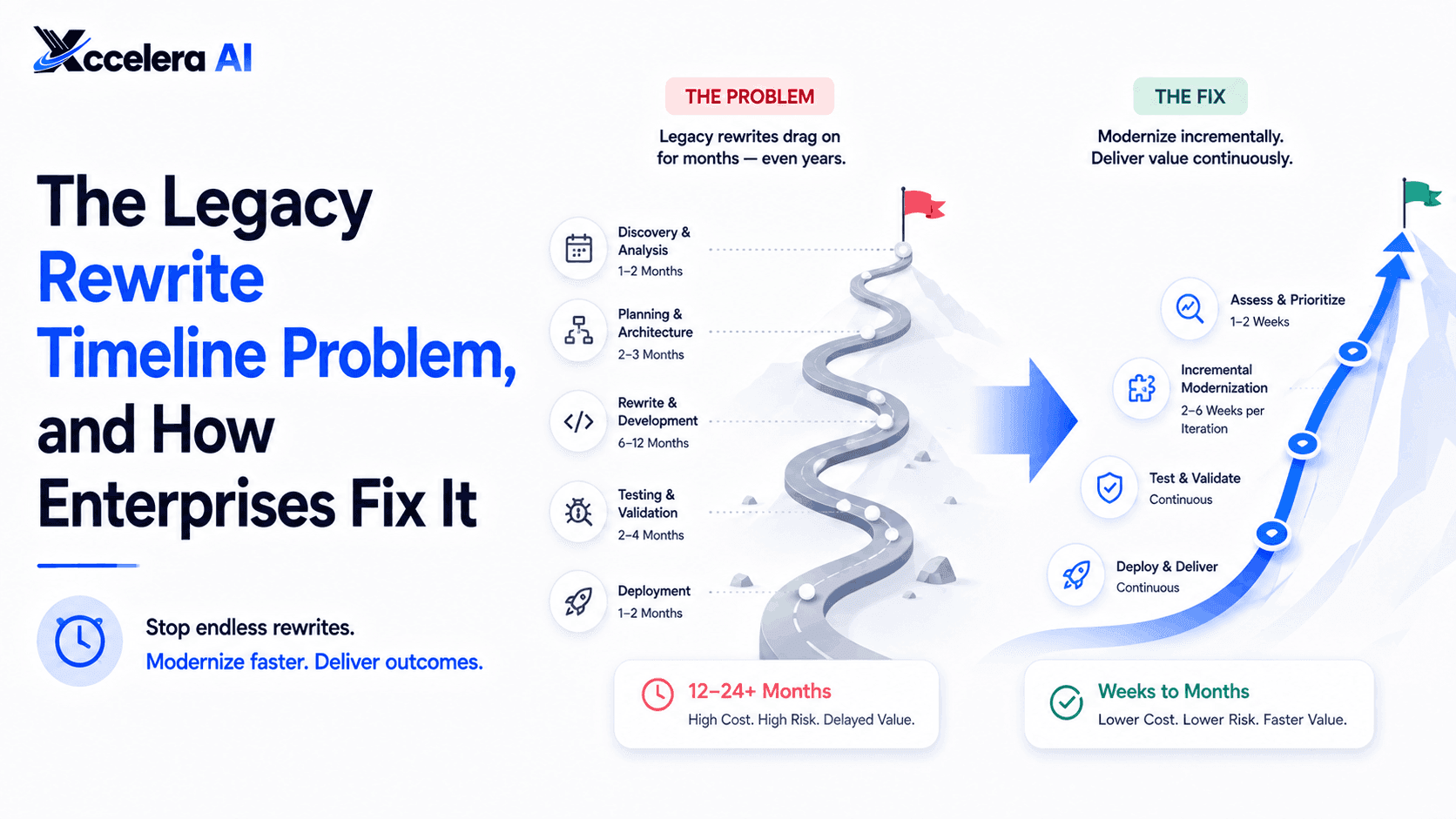
Legacy code modernization has become the defining infrastructure decision for enterprises still running COBOL, .NET, and monolithic systems in 2026. Manual rewrites drag on for years, drain engineering talent, and rarely land on the budget leadership originally approved.
AI-driven code migration is compressing multi-year rewrite programs into days and weeks, without sacrificing governance, auditability, or control over sensitive business logic. Enterprise leaders now face a clear choice. They can compound technical debt indefinitely, or modernize on a compressed, fully reviewable legacy system rewrite timeline that their board can actually trust.
The Real Cost of Legacy System Rewrite Timelines
Every enterprise running a legacy codebase eventually asks the same question. Is the cost of staying on old infrastructure lower than the cost of legacy code modernization? For most CTOs in 2026, the answer is no.
Legacy system modernization programs range from $50,000 for a focused application upgrade to well over $10 million for enterprise ERP and mainframe conversions, depending on complexity and integration scope.
Where the Hidden Spend Sits
Worldwide IT spending is projected to reach $6.08 trillion in 2026, according to Gartner. A large share of that spend goes toward keeping legacy infrastructure alive rather than funding new capability.
That imbalance carries a hidden cost. Every year spent maintaining an aging system is a year of slower releases and growing exposure to security and compliance risk. Leaders who treat modernization as a future decision are already paying for it today, just without a line item that says so.
Budget conversations that focus only on the sticker price of a rewrite miss the larger picture entirely. The real comparison is not modernization cost against zero. It is modernization cost against the compounding maintenance bill an enterprise already carries every single quarter.
Why Manual Legacy Code Migration Stalls Enterprise Roadmaps
Manual rewrites fail on predictability, not effort. Engineering teams stack a complex migration on top of business-as-usual work, and that combination creates burnout and bottlenecks fast. Network, security, and compliance changes routinely take longer than planned, and they rarely get sequenced early enough.
The Compounding Effect
Each delay is survivable on its own. Together, they turn a twelve-month plan into an eighteen-month program, and a fixed budget into an open-ended one.
As a result, engineering leadership loses the one thing a modernization business case depends on: a timeline stakeholders can actually trust. Once that trust breaks, future modernization requests face heavier scrutiny, longer approval cycles, and smaller budgets, even when the underlying technical need has only grown more urgent.
Legacy Modernization Risk Factors CTOs Cannot Ignore
Modernization risk rarely comes from the code itself. Instead, it comes from unpredictability across the program:
- Unchecked outputs that nobody can validate against the original system behavior
- Processes that cannot be repeated consistently across teams or vendors
- Governance bolted on after the project starts instead of built in from day one
- Scope expansion once teams uncover hidden dependencies mid-migration
Legacy modernization projects fail roughly 70 percent of the time for exactly these reasons, not because the underlying technology is impossible to move. Governance discipline applied from the first line of code, not after go-live, is what separates a contained migration from an open-ended one.
CTOs evaluating a modernization vendor should treat governance maturity as a qualifying criterion, not a nice-to-have added after the technical fit is confirmed.
Technical Debt Modernization Versus Full System Rewrites
Technical debt does not stay flat. It compounds. Enterprises accumulate roughly $361,000 of technical debt for every 100,000 lines of legacy code, and that figure grows sharply after year four.
A full rewrite is not always the answer, and neither is indefinite patching. In practice, the right path depends on how much valuable business logic still lives inside the legacy system, and whether it can be converted in phases instead of replaced outright.
Technical debt modernization done incrementally protects revenue-critical logic while still retiring the parts of the stack that cost the most to maintain.
AI-Driven Legacy Code Migration Explained
AI-driven legacy code migration works by having an AI system read and understand a codebase before converting it, rather than translating line by line. Developer trust in raw AI output has actually declined even as adoption climbed. That is why validation layered on top of AI conversion, not blind automation, defines the tools winning enterprise trust in 2026.
How the Process Actually Runs
A modern AI migration engine follows a consistent sequence. It connects to a source repository, fetches every file, and produces a written analysis document covering structure, dependencies, and conversion strategy before a single line changes.
The team then configures a target stack, and the engine converts files concurrently in a live, streaming pipeline instead of a black-box batch job. Binary assets, fonts, and configuration files carry through untouched. Test suite generation runs alongside the conversion itself, so validation starts the moment code lands.
Enterprise Application Modernization Timelines Compared
| Modernization Path | Typical Timeline | Primary Risk |
|---|---|---|
| Manual full rewrite | 18 to 48 months | Scope creep, staff turnover, budget overrun |
| Phased replatforming | 12 to 30 months | Parallel-run costs, integration drift |
| AI-driven code conversion | Days to weeks per module | Validation depth, business logic review |
Comprehensive manual migration programs commonly run 18 to 36 months, depending on landscape complexity and customization depth. AI-driven conversion compresses the analysis and translation phases dramatically, shifting the remaining bottleneck to testing and business logic validation, rather than raw code translation speed.
Governance and Compliance in Legacy System Migration
Legacy system migration is not just a code problem. It is a data exposure problem. Compliance scope under PCI DSS, HIPAA, and GDPR extends to sensitive data the moment it leaves its original environment, and legacy databases frequently store that data with minimal protection to begin with.
Building Compliance Into the Pipeline
Enterprises are not just migrating code when they modernize. They are migrating risk. Effective governance means encrypting credentials at rest, isolating tokens from the frontend, and keeping a complete audit trail of every file touched during conversion.
Any legacy code modernization program that skips this layer trades one liability for another.
Legacy Code Modernization Roadmap for 2026 and Beyond
Enterprise adoption of AI-assisted development has crossed a real threshold. Seventy-eight percent of Fortune 500 companies now run some form of AI-assisted development in production. For engineering leaders building a 2026 roadmap:
- Run a discovery pass across all legacy assets before scoping any conversion work
- Prioritize systems where technical debt and compliance exposure are both rising fastest
- Pilot AI-driven conversion on a bounded module before committing to full-scale migration
- Build validation and testing capacity in parallel with conversion, not after it
- Re-convert or iterate on target stack choices without re-uploading the original codebase
Xccelera’s Approach to Legacy Code Migration at Enterprise Scale
Waiting rarely lowers the cost of legacy code modernization. Each quarter spent on old infrastructure is a quarter competitors spend shipping faster on modern architecture.
Xccelera’s Legacy-to-Modern Code Migration Engine addresses this directly by pairing AI-driven analysis with a governed, reviewable conversion pipeline. The engine connects to an existing repository, generates a full analysis document before converting anything, and streams the conversion in real time so engineering teams can see exactly what changes and why.
Converted output lands in a complete file tree with test suite generation available alongside it, and publishing back to a source repository happens with encrypted credentials the frontend never touches.
The Xccelera Modernization Advantage
Xccelera builds the infrastructure enterprises need to modernize without gambling on timelines, budgets, or governance obligations. The company’s broader agentic AI portfolio extends beyond code migration into orchestration, integration, and security layers that keep modernized systems audit-ready long after the initial conversion is complete.
Visit xccelera.ai to see how the Legacy-to-Modern Code Migration Engine fits into a full-stack modernization strategy built for regulated, high-stakes enterprise environments.