FrontendX Design System Generation: How Reusable Components Are Extracted Directly From Figma
Modern product teams no longer struggle with building interfaces. Instead, they struggle with translating approved designs into production-ready code at scale. Every design handoff introduces interpretation, every interpretation introduces inconsistency, and every inconsistency compounds technical debt across the application lifecycle. As organizations accelerate release cycles and expand design systems across multiple products, the ability…
Modern product teams no longer struggle with building interfaces. Instead, they struggle with translating approved designs into production-ready code at scale. Every design handoff introduces interpretation, every interpretation introduces inconsistency, and every inconsistency compounds technical debt across the application lifecycle.
As organizations accelerate release cycles and expand design systems across multiple products, the ability to convert Figma assets directly into reusable React components has become an engineering requirement rather than a productivity enhancement. Consequently, teams that fail to address this gap face compounding delays and growing maintenance burdens.
This write-up elaborates on the structural problems created by traditional design handoffs, the role of design tokens in scalable frontend architecture, the mechanics of automated component extraction, the importance of validation pipelines, and how FrontendX transforms Figma designs into production-ready React applications with minimal human intervention.
The Design-to-Code Gap That’s Costing Engineering Teams More Than They Realize
Despite significant advances in collaborative design platforms, the gap between design intent and implementation remains one of the most expensive inefficiencies in software development. Design teams work inside Figma while engineers operate within code repositories, creating a translation layer that depends heavily on human interpretation.
Every button, spacing value, typography decision, and responsive behavior must often be manually recreated by developers. Although design specifications provide guidance, they rarely eliminate ambiguity. As a result, engineering teams spend valuable time translating visual assets instead of building business functionality — a problem that AI-powered software development is increasingly designed to solve.
The problem becomes more severe as products grow. A design update affecting dozens of screens may require developers to manually identify and modify components across multiple repositories. Moreover, small interpretation differences create inconsistent user experiences, forcing organizations into repeated design audits and frontend refactoring cycles.
Industry research by McKinsey has consistently shown that developers lose substantial portions of their workweek resolving design implementation challenges rather than delivering new functionality. What appears to be a minor handoff issue often becomes a measurable operational expense that slows release velocity, increases maintenance costs, and delays product delivery.
How Design Tokens Become the DNA of a Scalable Component System
Scalable design systems are built on a foundation of design tokens. Rather than storing visual decisions as isolated values scattered throughout an application, design tokens transform those decisions into centralized, reusable variables that can be consumed by every interface component. Furthermore, this approach establishes a single source of truth that both designers and developers can depend on.
Primitive, Semantic, and Component Tokens
At the lowest layer are primitive tokens such as colors, font sizes, spacing units, border radii, and elevation values. Above them sit semantic tokens that map business meaning to those primitives. Component-specific tokens then define how individual UI elements consume those semantic values.
This layered architecture creates consistency across an entire frontend ecosystem. When a design team updates a primary brand color inside Figma, every component referencing the corresponding token can inherit the change automatically — without requiring manual adjustments. This is precisely why organizations investing in product engineering prioritize token-based design systems early in their architecture decisions.
The ETL Analogy: How Token Extraction Works
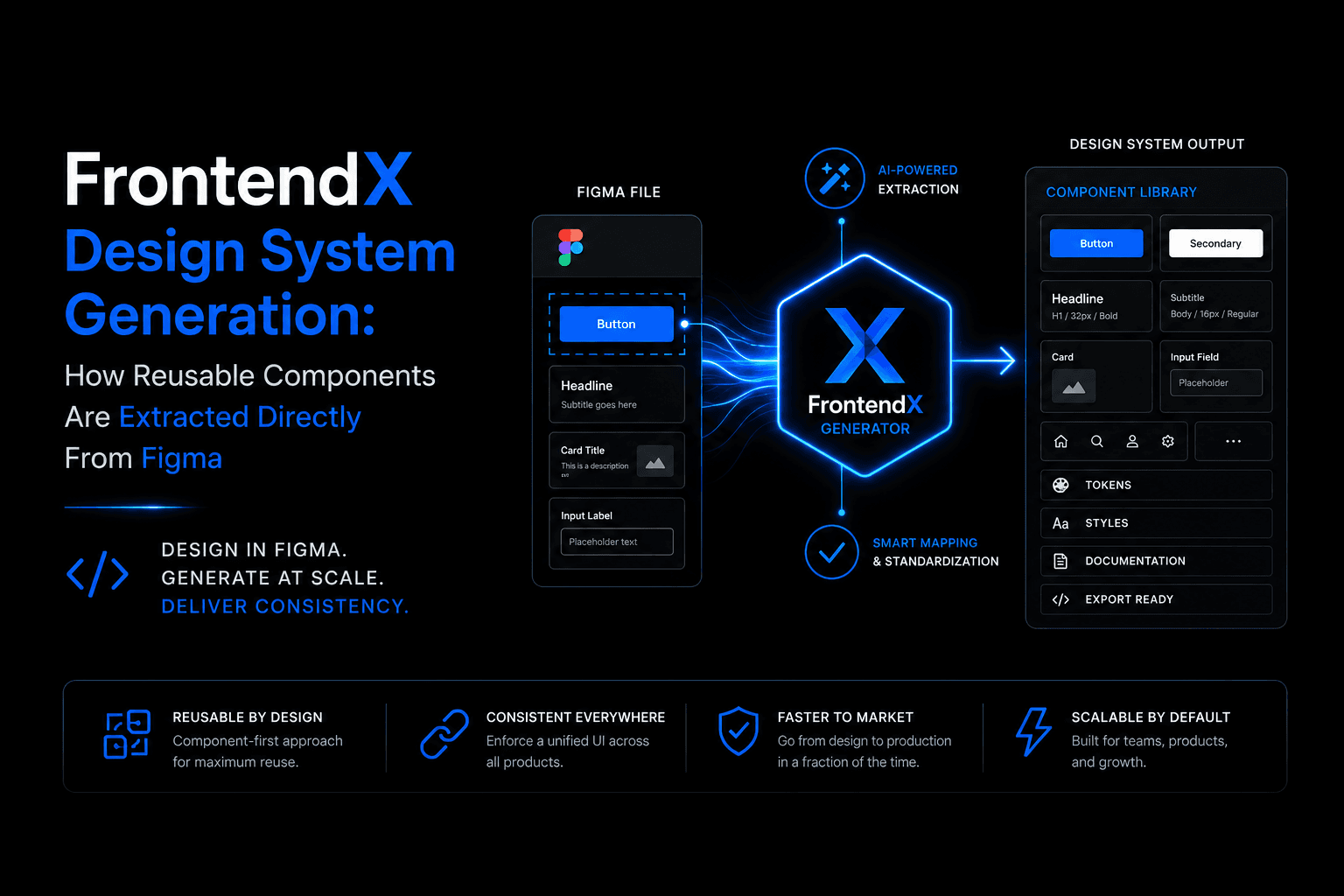
The extraction process functions similarly to an ETL pipeline. Design metadata is collected from Figma, transformed into structured token definitions, validated against system rules, and then exported into formats consumable by React applications. Instead of developers copying visual specifications screen by screen, the design language itself becomes executable.
According to Smashing Magazine’s guide on design tokens, organizations that adopt token-based systems report measurable improvements in cross-team design consistency and reduced time spent on UI reconciliation. As a result, teams dramatically reduce duplication and eliminate many of the inconsistencies that plague traditional handoff processes.
From Figma JSON to React: The Anatomy of Automated Component Extraction
Figma stores design information as structured data rather than static visual assets. Through its API, complete design trees can be accessed as JSON objects containing hierarchy information, component relationships, typography settings, layout constraints, colors, and interaction metadata. This structured representation, therefore, enables automated extraction pipelines to understand designs programmatically rather than interpreting screenshots.
The Role of Auto Layout in Code Generation
Auto Layout plays a particularly important role in this process. The spacing, alignment, and positioning behaviors defined within Figma closely resemble modern frontend layout mechanisms such as Flexbox and CSS Grid. Consequently, automated generators can map design constraints directly into responsive code structures without requiring additional developer interpretation.
The Four-Stage Extraction Pipeline
The process typically follows four stages:
- Fetch — The design file is retrieved through the Figma API.
- Parse — The JSON structure is analyzed into meaningful component relationships.
- Transform — Transformation engines convert design constructs into frontend equivalents.
- Generate — Code generation frameworks produce reusable React components.
Naming consistency further improves outcomes. When Figma components align with frontend naming conventions, generated code becomes easier to maintain and integrate into existing repositories. Instead of receiving fragmented design exports, engineering teams receive structured component architectures that reflect established development practices, a hallmark of mature generative-driven development workflows.
The DORA State of DevOps Report consistently highlights that teams with automated build and integration pipelines deploy significantly faster and experience fewer post-release failures. Automated component extraction directly contributes to those metrics by removing manual steps from the delivery chain.
Build Validation, Route Auto-Linking, and the Compile Error Problem
Generating frontend code is only one part of the challenge. Beyond generation itself, production readiness depends on rigorous validation.
Why Most Design-to-Code Tools Fall Short
Many design-to-code tools successfully generate components but fail to verify whether the resulting application actually compiles. This creates a misleading sense of automation where developers still spend hours correcting syntax issues, resolving dependency conflicts, and repairing broken imports. In practice, this means the time saved during generation is often lost during debugging.
A mature automation pipeline, therefore, treats validation as a core requirement rather than a post-processing step. Generated applications must pass build checks before they can be considered usable. This validation-first mindset is central to how agentic AI solutions approach autonomous software delivery.
Autonomous Correction Loops and Route Auto-Linking
Compile error detection enables systems to identify failures immediately after code generation. Autonomous correction loops can then analyze the error, modify the affected code, rerun validation, and continue iterating until the application builds successfully. As a result, the need for manual developer intervention is substantially reduced.
Route auto-linking extends this concept beyond individual components. Modern applications consist of interconnected screens, navigation structures, and dynamic user flows. Automated systems must, therefore, recognize relationships between generated pages and establish routing logic without manual configuration.
This capability represents the distinction between simple code exporters and agentic frontend generation platforms. Export tools produce code. Intelligent systems produce working applications capable of entering development workflows with minimal additional effort — a distinction that MIT Sloan Management Review attributes to the shift from task automation toward end-to-end process intelligence.
The 2026 Design System Standard: Code Connect, Continuous Sync, and Zero Drift
The traditional handoff model assumes design and engineering operate as separate functions connected through periodic exports. Modern design systems, however, increasingly reject that assumption in favor of continuous alignment.
Why Continuous Synchronization Is Replacing Periodic Exports
Continuous synchronization is emerging as the preferred operating model. Rather than exporting snapshots of design decisions, organizations maintain persistent relationships between design assets and production code. This shift is particularly relevant for teams scaling custom software development across multiple product lines simultaneously.
Code Connect initiatives exemplify this shift. Components inside design environments can be linked directly to their implementation counterparts, allowing teams to understand how visual assets map to production systems in real time. Additionally, this linkage enables immediate visibility when design changes risk breaking production behavior.
Eliminating Design Drift Across the Product Lifecycle
The benefits extend beyond convenience. Continuous synchronization significantly reduces design drift — a condition where implemented interfaces gradually diverge from approved design standards. Drift often accumulates silently through feature additions, bug fixes, and incremental UI updates. Over time, this silent divergence becomes one of the most expensive sources of frontend maintenance work.
Zero drift means that design intent and production implementation remain aligned throughout the product lifecycle. According to Figma’s research on design systems at scale, organizations with mature synchronization practices report significantly higher designer-developer satisfaction and faster iteration cycles. When synchronization becomes part of the workflow, UI inconsistencies decrease, maintenance overhead falls, and engineering teams spend less time reconciling differences between design repositories and codebases.
How FrontendX Eliminates the Gap Between Design Intent and Production Code
FrontendX was built specifically to remove the friction that exists between design creation and frontend implementation. Instead of relying on traditional handoff workflows, the platform accepts Figma URLs directly and processes the underlying design structure automatically.
What FrontendX Extracts and Generates
The system extracts design trees, identifies reusable components, captures typography specifications, spacing values, color systems, and layout behaviors, then translates them into React-based frontend architectures. This, in turn, eliminates the repetitive manual work typically associated with design implementation.
Beyond generation, FrontendX incorporates validation mechanisms that distinguish it from conventional export tools. Generated applications undergo compile verification, route generation, and autonomous correction processes that substantially reduce post-generation cleanup work.
FrontendX as Agentic Execution Within Xccelera’s Ecosystem
The platform also aligns naturally with modern design system practices by preserving token structures and reusable component patterns throughout the generation pipeline. As a result, organizations can move from approved design assets to deployable frontend applications significantly faster than traditional engineering workflows allow.
Within Xccelera’s accelerator ecosystem, FrontendX represents a practical application of agentic AI automation. Rather than assisting developers with isolated tasks, it autonomously performs the end-to-end transformation of design intent into validated production code — enabling teams to focus engineering effort on product differentiation rather than repetitive implementation work. Ultimately, this is what separates agentic platforms from conventional tooling: not just speed, but the ability to reason, validate, and self-correct across the entire generation pipeline.