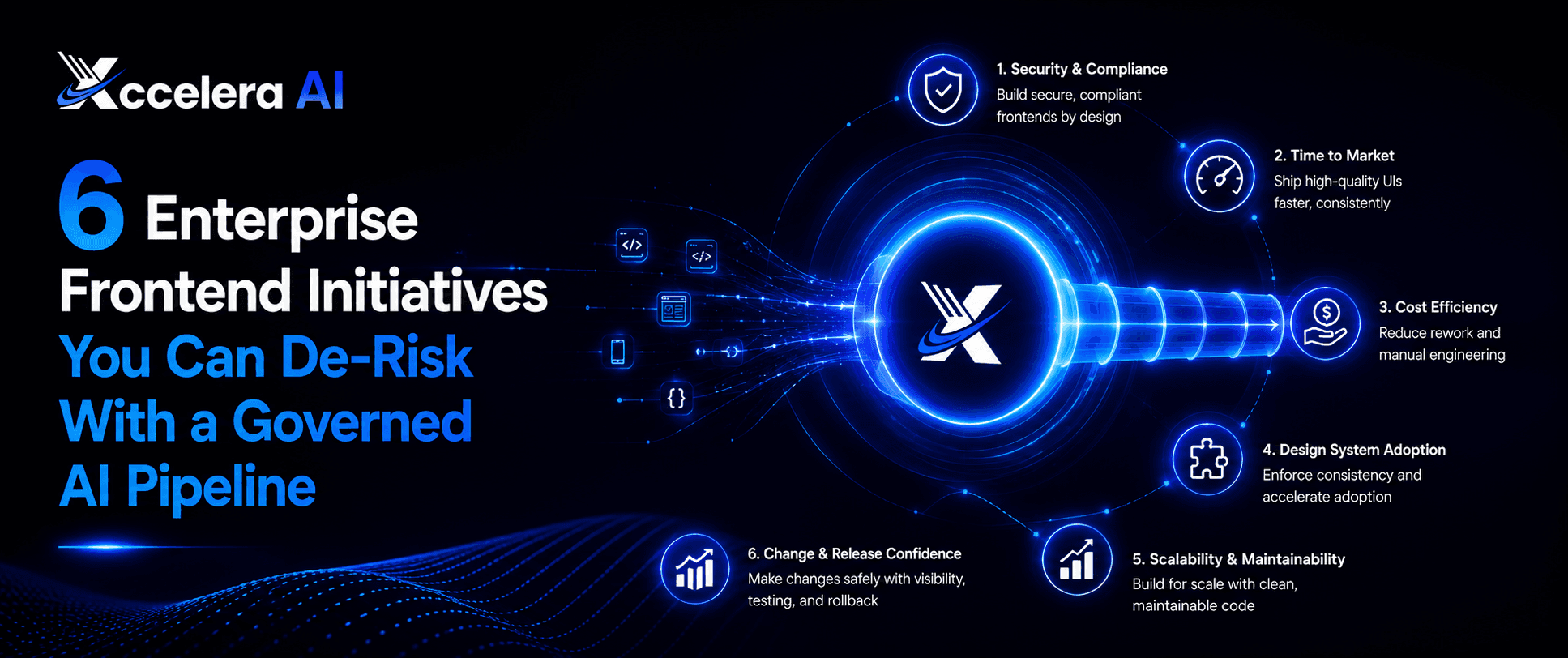
6 Enterprise Frontend Initiatives You Can De-Risk With a Governed AI Pipeline
Frontend delivery has quietly become one of the least governed parts of enterprise software. Internal tools, regulated mobile apps, MVP sprints, agency handoffs, and legacy imports all move through ad hoc AI usage with no ownership trail, no rollback, and no audit record. A governed AI pipeline closes that gap. This piece maps six frontend…
Frontend delivery has quietly become one of the least governed parts of enterprise software. Internal tools, regulated mobile apps, MVP sprints, agency handoffs, and legacy imports all move through ad hoc AI usage with no ownership trail, no rollback, and no audit record.
A governed AI pipeline closes that gap. This piece maps six frontend initiatives where structured, auditable AI generation replaces improvisation, and shows what buyers should expect from a platform built for the job.
The Governance Gap Behind Enterprise Frontend AI Adoption
Frontend teams adopted AI faster than security and compliance functions could track it. Developers paste specs into consumer tools, generate scaffolding outside version control, and ship components nobody reviewed against a written policy.
That pattern is now a quantified enterprise liability. Shadow AI in frontend teams is no longer a hypothetical risk. Verizon’s 2026 Data Breach Investigations Report found unapproved AI use on corporate devices tripled in a single year, climbing from 15 percent to 45 percent of the workforce. Source code was the single most common data type uploaded to generative AI tools, ahead of images and structured data.
This is precisely why a governed AI pipeline matters for frontend delivery specifically, not just for backend or data systems. Every initiative below traces back to the same requirement: generation, review, and rollback that live inside one auditable job model, instead of scattered across browser tabs and personal accounts.
Why Ownership Chains Matter Most
Most frontend AI tools generate code well but leave no record of who requested what, when, or against which project. That absence of an ownership chain is what turns AI-assisted speed into audit exposure the moment a regulator or a customer asks a question.
1. Internal Tools Built Without Shadow AI Risk
Internal dashboards are usually the first place frontend AI adoption goes uncontrolled, because nobody treats an internal admin panel with the same scrutiny as a customer-facing product. That is exactly backwards. Internal tools touch production data, often before proper access controls are in place.
A governed platform instead generates a data-driven dashboard from a plain-English specification, validates it through an automated judge and fix-pass loop before the job is ever marked complete, and hands back a live, previewable build rather than a static mockup.
Every listing is filtered down a per-user ownership chain, so a dashboard built by one team cannot silently surface in another team’s job queue. That single control addresses AI-generated frontend code governance at the point where most enterprises currently have none: the internal tooling layer that IT rarely audits closely.
2. Regulated Mobile Apps Delivered With Compliance Built In
Mobile delivery raises the stakes because regulated industries cannot ship an app that skipped a documented review step.
A governed pipeline authenticates every request with JWT bearer tokens and enforces ownership down the project, job, and log chain. As a result, compliance teams can reconstruct exactly what was built and by whom.
Native builds matter here too. Android output comes from a local Gradle build, while iOS builds run through a genuine Fastlane and Match pipeline on GitHub-hosted macOS infrastructure, producing a real App Store-signed IPA rather than a simulator artifact.
Frontend AI Pipeline Compliance in Practice
Compliance officers do not want assurances. Instead, they want evidence. A governed pipeline that logs every job, every modification commit, and every rollback gives them exactly that. This turns frontend AI pipeline compliance from a policy document into a queryable system record.
3. MVP Validation Sprints That Skip Technical Debt
Startups and product teams lose weeks to scaffolding before they ever validate an idea with a real user. A governed pipeline compresses that timeline by generating a shareable, live-previewable prototype straight from a product description. Teams then commit engineering budgets only after the concept proves itself.
As a result, technical debt does not accumulate silently in the background the way it does with rushed, ungoverned prototyping. Because every generated project is a real, git-versioned codebase rather than a disposable mockup, the MVP does not need a rebuild once it earns real investment. That continuity is what separates de-risking frontend initiatives with AI from simply generating throwaway demos.
4. Customer-Facing Web Portals Launched at Enterprise Scale
Customer portals carry the highest visibility and the least tolerance for a broken preview link during a stakeholder review. Each generation job gets its own dev server and a public tunnel, pre-warmed and probed for readiness before anyone outside engineering sees it.
In practice, that means a portal reaches a business stakeholder as a real clickable environment, not a slide deck screenshot.
| Capability | What It Delivers for Enterprise Portals |
|---|---|
| Live preview and tunnel | Public, shareable environment probed for readiness before handoff |
| Judge and fix-pass loop | Automated validation before a build is marked complete |
| Git-backed modify and rollback | Every change commits first; rejection is a hard reset, not a guess |
| Multi-target pipeline | React, Angular, and Expo or React Native through one job model |
| Redis-backed port allocation | Prevents concurrent jobs from colliding during scaled rollout |
This structure supports scalable frontend AI deployment because the same job model that builds one portal handles dozens running concurrently, without one job’s dev server colliding with another’s.
5. Agency-Led Frontend Delivery Under Governed Oversight
Agencies work from Figma frames and a written brief, then hand a client something they can click through in a real browser tab, with no local setup required on the client’s end.
A governed pipeline fetches Figma frames automatically as design reference at the start of generation. As a result, the agency’s design intent carries directly into the build, instead of getting reinterpreted by a developer.
For the agency, that shortens the review cycle. For the enterprise client, it means the deliverable already passed through the same fix-pass validation as an internally built product, closing a gap that ungoverned agency handoffs routinely leave open.
Client Review Without Local Setup
A client reviewing work through a public tunnel link, rather than a screen-share or a static export, catches integration issues earlier. That earlier catch is where most agency rework actually gets prevented.
6. Legacy Frontend Migration Without Business Disruption
Importing an existing repository is where most ungoverned AI tools introduce the highest risk, because nobody scans a stranger’s branch before running changes against it.
A governed pipeline instead imports the GitHub branch, runs a malicious-code scan before the modification pipeline touches anything, then drives the requested change through the same commit-first, accept-or-reject workflow used for greenfield builds.
The original production system is never touched directly. That single sequencing decision, scan before modify, is what makes legacy frontend import viable at enterprise scale, rather than a one-off engineering experiment nobody wants to repeat.
Scaling a Governed AI Pipeline Across Frontend Initiatives
Each initiative above solves a different problem, but they all run through the same underlying job model. That consistency is the actual value of a governed AI pipeline: one FastAPI and Celery backend, one PostgreSQL and Redis job queue, and one prompt-construction pipeline spanning React, Angular, and Android or Expo targets.
Frontend code quality assurance stops being a per-project decision and becomes a platform default, enforced identically whether the job is an internal dashboard or a signed mobile release.
An AI frontend engineering governance framework only earns enterprise trust when it behaves the same way under load as it does in a demo. A shared job model with locked port allocation and isolated preview sessions is what makes that true at scale.
Xccelera’s Governed AI Pipeline for Enterprise Frontend Delivery
Every initiative above depends on one thing: a frontend generation engine built for governance first, not added as an afterthought. Xccelera’s AI Frontend Development Engine gives enterprise teams that govern pipeline, generation, validation, live preview, and git-backed rollback in one auditable system.
Teams move faster without losing the ability to prove what shipped and why.
Visit xccelera.ai to see how a governed pipeline de-risks frontend delivery across your entire initiative portfolio.