From Prompt to Signed Build: How a Governed AI Frontend Engine Actually Works
Every engineering leader evaluating an AI frontend generation engine faces the same underlying question. Can a system generate real, production-grade frontend code fast, and still hold up under enterprise review, audit, and rollback requirements? Most tools answer only half of that question. Scaffolding gets faster, but preview sharing stays manual, iteration stays risky, and mobile…
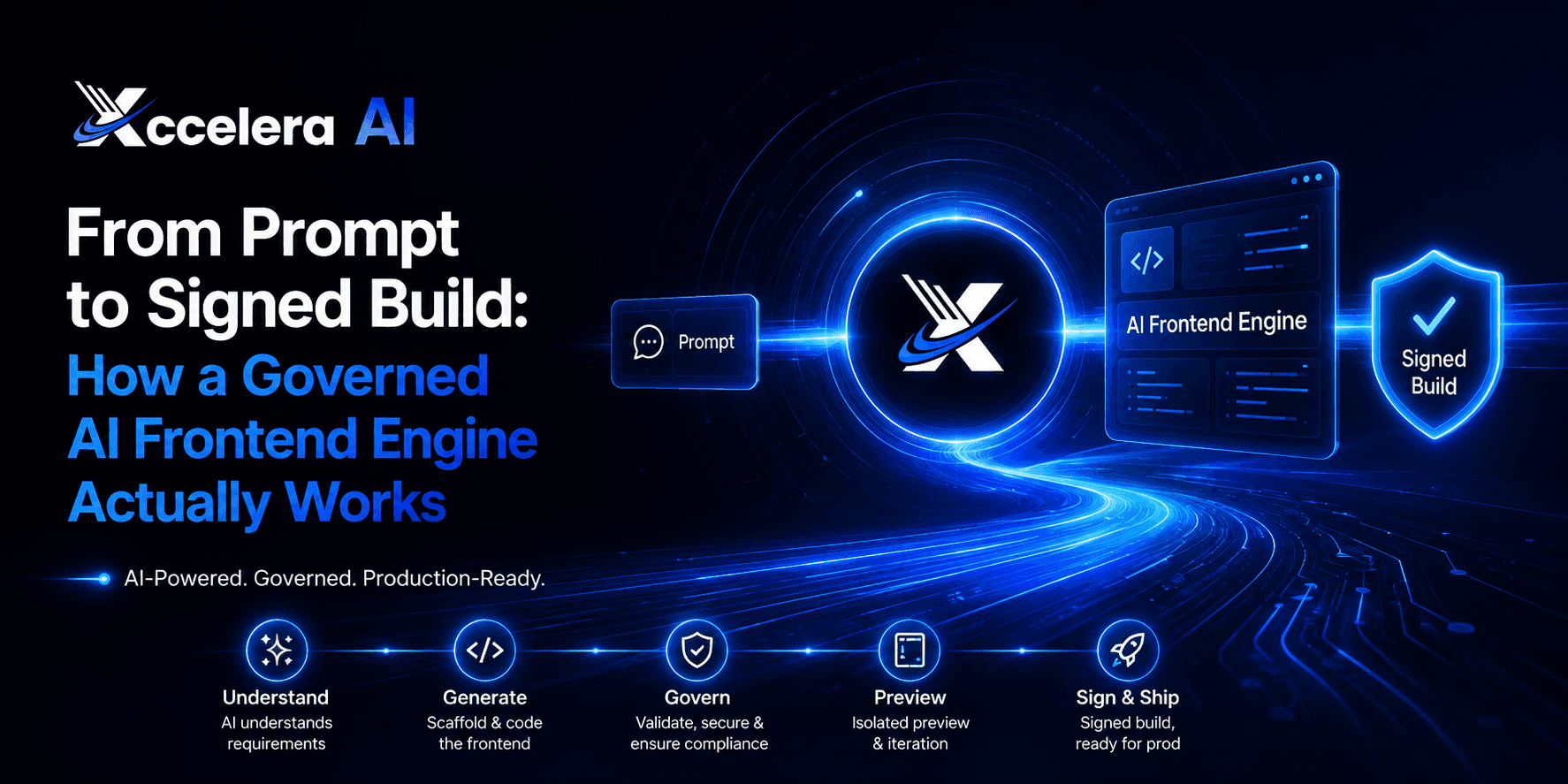
Every engineering leader evaluating an AI frontend generation engine faces the same underlying question. Can a system generate real, production-grade frontend code fast, and still hold up under enterprise review, audit, and rollback requirements?
Most tools answer only half of that question. Scaffolding gets faster, but preview sharing stays manual, iteration stays risky, and mobile release still means local SDKs and certificate management. This article breaks down the ten stages of a governed generation pipeline built to answer the whole question, from a plain-English prompt to a signed, shippable build.
Enterprise Frontend Development Bottlenecks Slowing Engineering Teams
Frontend delivery has not gotten meaningfully faster for most enterprise teams, even as backend automation has advanced. Every new project restarts the same cycle. Engineers scaffold routing, styling, and base components by hand, often burning a full day before real feature work begins.
Sharing progress with a stakeholder usually means a manual deploy, a port-forward, or a static screenshot instead of a working app. Iteration carries its own risk, too. A single request to “just tweak this one thing” against a working build has no safety net in most setups. A bad edit can undo hours of progress with no clean path back.
Mobile release compounds the problem further, requiring local SDKs, a physical Mac, provisioning profiles, and certificate management before an app ever reaches a device. Teams lose measurable velocity to four repeatable failure points, according to platform teams tracking delivery friction in 2026: slow scaffolding, no shareable live preview, unsafe iteration, and mobile build complexity.
An AI frontend generation engine exists specifically to collapse these four bottlenecks into one governed workflow, rather than solving each in isolation with a separate tool.
The cost of these bottlenecks compounds across a portfolio of projects. Each new client engagement, internal tool, or MVP repeats the same setup tax, and each repeat pulls senior engineers away from work that actually differentiates the product. As a result, leadership evaluating agentic AI systems for frontend delivery increasingly frames this as a portfolio-level velocity problem, not a per-project inconvenience.
Inside the AI Frontend Generation Engine: A Governed Pipeline Overview
A governed AI frontend generation engine does not treat generation as a single black-box step. Instead, it structures the entire journey, from requirement to signed artifact, as a sequence of validated stages. Each stage hands a well-defined output to the next, and nothing reaches a user unvalidated.
| Stage | Function |
|---|---|
| 01. Requirement Collection | Captures a plain-English app description, plus optional design references |
| 02. Target and Prompt Construction | Selects the correct prompt set for the chosen frontend or mobile target |
| 03. Automated Code Generation | Produces the full project structure, components, routing, and styling |
| 04. LLM-as-Judge Validation | Automatically scores generated output against defined quality criteria |
| 05. Package and Launch Preview | Zips the project and starts a detached development server |
| 06. Two-Stage Readiness Probing | Confirms both the local build and the public preview are truly live |
| 07. Live Preview Activation | Loads the working app into a real, shareable browser session |
| 08. Modify, Accept, or Reject | Applies changes as reviewable, reversible commits |
| 09. Finalize or Roll Back | Locks in accepted changes or restores the last known-good state |
| 10. Native Build and Signing | Produces a signed Android or iOS release candidate |
This structure lets an enterprise engineering organization treat frontend generation as infrastructure, rather than a novelty. Each stage stays auditable on its own, which matters as much to a security review as it does to a product manager waiting on a demo.
Prompt Construction and Requirement Collection for Governed Builds
The pipeline begins the moment a product owner or engineer describes the desired application in plain English. That description can optionally include design references, which the system fetches automatically and uses as a visual anchor for the generation stage that follows. Nothing about this first stage feels like configuring a build tool. Instead, it feels like writing a brief.
From there, the pipeline resolves the correct technical target before a single line of code is generated. That resolution step matters more than it appears to:
- It selects the appropriate system and user prompt set for the chosen framework, whether that is a web target or a native mobile target
- It locks in framework-specific conventions up front, so routing, styling, and component patterns stay consistent with the target platform
- It prepares the constructed prompt as a single, well-defined artifact that hands cleanly to the generation stage
This two-step separation of requirement capture and prompt construction is a deliberate governance choice. It means the system never generates code against an ambiguous or partially resolved target, which is a common source of inconsistent output in less structured tools.
For an engineering leader auditing this stage, the value lies in traceability. Every generated project traces back to a specific requirement input and a specific resolved target. This turns what would otherwise be an opaque generation event into a reviewable decision point, which matters even more once a security or compliance team asks how a given build was produced.
Automated Code Generation Inside the DeepAgents Architecture
Once the target and prompt are resolved, generation begins. This stage produces the full project structure in one pass, including components, routing, and styling, built specifically for the resolved target platform. This is where enterprise frontend automation actually happens, and where the difference between a governed engine and a static template generator becomes clear.
A static generator fills in a fixed template. A governed generation engine reasons about the requirement instead, and produces a structure suited to it, using an agent-based architecture built for exactly this kind of multi-step code construction.
“The teams that ship fastest are not writing less code. They are generating, previewing, and safely iterating on it in one continuous loop.”
That framing captures why generation alone is never treated as the finish line. Raw generated output, however capable the underlying model, is only useful once it has been checked against defined quality expectations. That check is the job of the next stage.
LLM-as-Judge Validation and the Fix-Pass Loop
Generated output does not reach a user directly. Instead, it passes through an automated validation stage first, where a judging process scores the project against defined correctness and completeness criteria. Anything that fails enters a fix-pass loop, where the system regenerates only the failing pieces rather than starting over.
This is one of the clearest expressions of AI code generation governance inside the entire pipeline. Nothing gets marked complete until it clears validation or the fix-pass loop is exhausted. As a result, a broken build never silently becomes someone’s live preview.
This matters because generation speed without validation just moves the review burden downstream, onto an engineer or a stakeholder who now has to catch the failure manually. Automating that check inside the pipeline keeps the burden where it belongs: inside the system that produced the output in the first place.
This pattern reflects a broader shift across production AI systems. Zylos Research’s 2026 analysis of LLM-as-judge deployment found that judge models moved from evaluation labs into live production loops because classifying output is fundamentally simpler than generating it. A smaller, cheaper verifier model can reliably catch failures a larger generator model introduces, which is exactly the asymmetry this stage exploits.
Live Preview Infrastructure and Two-Stage Readiness Probing
Validated code is not automatically useful if nobody can see it running. This stage packages the project and launches a detached development server, spawned independently so the preview survives even if the job that started it later restarts. A public tunnel then exposes that server, so a stakeholder can open it in a real browser tab, not a screenshot.
Before that tunnel is ever handed to a user, the pipeline runs two distinct readiness checks:
- A local readiness probe confirms the underlying build has actually compiled and is serving content, avoiding a race condition where a preview link opens before the app is ready
- A public tunnel readiness probe confirms the externally reachable URL itself is live, separate from the local check
This live preview infrastructure is a deliberate design decision, not a convenience feature. Skipping either probe risks handing a stakeholder a broken or half-loaded link, which erodes trust in the entire pipeline faster than any generation error would.
The same discipline extends to how the preview finally loads into a browser session. Rather than assuming the link is immediately safe to embed, the system checks reachability first and only then activates the live view. This avoids the interstitial or loading-state confusion that undermines confidence during a stakeholder demo.
Governed Modification Workflow: Accept, Reject, and Rollback Controls
Iteration is where most ungoverned tools fail enterprise scrutiny, because “just change this one thing” is exactly the kind of request that breaks a working build with no way back. A governed pipeline instead treats every project as a version-controlled repository from the moment it is generated, which changes the entire risk profile of iteration.
“Iterate without fear. Every modification request is a commit first, accept keeps the change, and reject resets exactly to what worked before.”
A modification request commits the pre-change state before anything else happens. The modification itself then runs as its own pass, restarts the live preview against the new state, and leaves the project in a pending review status with a specific candidate commit attached. Accepting the change finalizes it. Rejecting it performs a hard reset to the exact prior commit, never a partial or unclear undo.
This is the mechanism that lets senior engineering leadership treat iteration as safe by default, rather than something to be minimized. Change becomes reversible infrastructure instead of a risk to be managed manually.
Native Build and Signing for Android and iOS Release Candidates
A frontend that only runs in a browser preview stops short of what most product and mobile teams actually need. The final generation stage extends the same governed pipeline into signed mobile build automation, producing real release artifacts rather than a simulator build.
For Android, this stage runs a local build process that produces a signed application package ready for distribution. For iOS, the process is necessarily more involved:
- The project gets pushed to a dedicated, certificate-scoped repository branch
- A cloud-hosted macOS build runner compiles and signs the application using an automated signing workflow
- The signed build uploads directly to a release testing channel, ready for internal or beta distribution
Neither path requires an engineer to own a physical Mac, manage local certificates, or manually handle provisioning profiles. That removes one of the most consistently cited friction points in the entire mobile release process, without leaving the same governed job pipeline that generated the app in the first place.
That friction is well documented industry-wide. Bugfender’s analysis of iOS signing errors found that 89 percent of developers face certificate problems, and 60 percent struggle with provisioning profiles specifically. Automating this stage removes a failure point that trips up the large majority of teams shipping native iOS builds.
Greenfield Generation Versus Brownfield Import Governance
Not every engagement starts from nothing. A governed AI frontend generation engine has to support two distinct entry points, and it has to apply the same governance standard to both.
Greenfield generation starts from a plain-English description with no existing codebase. The full pipeline runs end to end, producing a working, previewable project with no prior code required.
Brownfield import, by contrast, starts from an existing repository branch, often one the system has never seen before. Before any modification pipeline touches that code, it runs through an automated malicious-code scan, closing a security gap that ungoverned import tools tend to skip entirely.
Both paths converge on the same modify, accept, reject, and rollback workflow once the project is inside the pipeline. That convergence is intentional. It means engineering leadership does not need a separate governance model for new builds versus inherited codebases, which is often where policy gaps quietly appear in less structured toolchains.
For agencies and internal platform teams juggling both entry points across a client or product portfolio, that single governance model reduces onboarding overhead substantially. A reviewer trained on how greenfield changes get approved already understands how brownfield changes get approved, since the underlying commit, accept, and rollback mechanics never change.
Xccelera’s Approach to Enterprise-Grade Frontend Generation Engines
Xccelera builds and governs the AI Frontend Development Engine behind this exact ten-stage pipeline, designed for engineering leaders who need generation speed without giving up review, rollback, or release control.
Every stage, from prompt construction to signed mobile build, is engineered as auditable infrastructure rather than a black box, so security and product teams can trust what ships.
Enterprises evaluating agentic AI systems for frontend delivery can explore how this governed approach fits their existing release process and compliance requirements at xccelera.ai.


