The Real Cost of Manual Frontend Scaffolding and Mobile Release Cycles
Enterprise engineering teams lose weeks of capacity to work that never touches the actual product. Scaffolding, routing, environment setup, and mobile release preparation all consume senior engineering hours long before a feature reaches a customer. Most leadership teams never see this frontend scaffolding cost broken out on a budget line, so it compounds…
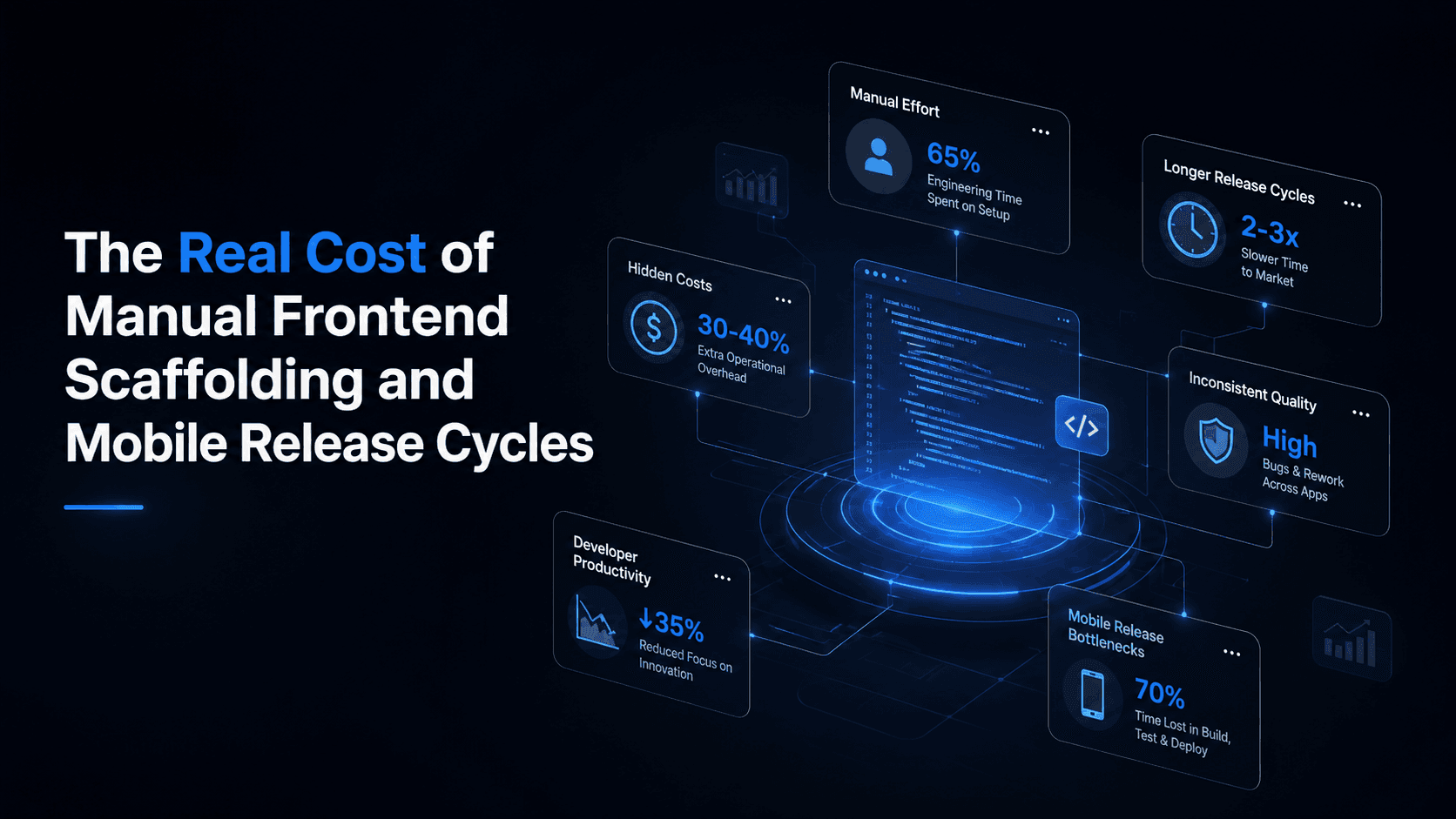
Enterprise engineering teams lose weeks of capacity to work that never touches the actual product. Scaffolding, routing, environment setup, and mobile release preparation all consume senior engineering hours long before a feature reaches a customer.
Most leadership teams never see this frontend scaffolding cost broken out on a budget line, so it compounds quietly across every sprint. An AI frontend development platform changes that equation. It collapses scaffolding, preview, iteration, and mobile release into one governed pipeline, turning weeks of setup into a same-day workflow.
The Hidden Engineering Cost of Manual Frontend Scaffolding
Every new frontend project starts the same way. A senior engineer configures the build tooling, wires up routing, sets design tokens, and builds the shell before a single business feature gets written.
Custom software development benchmarks put senior U.S. engineering rates between $125 and $250 per hour. The average enterprise project runs roughly $132,000 and takes about 13 months to deliver once integration and change management are factored in.
Scaffolding is rarely billed as its own line item, which is exactly why it survives budget reviews unchallenged. A senior engineer spending two or three days rebuilding a project shell, at a $150 to $250 hourly rate, represents $3,600 to $6,000 in sunk cost before any customer-facing work begins.
Multiply that across a dozen internal tools or client engagements a year. Scaffolding alone then becomes a six-figure line item hiding inside general engineering overhead. The core problem is not skill. Instead, it is repetition. Engineers keep re-solving a problem the organization has already solved dozens of times, and every repetition draws against the same finite senior capacity that product roadmaps depend on.
Frontend Scaffolding Time Sink Across Enterprise Teams
The scaffolding tax does not stop at project kickoff. It resurfaces every time a team debugs AI-assisted output that looks correct but is not.
Recent developer research shows that debugging remains one of the largest hidden costs in modern frontend work, even with AI copilots embedded in the editor. Nearly half of developers say debugging AI-generated code takes longer than writing it themselves, and most point to near-correct output as their biggest daily frustration.
That near-miss gap forces engineers back into manual verification, which erodes the very time savings AI tools were supposed to deliver. A governed pipeline changes the mechanics of that process:
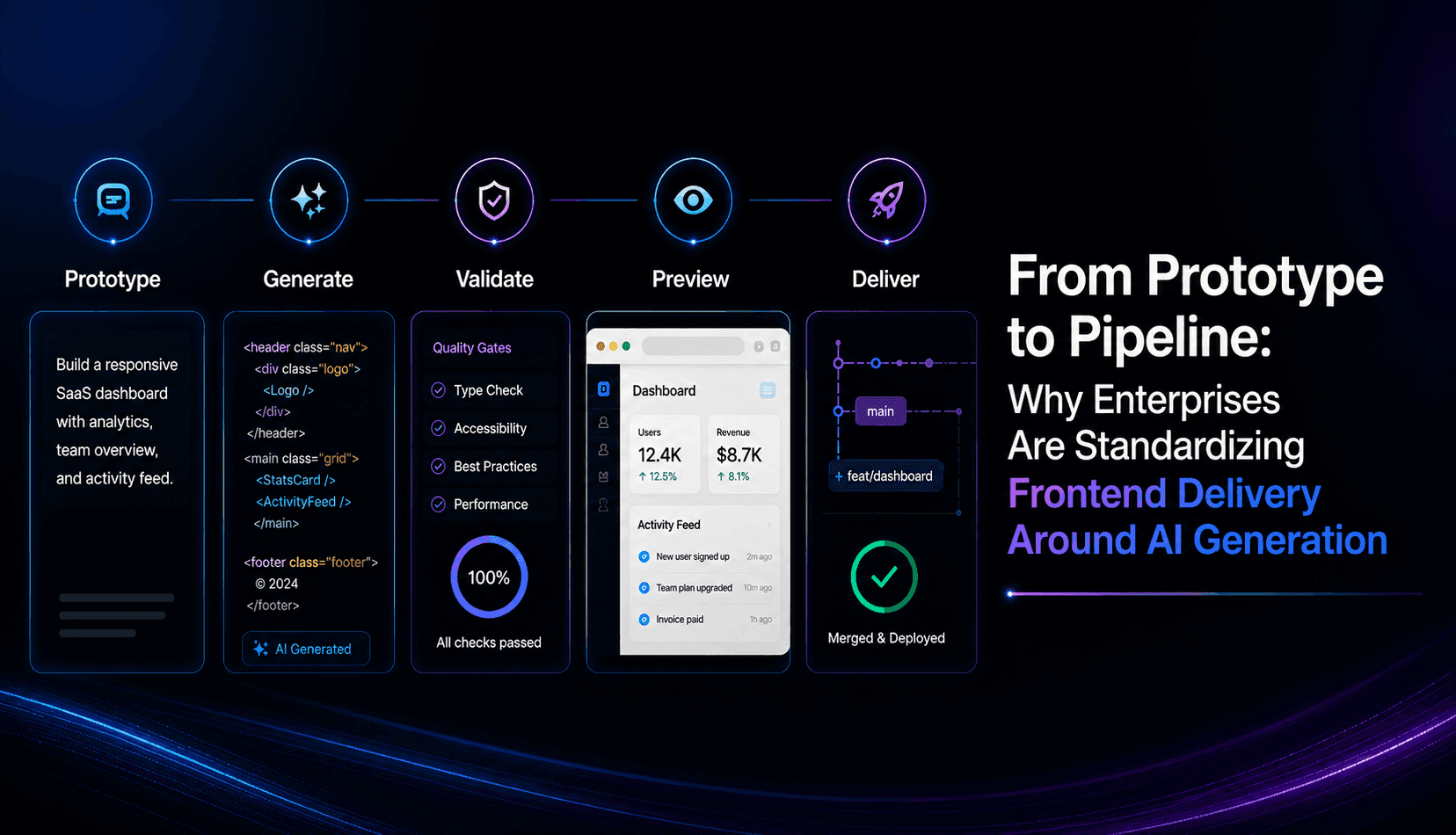
- It generates the full project shell against a validated per-language prompt library, rather than a single freeform prompt
- It runs every output through an automated judge and fix-pass loop before a job is ever marked complete
- It surfaces the result as a live, previewable build instead of a static code diff that still needs manual verification
For teams stretched across React, Angular, and mobile targets simultaneously, this removes the need to context-switch between three separate scaffolding conventions every time a new project starts.
Mobile Release Cycles and the App Store Bottleneck
Front-end delivery does not end at the browser. Mobile release remains one of the least predictable stages of enterprise software delivery, and 2026 data shows that unpredictability is getting worse, not better.
According to Appfigures data reported by TechCrunch, worldwide app submission volume surged 60 percent year over year in Q1 2026, and roughly 80 percent on iOS alone. By April 2026, releases were up 104 percent across both stores, stretching review queues industry-wide.
| Release Stage | Typical Enterprise Timeline (2026) |
|---|---|
| New app submission review | 2 to 5 days, spikes to 7+ days in peak periods |
| App update review | 24 to 72 hours |
| Rejection and resubmission cycle | Adds a full review period per rejection |
| Expedited review approval rate | Declining as request volume rises |
Every rejection resets the clock, and each resubmission consumes engineering hours that were never budgeted for release operations. Teams without a dedicated mobile release function absorb this volatility directly into product timelines. As a result, launch dates that leadership has already committed to publicly get pushed back.
Signed Builds Without a Dedicated Mobile Release Team
Producing a real, App Store-signed build has traditionally required a specialized skill set: certificate management, provisioning profiles, and a working macOS build environment.
Review scrutiny on AI-assisted submissions has only intensified this burden. Review teams now process a materially higher volume of AI-coded submissions, and queues have stretched accordingly as iOS release volume climbed roughly 80 percent year over year.
An AI frontend development platform removes the infrastructure dependency entirely. Instead of provisioning a local Mac and managing certificates by hand, a governed pipeline can dispatch the build to a remote, GitHub-hosted macOS runner, drive Fastlane and Match for signing, and push the finished package directly to TestFlight.
Android follows the same principle through a local Gradle build path that produces a signed APK without a parallel mobile engineering team. The result is a real, distributable build, not a simulator artifact, generated from the same job model that produced the web frontend.
Live Preview Environments Replacing Screenshot Reviews
Design-to-engineering handoff remains one of the most persistent friction points in frontend delivery, and both sides of the table agree it needs to change. The disconnect is not a perception problem. Instead, it shows up directly in how designers and developers rate their own process, with roughly nine in ten on both sides saying the handoff itself needs to change.
Static screenshots and PDF exports cannot answer basic stakeholder questions. Does the button state work? Will the layout hold on a real device? Does the animation feel right?
A live preview environment, backed by its own dev server and a public tunnel, answers all three in the same review cycle. Stakeholders click through a working build instead of imagining one from a static mockup, which cuts review rounds and shortens the distance between design approval and shippable code.
Iteration Risk in Frontend Development Without Rollback Safety
Speed without safety creates a different kind of cost. Industry-wide delivery benchmarks show a direct link between how fast changes ship and how often those changes cause problems in production.
According to DORA’s research on software delivery performance, elite engineering teams recover from failed deployments in under an hour and keep change failure rates below 5 percent. Low-performing teams, by contrast, can take days to weeks to recover and see failure rates of 46 percent or higher.
That spread between elite and low-performing teams is not about talent. Instead, it comes down to whether the underlying workflow treats every change as a git-backed, reversible event or as a one-way edit.
In a governed frontend pipeline, every modification request is committed before it runs. Accepting the change keeps it. Rejecting it triggers a hard reset to the exact prior commit, not a partial or unclear undo. That structural guarantee is what lets teams iterate quickly on a live, customer-facing build without absorbing elite-versus-low-performer risk on every single change.
From Prompt to Production-Ready Frontend Codebase
Trust remains the central tension in AI-assisted development, even as adoption climbs across the enterprise. Developers use these tools daily while remaining openly skeptical of unverified output. Over 80 percent use AI coding tools regularly, yet fewer than a third say they trust the results without review.
That trust gap is precisely why validation architecture matters more than generation speed. A prompt-to-production pipeline built for enterprise use cannot stop at generating code that compiles. Instead, it has to prove the output works before a human ever reviews it. That means:
- Running the generated project through an automated judge that checks for functional correctness, not just syntax
- Re-generating any failing portion through a fix-pass loop before the job is marked complete
- Handing the engineer a live, running build rather than an unverified diff to manually test
This is the difference between an AI frontend development platform and a code-completion tool. One produces suggestions an engineer still has to verify line by line. The other produces a validated, previewable application ready for the next stage of review.
Frontend Velocity as a Competitive Differentiator
Design tooling vendors are racing to close the design-to-code gap for a reason. The organizations that close it fastest gain a durable delivery advantage.
Recent product moves in the design tooling space make that competitive pressure explicit, as major vendors race to remove the days-long back and forth where a finished mockup gets rebuilt by hand. Both sides then argue over spacing, states, and fidelity to the original design.
Every day spent in that argument is a day competitors spend shipping. Enterprises that treat frontend velocity as an operational metric, not a developer convenience, are consistently first to market with new product surfaces. Direct Figma frame import at the start of the generation pipeline removes the days-long argument entirely, because the build starts from the same design tokens the designer approved, not a manual reinterpretation of them.
Xccelera’s Path to Faster, Safer Frontend Delivery
Manual scaffolding, unpredictable mobile release cycles, and unverified AI output all point to the same underlying gap. Enterprises need frontend delivery infrastructure, not another point tool.
Xccelera’s AI Frontend Development Engine closes that gap directly. It generates, validates, previews, and ships real web and mobile builds from one governed pipeline, with git-backed rollback protecting every iteration.
Enterprise teams get signed Android and iOS builds, live shareable previews, and a production-ready codebase they fully own, without adding a parallel mobile release function.
Full platform details are available at xccelera.ai.