From Prototype to Pipeline: Why Enterprises Are Standardizing Frontend Delivery Around AI Generation
Enterprise engineering leaders spend more time scaffolding frontends than building the products those frontends are meant to ship. A governed AI frontend development platform changes that equation. It turns a plain-English specification into a live, preview able, and eventually signed mobile build inside one auditable pipeline. This piece breaks down the architecture, governance controls, and…
Enterprise engineering leaders spend more time scaffolding frontends than building the products those frontends are meant to ship. A governed AI frontend development platform changes that equation.
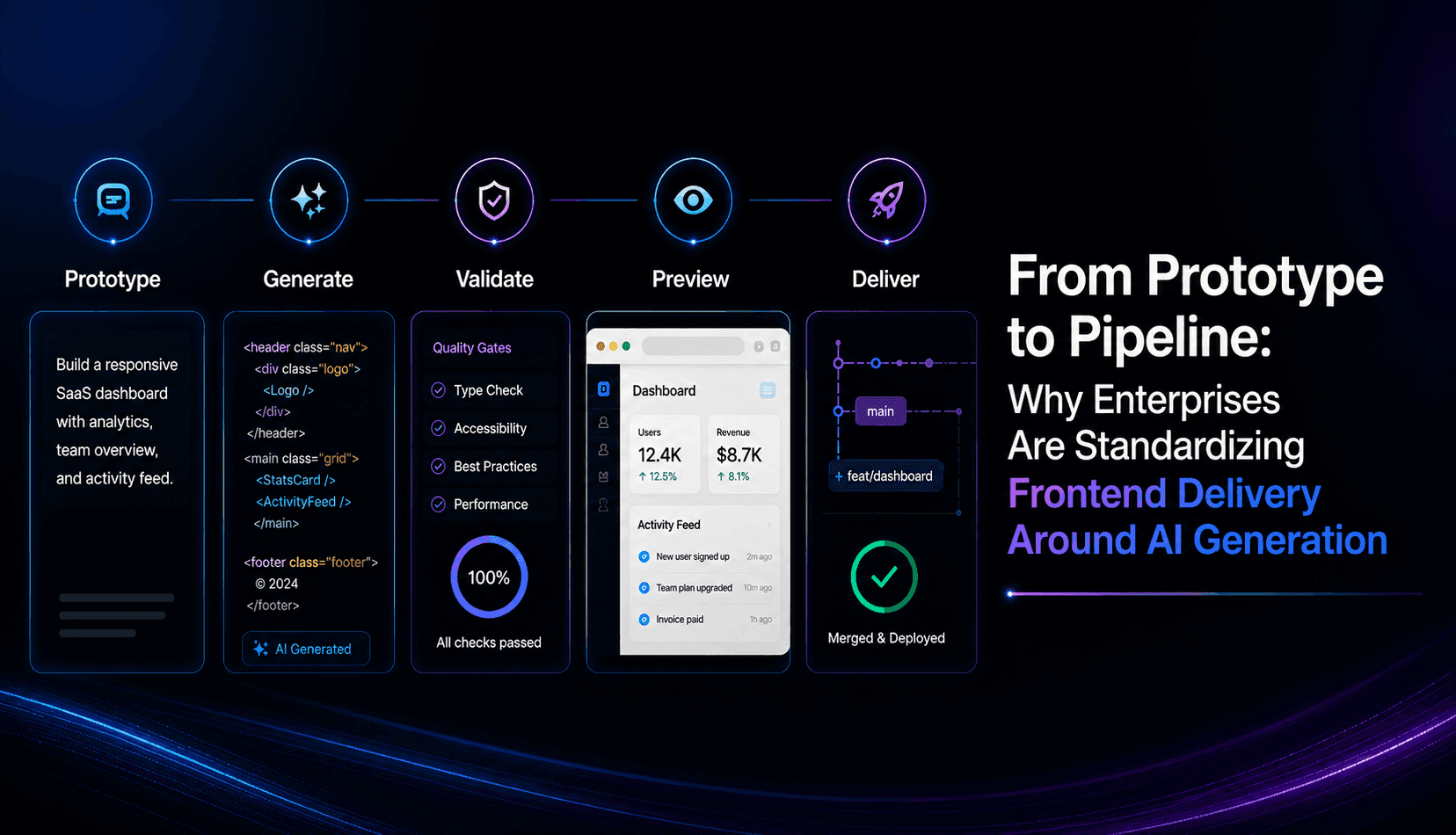
It turns a plain-English specification into a live, preview able, and eventually signed mobile build inside one auditable pipeline. This piece breaks down the architecture, governance controls, and delivery economics driving enterprises to standardize frontend production around AI generation systems. CTOs now treat this shift as infrastructure policy, not a developer productivity experiment.
The Hidden Cost of Manual Frontend Scaffolding and Slow Delivery Cycles
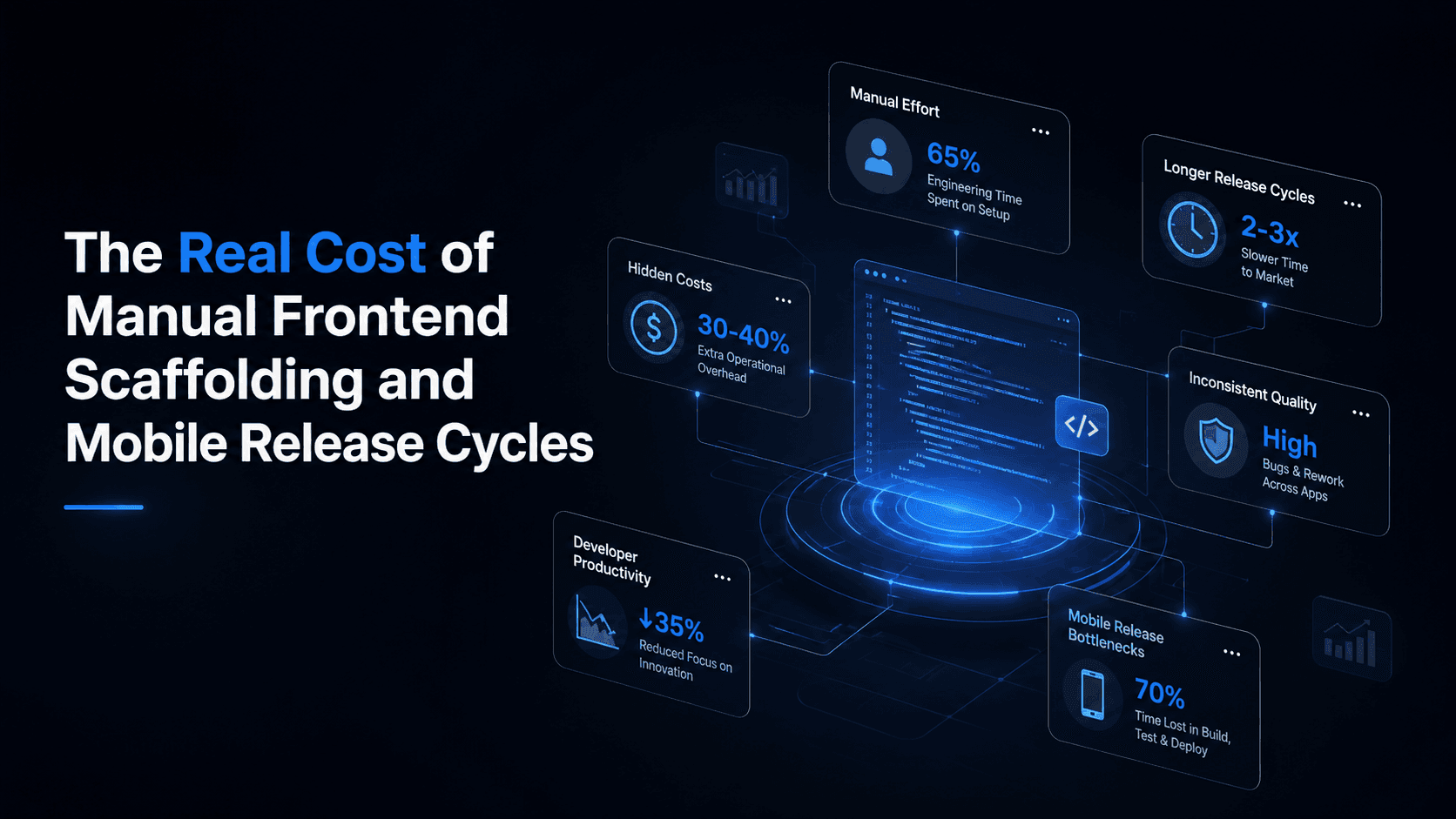
Every new enterprise application starts with the same tax. Teams rebuild routing, styling, base components, and a dev server before any real feature work begins. That tax repeats across every project, every framework, and every platform a company supports.
Frontend engineering teams report that AI coding tools now handle the bulk of this boilerplate reliably. However, the ROI shows up fastest in scaffolding and slowest in architecture decisions that still require senior judgment. The result is a split workload: routine setup that AI can compress into minutes, and structural decisions that still demand human oversight.
Enterprises that ignore this split waste engineering hours reinventing scaffolding logic project after project. An AI frontend development platform closes that gap instead, treating scaffolding as a solved, governed problem rather than a recurring manual task.
“The teams that ship fastest aren’t writing less code. They’re generating, previewing, and safely iterating on it in one continuous loop.”
That loop is precisely what enterprises are now standardizing around, because ad hoc scaffolding no longer scales against modern release cadence.
Where the Time Actually Goes
Setup work rarely shows up on a roadmap, yet it consumes the first days of nearly every sprint. Routing decisions, component boilerplate, and build tooling configuration repeat with almost no variation across projects. That repetition is exactly the pattern a governed generation pipeline absorbs.
Multiply that setup cost across a portfolio of internal tools, client-facing dashboards, and mobile companions. The wasted hours then compound into a measurable drag on quarterly delivery targets. Engineering leaders increasingly track this drag as a line item, not an assumption, because it directly shapes how many product bets a team can actually ship in a given release cycle.
Governed AI Pipeline Architecture Behind Automated Frontend Generation
A production-grade AI frontend generation platform is not a static template generator. Instead, it orchestrates real code generation, automated validation, and a live preview layer inside one job-based pipeline.
LLM-as-a-judge validation has moved from evaluation labs into production loops precisely because classifying output is simpler than generating it. This asymmetry allows a smaller verifier model to catch failures a generator model introduces, which is what makes automated judge and fix-pass validation practical at enterprise scale, rather than a novelty layered on top of code generation.
| Pipeline Stage | What Happens | Enterprise Value |
|---|---|---|
| Requirement Collection | Plain-English spec plus optional design references | Removes ambiguity before code is written |
| Prompt Construction | Target framework and language selected automatically | Consistent output across React, Angular, and mobile |
| Code Generation | Full project structure, routing, and styling produced | Eliminates manual scaffolding entirely |
| Judge and Fix-Pass Validation | Output scored and regenerated until it passes | Reduces defects reaching a live preview |
| Package and Launch | Dev server started and preview exposed | Stakeholders see a working app, not a mock-up |
This structure matters because it converts frontend delivery from a craft exercise into a repeatable, auditable process that engineering leadership can actually govern. Each stage produces a well-defined artifact before handing off to the next. As a result, nothing reaches a stakeholder unvalidated, and nothing about the process depends on which engineer happened to be available that week.
Turning a Plain-English App Description Into a Live, Shareable Preview
Once code passes validation, the pipeline packages and launches it automatically. A dev server starts detached from the job that triggered it, and a public tunnel exposes the running application before anyone touches infrastructure.
Real-time preview and chat-based editing are now treated as baseline expectations across modern AI app builders, not differentiators. This raises the bar for what enterprise buyers should demand from a platform.
- The pipeline pre-warms the application bundle before the preview tunnel opens, avoiding a cold-compile delay for the first viewer
- A readiness probe checks the public tunnel URL itself before the job is marked complete
- Stakeholders open a real, working application in a browser tab, not a static screenshot or a recorded demo
That sequence replaces a process that traditionally required a manual deploy, a port-forward, or a screenshot substituting for the real product experience.
Safe Iteration at Scale: Git-Backed Modify, Accept, and Rollback Controls
Iteration is where most AI-assisted development tools quietly lose enterprise trust. A single bad edit against a working application, with no clean path back, is an unacceptable risk for production systems.
Version control now functions as compliance infrastructure, not just developer convenience. It provides an immutable, auditable record of who changed what and when across AI-generated logic.
- Every modification commits the pre-change state first, before any generation pass touches the codebase
- Rejecting a change triggers a hard reset to the exact prior commit, never a partial or unclear undo
- Accepting a change simply repackages what the preview already reflects, with no separate rebuild step
- Detached preview infrastructure means a worker restart cannot silently kill a live session mid-review
This is the control layer that turns “AI wrote this” from a liability into a governed, reversible engineering decision that a compliance team can actually sign off on.
Greenfield App Creation Versus Brownfield Repository Modernization
Enterprises rarely start clean. Most frontend work happens against an existing codebase nobody fully documented, and brownfield modernization has become one of the more difficult problems in AI-assisted engineering.
Deep semantic understanding of an existing repository has to happen before any AI-driven change is proposed. Otherwise, specifications written against an incomplete model of the system produce integration failures that only surface in production.
A capable platform therefore needs to support both starting points cleanly. Greenfield generation builds a working, previewable project from a plain-English description with no prior codebase required. Brownfield import instead pulls in an existing repository branch, scans it for malicious code before anything else runs, and then drives the same governed modification pipeline against it.
Treating both paths through identical review and rollback logic keeps governance consistent regardless of where a project starts. That consistency matters more to a CTO than which path is faster on any single project.
Signed Android and iOS Mobile Builds Without Local Toolchain Overhead
Mobile release pipelines have historically been the slowest part of any frontend delivery process. One documented enterprise case needed four days for a single release, with signing, compilation, and store deployment carried out manually by one engineer. Automating that same pipeline cut the cycle to under a day. That gap between manual and automated mobile delivery is exactly what enterprises are now trying to eliminate industry-wide.
A governed generation platform folds native builds into the same job pipeline used for web output. Android output runs through a local Gradle build. iOS output pushes to a dedicated build branch, where a remote macOS runner handles signing and delivery to a beta testing channel, with no local Mac, Xcode installation, or manual certificate management required from the requesting team.
One pipeline covering React, Angular, and mobile targets alike means engineering leadership governs a single system instead of three disconnected toolchains, each with its own release calendar, its own failure modes, and its own on-call burden.
Security, Ownership, and Governance Controls Across the Generation Pipeline
Speed without governance is a liability, and the data backs that concern directly. Veracode’s 2025 GenAI Code Security Report, which tested more than 100 LLMs, found that AI-generated code carries roughly 2.74 times more vulnerabilities than human-written code, with defect rates that have not meaningfully improved across recent model generations.
That reality makes structural controls, not quarterly reminders to review code carefully, the only credible governance posture for enterprise AI-generated frontends.
- JWT-based authentication enforces per-user ownership down through every project, job, and log record
- Every imported repository runs through a malicious-code scan before the modification pipeline ever touches it
- Port allocation is reservation-locked, preventing two concurrent jobs from colliding on the same environment
- Schema changes run as idempotent, hand-written migrations, so a missing column fails loudly instead of breaking silently in production
These controls are what separate a governed enterprise platform from a consumer-grade AI app builder that was never designed to survive a compliance review.
Xccelera Sets the Standard for the AI Frontend Development Platform Era
Xccelera built its AI Frontend Generation and Iteration Platform for enterprises that need frontend delivery to be fast, governed, and reversible at once, not one traded against the other two.
The platform takes a plain-English specification through generation, judge-based validation, live preview, git-backed modification, and signed mobile release inside a single accountable pipeline.
For engineering leaders standardizing frontend delivery in 2026, that consolidation is the difference between an experiment and infrastructure. Full platform details are available at xccelera.ai.