From Pilot to Production: How Service-as-Software Matured in H2 2026
Service-as-Software moved from concept to operating reality faster than most enterprise buyers expected. The first wave of AI agent adoption promised autonomous execution. Instead, it delivered a governance gap, a pricing standoff, and thousands of stalled pilots. By the second half of 2026, however, the market has recalibrated. Outcome-based contracts are replacing seat licenses. Regulators…
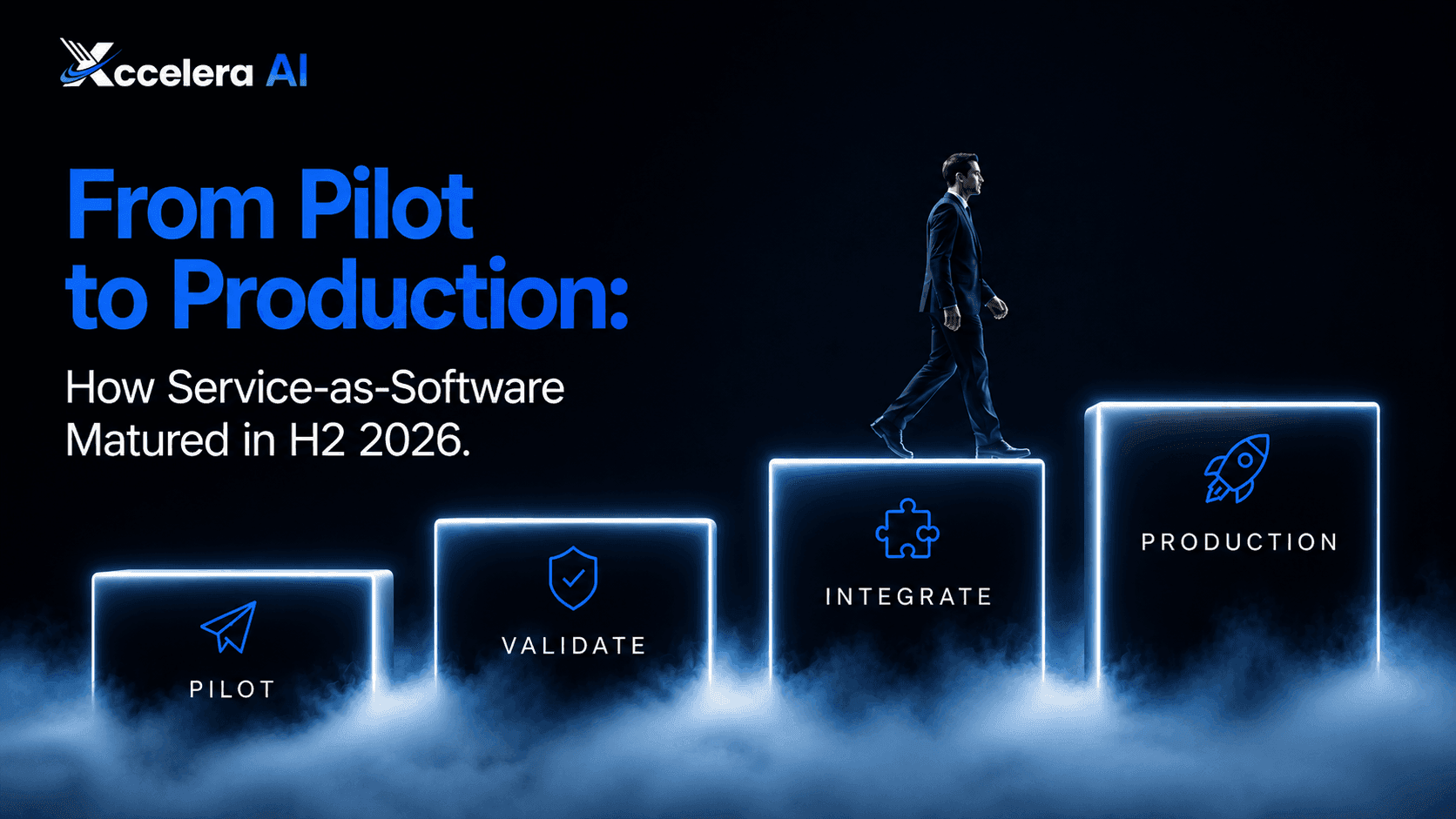
Service-as-Software moved from concept to operating reality faster than most enterprise buyers expected. The first wave of AI agent adoption promised autonomous execution. Instead, it delivered a governance gap, a pricing standoff, and thousands of stalled pilots.
By the second half of 2026, however, the market has recalibrated. Outcome-based contracts are replacing seat licenses. Regulators have set enforceable deadlines. And production-grade agents now outnumber demo-stage prototypes in several industries.
This piece maps what actually changed, why early rollouts stalled, and what separates the enterprises now compounding value from those still stuck in pilot purgatory.
Service-as-Software Beyond the SaaS Playbook
Service-as-Software describes software that performs the job itself, instead of giving a human the tools to do it. A support ticket used to require an agent logging into a dashboard. Now an autonomous system reads the ticket, resolves it, and closes the loop without a human touching the screen.
This distinction matters because it changes what buyers are actually purchasing. Enterprises no longer license access to a tool. Instead, they contract for a completed unit of work. Salesforce, ServiceNow, and SAP have each restructured parts of their business around this idea in 2026, treating agentic AI as a force reshaping enterprise pricing.
The shift forces a harder question for every enterprise buyer. Does the vendor’s system actually finish the job, or does it just assist a human who still finishes it? That question now shapes procurement scorecards. Buyers increasingly ask vendors to prove completion rates before signing, not after the first renewal cycle. As a result, sales cycles have lengthened for vendors that cannot show verified outcome data, even when their underlying technology performs well in demos.
The First Wave of Agentic AI Adoption in Review
Momentum built quickly through 2025 and early 2026. Nearly every enterprise application now ships with an agent embedded somewhere. Roughly 80 percent of enterprise applications updated in the first quarter of 2026 included at least one AI agent, up from just a third in 2024.
That statistic looks like victory on the surface. It is not. Embedding an agent is not the same as running one in production at scale.
Most organizations discovered this gap the hard way. They built a narrow pilot that worked well under curated conditions. Then it struggled the moment real-world variability entered the picture. According to Forrester’s 2026 State of Agentic AI report, three-quarters of enterprise leaders say they are adopting agentic AI, yet only a small minority run it in meaningful production.
The first wave taught a blunt lesson. Enthusiasm scales faster than infrastructure, and infrastructure determines whether an agent survives contact with production traffic. In practice, the enterprises that avoided this trap treated their first agent as a controlled experiment, not a finished product. They instrumented every decision the agent made, then used that data to decide whether the workflow deserved a larger deployment.
Outcome-Based Pricing Replacing Per-Seat Licensing
Per-seat pricing assumed one seat equaled one unit of productive work. That assumption breaks the moment an agent replaces the human sitting in the seat. Vendors responded by billing for results instead of access.
Intercom charges customers only when its AI agent fully resolves a support conversation, and it charges nothing for failed attempts. Meanwhile, Zendesk built its own model around charging exclusively for tickets the AI actually resolves, shifting performance risk onto the vendor. The pattern extends well past customer support.
Enterprise procurement teams still want predictable budgets. So most contracts in 2026 blend a lower base fee with variable outcome billing, rather than moving to pure consumption pricing overnight.
| Pricing Model | How It Charges | Where It Dominates in 2026 |
|---|---|---|
| Per-seat | Fixed fee per user license | Legacy productivity software |
| Usage-based | Fee per API call or token | Developer platforms and infrastructure |
| Outcome-based | Fee per completed, verified task | Customer support, sales, finance operations |
| Hybrid | Base fee plus outcome billing | Most enterprise agent contracts today |
Enterprise Barriers That Stalled Early Rollouts
The production gap remains the defining statistic of this cycle. Almost four in five enterprises have adopted AI agents in some form. Yet only about one in nine actually runs them in production.
Root causes cluster around a small set of recurring failures. Digital Applied’s 2026 enterprise data analysis, drawing on Forrester’s research, traced 41 percent of failed deployments to unclear success criteria, 33 percent to insufficient data or tool access, and 26 percent to evaluation coverage that drifted over time.
None of these are model quality problems. They are scoping and ownership problems that surface only once an agent leaves a controlled pilot environment. Enterprises that treated agent deployment as a procurement decision, rather than an operating model change, hit this wall almost every time.
Ownership matters as much as technology here. A pilot without a named, accountable owner tends to drift once the original sponsor moves to another priority. That drift is exactly what turns a promising prototype into an abandoned line item.
Where Pilots Actually Break Down
- Integration friction with legacy systems that were never designed for autonomous callers
- Missing monitoring tooling that leaves quality problems invisible until they compound
- No single owner accountable for an agent once it leaves the pilot team
- Data access scoped for humans, not for machine-speed query volume
Each of these gaps is fixable, but only if leadership treats them as infrastructure investments rather than afterthoughts. Enterprises that build monitoring and ownership structures before the first agent ships tend to clear the production gap far faster than those retrofitting governance after a failed launch.
Governance and Compliance Requirements for Autonomous Agents
Regulation caught up to deployment velocity in 2026. The EU AI Act gained full enforcement power on August 2, 2026, with penalties reaching up to €35 million or 7 percent of global annual revenue for noncompliant high-risk systems.
Singapore moved first on agent-specific rules. Its Model AI Governance Framework for Agentic AI, published in January 2026, became the first comprehensive governance framework built specifically for autonomous agents. It requires each agent to carry a verifiable digital identity and an audit trail showing which agent acted under whose authorization.
The compliance bar keeps rising, yet most organizations remain unprepared for it. Only 30 percent of organizations have reached maturity level three or higher across strategy, governance, and agentic AI controls.
Boards are now asking a question procurement teams cannot dodge. Can this vendor prove, on demand, exactly which agent took which action and under whose authority? That question is reshaping vendor selection criteria across every regulated industry. Legal and compliance teams now sit in agent procurement meetings from the first evaluation call, not just at final sign-off, because retrofitting audit trails onto a live system costs far more than building them in from the start.
Autonomous Agents Taking Over Operational Workflows
Financial services and insurance moved fastest into real production use. This was not because their models were better, but because their compliance infrastructure already existed. Financial services firms reach advanced production deployment at nearly twice the rate of healthcare organizations, a gap driven by regulatory maturity rather than technical capability.
The workflows succeeding at scale share a common shape. They are narrow, measurable, and tolerant of iteration, rather than open-ended and customer-facing from day one. Support triage, contract clause drafting, and inventory forecasting all fit that profile.
Enterprises attempting a fully autonomous, customer-facing workflow before proving a narrower one almost always extend their own timeline instead of shortening it. Sequencing turns out to matter more than ambition. Teams that proved value on a bounded, internal-facing workflow first found it far easier to win budget and trust for the next, more visible deployment.
Metrics That Define Service-as-Software Maturity Today
Boards evaluating agent programs now track a consistent set of numbers instead of vague productivity claims. Time to value has become the clearest signal of program health. Median payback across functions runs 5.1 months, with sales development agents paying back in 3.4 months and finance and operations agents taking closer to 8.9 months.
ROI concentration tells the rest of the story. Only about 23 percent of organizations report significant ROI from AI agents today, which means most programs are still funding the learning curve rather than harvesting the return.
Enterprises serious about Service-as-Software increasingly build a standing scorecard covering completion rate, cost per outcome, escalation frequency, and audit trail completeness, reviewed monthly rather than at renewal time. That cadence matters because agent behavior drifts as underlying models update and workflows change. A metric checked once a year cannot catch a regression that compounds over ninety days.
Xccelera’s Role in the Next Phase of Service-as-Software
Every barrier above traces back to one cause. Enterprises built agents like software, then found autonomous systems needing lifecycle discipline traditional development never required.
An AI Agent Lifecycle Management Platform closes that gap. It embeds role-based access, approval gates, version history, and audit trails into every agent from creation, not bolted on later. Cost visibility arrives before deployment, not after the invoice.
Generated code lives in the enterprise’s own repositories, so there is no lock-in and no black box for auditors. That combination of governed speed and transparency turns Service-as-Software into a durable advantage.
Learn more at xccelera.ai.