AI Agent Lifecycle Management: What Enterprises Get Wrong in 2026
AI agent lifecycle management separates enterprises that scale AI safely from those that lose control of it. Agents move from pilot to production fast. However, governance, guardrails, and ownership often lag behind. That gap becomes a balance sheet problem long before it becomes a technical one. The Governance Gap Behind Enterprise AI Agent Adoption Enterprise…
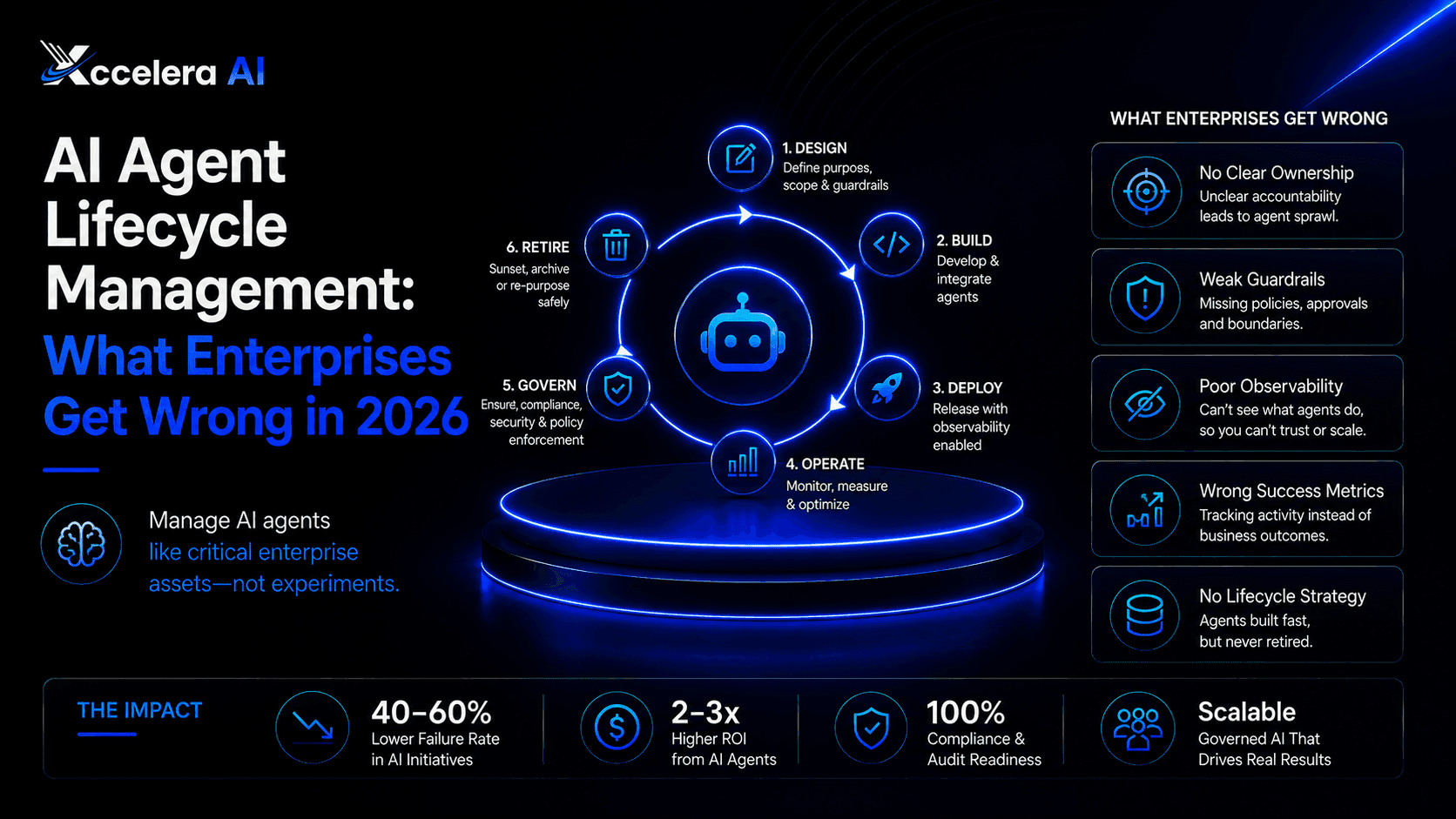
AI agent lifecycle management separates enterprises that scale AI safely from those that lose control of it. Agents move from pilot to production fast. However, governance, guardrails, and ownership often lag behind. That gap becomes a balance sheet problem long before it becomes a technical one.
The Governance Gap Behind Enterprise AI Agent Adoption
Enterprise adoption of autonomous AI agents has outpaced the AI agent lifecycle management practices built to govern them. IBM’s 2026 Institute for Business Value study found that 77% of organizations say AI adoption is already outpacing their governance capabilities.
A separate survey found that only 21% of enterprises have a mature governance model for agentic AI risk. Consequently, agents access sensitive data, trigger workflows, and make decisions with limited human oversight.
Without disciplined AI agent lifecycle management, organizations end up running infrastructure they cannot audit or safely retire. This is not a technology failure. Instead, it is a program design failure that compounds with every agent deployed. Therefore, enterprise AI agent governance cannot stay an afterthought once agents touch production systems.
The Business Cost of Skipping AI Agent Lifecycle Management
Every agent deployed without lifecycle discipline becomes a standing liability. Unclear ownership and unreviewed access do not simply disappear. Instead, they resurface later as incident response costs, failed audits, or a breach nobody can trace back to an approval.
AI agent lifecycle management prevents that outcome. It treats governance as a built-in cost of doing business, not a cleanup expense paid after something breaks.
Enterprises that get this right enforce checkpoints across six stages:
- Requirement approval
- Guarded build
- Human sign-off
- Deployment
- Monitoring
- Structured retirement
Skip a checkpoint, and the cost moves downstream and grows. This is exactly where an AI Agent Lifecycle Management Platform earns its place: it makes those checkpoints the default path, not an extra step teams must remember.
Cutting Build Time With an AI Agent Development Platform
A traditional agent project starts from zero every time. Teams rebuild architecture decisions, guardrail logic, and deployment pipelines on every effort. As a result, the repetition costs real budget.
An AI agent development platform removes that repetition by standardizing the parts of the build that rarely change. Teams describe the intended behavior, and the platform generates the architecture, code, and configuration around it.
Governance gets designed into the build stage, not patched on afterward. Consequently, enterprises adopting a proper AI agent development platform report shipping working agents in hours instead of quarters. This frees engineers to focus on logic that creates value instead of boilerplate.
AI Agent Deployment Automation at Enterprise Scale
Manual deployment does not scale past a handful of agents. Once an organization runs dozens across departments, AI agent deployment automation becomes the only realistic path to consistency.
It handles several tasks automatically:
- Packages agents with dependencies
- Provisions infrastructure automatically
- Injects secrets and network policies
- Confirms guardrails are active before anything goes live
Furthermore, AI agent deployment automation protects enterprise AI agent governance by making every deployment traceable. As a result, audit trails stay consistent, and nobody reconstructs an incident from memory.
Once multi-agent orchestration enters the picture, a single misconfigured deployment can affect every agent downstream. This is exactly the risk AI agent deployment automation is built to remove.
AI Agent Orchestration Platform vs Single-Agent Tools
A single agent handling one task is easy to manage. However, complexity grows once several agents need to coordinate, hand off work, or share context.
An AI agent orchestration platform assigns clear ownership to each agent. It also logs every handoff and gives operators one view of the workflow instead of scattered logs. This matters for AI agent lifecycle management because multi-agent orchestration introduces new failure modes: one agent’s bad output can cascade into another agent’s decision before a human sees it.
Enterprises running fraud detection or document review pipelines need multi-agent orchestration to stay predictable. Meanwhile, a mature AI agent orchestration platform makes every handoff auditable instead of forcing teams to reconstruct the chain after the fact.
LLM Guardrails Against Rogue Agent Behavior
Agents fail quietly more often than they fail loudly. For example, a sales agent might update records from weak context. Similarly, a support agent may escalate late because its thresholds were never reviewed.
According to the OWASP Top 10 for Agentic Applications 2026, autonomous agents introduce risks like goal hijacking, tool misuse, and cascading failures that traditional LLM security cannot catch alone.
LLM guardrails catch these failure modes before they compound:
- PII detection
- Prompt injection prevention
- Toxicity filtering
- Relevance checks
- Cost controls that stop runaway spend from a single misconfigured agent
Building LLM guardrails into an agent’s code, rather than bolting them on as middleware, keeps enterprise AI agent governance consistent across every deployment. Guardrails applied inconsistently protect nothing. In fact, that inconsistency is what regulators and auditors find first.
Enterprises that skip LLM guardrails at the code level end up patching the same failure mode across a dozen agents instead of fixing it once.
The Real Requirements of Enterprise AI Agent Governance
Enterprise AI agent governance goes beyond a policy document. It requires identity provisioning for every agent, continuous behavioral monitoring, and a clear decommissioning process once an agent stops earning its keep.
As Palo Alto Networks notes, the average enterprise now faces a staggering machine-to-human identity ratio, and every agent identity represents a potential point of exposure.
Organizations that treat AI agent lifecycle management as a checkbox exercise accumulate excessive privilege and unclear ownership across their agent population. This makes incident response and compliance review far harder than it needs to be.
Strong enterprise AI agent governance answers three questions at any moment:
- Which agents exist?
- Who owns each one?
- What can each agent access?
Without clear answers, organizations are not running a governed AI agent development platform. Instead, they are running autonomous shortcuts nobody fully controls.
AI Agent Lifecycle Stages at a Glance
| Stage | Business Risk If Skipped |
|---|---|
| Requirement Capture | Agents built without a clear business case or owner |
| Guarded Build | Security and compliance gaps added too late to fix cheaply |
| Human Approval | Unreviewed agents reaching customers or handling sensitive data |
| Deployment | Inconsistent, error-prone rollouts with no audit trail |
| Monitoring | Silent performance drift that surfaces as a customer complaint |
| Retirement | Orphaned agents left with standing access nobody is watching |
This structure reflects how mature AI agent lifecycle management actually runs in production, not how it looks on a planning slide. It holds even as multi-agent orchestration adds more moving parts to track.
Building AI Agents Faster Without Losing Control
Speed and governance are often treated as opposites. However, that framing does not hold up. Teams that build AI agents faster by skipping guardrails simply move their risk downstream, where it costs more to fix.
The organizations getting this right take a balanced approach. They build AI agents faster by standardizing the repeatable parts of development, while keeping human approval a hard gate before production. That combination lets teams build AI agents faster without skipping the checkpoints that matter.
An AI agent development platform designed this way treats governance as infrastructure, not friction. This is precisely why it can move quickly and stay accountable at the same time.
Agent Observability: The Line Between Prototype and Production
A prototype that works in a demo is not the same as an agent ready for production traffic. Agent observability closes that gap by giving teams a continuous view into how an agent behaves once real users interact with it.
Without agent observability, performance drift goes unnoticed until it becomes a customer complaint or a compliance finding. Strong agent observability tracks usage patterns, flags anomalies, and ties every action back to a specific agent version.
It is a core pillar of AI agent lifecycle management, because a deployed agent is never really finished. Ultimately, agent observability is what catches drift early instead of after damage is done.
Frequently Asked Questions
What is the fastest way to start AI agent lifecycle management with no framework today? Inventory every agent in development or production and assign an owner to each. A governed AI agent development platform layers structured lifecycle management on top of that inventory without a full rebuild.
How does AI agent deployment automation reduce compliance risk? Automated pipelines apply the same guardrails and audit logging to every agent. As a result, compliance teams get consistent records instead of ad hoc documentation.
Do LLM guardrails slow down agent performance? Guardrails embedded at the code level run with minimal latency impact. Still, they block PII leakage and cost overruns before those issues cause damage.
Can one AI agent orchestration platform manage agents across multiple LLM providers? Yes. A properly built orchestration layer routes requests across providers by task, which avoids vendor lock-in — especially in multi-agent orchestration setups where different agents call different models.
What is the biggest governance mistake enterprises make, and does AI agent lifecycle management apply below enterprise scale? Treating governance as a launch requirement instead of a continuous process is the biggest mistake. AI agent lifecycle management applies well below enterprise scale too, since ownership gaps create risk regardless of headcount.
Built for the Full Agent Lifecycle
Closing the gap between deployment speed and enterprise AI agent governance takes more than good intentions. It takes an AI Agent Lifecycle Management Platform built to handle requirement capture, guardrail injection, human approval, deployment, and monitoring inside one governed workflow.
Xccelera built that platform for engineering teams who need to build AI agents faster without losing control of what they ship. It is backed by multi-provider LLM support, so no single vendor decision locks in the outcome.
Learn more at xccelera.ai.


