From Sprints to Self-Running Pipelines: The Agentic SDLC Transition Playbook
Software teams built their processes around a human bottleneck: the sprint. That bottleneck is disappearing fast. Autonomous agents now plan tickets, write code, generate tests, and trigger deployments without waiting for a two-week cadence to catch up. Engineering leaders who treat this shift as a minor productivity add-on are missing something bigger. The agentic SDLC…
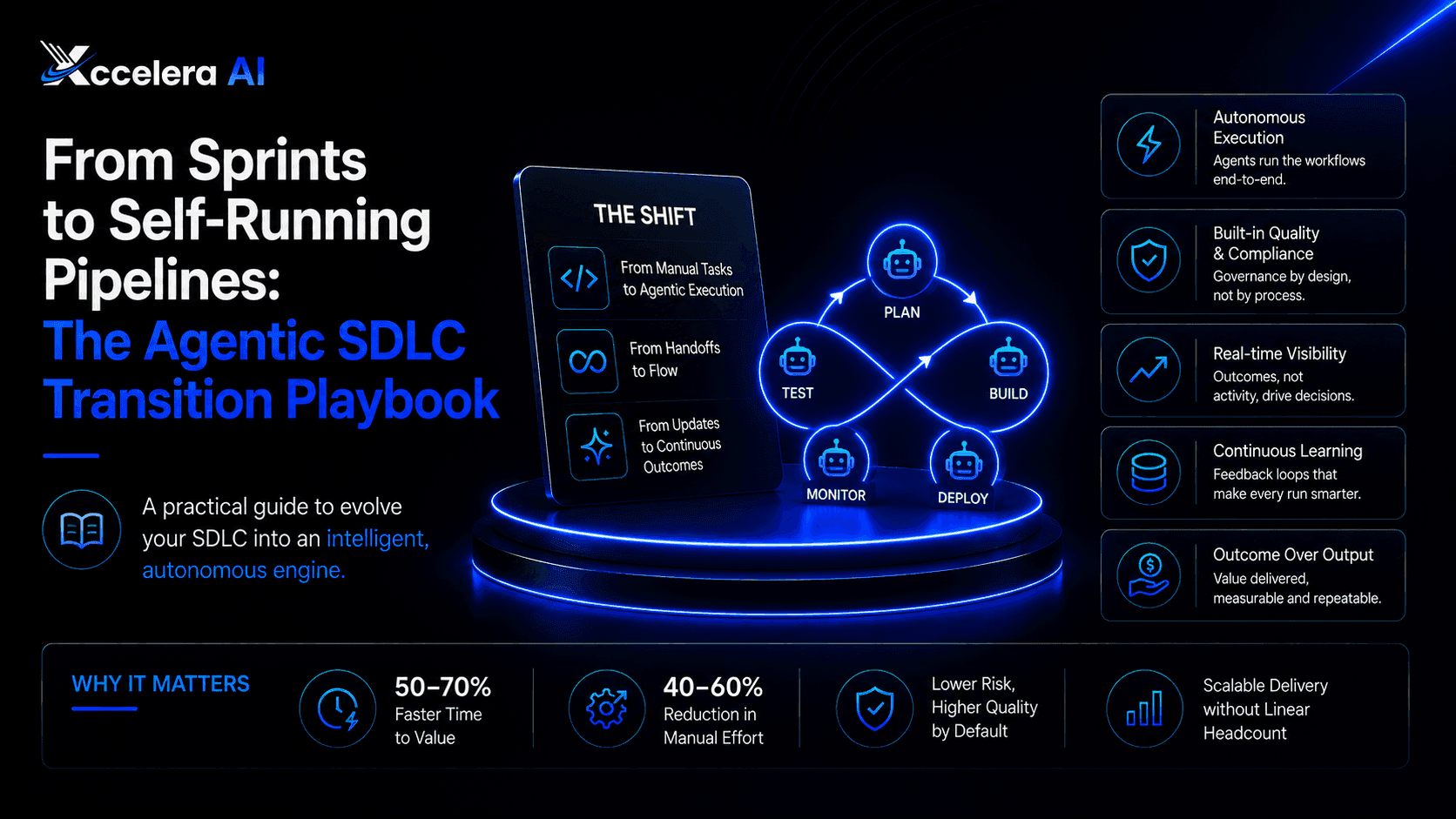
Software teams built their processes around a human bottleneck: the sprint. That bottleneck is disappearing fast. Autonomous agents now plan tickets, write code, generate tests, and trigger deployments without waiting for a two-week cadence to catch up.
Engineering leaders who treat this shift as a minor productivity add-on are missing something bigger. The agentic SDLC doesn’t just speed up the old lifecycle — it replaces it entirely with continuous, goal-directed execution.
Below, we break down what actually changes, where the risk sits, and how your team can move from sprint planning to a pipeline that runs itself.
Why the Software Development Lifecycle Is Breaking Under Sprint-Based Assumptions
The Sprint Was Built for Human Bandwidth
Sprint planning was never a technical constraint. Instead, it’s a scheduling compromise — a way to batch decisions into a cadence that engineers, product managers, and stakeholders can realistically keep up with, as outlined in Atlassian’s overview of sprint planning fundamentals.
Two-week cycles exist because humans need time to write code, review it, test it, and debate priorities along the way. However, none of that reasoning applies to an autonomous agent. An agent can execute a multi-step task, check its own output, and move to the next item within minutes.
Where Fixed Cycles Now Create Bottlenecks
Once agents enter the picture, the sprint boundary stops protecting quality. Instead, it starts throttling throughput.
Consequently, teams running AI agents in software development often finish a sprint’s planned work in days. Then they sit idle until the next planning session opens new tickets. As a result, the backlog becomes the real constraint, not the agent’s capacity to execute against it.
Because of this, product and engineering leads increasingly hold emergency backlog-grooming sessions mid-sprint just to keep agents supplied with work. This defeats the entire purpose of a fixed planning cadence.
- Idle compute during the back half of the sprint
- A crunch of unplanned requests once tickets run dry
- Emergency grooming sessions that undercut planning discipline
Why Faster Sprints Is the Wrong Fix
Shortening sprints to one week, or shipping more frequently, only treats the symptom. The real fix is dropping the fixed cycle altogether in favor of continuous intake and execution — which is the actual premise behind an agentic SDLC.
What Makes a Pipeline Self-Running: Defining the Agentic SDLC
Agentic SDLC Versus AI-Assisted Development
There’s a meaningful line between a developer using AI-assisted coding and a team running a full agentic SDLC. With AI-assisted work, a human still directs every prompt and accepts or rejects each suggestion in real time.
An agentic software development lifecycle flips that relationship. Agents pursue a defined goal across multiple steps on their own. Meanwhile, a person sets intent and reviews the outcome, rather than approving each individual move.
Goal-Directed Execution Loops, Explained
In practice, this looks like an agent picking up a ticket, writing the implementation, and generating and running tests. Then it opens a pull request and flags anything it couldn’t resolve with confidence.
Crucially, the loop only pauses for genuine ambiguity or a defined review checkpoint — not for routine steps a human would otherwise babysit.
This Is a Lifecycle Change, Not a Tooling Upgrade
Swapping a code editor plugin for a smarter one is simply a tooling change. Restructuring who or what initiates each phase of delivery, however, is a lifecycle change. That distinction matters enormously when leadership decides where to invest first.
Where Agents Take Over: Planning, Coding, Testing, and Review
Ticket-to-Code Handoffs
Modern agentic coding workflows start earlier than most teams expect. Agents now triage incoming tickets, estimate scope, and draft implementation plans before a single line of code gets written. As a result, they cut the lag between a reported issue and a working fix.
Automated Test Generation and Coverage Gains
Test creation has quickly become one of the most reliable places to hand off work entirely. Agents generate test cases against new code, run them, and iterate until coverage meets a defined bar. Often, they surface edge cases that a rushed human review would miss.
Review-Layer Agents and What They Actually Check
Review agents are not rubber stamps. Instead, they check for regressions, security patterns, and adherence to team standards. Anything outside their confidence threshold gets routed to a human reviewer rather than merged blind — this is exactly where human-in-the-loop code review earns its keep inside an otherwise autonomous chain.
Stage-by-Stage Responsibility
Mapping which agent owns which stage — and where the handoff to a person happens — is arguably the single most useful exercise a team can do before scaling beyond a pilot project.
Teams that skip this mapping exercise tend to end up with:
- Overlapping agents duplicating the same work
- Ownership gaps, where nothing owns a stage until a human notices something slipped through
- Slower onboarding for new engineers trying to understand the pipeline
A simple, regularly updated ownership chart prevents both problems and gives new engineers a fast way to understand how the pipeline actually functions.
Deployment and Operations Without Constant Human Triggers
Flag-Based Rollout Automation
Autonomous software delivery extends well past the merge. Agents can push a release behind a feature flag, monitor the rollout against defined health metrics, and expand or halt exposure — all without a human standing by to click a button at each stage.
Incident Triage and Summary Generation
When something breaks in production, agents built for this stage can correlate logs and isolate the likely cause. They can then produce a concise incident summary before an on-call engineer has even finished reading the alert. That compresses response time meaningfully during the hours nobody wants to be paged.
Where Human Escalation Still Has to Exist
Still, none of this removes the need for a person with authority to make judgment calls on customer-facing risk. An AI-driven DevOps pipeline should escalate automatically once impact crosses a defined severity line — it should never attempt to resolve every incident silently.
The Cost of Skipping Oversight
Teams that grant full autonomy without escalation paths tend to discover the gap during their first serious outage. Unfortunately, that’s the worst possible time to learn it.
Governance, Identity, and Risk in an Autonomous Pipeline
Agent Identity and Authentication Challenges
An agent that can commit code or trigger a deployment needs an identity, credentials, and an audit trail — just like any employee would. Most engineering organizations are still catching up on this basic requirement. In fact, NIST’s AI Agent Standards Initiative now treats agent identification, authorization, access delegation, and logging as a first-order security problem, not a future-state consideration.
According to PwC Middle East’s regional study on generative AI in the software lifecycle, organizations investing early in structured observability and governance are positioned to set the performance benchmark for speed and quality as agentic adoption matures.
Excessive Agency and Privilege Abuse
Granting an agent broad write access because it’s convenient — rather than because the task genuinely requires it — is exactly how minor mistakes turn into production incidents. Therefore, scope every permission to the narrowest task the agent actually needs to complete.
Practical Guardrails Before Expanding Authority
- Start with reversible actions only
- Require explicit approval for anything touching customer data or infrastructure configuration
- Log every autonomous decision in a format a human can audit after the fact
Making the Transition: From Sprint Cadence to Continuous Agent Execution
Phased Rollout Sequencing
Don’t attempt a single cutover from sprint planning to a fully autonomous pipeline. Instead, start with one narrow, low-risk workflow — such as automated test generation. Prove it holds up under real production load, then expand scope one stage at a time.
Building Observability Before Expanding Scope
Multi-agent orchestration across an entire engineering team only works if leadership can see what every agent did, and why. That’s why DORA’s software delivery performance research consistently finds that AI adoption improves individual productivity while often destabilizing team-level delivery metrics when observability is weak. Invest in logging and monitoring before adding a second or third autonomous stage — not after something goes wrong.
Measuring Readiness to Hand Over More Autonomy
Track defect rates, rollback frequency, and time to resolution before and after each expansion:
- If those numbers hold steady or improve, the team is ready for the next stage
- If they slip, pause and diagnose before adding more scope
For broader context on how autonomous coding activity is reshaping engineering output at scale, GitHub’s Octoverse 2025 report found that repositories using agentic CI patterns show meaningfully faster time-to-resolution on issues — reinforcing why observability has to come first.
Common Failure Patterns During Transition
The most common mistake is treating the agentic SDLC as a one-time migration project. In reality, it’s an ongoing operating model that needs continuous tuning, just like any other production system.
A close second is letting agent scope creep in through informal requests rather than a deliberate expansion plan. This quietly erodes the observability and audit trail a team spent months building.
Ultimately, organizations that treat each new stage of autonomy as its own small rollout — complete with a rollback plan — consistently outperform those that expand permissions all at once under deadline pressure.
How Xccelera Builds the Self-Running Pipeline for Enterprise Teams
Enterprises moving off sprint-based delivery need orchestration, governance, and system integration handled as one coherent operating model — not a collection of point tools stitched together after the fact.
Xccelera designs and deploys Agentic AI Services that turn autonomous pipeline concepts into production-ready infrastructure. Agents plan, build, test, and ship under defined human oversight rather than unchecked automation.
For teams still mapping which stage owns what, our breakdown of what an agentic SDLC actually looks like, stage by stage is a practical next read. And if agent identity and access control are on your radar, this practical checklist for AI agent identity, access control, and monitoring is a good place to start.
Xccelera’s Accelerators — including ApiX for backend generation — extend this model directly into the build stage. This gives engineering teams a working path from configuration to deployed application without manual scaffolding at every step.
Once your pilot workflow proves out, our blueprint for maximizing ROI in agentic workflows walks through exactly how to expand scope safely.
For teams evaluating what a genuinely self-running pipeline looks like in practice, Xccelera’s work across enterprise engineering organizations is documented on our site.