From Zero to Full Backend: What ApiX Actually Generates When You POST a Config
Most backend builds still start the same way: engineers writing boilerplate, configuring databases, and manually testing endpoints. ApiX ends that cycle entirely. POST a config, and ApiX autonomously generates APIs, provisions databases, tests 100-plus endpoints, and delivers a production-ready backend with zero human supervision. No seat fees, No developer queue, No QA cycles. Just a…
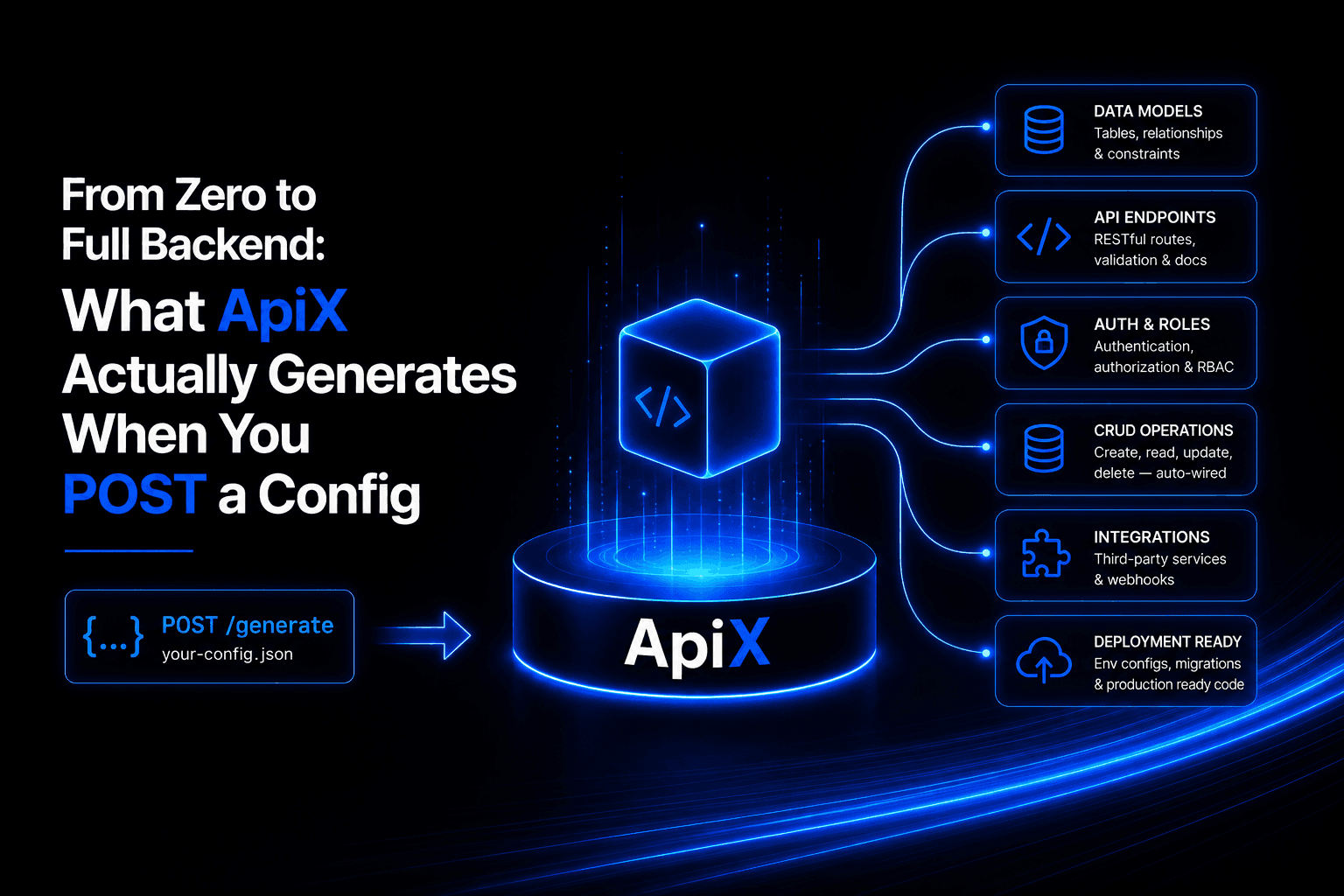
Most backend builds still start the same way: engineers writing boilerplate, configuring databases, and manually testing endpoints. ApiX ends that cycle entirely. POST a config, and ApiX autonomously generates APIs, provisions databases, tests 100-plus endpoints, and delivers a production-ready backend with zero human supervision. No seat fees, No developer queue, No QA cycles. Just a config in, and a fully validated, production-ready backend out. For engineering leaders serious about delivery velocity, ApiX is not an optimization. It is a replacement.
The Backend Problem No One Talks About
Enterprise product teams have normalized one of the most expensive inefficiencies in software delivery. Every new build begins with the same sequence: stand up the API layer, configure the database, write the authentication logic, scaffold the endpoints, and then test everything manually before a single product feature gets touched. That cycle repeats across every project, every sprint, and every product line — and nobody in the boardroom is measuring how much it costs.
Why This Is a Strategic Problem, Not a Technical One
The engineers doing this work are not junior. These are senior developers and architects who understand system design, scalability, and security. The problem, however, is that their time is being consumed by work that follows a predictable pattern and produces a predictable output. Repetitive, high-skill labor applied to low-differentiation tasks is, by definition, organizational inefficiency.
Backend API development costs for a mid-complexity project range from $10,000 to $60,000 for custom builds, according to Monocubed’s 2026 backend API development guide. Furthermore, The New Stack’s analysis of frontend and backend development dynamics confirms that API dependency between teams creates sequential drag, with frontend teams stalled waiting for backend APIs to reach functional status before meaningful product progress begins. That sequential drag compounds, moreover, across every product initiative running in parallel.
Ultimately, the problem is not that engineers cannot build backends. Rather, the problem is that building backends this way in 2026 is an avoidable cost that most organizations continue to absorb without question. To understand the broader shift this represents, it helps to examine how Xccelera’s agentic AI solutions are redefining what autonomous software delivery looks like at the enterprise level.
What ApiX Is and How It Fits the Agentic AI Stack
The enterprise software landscape is moving swiftly from AI-assisted development to AI-executed development. The distinction is significant and consequential. Assistance tools suggest, complete, and recommend. Execution agents, by contrast, plan, build, validate, and deliver — with no human in the loop between input and output.
From AI Assistance to Autonomous Execution
ApiX is an autonomous backend generation agent. It does not suggest code for a developer to review. It does not generate scaffolding that requires human assembly. Instead, it receives a configuration input, executes a complete backend build pipeline, and produces a production-ready backend with tested endpoints and a validated database — entirely autonomously.
This positioning places ApiX within the agentic AI execution layer, a fundamentally different architectural class from code generators, low-code platforms, and developer copilots. As a result, it represents a step-change rather than an incremental improvement. To explore the full scope of this capability, see ApiX on Xccelera’s platform.
As per new analysis of AI backend generation, 84% of development teams now use AI tools to accelerate backend workflows — yet most of those tools still require human supervision at critical stages. ApiX removes that dependency at the execution layer, which is precisely where the time and cost drain lives.
The shift matters because backend generation is not a creative problem. It is, in fact, a structured, repeatable process that follows defined rules. That structure makes it an ideal target for autonomous execution rather than assisted execution. This is also why Xccelera’s broader AI-powered software development practice is designed around agents that handle the entire delivery pipeline — not just fragments of it.
What Happens the Moment You POST a Config
The ApiX execution pipeline begins with a single POST request carrying a configuration file. That single action, notably, triggers a fully autonomous sequence that covers every stage of backend construction without human intervention at any point.
The Autonomous Execution Sequence
The pipeline proceeds sequentially through API route generation, database schema creation, environment configuration, and endpoint wiring. ApiX uses pre-embedded prompts powering the autonomous loop, which means the reasoning required to make architectural decisions during generation is built into the system rather than delegated to a human reviewer.
Database provisioning runs automatically as well, with ApiX defaulting to Postgres and falling back to SQLite when environment conditions require it. The fallback logic is not manual. ApiX probes the database environment, detects configuration conditions, and selects the appropriate database layer without operator input. This auto-validation capability, therefore, eliminates one of the most common failure points in backend generation pipelines: the gap between what the generator produces and what the target environment can support.
According to Neos Alpha’s 2026 analysis of API trends, APIs are undergoing a fundamental shift from static integration connectors to dynamic execution infrastructure designed to support autonomous AI workflows. ApiX operates at that frontier, generating APIs that are not just functional but designed for autonomous post-generation validation from the moment the config is processed. This also connects directly to how Xccelera’s custom AI agent development approaches autonomous execution across the software delivery stack.
The 100-Plus Endpoint Testing Layer
Most backend generation tools stop at generation. ApiX, however, does not. After completing the build, ApiX autonomously tests every generated endpoint, probing for failures, identifying errors, and correcting database-level issues in real time — before any human reviews the output.
Auto-Correction Without Human Supervision
The testing layer is not a pass-fail report handed to a developer. Instead, ApiX detects endpoint failures, traces them to their root cause within the generated backend, applies corrections, and retests. This auto-probe and correction loop operates across 100-plus endpoints per run, covering the full surface area of the generated backend without operator intervention.
SitePoint’s 2026 analysis of AI agent testing automation confirms that autonomous test generation and self-healing test execution are now defining the quality assurance standard for agentic software systems. Teams using threshold-based automated validation with agentic correction cycles are, as a result, eliminating manual QA review stages that previously consumed significant engineering time between generation and deployment.
Tricentis’s 2026 QA trends research reinforces this shift, noting that agentic quality intelligence systems that continuously analyze and correct errors in generated outputs are becoming the operational standard for teams running at delivery velocity. ApiX’s endpoint testing layer applies this exactly — consequently making the backend production-ready before a human ever opens the output. For teams looking to understand how this fits within a broader quality engineering mandate, Xccelera’s quality engineering practice provides additional context.
ApiX vs Human Developers vs Existing Platforms
The cost case for ApiX is not theoretical. It holds, in fact, across three distinct comparisons: against human development, against managed backend platforms, and against the total cost of ongoing dependency on either.
Cost Comparison: Three Scenarios
Against human development, the numbers are direct. A custom backend API project costs between $10,000 and $60,000 in developer time for mid-complexity builds, with senior US-based API architects billing $120 to $140 per hour. ApiX, by contrast, replaces that cycle at per-run pricing: SMALL runs at $0.20 to $0.55, MEDIUM at $0.90 to $2.10, and LARGE at $3.00 to $9.00. The cost differential is not incremental. It is structural. For a detailed breakdown of why this matters at the organizational level, Xccelera’s comparison of AI agents versus hiring developers lays out the full economic case.
Against managed platforms, the comparison shifts to capability. Supabase Pro starts at $25 per month, and Firebase operates on a pay-per-operation model that scales unpredictably with usage. Tech-Insider’s 2026 analysis of Supabase versus Firebase confirms that Firebase billing at scale has produced invoices that jumped from $1,200 to $30,000 monthly without warning for teams that hit traffic inflection points.
Both platforms provide managed infrastructure. Neither, however, provides autonomous backend generation, auto-tested endpoints, or database auto-validation. They require developers to build on top of them. ApiX, on the other hand, builds the backend itself.
The capability gap is not a feature comparison. It is, rather, an architectural distinction. Managed platforms are infrastructure that developers configure. ApiX is an agent that generates, validates, and delivers.
ApiX and FrontendX: From Config to Production Full-Stack
The ApiX addresses the backend. FrontendX addresses the frontend. Together, they close the entire gap between a configuration input and a production-ready, fully deployed full-stack application.
The Full-Stack Autonomous Pipeline
FrontendX takes Figma designs and converts them directly into working React applications, extracting exact fonts, colors, spacing, and typography from the design file, auto-linking all routes, and auto-correcting compile errors without developer input. No code writing, No manual component assembly, No handoff friction between design and engineering.
When ApiX and FrontendX run together, the delivery model shifts fundamentally. A product team provides a config file and a Figma design. The autonomous pipeline then produces a complete, tested, production-ready full-stack application. Figma’s 2026 analysis of AI app builders confirms that full-stack automation tools that combine Figma-to-code frontend generation with autonomous backend provisioning are compressing delivery timelines from weeks to hours for teams that have adopted the agentic workflow.
For founders, product managers, and engineering leaders running multiple concurrent product initiatives, that compression is not a convenience. It is, instead, a competitive repositioning of what their teams can deliver per quarter without scaling headcount.
Why Engineering Leaders Should Deploy ApiX Now
The window for first-mover advantage in autonomous backend delivery is open. Engineering organizations that restructure their product delivery model around ApiX now will, consequently, compound that advantage through every product cycle that follows.
Xccelera’s Agentic AI Platform: Infrastructure for Autonomous Software Delivery
ApiX is part of Xccelera’s broader agentic AI platform, purpose-built to transform how enterprises build, test, and ship software autonomously. Xccelera’s architecture positions ApiX not as a standalone tool but as an execution layer within an orchestrated agentic system — where autonomous agents handle the repeatable, high-cost stages of software delivery so engineering teams can focus on architecture, differentiation, and product strategy.
For CTOs and engineering VPs, the strategic implication is direct. Senior engineers freed from backend scaffolding cycles return to solving problems that require human judgment. Product velocity accelerates because backend delivery no longer depends on engineering queue availability. And cost per backend drops from thousands of dollars to single digits per run.
Instaclustr’s 2026 analysis of agentic AI frameworks confirms that organizations deploying autonomous execution agents across their software delivery pipelines are achieving structural efficiency gains that compound over time — not one-time productivity improvements. ApiX delivers exactly that compounding advantage: every backend that would have consumed weeks of engineering time is now delivered autonomously, tested completely, and ready for deployment.
The organizations deploying ApiX today are not, therefore, optimizing their current development model. They are replacing it with one that operates at a fundamentally different cost structure and delivery velocity. For enterprises serious about scaling product output without scaling headcount, that is ultimately the only rational direction.