How Engineering Teams Are Restructuring Around Agentic Workflows
Engineering teams are restructuring around agentic workflows faster than most org charts can keep up. What used to be a tooling decision — which AI assistant to license — has become a structural one. Agentic workflow restructuring now means asking who owns an outcome when an agent executes most of the work. That question…
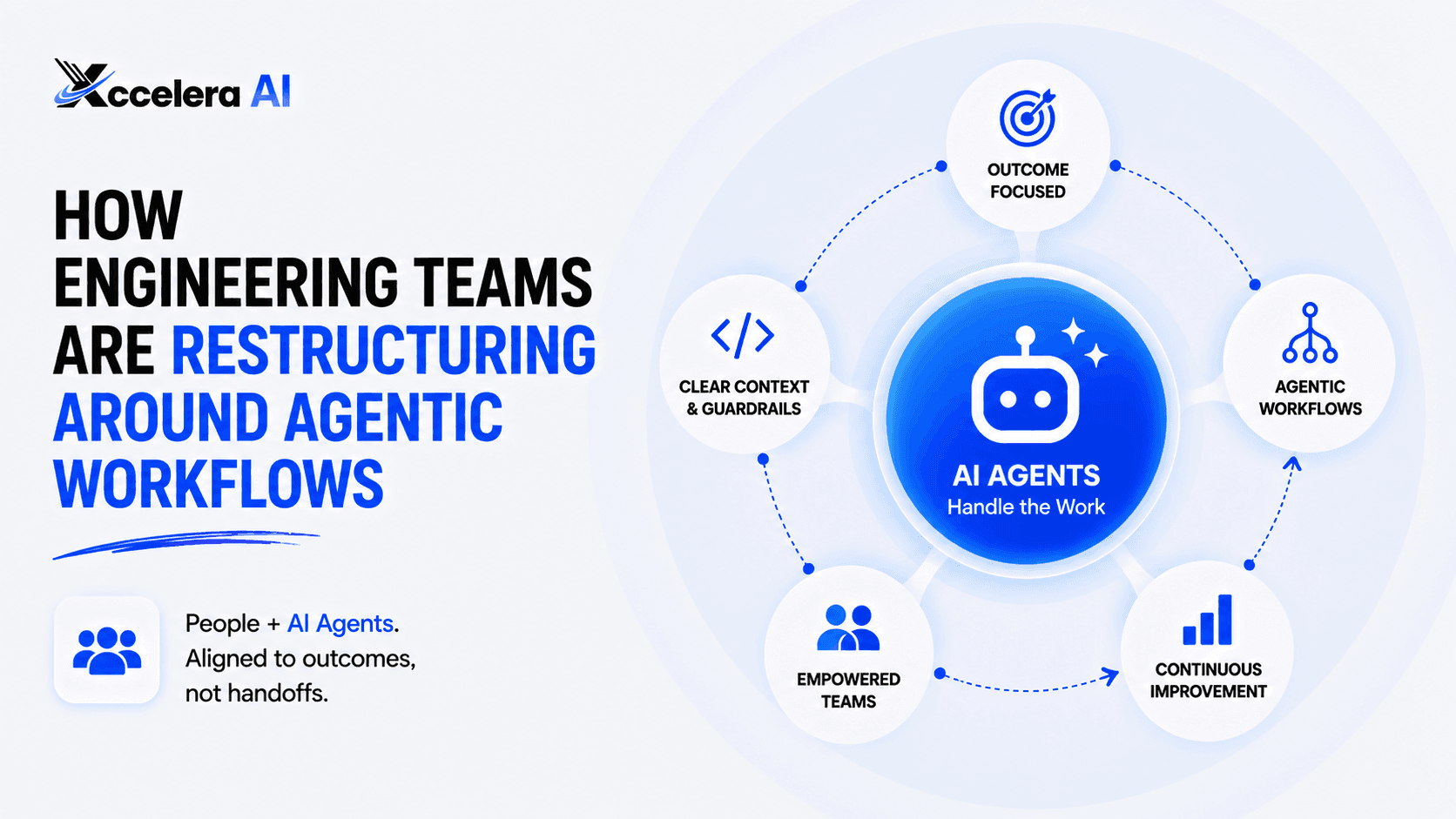
Engineering teams are restructuring around agentic workflows faster than most org charts can keep up. What used to be a tooling decision — which AI assistant to license — has become a structural one.
Agentic workflow restructuring now means asking who owns an outcome when an agent executes most of the work. That question is reshaping headcount, reporting lines, and how work gets reviewed. This isn’t a future-state conversation anymore. It’s happening in Q3 2026 planning cycles right now.
Why Are Engineering Teams Restructuring Around Agentic Workflows?
The trigger is simple. Agents can now own a process end-to-end, not just answer a prompt. A traditional AI tool takes an input and returns an output. An agent plans, executes, checks its own work, and escalates when it hits a wall. That capability jump changes what a “team” needs to look like.
McKinsey’s research on enterprise AI deployment points to real numbers behind the shift. Organizations running agents at this level report 20 to 40 percent reductions in operating costs. Some see EBITDA margins climb 12 to 14 points, driven by agents absorbing multi-step reasoning work.
Those numbers only materialize with the right structure. Bolting agents onto an unchanged org chart mostly produces confusion. Someone still has to own the outcome, catch the failure mode, and decide when an agent’s output ships. Restructuring is how companies make that ownership explicit.
Three Forces Driving the Timing
- Model reliability crossed a threshold. Agents can now reason through multi-step tasks without constant correction.
- Tooling costs shifted. Usage-based pricing for coding agents signals the industry now treats agents as a default mode, not a novelty.
- Governance pressure increased. Regulators and boards want defined checkpoints for AI-driven work, which forces clearer ownership.
There’s also a talent argument underneath all of this. Engineers increasingly expect to work alongside agents, not around them. Senior engineers want to spend their time on architecture and judgment calls, not repetitive implementation work an agent could handle. Org design has quietly become a recruiting lever, not just an efficiency one.
What Does an AI-Native Engineering Pod Look Like?
The clearest structural pattern in 2026 is the small, outcome-focused pod. Instead of a 10 to 15 person feature team, companies are forming 2 to 4 person units with one clear deliverable.
Each pod pairs a small number of engineers with one or more agents handling execution. The humans shift toward judgment calls: architecture decisions, edge cases, and quality bars an agent can’t yet set on its own. Volume work — boilerplate, test generation, first-draft implementation — moves to the agent layer.
This isn’t about shrinking teams for cost-cutting alone. Instead, it’s about matching team shape to where human judgment actually adds value now. A pod owns a narrow outcome fully, rather than a broad surface area partially.
Compare that to the classical model, where large teams split ownership across many contributors and a single feature could touch five different reviewers before shipping. Pods compress that chain. Fewer handoffs mean faster cycles, but only if the pod has clear authority to decide and ship.
Pod size matters more than it sounds. Most current patterns land at 2 to 4 engineers per pod, each paired with one or more agents. Push past that, and the clear ownership the model depends on starts to dilute.
How Are Roles and Ownership Changing for Agent-Augmented Work?
Job titles aren’t disappearing, but the content behind them is shifting hard. A senior engineer’s day now includes reviewing agent-generated pull requests, setting guardrails for what an agent can touch unsupervised, and stepping in when an agent’s plan looks wrong.
| Role | Traditional Focus | Agentic-Era Focus |
|---|---|---|
| Engineer | Writing code directly | Directing, reviewing, and correcting agent output |
| Tech Lead | Sprint planning, code review | Defining agent guardrails and escalation paths |
| Engineering Manager | Headcount and delivery tracking | Pod outcome accountability and agent governance |
| QA/Test | Manual and scripted testing | Designing evaluation frameworks for agent output |
This is less about new job titles and more about a shift in what “senior” means. Judgment, architecture, and quality control now carry more weight than raw output volume. That’s a meaningful change for how companies hire, promote, and evaluate engineering talent.
What Governance and Guardrails Does Agentic Restructuring Require?
Speed without oversight creates risk fast. Industry data backs this up directly. According to IBM’s 2026 Institute for Business Value study, 70 percent of surveyed executives say teams across the business are deploying technology faster than IT can track. That gap is exactly where re-orgs need to focus first.
Habits the Organizations Getting This Right Share
- Defined checkpoints. Agents flag decisions above a certain risk threshold for human sign-off, rather than proceeding silently.
- Clear ownership per workflow. One accountable owner exists for every agent-run process, not a diffuse group.
- Audit trails by default. Every agent decision and tool call gets logged, so failures are traceable after the fact.
A useful model here is RACI, adapted for agent-run processes. One person stays Accountable for outcomes, a process owner is Responsible for the day-to-day, and front-line engineers are Informed and ready to intervene. Structured escalation, not free-form AI use, is what separates resilient rollouts from risky ones.
When an agent makes a mistake, the answer is never “the agent.” Instead, it’s the pod’s designated owner, mapped clearly under the RACI model above. Companies that skip this step end up with finger-pointing instead of fixes when something breaks in production.
Tooling rarely needs a full overhaul to support this. Most teams layer agent orchestration on top of existing observability, ticketing, and communication platforms rather than ripping them out.
How Do You Sequence the Re-Org Without Breaking Delivery?
Restructuring while shipping products is genuinely hard. Teams that do this well don’t flip the whole org at once. Instead, they walk up a staircase of increasing complexity.
Start with contained, repeatable workflows — internal tooling, test generation, documentation — where failure is low-cost and recoverable. Prove the pod model there before touching customer-facing systems. Expand pod structures only after the governance layer has been tested under real conditions.
A common mistake is starting with the most painful, highest-value workflow first. It feels efficient, but the team hasn’t built the agent discipline that process requires yet. Save that step for later, once checkpoints and escalation paths have proven themselves on lower-stakes work.
Communication matters as much as sequencing. Engineers need to understand why their team is changing shape, not just that it is. Framing the shift around judgment and ownership, rather than replacement, tends to reduce resistance.
Budget for a slower first pod than expected. The goal of the first 60 to 90 days isn’t speed. Instead, it’s proving the governance model holds under real delivery pressure, so the next pod can move faster with confidence.
Traditional Team Structure vs. Agentic Pod Structure
| Dimension | Traditional Team | Agentic Pod |
|---|---|---|
| Team size | 8–15 engineers | 2–4 engineers + agents |
| Work unit | Feature or epic | End-to-end outcome |
| Review chain | Multiple sequential reviewers | Single accountable reviewer |
| Human focus | Implementation | Judgment, architecture, quality |
| Governance | Ad hoc code review | Defined checkpoints, audit trails |
Re-orgs like this rarely succeed as a one-time project. They need an operating model that keeps pace as agent capability improves.
Xccelera works with engineering leaders to design agent-augmented team structures, set governance checkpoints, and sequence the rollout without breaking delivery.
If your org is weighing this shift, a structured pilot is the lowest-risk place to start proving the model works. Learn more at xccelera.ai.