Build vs Buy: How Enterprises Are Deciding on Agentic Workflow Infrastructure
Enterprise leaders evaluating agentic workflow infrastructure face a decision that reshapes cost structure, delivery speed, and governance posture for years. Build vs buy AI agents is the question every team hits once pilots end. Building in-house promises control but demands sustained engineering investment most teams underestimate. Buying a purpose-built platform compresses time to production and…
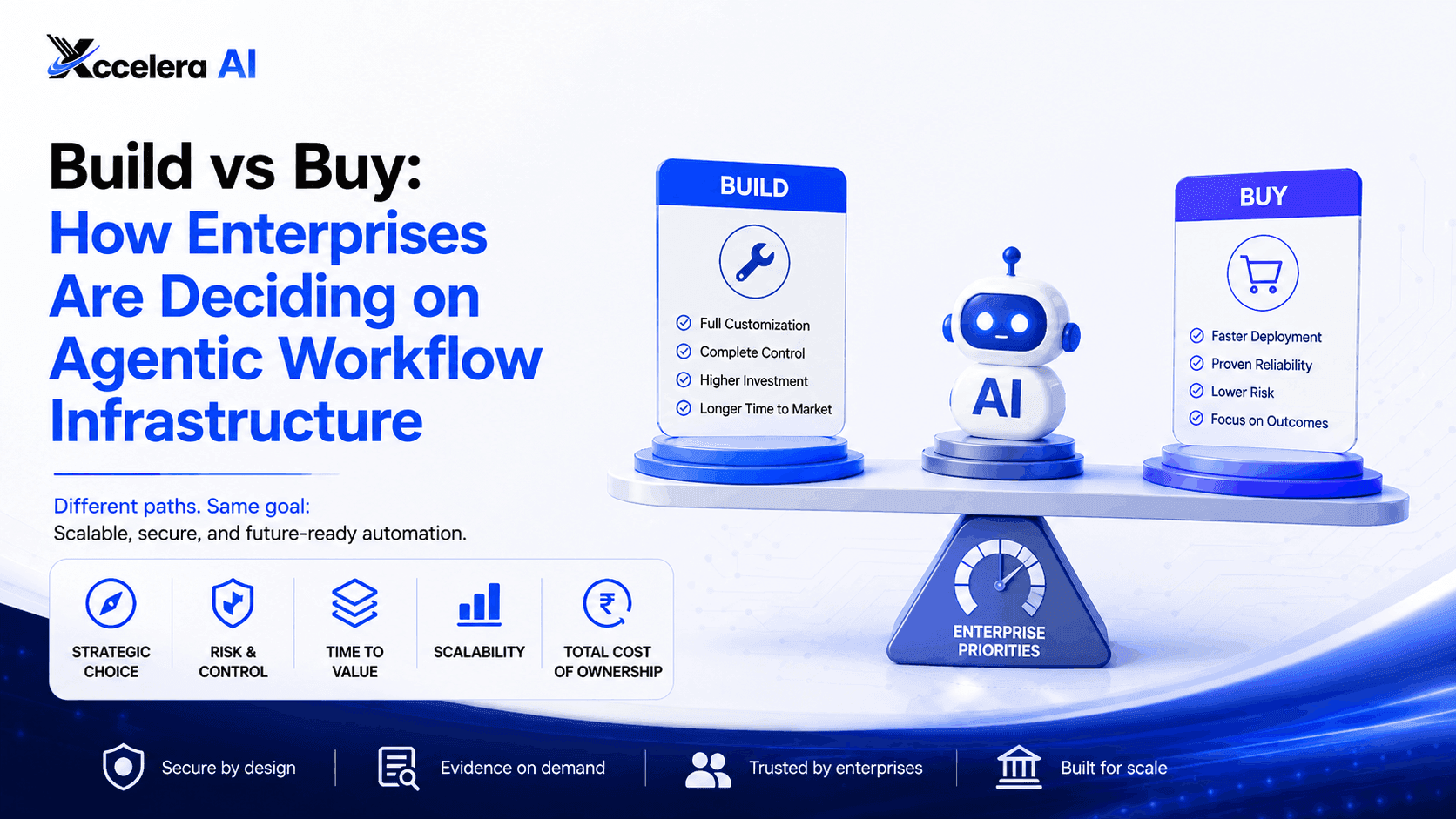
Enterprise leaders evaluating agentic workflow infrastructure face a decision that reshapes cost structure, delivery speed, and governance posture for years. Build vs buy AI agents is the question every team hits once pilots end.
Building in-house promises control but demands sustained engineering investment most teams underestimate. Buying a purpose-built platform compresses time to production and bakes governance in from day one.
This piece breaks down the total cost of ownership, engineering burden, and evaluation criteria enterprises are using to make that call in 2026.
The Build vs Buy Decision Facing Enterprise AI Leaders Today
Every enterprise moving past pilot projects eventually confronts the same question. Build agentic workflow infrastructure in-house, or buy a platform engineered for the job?
This decision determines how fast a company ships autonomous agents, how much it spends doing so, and how defensible its governance posture becomes.
Why the Decision Has Become Urgent
Boards now expect measurable outcomes from AI investment, not roadmaps. Engineering leaders who once treated agent orchestration as a side project are discovering it demands dedicated infrastructure: memory layers, tool integration, observability, and security controls.
For most enterprise use cases, buying a platform proves the more practical path. According to Aisera’s 2026 build vs buy guide, buying reduces time-to-value from 18 months to weeks for roughly 90 percent of enterprise use cases.
That said, the calculus shifts for organizations whose agents constitute core intellectual property or require sovereign control over regulated data. In those cases, in-house AI agent development can justify its cost. For everyone else, the question is really about where engineering time creates the most value.
Total Cost of Ownership: In-House Agentic Infrastructure vs Vendor Platforms
Total cost of ownership for AI agents rarely shows up as a single line item. Instead, it accumulates across development, infrastructure, inference, and the ongoing labor needed to keep systems production-ready.
Where the Crossover Point Sits
Enterprise data from 2026 points to a rough crossover near one million agent conversations per year. Below that volume, buying wins on speed and integration simplicity, according to Digital Applied’s enterprise TCO analysis.
Above it, the per-token economics of a custom stack can outperform packaged platform pricing, provided the organization has already absorbed the upfront engineering cost. That upfront cost is not trivial. A senior engineer dedicated to the build path typically runs over $120,000 in year one alone, before observability and operations spend is added.
As a result, most enterprises underestimate how long it takes to reach that crossover. In practice, an enterprise agentic AI platform bought off the shelf lets teams start capturing value immediately, while the build path only pays off once volume and optimization catch up. That gap is exactly where most build decisions quietly fail.
Engineering Time Sunk Into Custom Agent Orchestration
Building an enterprise-grade agent from scratch is rarely just a prompt-engineering exercise. It requires a full stack: vector databases, orchestration frameworks, monitoring, logging, and identity controls, all stitched together before the agent does anything useful.
The Hidden Cost Layers
Initial development for a robust, governed agent typically ranges from $200,000 to $800,000, depending on integration depth and compliance requirements. Infrastructure setup alone, covering tooling and early LLM API costs, often adds another $30,000 to $150,000.
Then ongoing inference costs scale with usage, frequently landing between $20,000 and $200,000 annually for a single core agent. None of this includes the engineering time spent debugging orchestration failures or patching security gaps discovered after deployment.
Teams pursuing in-house AI agent development often redirect their best engineers away from the domain logic that actually differentiates the business. Instead, that time goes toward plumbing a vendor platform would have handled by default.
Speed to Production: Custom Builds vs Purpose-Built Platforms
Speed separates the winners in agentic AI adoption from the teams still debugging prototypes. A platform built specifically for agent orchestration infrastructure gets a team from concept to production in weeks. A custom build, even with a strong team, routinely stretches past a year.
Forrester research cited by Nexus’s build vs buy framework predicts that 75 percent of companies attempting to build their own agentic systems will fail, citing the complexity of diverse models, retrieval-augmented generation stacks, and niche expertise required.
What Slows a Custom Build Down
Every integration a custom stack needs, from authentication flows to API-specific error handling, has to be written, tested, and maintained by hand. A managed platform instead offers pre-built connectors and handles authentication centrally, so engineers spend their time on workflow logic rather than plumbing.
For most enterprises, speed to production is the deciding factor, and it consistently favors a bought platform over a from-scratch build.
Governance and Scalability Gaps in Homegrown Agentic Systems
Governance gets treated as an afterthought in many custom builds, and that mistake gets expensive fast. When a production incident happens, generic logs are not enough. Teams need a full trace of which agent acted, on what input, under what constraints, and with which tools.
Why Observability Cannot Be Bolted On Later
Without built-in observability, debugging becomes slow and often insufficient for regulated environments. Enterprises that skip this step end up retrofitting audit trails, approval gates, and role-based access after an incident forces the issue, not before.
An agentic workflow infrastructure decision that ignores governance from day one is not really finished, no matter how functional the agent looks in a demo. Scalable systems require version control, human approval checkpoints, and cost visibility baked into the platform itself.
Agentic Workflow Infrastructure Evaluation Criteria for Enterprise Buyers
Choosing a platform requires more than comparing feature lists. A structured agentic AI vendor evaluation looks at ownership, security, and flexibility together, not in isolation.
| Evaluation Criterion | Build In-House | Buy a Platform |
|---|---|---|
| Time to production | 6 to 18 months | Days to weeks |
| Upfront cost | $150,000 to $800,000 | Subscription or usage-based |
| Governance and audit trails | Built manually, often late | Included by design |
| LLM vendor flexibility | Depends on architecture choices | Config-level switching |
| Code ownership | Full internal ownership | Varies by vendor |
| Ongoing maintenance burden | High, dedicated team required | Shared with vendor |
No single row decides the outcome. A regulated enterprise with unique compliance needs might accept a longer build timeline in exchange for full ownership. A team under pressure to ship in a quarter will weigh time to production far more heavily.
Xccelera’s Agent Lifecycle Management Platform as the Buy-Side Answer
Enterprises that choose to buy still need a platform that treats governance as a starting point, not an add-on. An AI Agent Lifecycle Management Platform addresses this directly by generating production-quality agent code that ships with role-based access controls, human approval gates, and full version history built into every deployment.
Where This Changes the Build vs Buy Math
Instead of spending months standing up orchestration, deployment, and guardrails from scratch, engineering teams move from blueprint to production in hours. Six layers of safety controls come embedded at the code level, rather than patched on afterward.
The platform generates real source code that lives in the enterprise’s own repositories, so there is no proprietary runtime lock-in and no dependency on a single LLM provider. Teams can switch between model providers with a configuration change rather than a rewrite.
For enterprises weighing the total cost of ownership AI agents demand against the governance risk of a homegrown stack, this model offers a middle path. It combines the ownership benefits typically associated with building with the speed and governance-by-default typically associated with buying.
Xccelera powers this decision with infrastructure built for it. Xccelera designs and deploys agentic AI systems that give enterprises governed, auditable, production-ready agents without the months of undifferentiated engineering work a custom build demands.
Teams evaluating agentic workflow infrastructure get speed, security, and full code ownership in one platform. Learn more at xccelera.ai.