From Pilot to Platform: Scaling an Agentic SDLC Across Multiple Product Lines
Most enterprises can run one successful agentic SDLC pilot inside a single engineering team. Very few can repeat that success across five product lines running in parallel. The moment an agentic workflow leaves its home team, different repositories, different approval chains, and different risk tolerances collide, and fragmented pilots pile up instead of a scaled…
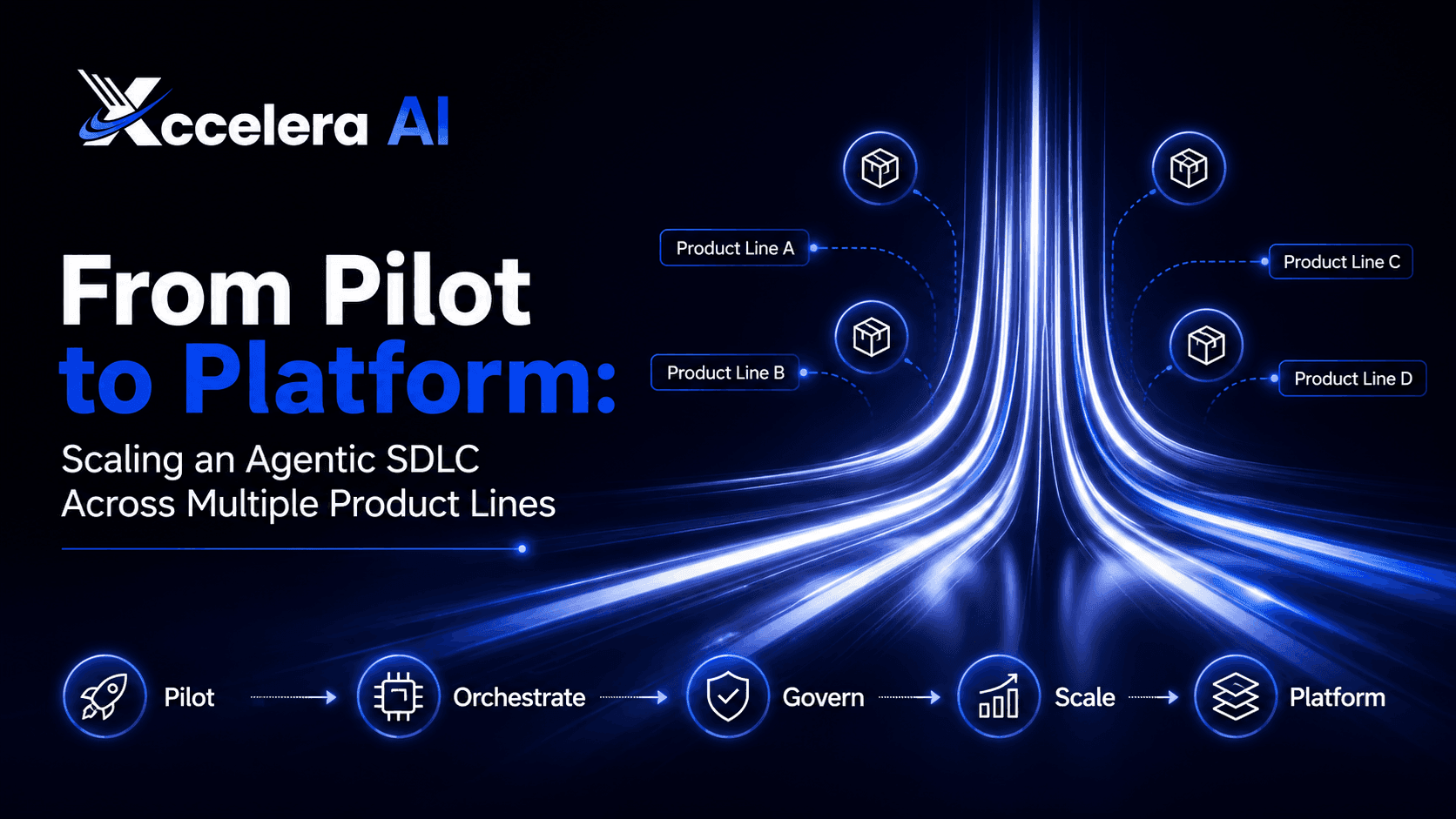
Most enterprises can run one successful agentic SDLC pilot inside a single engineering team. Very few can repeat that success across five product lines running in parallel.
The moment an agentic workflow leaves its home team, different repositories, different approval chains, and different risk tolerances collide, and fragmented pilots pile up instead of a scaled system.
Governance built in from day one, a shared orchestration layer, outcome-driven metrics instead of activity counts, and tight coordination between engineering, security, and product functions determine which organizations turn early wins into a platform-wide operating model. The gap between a promising demo and a durable, portfolio-wide agentic SDLC is almost never a technology gap. It is an architecture and ownership gap, and it is closeable with the right foundation.
Pilot Programs Stall Before Reaching Enterprise-Wide Scale
A single engineering team can stand up an agentic SDLC pilot in weeks. Scaling that same pilot across a multi-product portfolio is a different problem entirely. Industry research through 2026 converges on an uncomfortable number here.
Somewhere between 70% and 90% of agentic AI pilots fail to reach production, and several analyst firms place the figure closer to 88%. Technology is rarely the bottleneck. Foundation models can now plan across multi-step tasks, call tools reliably, and recover from many of the errors that broke earlier automation attempts.
The real constraint is organizational. A pilot succeeds inside one team because that team controls its own tooling, its own approval chain, and its own definition of done. Move the same workflow into a second product line and none of those assumptions hold. Different teams use different repositories, different deployment targets, and different risk tolerances.
Each product line reinvents the agent from scratch, duplicating the same architecture decisions and the same mistakes. As a result, the organization ends up with five disconnected pilots instead of one scaled system.
This is precisely the moment where an agentic SDLC needs a shared lifecycle layer instead of five parallel experiments. A platform purpose built to manage agent creation, versioning, deployment, and governance across teams turns fragmented pilots into a repeatable pattern that any product line can adopt without rebuilding the foundation each time.
Agentic SDLC Architecture Built for Multi-Product Portfolios
Scaling an agentic SDLC across product lines demands an architecture that separates what stays constant from what changes per team.
What stays constant: identity and access controls, approval workflows, audit trails, and the underlying orchestration engine. What changes per team: the specific tools an agent calls, the codebase it touches, and the business logic it automates.
By April 2026, enterprise leaders had already shifted from isolated agentic pilots toward orchestrated production pipelines built on this separation. Landmark platform launches that quarter pushed organizations toward architecture and governance as the priority, ahead of episodic experimentation.
That shift matters for any company running more than one product line, because it confirms the winning pattern is not more pilots. It is one governed foundation that every product team builds on top of.
A brownfield-compatible approach matters just as much as a greenfield one. Most enterprise codebases were not designed with agents in mind, so any scaling architecture needs to layer AI capability onto existing repositories without forcing a rewrite. Teams that connect agent-generated code as a namespaced module, respecting existing conventions, move faster than teams that treat every integration as a new project.
Governance Frameworks That Prevent Agent Sprawl Across Teams
Agent sprawl is what happens when scaling succeeds technically but fails organizationally. Departments stand up agents independently, each solving a local problem, and the enterprise ends up with a fragmented landscape that cannot be audited consistently.
Gartner’s official forecast projects the average Global Fortune 500 enterprise will run more than 150,000 AI agents by 2028, up from fewer than 15 in 2025, yet only 13 percent of organizations currently believe they have the right governance in place to manage them.
Gartner’s own six-step framework for controlling sprawl starts with policy, not tooling. Establish clear rules for when and how agents get built, who can create them, and which connectors are permitted, before addressing anything downstream. Skipping ahead to technical controls without that policy layer tends to produce gaps that undermine the entire governance program.
Governance components every multi-product rollout needs:
| Control Layer | What It Prevents | Who Owns It |
|---|---|---|
| Centralized agent registry | Untracked agents with unknown data access | Platform or DevOps team |
| Role-based access control | Unauthorized production changes | Security team |
| Human-in-the-loop approval gates | Unreviewed high-risk actions | Product owners |
| Version history and audit trails | Untraceable changes across teams | Engineering leadership |
| Cost budgets per agent | Runaway spend from misconfigured agents | Finance and engineering |
Governance built in from day one, rather than retrofitted after an incident, is consistently what separates organizations that scale agentic development safely from those that spend the following year cleaning up.
Standardizing Agent Orchestration Across Independent Product Lines
Orchestration standardization is where most multi-product rollouts either compound their gains or quietly fall apart. Every additional product line brings its own tools, its own middleware, and its own integration debt if there is no shared orchestration layer underneath.
Cross-functional deployment breaks down for a simple reason: workflows that run cleanly inside one team often fail the moment they are rolled out across five departments, because integration complexity grows with every new system added to the chain.
The fix is not asking every product team to agree on identical tooling. It is giving every team a common orchestration substrate, LLM-agnostic connectivity, shared authentication, and a consistent deployment path, while letting each team define its own agent logic on top of it. That approach lets a payments team and a support team run entirely different agents while both inheriting the same guardrails, the same rollback mechanisms, and the same audit posture.
Standardization also removes vendor lock-in risk at the exact moment it matters most, when a company is committing to a platform across its entire product surface rather than a single pilot. Teams that can switch model providers with a configuration change, rather than a rewrite, protect that scaling investment against a single vendor’s roadmap changes.
Metrics That Separate Real Scaling From Pilot Fatigue
Pilot fatigue looks like activity without outcomes. Deployment counts climb, dashboards light up, and leadership reports strong adoption, but no workflow has actually been redesigned end to end.
A healthier 2026 baseline for real scaling is two to four workflows redesigned around agents, each with a named owner, a defined success metric, and a documented rollback plan.
DORA’s research adds a sharper warning for engineering leaders specifically. A 25 percent increase in AI adoption correlated with a 1.5 percent decrease in delivery throughput and a 7.2 percent decrease in stability among lower-performing teams. AI amplifies the strengths of high-performing organizations and the dysfunctions of struggling ones; it does not fix either automatically.
That finding reframes what a scaling metric should measure. Deployment frequency alone tells a company almost nothing if change failure rate is rising in parallel.
The organizations closing the gap between pilot and platform track outcome metrics over activity metrics. Time to value, cost per successful task, and change failure rate matter more than how many agents exist. A named owner with budget authority and a measurable target outcome, present in the large majority of successful agent deployments, remains the single strongest predictor of sustained ROI across a multi-product rollout.
Cross-Functional Alignment Between Engineering, Security, and Product Teams
Scaling an agentic SDLC is as much a coordination problem as an engineering one. Recent enterprise research shows more than half of organizations now deploy agents for multi-stage workflows, and a growing share have progressed to cross-functional processes spanning multiple teams rather than staying contained inside one.
That progression only works when engineering, security, and product functions share a common definition of what “production ready” means.
Security teams need visibility into what data an agent can touch before a product team ships it. Product teams need a fast path to iterate without waiting weeks for a security review on every change. Engineering needs a deployment pipeline that treats agent code with the same rigor as any other production code, including tests, rollback plans, and code review. None of that happens by accident across five product lines pursuing five separate roadmaps.
The organizations that get this right build a shared review cadence rather than five parallel approval processes. One registry, one risk classification model, one escalation path. That structure lets every product team move independently day to day while still rolling up to a single governance picture that a CTO or board can actually read.
Xccelera’s Framework for Platform-Wide Agentic Transformation
Every principle above points toward the same conclusion. Scaling an agentic SDLC across a multi-product portfolio requires a shared lifecycle foundation, not five separate pilots reinventing the same architecture.
That foundation needs governance built in from the first agent created, not retrofitted after the first incident. It needs orchestration that standardizes identity, deployment, and audit trails while leaving room for each product team to build its own logic on top.
Xccelera approaches this challenge through a platform-first lens built specifically for organizations that cannot afford to run agentic development as a series of disconnected experiments. Rather than treating each product line as its own island, the underlying architecture centers on a governed agent lifecycle layer, complete with role-based access, human approval gates, full version history, and cost visibility before any deployment commits real spend.
Every agent built on that foundation inherits the same six-layer guardrail structure regardless of which product team created it, and every deployment ships as code the engineering team actually owns rather than a black box tied to a single vendor’s runtime.
That combination, a shared foundation with team-level flexibility, is what separates enterprises that scale agentic development safely from those still fighting the same pilot battle in every new product line. Getting there does not require ripping out existing repositories or forcing every product team onto identical tooling. It requires one governed lifecycle layer that every team plugs into, so the second, third, and fifth product line inherit the guardrails instead of rebuilding them.
Organizations ready to move beyond one-off proofs of concept toward a governed, platform-wide agentic SDLC can find Xccelera’s full product portfolio and technical documentation at xccelera.ai.