The Hidden Operating Costs Service-as-Software Buyers Overlook
You negotiated the rate. You got board approval. Eighteen months later, your effective spend has doubled, and nobody can point to the exact line item that did it. That’s not a pricing failure. It’s a visibility failure, and it happens to almost every enterprise buyer who evaluates a Service-as-Software contract on the headline rate alone.…
You negotiated the rate. You got board approval. Eighteen months later, your effective spend has doubled, and nobody can point to the exact line item that did it.
That’s not a pricing failure. It’s a visibility failure, and it happens to almost every enterprise buyer who evaluates a Service-as-Software contract on the headline rate alone.
Every procurement team focuses on that number. Few examine what happens after signature, when infrastructure draws, orchestration overhead, governance tooling, and switching penalties start compounding against the budget. These hidden operating costs rarely show up on a vendor’s pricing page, yet they routinely double or triple the effective spend within 18 months of deployment.
Enterprise buyers who model only the quoted per-run or per-outcome rate consistently underestimate agentic AI total cost of ownership by a wide margin, because the contract price and the operating cost are two different numbers entirely.
This piece maps the categories that actually drive total spend and shows how a structured framework protects budget integrity from day one.
Service-as-Software Pricing Is Reshaping How Enterprises Budget for AI
The shift away from per-seat licensing has changed how finance leaders evaluate AI agent operating costs. When an autonomous agent resolves a task without a human logged into a dashboard, the per-user metric stops measuring anything useful.
Enterprise buyers are moving toward outcome-linked contract structures, with predictions that a majority of large IT services agreements will soon include clawback provisions or levers tied directly to results rather than access.
That shift sounds like progress for buyers chasing value alignment. In practice, it introduces a new budgeting problem: outcome-based AI pricing ties spend to volume and performance variables that are far harder to forecast 12 months out than a flat license fee ever was.
Finance teams accustomed to predictable renewal cycles now need dynamic cost models that flex with usage, which most procurement processes were never built to handle.
Beyond the Sticker Price: Infrastructure and Compute Costs
The quoted rate on a Service-as-Software pricing model almost never includes what it costs to get the system running inside enterprise infrastructure.
- Implementation and integration work can add 20-30% on top of the initial contract price
- Training, ongoing maintenance, and usage overages routinely surprise buyers who priced only the base subscription
These aren’t edge cases. They’re structural gaps in how vendors present pricing, because a clean sticker price sells better than a fully loaded cost projection.
Why Buyers Miss This Category
Procurement teams typically benchmark the headline number against competitors and stop there. Compute draw, data pipeline work, and staff hours spent on configuration sit outside that comparison entirely, so they never make it into the business case that gets board approval.
Integration and Orchestration Overhead Vendors Rarely Disclose
Connecting an autonomous agent to existing systems is rarely a plug-and-play exercise, and the compute meter runs the entire time engineering teams are stitching connections together.
AI-native application spend has climbed sharply across enterprise software portfolios, which is pushing vendors toward access-versus-consumption packaging so they can recover rising inference costs while still offering buyers a forecastable number.
An unlimited-use tier inside a flat subscription looks attractive on paper. In reality, it can quietly erode vendor margins to the point where renewal pricing jumps sharply, and that increase lands on the buyer’s desk with little warning.
Monitoring, Observability, and Governance Costs
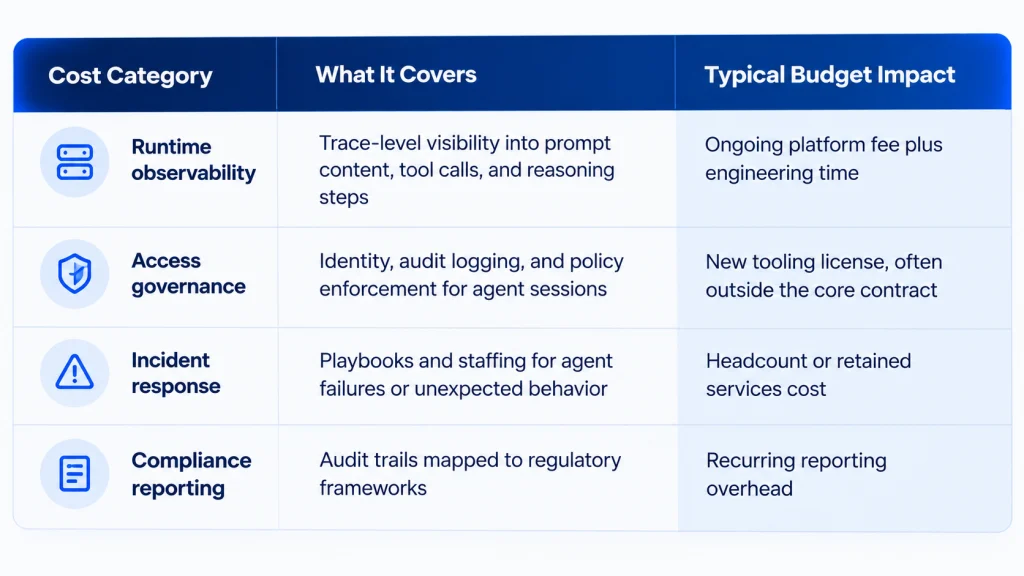
Autonomous systems that take action inside enterprise environments cannot run unmonitored, and the tooling required to watch them is rarely bundled into the base contract.
Gartner has projected that more than 40% of agentic AI projects will be canceled by 2027 because of inadequate risk controls, a governance forecast rather than a technology one. Here’s where these costs typically land across a standard deployment:
Scaling Penalties: Why Usage-Based Pricing Breaks Down at Volume
A pricing model that looks efficient during a pilot can become the single largest budget risk once an organization scales.
Some major platforms now run three concurrent pricing structures at once, spanning per-conversation, credit-bundle, and per-user licensing, specifically because usage-based agentic pricing has proven difficult for buyers to predict in advance.
As a result, the model chosen during a proof of concept is frequently the wrong model once volume climbs into enterprise territory, and renegotiating mid-contract rarely favors the buyer.
Vendor Lock-In and the Switching Costs Buried in Long-Term Contracts
Agentic AI vendor lock-in compounds faster than traditional software dependency because workflow logic, not just data, gets embedded in a specific vendor’s orchestration layer.
Vendor lock-in already costs enterprises an average of roughly $315,000 per migration, and the problem is getting worse as organizations extend dependency into LLM providers and the AI data path itself.
The relevant switching cost is rarely the license fee. It’s the cost of rebuilding custom agents, retraining employees, and migrating underlying data connections. That distinction matters at contract negotiation, not at renewal, because exit terms negotiated after signature carry almost no leverage.
Talent and Change Management Costs Behind Successful Adoption
Technology spend is only part of the ledger. Organizations that skip investment in workforce readiness pay for it later in stalled adoption and unrealized returns.
Forrester estimates $5.5 trillion in economic value is at risk from AI skills gaps and delayed implementation, and EY research found that roughly 40% of potential productivity gains go unrealized when companies lack a talent training strategy.
Budget planning that ignores this category consistently underestimates total program cost. It shows up as:
- Retraining existing staff to supervise and audit autonomous workflows
- Hiring specialized AI engineering roles that didn’t exist in most organizations two years ago
- Building internal change management capacity so new workflows actually stick after rollout
- Funding cross-functional governance committees that bridge legal, security, and operations
Building a Total Cost of Ownership Framework
Enterprise AI procurement costs need a framework that captures every category above in one model, not a single quoted rate treated as the full answer.
A defensible total cost of ownership model separates the contract price from implementation, orchestration, observability, scaling risk, switching exposure, and talent investment, then tracks each against a defined baseline. For teams building that model, understanding the full pricing breakdown behind agentic AI services is a useful starting benchmark.
Buyers who build this model before signature negotiate from a position of clarity, instead of discovering the true number during the first renewal cycle. That single discipline separates programs that deliver durable ROI from the ones that quietly get flagged for cancellation once true costs surface.
How Xccelera Approaches Transparent, Outcome-Aligned AI Economics
Xccelera built its AI Agent Lifecycle Management Platform specifically to close the visibility gap that produces the hidden operating costs described above.
The platform gives enterprise teams a single control layer across agent creation, deployment, governance, and retirement, so infrastructure draw, orchestration overhead, and compliance obligations are visible before they compound into budget surprises.
Rather than treating observability and governance as costly add-ons purchased after deployment, Xccelera embeds lifecycle tracking into the platform itself, giving finance and engineering leadership a shared, auditable view of what an agentic AI investment actually costs to run at scale. This approach reflects the broader shift toward outcome-based pricing structures that enterprise buyers are demanding across the industry.
For organizations building a defensible total cost of ownership model, that structural transparency is the difference between an agentic AI program that scales predictably and one that gets abandoned once the real numbers surface.
Final Thoughts
The headline rate was never the real number. It’s just the number that’s easiest to compare on a vendor scorecard. The buyers who protect their budget are the ones who map infrastructure, orchestration, governance, scaling, switching, and talent costs before they sign, not after the first renewal notice arrives.
Discussion question: Has your organization modeled the full cost of a Service-as-Software contract beyond the quoted rate, or is that work still happening after signature?
If you’re navigating Service-as-Software procurement at your own organization, consider subscribing for more breakdowns like this one.