Service-as-Software vs Traditional SaaS: What Changes for Enterprise Buyers
The enterprise software landscape is undergoing its most significant structural shift since the cloud displaced on-premise infrastructure. After two decades of SaaS dominance, a new paradigm—Service-as-Software—is rewriting the rules of procurement, pricing, and value delivery. For CIOs, CFOs, and procurement leaders, understanding this shift is no longer optional. It determines whether technology budgets deliver genuine…
The enterprise software landscape is undergoing its most significant structural shift since the cloud displaced on-premise infrastructure. After two decades of SaaS dominance, a new paradigm—Service-as-Software—is rewriting the rules of procurement, pricing, and value delivery.
For CIOs, CFOs, and procurement leaders, understanding this shift is no longer optional. It determines whether technology budgets deliver genuine business outcomes. Otherwise, those budgets simply continue funding tools that create more work than they eliminate.
The End of the License Model: Why SaaS Is Being Redefined
The Hidden Cost Behind Every License
Traditional SaaS built its economics on a straightforward premise: charge for access, then leave the work to the buyer. However, that model has reached its breaking point. For every dollar enterprises spend on software licenses, they spend an estimated $1.50 on the human labor required to implement, configure, integrate, and operate those tools.
In short, the license fee is merely the entry ticket. The real, hidden cost is the army of administrators, integration specialists, and internal champions needed to extract value.
Buying the Oven, Doing the Baking
Enterprise architects describe this dynamic as “buying the oven and being left to do the baking.” SaaS vendors delivered increasingly sophisticated platforms, yet the fundamental bargain remained unchanged. Enterprises owned the tools; they also owned the responsibility for making those tools produce results.
CRM systems didn’t close deals. Analytics platforms didn’t generate insights. Marketing automation didn’t run campaigns. Instead, humans did all of that, using software as an instrument rather than a solution.
Tool Fatigue at Unprecedented Scale
Consequently, tool fatigue has reached an unprecedented scale. Large enterprises now maintain an average of over 370 SaaS applications. Each one demands attention, training, and ongoing management.
Software ROI, measured honestly against total cost of ownership, has become difficult to justify in many categories. Ultimately, the economic trigger behind the Service-as-Software shift is this exact frustration: buyers are exhausted by purchasing capability they must then operationalize themselves. They want outcomes, not ovens.
Copilots vs Autopilots: The Real Distinction Buyers Must Understand
The transition from SaaS to Service-as-Software hinges on one distinction most enterprise buyers currently misunderstand: Copilot vs Autopilot. Misclassifying one as the other is the fastest route to overpaying for technology that never escapes the software budget category.
Copilots: Human-in-the-Loop by Design
Copilots are human-in-the-loop systems. They assist, suggest, and accelerate human work, but they never replace it. For instance, a developer Copilot generates code suggestions, while a human developer still reviews, modifies, and implements them.
Since the output depends on human judgment and effort, Copilots compete for software budgets. They function as productivity tools, and their value shows up as efficiency gains — faster coding, quicker document drafting, accelerated data analysis. The human remains the execution engine throughout.
Autopilots: Outcomes Without Intervention
Autopilots, by contrast, operate on a fundamentally different logic. They execute outcomes directly, without continuous human intervention. An autopilot for invoice processing doesn’t assist an accounts payable clerk. Instead, it receives invoices, validates them against purchase orders, routes exceptions for approval, and executes payment.
Because the outcome arrives complete, the human moves from operator to exception handler. Since Autopilots deliver finished work, they compete for services budgets — the far larger pool of spending currently allocated to outsourced processing, managed services, and internal operations teams.
Why This Distinction Creates a Moat
This split creates a durable competitive moat for Autopilot vendors. Every outcome an Autopilot delivers generates proprietary data about what worked, what required human intervention, and how edge cases got resolved.
That outcome data becomes a training asset, one that improves performance over time. It creates a defensible advantage that Copilots, dependent on individual user behavior, cannot easily replicate. This underlying architecture shift points toward what technologists call “Enterprise as Code,” where business processes are encoded into autonomous systems, rather than documented in manuals and executed by humans clicking through screens. Xccelera’s own framework for custom AI agents reflects exactly this shift in practice.
How Enterprise Pricing Logic Is Being Rebuilt Around Outcomes
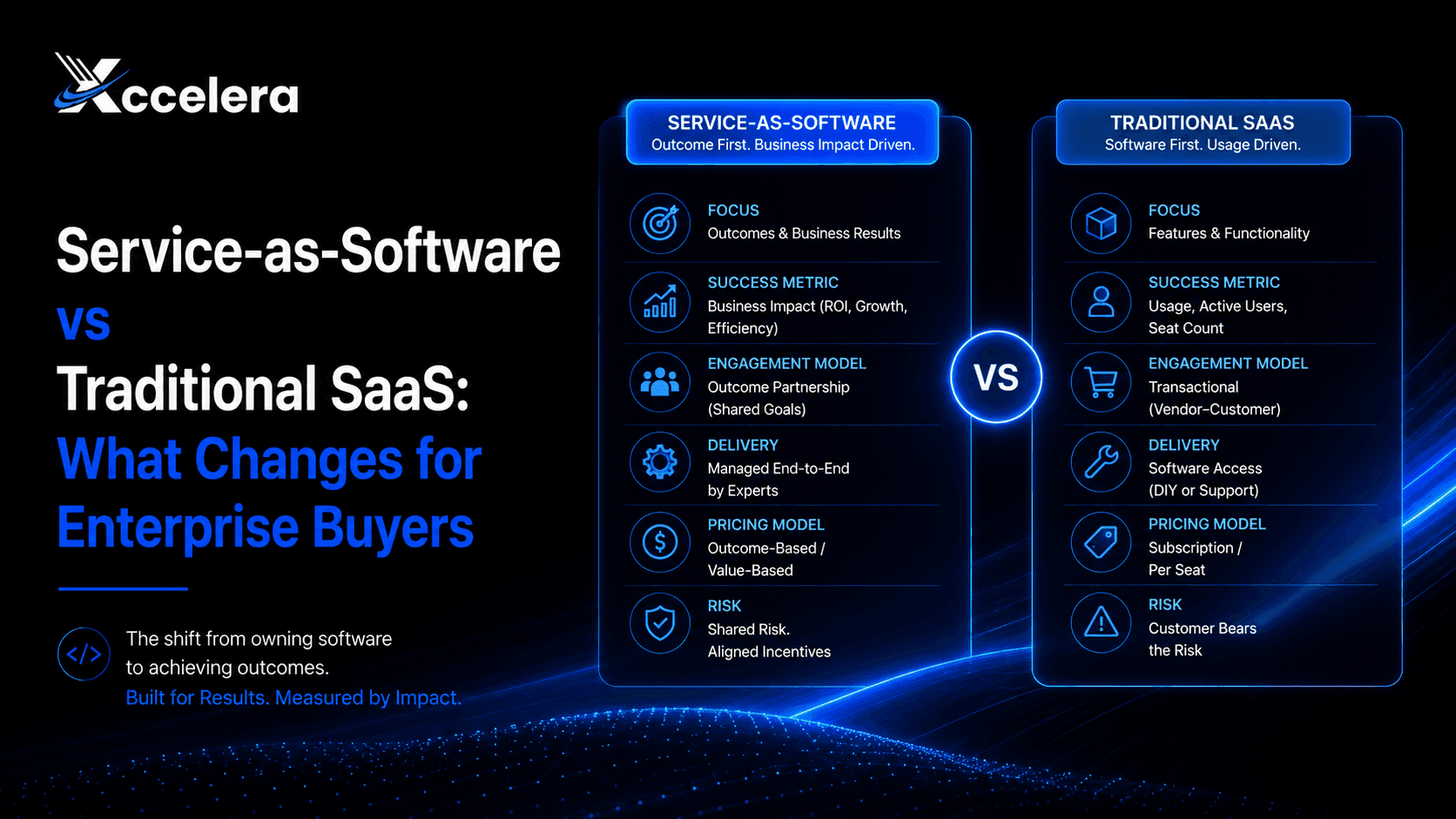
Enterprise procurement is undergoing a quiet revolution. The per-seat license model that dominated SaaS for two decades is giving ground to hybrid and outcome-based structures. These new models tie vendor compensation to measurable results, rather than user counts.
Seat-based pricing isn’t disappearing entirely — CIOs still value budget predictability, and many prefer licensing models that allow cost forecasting. But the growth is happening elsewhere. Hybrid models that combine base platform fees with outcome-based components are quickly becoming the enterprise standard.
For example, a customer service Autopilot might charge a platform fee for system access, plus a per-resolution fee for successfully handled tickets. Similarly, an invoice processing Autopilot might charge per document processed, with pricing that declines as volume increases.
The challenge enterprises face, however, is outcome attribution. When an Autopilot resolves a customer inquiry, who gets credit if the resolution required human escalation midway? Verified-result billing is emerging as the answer, where vendors charge only for fully autonomous completions. This shifts the burden of proof onto the provider and aligns incentives in ways that traditional SaaS never could.
Compute cost dynamics are also reshaping vendor contracts. AI-native services consume significant computational resources, and those costs remain variable. Forward-thinking enterprises are now negotiating compute-cost transparency clauses. This ensures they understand what portion of their fees covers inference, model hosting, and processing, rather than vendor margin. This financial granularity was unnecessary when software simply provided an interface for human operators. Now, it’s essential.
Governance and Vendor Lock-In Considerations
The shift toward outcome-based pricing introduces governance questions that traditional procurement frameworks weren’t designed to handle. When a vendor’s Autopilot makes decisions affecting customers, employees, or financial reporting, who owns the liability?
Procurement teams are now inserting performance guarantees and error-rate caps into contracts. They’re also demanding remediation protocols for when autonomous systems fail. Meanwhile, vendor lock-in concerns intensify because outcome data — the proprietary training asset that improves Autopilot performance — becomes harder to migrate than traditional SaaS data ever was.
Enterprises are responding by demanding data portability clauses. Many are also maintaining multi-model strategies that prevent dependence on any single provider’s autonomous capabilities.
What Buyers Must Now Screen For: Governance, Provenance, and Lock-In
As autonomous systems assume execution authority once held by human teams, the enterprise procurement checklist has expanded dramatically. Model provenance, data governance, and vendor lock-in risk are no longer optional diligence items. Instead, they now stand as standard evaluation criteria alongside features and pricing.
Model Provenance Demands Are Intensifying
Buyers want to know what data trained the models powering their Autopilots. They also want to know whether that data was legally sourced, and what biases might be embedded. This isn’t an academic concern; it’s regulatory exposure.
An Autopilot making hiring recommendations or credit decisions carries compliance obligations that a traditional SaaS dashboard never did. Training data transparency is quickly becoming a contractual requirement, with enterprises reserving audit rights over model development processes.
Data Governance Extends to Operational Data
This concern also extends to operational data. When an Autopilot processes enterprise information, where does that data reside? Is it used to train the vendor’s broader models? What certifications does the vendor actually hold?
SOC 2, ISO 27001, and emerging AI-specific frameworks like the NIST AI Risk Management Framework are becoming procurement gatekeepers. Vendors without verifiable governance frameworks are being excluded from consideration, regardless of their technology’s capability.
Vendor Lock-In Takes New Dimensions
Vendor lock-in risk also takes on new dimensions in the Service-as-Software era. Traditional SaaS lock-in centered on data export difficulty. Autopilot lock-in involves something more pernicious: the accumulated outcome data that makes the service effective.
Switching costs include retraining new models on enterprise-specific patterns, a process that can take months. As a countermeasure, multi-model diversification strategies are emerging, with buyers intentionally distributing autonomous workloads across providers to maintain negotiating leverage and migration optionality.
Ultimately, financial scrutiny now reaches well beyond license fees into compute costs, outcome verification mechanisms, and liability allocation. The total cost equation has become genuinely total.
Why SaaS Won’t Disappear, and What Buyers Should Expect Instead
Predictions of SaaS obsolescence are premature. Enterprises continue to value the risk transfer, compliance coverage, and accountability that established vendors provide. Those attributes won’t vanish simply because autonomous execution becomes possible.
Risk Transfer Still Matters
Risk transfer remains a core reason enterprises buy software. When a SaaS vendor handles data security, uptime, and regulatory compliance, they absorb liability that an in-house build would otherwise place squarely on the enterprise. This hasn’t changed.
What has changed is the nature of the services that SaaS vendors wrap around their platforms. The future isn’t SaaS disappearing — it’s SaaS absorbing Service-as-Software capabilities, offering Autopilot execution alongside traditional human-operated interfaces.
The Hidden Liability of In-House AI Builds
In-house AI builds carry hidden liability that many enterprises underestimate. Building an autonomous agent for a critical business process requires more than model development. It also demands ongoing monitoring, bias detection, performance evaluation, and regulatory compliance management.
Most enterprises lack these capabilities at scale. As a result, the “build versus buy” calculus increasingly favours vendors who can spread these governance costs across multiple customers, while still providing contractual indemnity. Xccelera’s AI agent consulting practice exists precisely to close this capability gap.
Compliance and Certification Still Drive Value
Compliance, indemnity, and certification value persist, too. Regulated industries — financial services, healthcare, government contracting — will continue requiring vendor relationships that provide clear chains of accountability. Service-as-Software vendors who can demonstrate certified compliance, while still delivering autonomous outcomes, will capture disproportionate value.
The Realistic Outcome: A Hybrid Landscape
The realistic outcome, then, is a hybrid landscape. Enterprise buyers should expect to manage portfolios where traditional SaaS handles record-keeping, workflow management, and compliance-heavy functions. Meanwhile, Service-as-Software components execute discrete, high-volume outcomes.
Execution autonomy will augment vendor relationships rather than replace them entirely. The winning enterprise strategy is neither wholesale SaaS abandonment nor uncritical AI adoption. Instead, it’s thoughtful integration of autonomous capabilities, applied where they demonstrably reduce total cost while maintaining governance standards.
How Xccelera Helps Enterprises Make the Transition
Enterprises evaluating Service-as-Software need more than point solutions. They need execution partners capable of building autonomous, governed systems that deliver outcomes rather than features. Xccelera positions itself as the operational bridge between legacy SaaS dependency and outcome-driven agentic infrastructure.
Xccelera’s approach combines Accelerators and AI Agents into a single agentic execution framework that moves beyond the Copilot paradigm. Rather than providing tools that require human operation, Xccelera builds systems that execute business processes autonomously — from data ingestion, through analysis, to action. Throughout, it maintains the audit trails and governance documentation that enterprise compliance demands.
In other words, this is not software that helps people work faster. It is software that does the work. To see how this plays out in practice, Xccelera’s agentic AI solutions page details the underlying architecture.
Governance is embedded in Xccelera’s deployment practices from day one. Every autonomous decision point includes logging, explainability, and human escalation pathways that satisfy audit requirements without reintroducing manual processing as the default. As a result, enterprise buyers can demonstrate to regulators and internal audit teams exactly what decisions were made autonomously, on what basis, and with what oversight — capabilities that early-generation AI tools consistently lacked. Xccelera’s DevSecOps and secure development practices reinforce this governance layer end to end.
The transition Xccelera facilitates is conceptual as much as technological. Moving buyers from tool ownership to outcome ownership requires rethinking what success actually looks like. Traditional SaaS success meant user adoption and feature utilization. Service-as-Software success, however, means the work gets completed accurately, quickly, and with minimal human intervention.
Xccelera structures its engagements around these outcome metrics, aligning vendor incentives with enterprise results rather than license expansion. You can also read Xccelera’s take on AI agents vs hiring developers for a deeper cost comparison, or review the broader economics of AI agents for measured ROI outcomes.
For enterprise decision-makers, the long-term positioning is clear. The organizations that thrive through this transition will embrace autonomous execution without abandoning governance. They’ll demand outcomes without sacrificing accountability, and they’ll choose partners capable of delivering both.
Service-as-Software isn’t simply a technology trend to monitor. It’s a procurement reality to operationalize — and the timeline for doing so is now measured in quarters, not years.