Agentic SDLC vs Traditional Development: A Side-by-Side for Engineering Leaders
Software engineering leaders now face two competing operating models. Both run side by side inside the same organization. Traditional SDLC relies on human-paced increments, small pull requests, and manual review gates. This rhythm has defined software delivery for two decades. However, Agentic SDLC replaces much of that rhythm entirely. Autonomous agents now plan, code,…
Software engineering leaders now face two competing operating models. Both run side by side inside the same organization.
Traditional SDLC relies on human-paced increments, small pull requests, and manual review gates. This rhythm has defined software delivery for two decades. However, Agentic SDLC replaces much of that rhythm entirely. Autonomous agents now plan, code, test, and ship continuously, often producing large batch outputs.
Consequently, traditional review processes were never built to absorb this volume. For CTOs, VPs, and engineering directors, the real question isn’t whether to adopt agentic workflows. Instead, it’s how fast to restructure governance, review, and accountability around them, without losing control of quality, security, or cost.
Why Traditional SDLC Is Buckling Under AI-Era Demand
The Deterministic Assumptions Behind Classic Delivery
Traditional SDLC was built for deterministic systems and human-paced output. Planning, coding, testing, and review moved in small, predictable increments. Therefore, a developer picking up a ticket could reasonably estimate delivery time.
This model assumed one key thing: the person writing the code was also accountable for reviewing it. It also assumed pull requests would stay small enough to reason about line by line.
Where the Cracks Are Showing First
Agents now work for extended stretches inside sandbox environments before submitting output. As a result, the resulting pull requests can touch dozens of files at once.
Review queues expand instead of clearing. Meanwhile, velocity gains from faster code generation quietly vanish into reviewer bottlenecks. Engineering leaders who measured success by lines shipped are discovering something surprising: the real constraint has moved downstream, from typing speed to verification capacity.
In short, pull requests generated by agents now run many times larger than those written by human engineers. Reviewers who once cleared a queue in an afternoon are finding the same queue takes days.
What This Means for Leaders Right Now
Interestingly, the organizations under the most strain aren’t lagging on AI adoption. Rather, they scaled agent output before scaling verification. Recognizing that mismatch early separates teams that capture real velocity gains from teams that simply trade one bottleneck for another.
What Actually Makes an SDLC Agentic
Definition and the Line Between Assisted and Autonomous
An agentic SDLC is defined by autonomous agents operating across planning, coding, testing, and review. It isn’t defined by AI simply completing lines inside an editor.
Structured AI-assisted coding still depends on a human writing detailed prompts and manually testing results. Agentic engineering, by contrast, hands over intent. A human states the goal, such as building a feature, and orchestrated agents decompose the work, generate artifacts, run tests, and prepare a release. Throughout this process, a human stays accountable for outcomes.
Orchestration Is the Differentiator
Orchestration is the mechanism separating agentic development from a mere collection of AI-assisted tools. Specialized agents coordinate through shared protocols. They handle transitions, retries, and escalations without a human manually stitching each step together.
Without this coordination layer, organizations end up with fragmented point solutions. These solutions speed up individual tasks but fail to move overall team productivity by much. For a deeper look at how multi-agent systems coordinate this handoff, see how orchestration frameworks are architected.
Where Teams Sit on the Spectrum
Not every organization needs to jump straight to full autonomy. Consider these three stages:
- Vibe coding — casual prompting with minimal codebase understanding, best for prototypes and throwaway scripts
- Structured AI-assisted coding — detailed prompts with manual testing, best for features inside an established codebase
- Agentic engineering — the disciplined end of the spectrum, best for production-grade delivery at scale
Engineering leaders get more value treating this as a maturity curve rather than a single switch to flip.
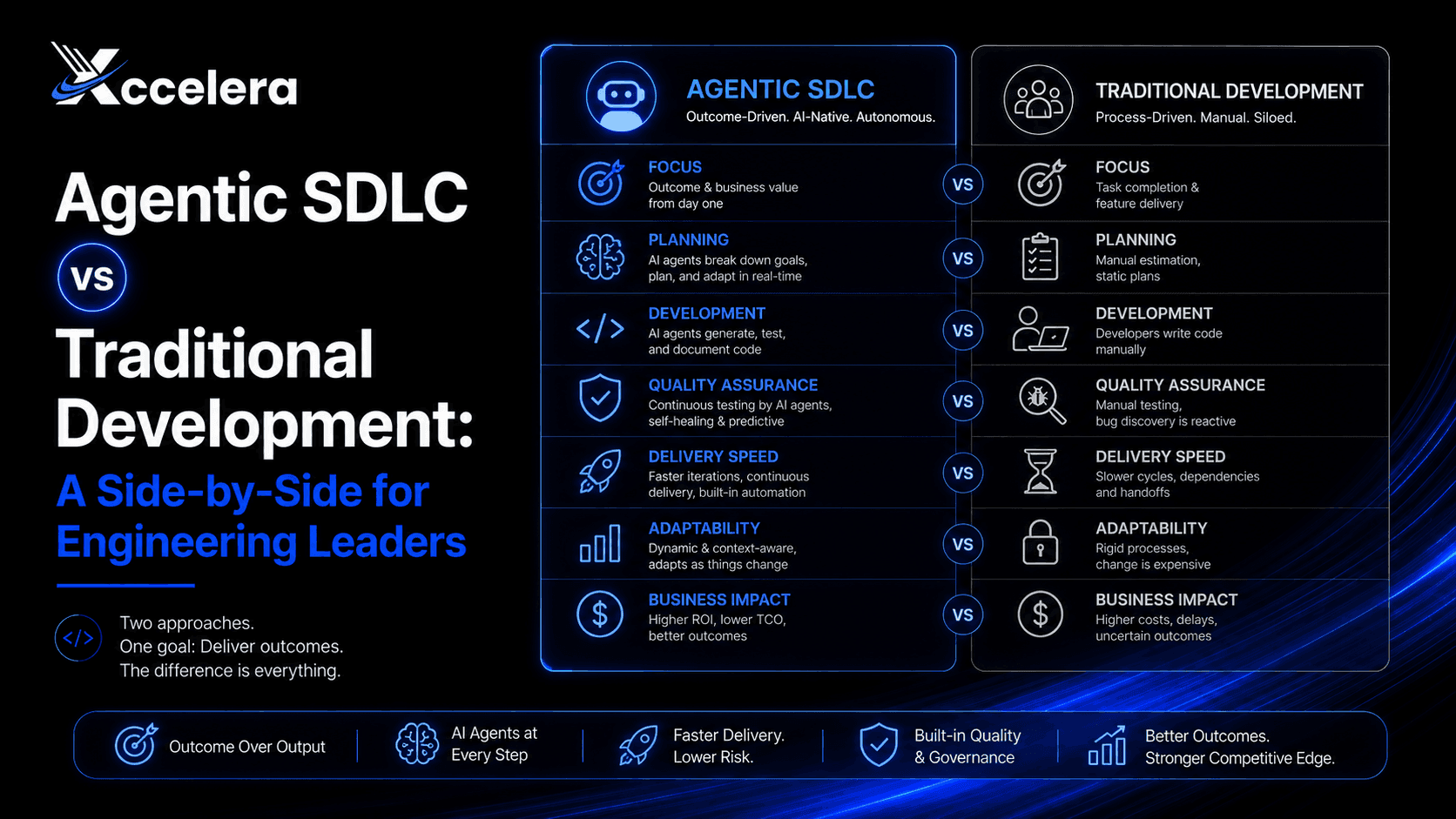
Agentic SDLC vs Traditional SDLC: The Side-by-Side Comparison
Lead Time and Deployment Frequency
Traditional teams typically measure lead time in days or weeks. They also deploy weekly or on demand. Agentic teams, however, compress that same lead time to hours. Furthermore, they can deploy many times a day, since agents remove the human coordination overhead that historically sat between a finished change and a released one.
Review Cadence and Accountability
Traditional workflows favor small, frequent pull requests alongside continuous integration checks that catch mistakes early. Agentic workflows, on the other hand, favor asynchronous, batch-style contributions. This shift raises the stakes of each review cycle significantly.
Accountability shifts accordingly, too. Developers are no longer judged solely on the code they personally wrote. Instead, they’re judged on whether what ships, regardless of who or what authored it, actually works in production.
Flow Efficiency and Team Satisfaction
Beyond standard delivery metrics, the comparison also extends into flow and satisfaction. Traditional teams absorb significant waiting and context switching between handoffs. Agentic teams, conversely, report fewer handoffs and less toil-heavy work.
This shift frees engineers for judgment calls instead of repetitive execution. Notably, it shows up directly in retention and satisfaction data alongside the harder delivery numbers.
Where Agentic SDLC Delivers Measurable Value
Enterprise data now backs up what engineering leaders are observing internally. According to DORA’s State of AI-assisted Software Development research, organizations applying GenAI across planning, development, testing, and operations together are releasing software far more often, while also reporting meaningful defect reductions.
However, teams that confine AI to the coding step alone see smaller wins. Coding output improves by roughly 30 to 40 percent. Yet overall team productivity often rises by less than 10 percent, because planning, testing, and release remain manual. Simply put, the bottleneck just relocates.
Additionally, AI-centric organizations report notable reductions in operating costs. This comes alongside meaningful EBITDA margin gains, driven largely by automation and faster cycle times rather than headcount growth.
The pattern is consistent: value concentrates where the full lifecycle gets redesigned. It doesn’t concentrate where a single tool is bolted onto an unchanged process. Left unaddressed, higher code generation rates simply create more pull requests and more reviewer interactions. This expands queues rather than increasing throughput. That’s precisely why organizations capturing the largest gains pair agent adoption with a rebuilt review and verification layer, rather than layering agents onto an unchanged workflow. Xccelera’s own breakdown of AI agents vs traditional development explores this pattern in more depth.
The New Risk Surface: Governance and Accountability
Large Pull Requests Create Review Blind Spots
A subtle architectural violation buried inside a four-thousand-line agent-generated pull request is far harder to catch. Compare that to the same mistake in a fifty-line human-written one — the difference is stark.
Reviewing that volume with the same rigor applied to smaller changes isn’t realistic through manual review alone. As a result, automated, deterministic verification has become load-bearing rather than optional.
New Threats Demand New Controls
Prompt injection is now a first-class attack surface. Traditional SDLC security models never accounted for it, since they assumed input was simply data. You can review the OWASP Top 10 for LLM Applications for a detailed breakdown of this emerging risk category.
Agent identity, authentication, and least-privilege permissioning have become active governance questions, not theoretical ones. Consequently, organizations are extending frameworks like the NIST AI Risk Management Framework and ISO/IEC 42001. Many are also adopting policy-as-code approvals with reasoning capture, so every agent action stays explainable and revocable.
The Governance Habit That Actually Sticks
The most effective operating principle emerging across mature adopters is simple to state, yet hard to enforce: no merge without an evaluation.
Treating that principle as a working practice, rather than a documentation exercise, is what separates organizations building durable agentic systems from those quietly accumulating undocumented risk. Xccelera’s guide on securing AI agents offers a practical checklist for exactly this challenge.
A Practical Roadmap for Engineering Leaders Making the Shift
Making this transition well requires sequencing, not shortcuts. Consider this roadmap:
- Establish governance first — including identity, permissioning, and audit trails for every agent action
- Build a shared orchestration layer — so agents across planning, coding, testing, and deployment don’t operate in fragmented silos
- Modernize review infrastructure — so automated verification can absorb pull request volumes that manual review simply cannot
- Align culturally around new accountability — where teams own shipped outcomes rather than individually authored code
- Measure progress against concrete delivery metrics — including lead time, deployment frequency, and defect rates, rather than lines of code generated
Skipping governance to chase velocity is the most common failure pattern among organizations that stall out mid-transition. Each step reinforces the next. Governance without modernization stalls. Modernization without orchestration lacks direction. And data without assurance simply introduces new risk.
Therefore, leaders get the most durable results by progressing through this roadmap methodically, rather than skipping ahead to the steps that look most impressive on a slide.
How Xccelera Builds the Agentic SDLC for Enterprise Teams
Xccelera operationalizes this shift through purpose-built accelerators, rather than a single generic tool.
- ApiX generates backend systems autonomously from a configuration input. It produces APIs, database setups, and fully tested endpoints without human supervision.
- FrontendX converts Figma designs directly into working React applications. It extracts exact typography and spacing while auto-linking every route.
Together, these two form a config-to-production delivery system. This mirrors the build and test phases of the agentic SDLC described above, and it complements Xccelera’s broader product engineering capabilities.
Meanwhile, LibX addresses the governance layer directly. It scans repositories for known vulnerabilities, upgrades dependencies, and opens ready-to-merge pull requests. This cuts remediation from days to minutes, while supporting SOC 2, HIPAA, PCI-DSS, and ISO 27001 compliance needs.
For engineering leaders evaluating how to move from traditional development toward a governed agentic model, xccelera.ai outlines how these systems fit together into one operational stack. You can also explore Xccelera’s related take on architecting autonomous SDLC for further implementation detail.