The Voice Agent Takeover: How XOra and Its Peers Are Quietly Replacing Human Call Centres
AI voice agents are no longer pilot experiments. Instead, they are becoming standing infrastructure inside enterprise call centers. These systems now automate routine support, scheduling, and outbound calls at a fraction of human cost. Moreover, they run continuously without shift constraints. This piece breaks down how platforms like XOra work end to end, the documented…
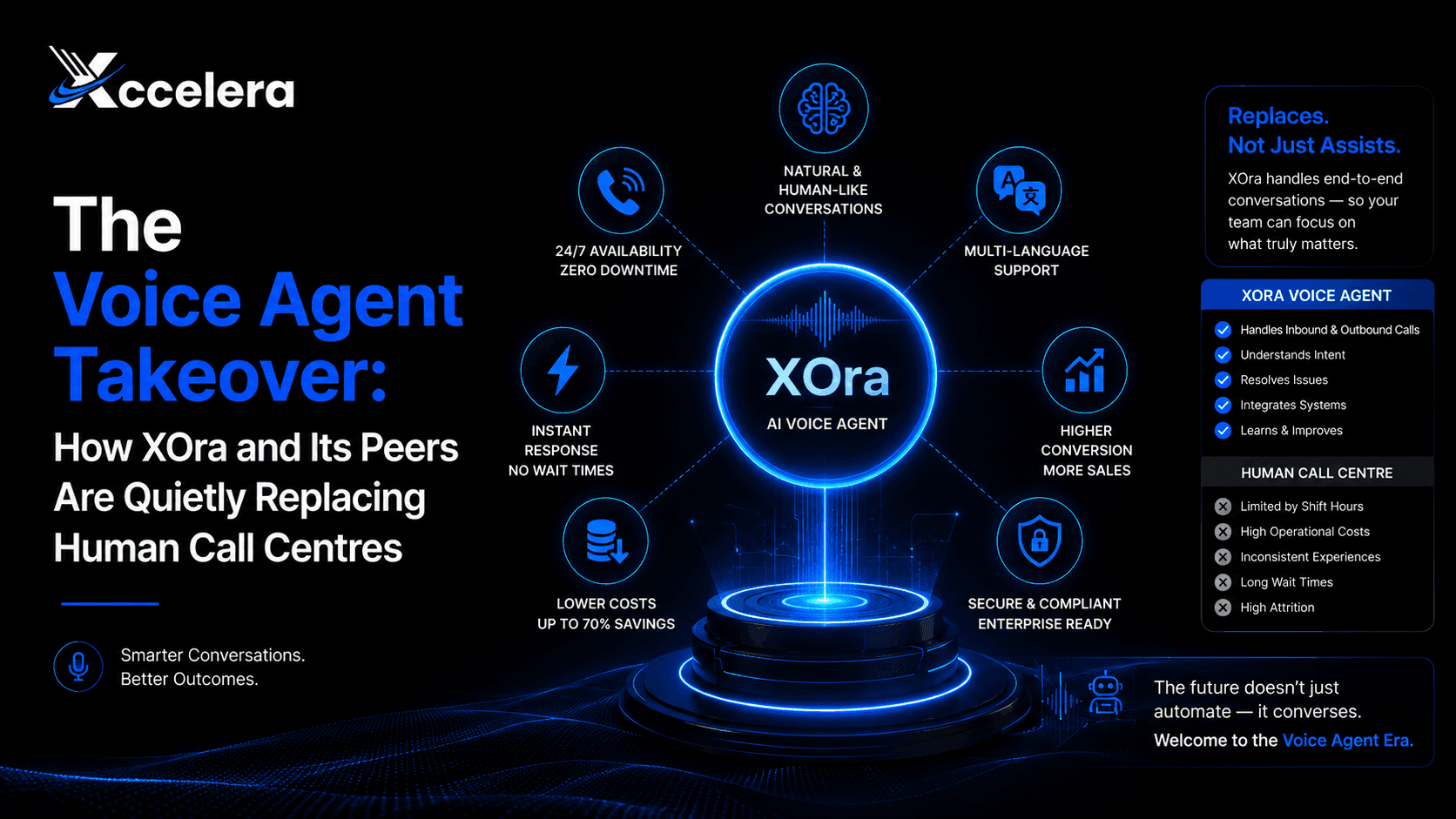
AI voice agents are no longer pilot experiments. Instead, they are becoming standing infrastructure inside enterprise call centers.
These systems now automate routine support, scheduling, and outbound calls at a fraction of human cost. Moreover, they run continuously without shift constraints. This piece breaks down how platforms like XOra work end to end, the documented ROI numbers driving adoption, and where human agents remain essential.
Why Call Centers Became the First Battleground for AI Voice Agents
A Structural Problem Decades in the Making
Call centers carry a structural problem that has existed for decades: high turnover, inconsistent quality, and a cost base dominated by labor. Industry data shows that over 70% of U.S. call center reps experience burnout within their first year. This figure explains why so many support operations struggle with consistency, even after heavy training investment.
Voice AI did not arrive as a novelty feature; it arrived as a direct response to that instability. Strategic deployment reduces costs by preventing escalations early, optimizing workforce planning, and cutting training time. As a result, voice agents shifted from a “nice to have” layer to a core operational asset, much like the workflows behind Xccelera’s Voice Agent platform.
The Scale Is Already Visible in the Data
The scale of this shift shows up clearly in market data. According to Acumen Research and Consulting, the global call center AI market was worth $1.9 billion in 2022 and is projected to reach $14.6 billion by 2032, reflecting a 22.7% compound annual growth rate. North America leads this curve, meaning U.S. enterprises are setting the pace for what “normal” looks like in customer operations.
Tier-1 support became the entry point for a simple reason: it is high-volume, repetitive, and easy to measure. Once an organization sees a voice agent resolve thousands of routine calls without quality loss, the conversation shifts quickly. It moves from “can this work” to “where else can this work.”
Inside the Pipeline: How Voice Agents Like XOra Actually Work
A modern voice agent is not a single piece of software. Rather, it is a coordinated pipeline where each stage hands off to the next in real time.
From Speech to Understanding
The pipeline begins with automatic speech recognition, which converts spoken audio into text with enterprise-grade accuracy. Today’s Voice AI delivers sub-second latency, support for 50+ languages, and accuracy above 95% — the baseline enterprises now expect before going live.
Once speech is transcribed, a language model layer extracts intent. In other words, the system determines not just what was said, but what the caller actually wants. From there, business logic takes over: querying databases, checking order status, or triggering a workflow, similar to the automated resolution flow inside Xccelera’s ITSM Agent for IT service requests.
Closing the Loop
The final stage converts the response into natural speech through neural text-to-speech, then logs the interaction. This step often gets overlooked, yet it is where long-term value compounds.
Platforms connect interactions to broader systems like CRMs and scheduling tools. Consequently, every call becomes structured data rather than a one-time transaction. Memory-driven context lets the same agent recall prior interactions, so returning callers never repeat themselves — a detail that materially affects satisfaction scores over time.
The Real Numbers: Cost and Performance Shifts Driving Adoption
The Cost Gap That Changes Budget Conversations
The business case for voice agents has moved past theory into documented outcomes. Human-handled calls cost up to $12 each, versus just $0.30 to $0.50 for an AI agent. That gap compounds quickly across high-volume operations. At thousands of calls per month, it alone can fund an entire technology rollout within a single quarter.
Payback periods reflect this gap. A regional insurer replaced 50% of after-hours staff with an AI voice agent and saved $480,000 annually, while also improving first-call resolution. Similarly, a logistics firm cut average handle time from 6 minutes to 3.8 minutes. These are operational results, not hypothetical projections.
What the Independent Research Shows
Longer-term studies reinforce the same direction. A 2025 Forrester Consulting Total Economic Impact study focused on PolyAI customers found that a composite organization saved $10.3 million in agent labor costs over three years. It also cut call abandonment by 50% and achieved payback in under six months.
For finance and operations leaders, the calculation is increasingly straightforward. They simply compare the fully loaded cost of current staffing, including turnover and training, against a system that runs continuously without shift premiums.
What Voice Agents Still Cannot Do (And Why That Matters)
The Empathy Gap
Despite rapid adoption, voice agents are not a full replacement for human teams. Pretending otherwise creates real operational risk.
AI cannot yet replicate the emotional intelligence that helps agents empathize with customers in stressful situations. This is not a minor gap. Calls involving billing disputes, healthcare concerns, bereavement, or fraud reports require judgment and tone that current systems cannot carry alone.
Why the Hybrid Model Is Permanent, Not Temporary
AI automates routine tasks, while humans handle empathy, edge cases, and trust-sensitive calls. In practice, this creates a hybrid model: AI manages routing, summaries, and FAQs, while humans manage escalations and retention. This division of labor is not a temporary phase before full automation. It is closer to the permanent shape of the industry.
The practical risk appears when companies skip escalation design entirely. A voice agent that traps a frustrated customer in an automated loop does more brand damage than no automation at all — which is why building deliberate handoff paths matters as much as the underlying conversational AI architecture itself.
The Shift Toward Always-On Digital Workforces
Removing the Time Constraint
The most significant change voice agents bring is not cost reduction; it is removing the time constraint that has shaped customer operations for a century. Call deflection through sophisticated systems can handle 30 to 60% of routine inquiries without human intervention, freeing agents for complex issues.
That freed capacity does not sit idle. Instead, it gets redirected toward retention work, complex problem-solving, and relationship management — the tasks that actually require a person.
Where This Becomes Most Visible
Outbound use cases show this shift most clearly. One company deployed an AI voice agent to re-engage thousands of dormant leads with incomplete CRM data. It conducted hundreds of conversations that would not have been cost-effective for a human team to attempt manually.
Voice AI has evolved from experimental deployments into mission-critical infrastructure. Indeed, the broader conversational AI market is projected to expand from $7.63 billion in 2025 to $139 billion by 2033, signaling a permanent shift in how enterprises think about coverage and staffing.
How Xccelera’s XOra Brings This to Enterprise Teams
One Integrated Pipeline, Not a Patchwork
Xccelera built XOra as a direct response to the gap between what voice agent technology can do and what most enterprises can realistically deploy alone. Rather than stitching together separate vendors for speech recognition, language understanding, and telephony, XOra runs as a single integrated pipeline designed for production from day one.
The system follows the same architecture outlined throughout this piece. Speech is processed through high-accuracy recognition, a language model layer applies business logic, and responses are delivered through neural text-to-speech with sub-second latency — an approach detailed further in Xccelera’s breakdown of autonomous voice workflows.
Built Around the Use Cases Enterprises Actually Need
What sets XOra apart is how tightly these stages connect to existing enterprise systems. Every call automatically syncs to CRM platforms and ticketing systems, so support teams never work from incomplete records.
XOra is built around the use cases enterprises ask for most:
- Tier-1 support that handles routine inquiries around the clock
- IT helpdesk functions that resolve common technical issues without queue times
- Scheduling that runs without staffing constraints
- Outbound sales calls that follow up on leads the moment they arrive
Memory-driven context means returning callers are recognized immediately. Meanwhile, noise cancellation keeps call quality consistent regardless of environment — a philosophy also reflected in how Xccelera approaches decision-making through speech interfaces more broadly.
Where to Start
For organizations evaluating voice automation, XOra offers a path that skips building the underlying pipeline from scratch.


