Real-Time Conversational Intelligence: The New Standard for AI Voice Agents
Real-time conversational intelligence is redefining how enterprises communicate, automate, and compete. AI voice agents now process, reason, and respond within milliseconds, replacing legacy IVR and static bots. This piece covers the technology stack, ROI benchmarks, governance imperatives, and how Xccelera deploys production-grade voice AI at enterprise scale. The Voice AI Inflection Point Enterprises Can…
Real-time conversational intelligence is redefining how enterprises communicate, automate, and compete. AI voice agents now process, reason, and respond within milliseconds, replacing legacy IVR and static bots. This piece covers the technology stack, ROI benchmarks, governance imperatives, and how Xccelera deploys production-grade voice AI at enterprise scale.
The Voice AI Inflection Point Enterprises Can No Longer Ignore
Enterprise AI has reached a decisive threshold where voice agents are no longer optional infrastructure. Market growth, shifting customer expectations, and measurable ROI are converging to make real-time conversational intelligence the new competitive baseline for U.S. enterprises across every vertical.
The numbers have moved past debate. Production voice agent implementations grew 340% year-over-year, with 67% of Fortune 500 companies now running live systems, according to AI Voice Research’s analysis of 500-plus organizations. That figure does not describe experimentation. It describes a structural shift in how enterprises operate their customer-facing communication infrastructure.
From Pilot to Production
What changed is not the technology alone. The economics flipped. Voice AI costs roughly $0.40 per call, compared to $7 to $12 per call for human agents, representing a 90-95% cost reduction per automated interaction. For any director running a contact center at scale, that arithmetic ends the pilot conversation entirely.
The global Voice AI Agents Market is projected to expand from $3.14 billion in 2024 to $47.5 billion by 2034, reflecting a 34.8% compound annual growth rate, with North America currently accounting for over 40% of that market. Enterprises that treat this as a future-state initiative are already operating behind their competitors. The inflection point is not approaching. It has arrived.
What Real-Time Conversational Intelligence Actually Means
Real-time conversational intelligence is not a single feature but a layered architecture combining automatic speech recognition, natural language understanding, and live reasoning, enabling AI voice agents to interpret intent, maintain context, and respond within a 200-millisecond window.
Strip away the marketing language and real-time conversational intelligence resolves to a specific engineering problem: how does a machine hear, understand, reason, and respond before the human caller notices a gap?
The Three-Layer Architecture
A conversational AI platform uses natural language understanding, speech recognition, and automation to enable real-time conversations between machines and humans across voice and text channels. Those three layers, ASR converting speech to processable text, NLU extracting intent and context, and TTS synthesizing a natural-sounding response, must execute sequentially and fast enough to feel seamless.
What separates modern real-time conversational intelligence from legacy IVR is not speed alone. Unlike traditional IVR systems, voice AI agents reason through context and take governed actions, connecting to live business data, executing workflows, and escalating to humans when needed, all within a single uninterrupted call. The system does not navigate a menu. It solves a problem.
Orchestration platforms are emerging to abstract away integration complexity, allowing enterprises to focus on outcomes rather than plumbing, while context awareness ensures that no prior interaction is ever treated as an isolated event.
Low Latency Is Not a Feature. It Is the Foundation.
Latency is not a performance metric buried in a vendor spec sheet. It is the single variable that determines whether a voice AI deployment earns user trust or destroys it within the first three seconds of a call.
Humans pause roughly 200 milliseconds between conversational turns. That biological rhythm is the target every enterprise voice system must match. Systems relying on one-to-three second cloud round-trips cannot deliver natural conversation. They deliver walkie-talkie chat. For customer-facing deployments, that distinction translates directly into abandonment rates and brand damage.
The Sub-600ms Benchmark
Customer satisfaction data shows a strong correlation between sub-500ms response times and positive user perception, with sharp degradation in experience above 800ms. That threshold has now become the enterprise evaluation standard, not a stretch goal.
Hybrid Architecture as the Solution
The breakthrough architecture that delivers the required speed mimics human cognition, utilizing a dual system that splits intelligence between fast, local reflexes and slow, deliberate cloud-based reasoning. Enterprises still defaulting to full cloud round-trips on every utterance are engineering their own failure into the stack from day one.
How Enterprise AI Voice Agents Process and Reason in Real Time
Behind every seamless voice interaction sits a precision-engineered execution stack. Understanding how streaming ASR, quantized language models, and retrieval-augmented generation work together is what separates enterprises that deploy successfully from those that stall in proof-of-concept indefinitely.
The pipeline starts the moment a caller speaks. Streaming automatic speech recognition converts live audio to text without waiting for a full sentence. That text feeds directly into a language model that reasons through intent, retrieves context, and formulates a response. Text-to-speech synthesis then converts that response back to natural audio, often before the language model has finished generating the full output.
Quantized Models and RAG Grounding
Researchers are designing pipelines with streaming ASR, quantized LLMs, and real-time TTS to support conversational latency under a 1.0 real-time factor, achieving approximately 95% accuracy at around 180 milliseconds response latency.
Where RAG Changes the Game
Retrieval-augmented generation combines a retrieval system that finds relevant documents from an enterprise knowledge base with a generative model, grounding responses in company-specific data rather than generic training. Without RAG grounding, a voice agent answers for a generic business. With it, the agent answers for yours, accurately and in real time.
Emotional Intelligence and Context Awareness in Voice AI
The enterprises pulling ahead are not just deploying faster voice agents. They are deploying smarter ones, systems that detect frustration, adapt tone mid-call, and carry full conversational memory across every interaction, producing outcomes that static automation cannot touch.
A caller expressing urgency does not need a cheerful response. They need recognition. AI voice agents are now trained to recognize emotions in speech and adjust their delivery accordingly, whether detecting urgency in a service request or picking up hesitation in a sales inquiry. That capability shifts the interaction from transactional to genuinely responsive.
Context Memory Across Full Conversations
True reliability transcends simple command recognition. Systems must maintain contextual awareness across multiple dimensions: identifying who is speaking through voice biometrics, determining intent by distinguishing direct commands from ambient conversation, and preserving conversational memory of recent dialogue history.
Measurable Impact on Satisfaction
One deployment increased scheduling NPS by 38% while filling underutilized provider capacity, allowing human teams to focus on meaningful work instead of routine call handling. Emotional intelligence in voice AI is not a UX enhancement. It is a revenue and retention variable that shows up directly in measurable business outcomes.
Where Enterprise Voice AI Delivers Measurable ROI
The ROI case for enterprise voice AI has moved well beyond projections. Verified deployments across banking, healthcare, and retail are producing documented cost savings, faster resolution rates, and payback periods that make the business case impossible to dismiss.
The financial proof is now substantial and documented. Enterprises using voice AI systems report three-year ROI figures ranging from 331% to 391%, with a 2025 Forrester Consulting study revealing that a composite organization saved $10.3 million in agent labor costs over three years, cut call abandonment rates by 50%, and achieved payback in under six months.
Banking and Healthcare Lead
A leading EU financial institution handling 285,000 monthly calls deployed a voice agent across 58 conversational paths, now processing over 156,000 calls per month autonomously, generating $7.7 million in annual savings, 94% first-call resolution, and a 41% reduction in peak wait times.
The Efficiency Gap Is Compounding
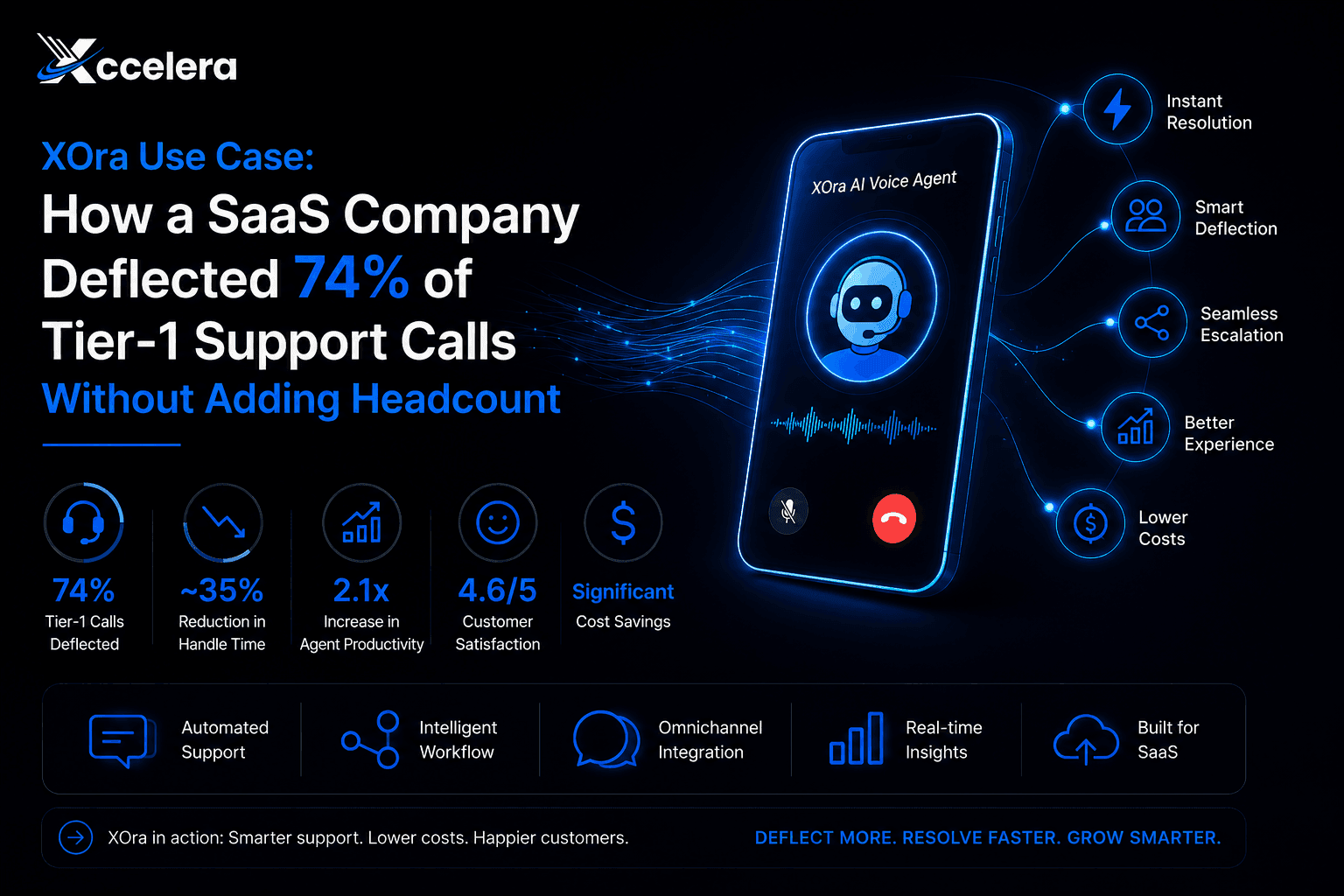
Voice AI agents reduce average handle time by 25% to 50% through instant data access and accurate intent recognition, with first contact resolution rates surpassing 90%, compared to the 70-75% industry average for human agents. Every month an enterprise delays deployment, that efficiency gap widens in a competitor’s favor.
The Governance Gap: Compliance, Security, and Audit Readiness
Enterprise AI has reached a decisive threshold where voice agents are no longer optional infrastructure. Market growth, shifting customer expectations, and measurable ROI are converging to make real-time conversational intelligence the new competitive baseline for U.S. enterprises across every vertical.
Scaling voice AI without governance is not a calculated risk. It is a liability on a timer.
Compliance Built In, Not Bolted On
HIPAA, SOC 2 Type II, GDPR, and the EU AI Act (full enforcement: August 2026) are not future considerations. They govern every live deployment today. Enterprises retrofitting compliance post-launch face compounding audit exposure at machine speed. According to Kore.ai’s 2025 enterprise analysis, governance gaps remain the most cited failure point in regulated voice AI rollouts.
From 2% to 100% Audit Coverage
Traditional QA reviews 2% of calls. Governance-ready voice AI logs 100%, creating a defensible, searchable audit trail no human-agent operation can match. CEO Today Magazine’s 2026 deployment report confirms that organizations architecting compliance from day one report faster regulatory approvals and lower remediation costs.
Omnichannel Execution: From Voice to Full Conversational Continuity
Deploying voice in isolation is an architectural dead end. Customers move across channels mid-interaction, voice to chat, chat to email, without repeating context. Enterprises that cannot maintain continuity across those transitions lose the interaction and the customer.
Context That Travels With the Customer
Unified context preservation across voice, SMS, and chat channels drives an 18-25% boost in customer lifetime value. Customers who switch channels without re-explaining their issue complete transactions at measurably higher rates, a direct revenue variable that single-channel deployments structurally cannot capture.
Multilingual Execution at Scale
A single omnichannel deployment can serve linguistically diverse customer bases without separate language-specific builds, directly cutting operational overhead for enterprises operating across global markets.
Omnichannel is not a feature upgrade. It is the architecture that transforms voice AI into a complete enterprise communication layer.
How Xccelera Architects Enterprise-Grade Real-Time Voice AI Systems
Most enterprises stall at proof-of-concept because they treat voice AI as a product purchase rather than a systems engineering challenge. Xccelera approaches it differently.
Orchestration First, Deployment Second
Xccelera engineers agentic voice AI platforms with orchestration and governance layers built in before a single call goes live. CRM integration, telephony compatibility, compliance readiness, and escalation pathways are architected as core components, not afterthoughts. Every deployment is designed to perform at production scale from day one, not optimized retroactively after failure.
Outcome-Driven Architecture
Xccelera’s deployment model ties every technical decision directly to measurable business outcomes: cost per call, first-call resolution rate, and compliance audit readiness. Enterprises working with Xccelera do not receive a configured vendor product. They receive a purpose-built agentic voice system aligned to their operational objectives.
The Autonomous Voice Enterprise: What Comes Next
The next phase of enterprise voice AI is not reactive automation. It is proactive intelligence that anticipates needs, initiates workflows, and continuously optimizes without waiting for a human trigger.
Agentic Voice Workflows Redefine Operations
Voice agents are already transitioning from single-call handlers to multi-step workflow executors. Systems that once answered questions now initiate follow-ups, trigger backend processes, and route outcomes across departments autonomously. By 2029, industry projections point toward 80% autonomous resolution rates across standard enterprise voice interactions.
The Strategic Imperative for Leadership
For C-suite decision makers, the question is no longer whether autonomous voice AI belongs in the enterprise stack. The question is how fast the organization can restructure operations around it. Enterprises that delay cede compounding efficiency advantages to competitors already scaling agentic voice infrastructure.
Xccelera exists at this intersection, translating the autonomous voice enterprise from a strategic vision into an operational reality for organizations ready to lead.