XOra Use Case: How a SaaS Company Deflected 74% of Tier-1 Support Calls Without Adding Headcount
AI-powered Tier-1 call deflection is reshaping how SaaS companies scale support without scaling payroll. A mid-size SaaS company deployed XOra, an autonomous AI voice agent, and as a result resolved 74% of inbound Tier-1 support calls without hiring a single additional agent. What follows is the operational setup, the call pipeline architecture, the financial impact,…
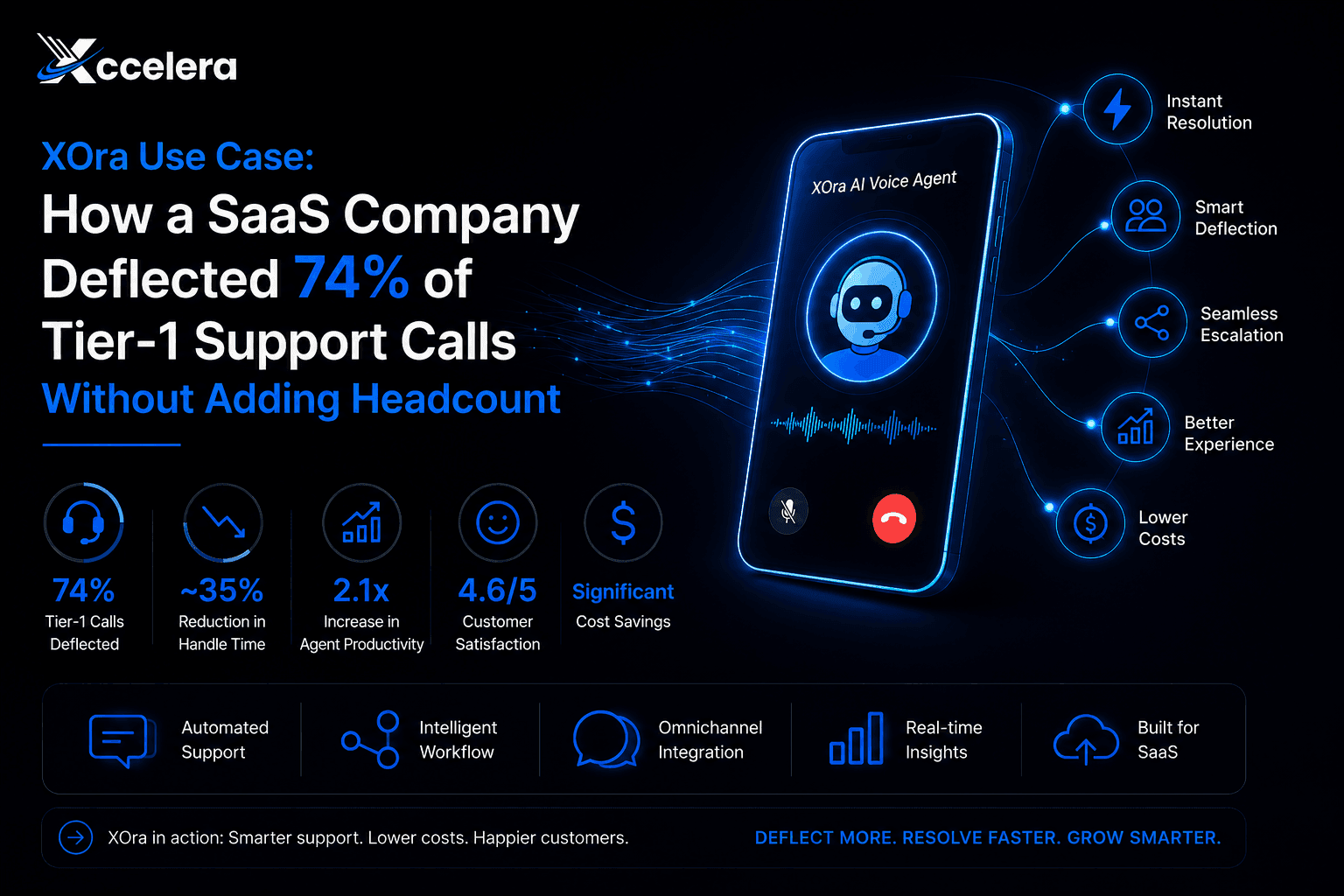
AI-powered Tier-1 call deflection is reshaping how SaaS companies scale support without scaling payroll. A mid-size SaaS company deployed XOra, an autonomous AI voice agent, and as a result resolved 74% of inbound Tier-1 support calls without hiring a single additional agent. What follows is the operational setup, the call pipeline architecture, the financial impact, and ultimately what it means for SaaS support leaders rethinking how they scale service delivery in 2026.
The Tier-1 Support Problem Every Scaling SaaS Company Hits
When Headcount Becomes the Wrong Answer
Growth compounds the support problem before leadership sees it coming. A SaaS company crossing 500 customers rarely notices the volume creep. However, by the time it reaches 2,000, the Tier-1 queue is consuming the majority of agent hours, and the tickets driving that volume are almost entirely predictable: password resets, billing status checks, onboarding FAQs, feature access questions, and basic account management.
The financial exposure is significant. Industry benchmarks place SaaS support cost-per-ticket at $18 to $35 for human-handled interactions, according to Zendesk’s CX Trends research. Phone support, specifically, runs three to five times more expensive per query than email or chat, since agents handle one call at a time and handle time is longer. Consequently, for a Series B company processing 40,000 monthly tickets, that math produces a support payroll line approaching $5 million annually before quality assurance, tooling, and management overhead are even added.
The Headcount Trap
The reflex response is to hire. More agents, more capacity, problem solved — or so it seems. Except the problem is not capacity. It is composition. When 70% of inbound calls are Tier-1, adding headcount to absorb volume means adding cost to a problem that does not actually require human judgment to resolve.
Accordingly, SaaS teams restructuring around AI in 2026 are collapsing the Tier-1 layer entirely and redeploying human agents toward Tier-2 escalations, complex integrations, and churn-risk accounts. The companies still scaling through headcount, by contrast, are not solving the problem. They are simply deferring it at an increasing cost. This shift mirrors the broader pattern documented in Xccelera’s breakdown of AI agents vs. hiring developers, where the cost curve consistently favors execution-capable automation over linear headcount growth.
Why Voice AI, Not Chatbots, Was the Right Call
The Resolution Gap Nobody Talks About
Deploying a chatbot to reduce call volume sounds logical until the data comes back. Most text-based deflection tools redirect customers from a knowledge base article rather than resolving the underlying request. The containment rates tell the story: industry-wide median deflection across chat sits at 45 to 55%, with top platforms reaching 70 to 85% only on Tier-1 queries backed by well-curated knowledge bases. That ceiling exists because chatbots can answer questions; they cannot, however, execute actions.
The SaaS company in this case received the majority of its Tier-1 volume over the phone. Customers calling about billing, access issues, and account status are not looking for an article — they want the action completed. Therefore, a voice AI agent purpose-built for resolution, not redirection, closes that gap. As practitioners in the field have noted, AI platforms that can only talk, but cannot look up an order, reset a password, or check an account balance, are essentially sophisticated IVRs that route to a human anyway. For a deeper look at how conversational agents differ from simple assistants, see Xccelera’s comparison of AI agents vs. AI assistants.
What True Deflection Requires
Genuine call deflection demands backend execution capability. The voice agent must connect to CRM records, pull account status in real time, authenticate the caller, perform the requested action, and confirm resolution — all within a single interaction. Without that execution layer, deflection figures are measuring abandoned calls, not resolved ones, and that distinction matters considerably when building a business case for leadership.
Inside XOra’s Call Pipeline: How the System Actually Runs
From First Word to Closed Ticket
XOra runs a modular, streaming voice pipeline engineered for sub-second response latency. When a caller connects, the system begins with Whisper-class automatic speech recognition, capturing and transcribing audio in real time with noise cancellation active throughout. From there, the transcribed text moves immediately into an LLM reasoning layer that identifies caller intent, extracts entities such as account identifiers, issue type, and authentication signals, and maps the request to the appropriate business logic workflow.
Next, XOra calls the relevant backend APIs. For a billing status inquiry, it pulls the account record from the connected CRM. For an access reset, it executes the action directly against the connected system and confirms completion. Finally, neural TTS generates a natural, human-paced voice response delivered back to the caller, and the entire interaction is logged, summarized, and synced to the CRM and ticketing platform without any agent involvement. This end-to-end execution model is what distinguishes a true voice agent from a routing-only IVR system.
When Escalation Is the Right Call
Not every inbound call belongs with the AI. XOra’s escalation logic operates on defined confidence thresholds and intent classification. Specifically, when a caller’s request falls outside the agent’s resolution scope, expresses significant emotional distress, or involves account complexity requiring human judgment, the system transfers the call to a live agent with full transcript, intent summary, and recommended next action attached. As a result, the human agent inherits context rather than starting over. That handoff quality is not merely a UX feature — in regulated environments, it is a compliance requirement.
The Deployment: What the SaaS Company Set Up and How Fast
Starting With the Right Call Categories
Before a single call routed to XOra, the team conducted a structured audit of the previous 90 days of inbound call data. The objective, ultimately, was identifying which Tier-1 query types were highest in volume, lowest in complexity, and most consistently resolved within a single interaction. Password resets, billing inquiries, feature access questions, and onboarding status checks met all three criteria and, together, accounted for the significant majority of total call volume.
Integration, Staged Rollout, and Go-Live
XOra integrated with the company’s existing CRM and helpdesk stack through standard API connections, so no infrastructure rebuild was required. The deployment then followed a staged rollout: a defined subset of inbound traffic was routed to XOra first, containment rates were measured against baselines, escalation thresholds were calibrated, and edge cases were identified and addressed before full-volume routing was enabled.
Production voice AI deployments have grown 340% year-over-year in 2026 across enterprise organizations, and the teams achieving the fastest ROI consistently share the same pattern: piloting on a narrow, high-volume, low-complexity use case before scaling further. Meanwhile, compliance and governance configuration ran in parallel with technical setup. Audit logging, PII handling architecture, and escalation documentation were all verified before any live caller traffic was authorized.
The 74% Result: Metrics, Cost Impact, and What Moved
What the Numbers Actually Mean
A 74% Tier-1 call deflection rate positions this company above the industry median and within the range of top-performing enterprise deployments, where best-in-class platforms report 60 to 80% containment on structured Tier-1 queries. Importantly, context matters here: the 74% figure reflects calls fully resolved by XOra without human intervention, measured against follow-up ticket activity to confirm resolution quality. Abandoned calls were excluded from the count entirely.
The Financial Shift
The cost impact compounded quickly. Human-handled phone support in SaaS runs at the higher end of the cost-per-ticket range, whereas AI-resolved interactions cost a fraction of that per resolution. Across the monthly call volume this company processed, the difference between resolving 74% of Tier-1 calls autonomously versus through human agents produced material operating savings without a single headcount addition.
Equally significant, existing agents stopped spending the majority of their hours on password resets. Instead, they moved to Tier-2 escalations, complex technical troubleshooting, and retention-critical accounts — meaning the team’s effective capacity expanded without the payroll line moving at all. IBM’s research across 412 enterprises deploying AI for Tier-1 support measured an average 30% operating cost reduction, with the primary driver being deflected tickets rather than headcount cuts. Notably, this deployment landed above that benchmark.
First Contact Resolution and CSAT
First Contact Resolution rates improved because XOra resolved the interaction completely in the first call rather than logging a ticket for follow-up. Callers who previously waited for a callback or an email response, therefore, received resolution in real time instead. That speed change was reflected clearly in satisfaction signals across the account base, reinforcing findings from Xccelera’s analysis of customer satisfaction and the agent experience.
Compliance, Governance, and What Every SaaS Director Must Verify
The Compliance Surface Is Larger Than It Looks
Voice AI in a SaaS environment touches more regulatory surfaces than most teams anticipate at procurement. Every inbound call captures conversational data, often including PII. That data, in turn, moves through an ASR layer, an LLM reasoning layer, backend APIs, CRM systems, and call recording infrastructure — and each transition represents a subprocessor boundary and a potential compliance gap.
SOC 2 Type II is the floor, not the ceiling. Directors evaluating voice AI vendors should therefore verify the full compliance stack: ISO 27001 for information security management, GDPR for any EU data subjects in the customer base, and HIPAA if any health-related SaaS workflows touch the support pipeline. PII redaction must occur at the ingestion layer, not at the model layer — redaction after transcription is simply too late.
Escalation Auditability Is a Regulatory Feature
Clean escalation with full context transfer and no information drift is not just a customer experience consideration. In regulated environments, a voice agent that guesses or fabricates a response during an escalation creates real legal exposure. Immutable call logs, full reasoning traces, and documented handoff protocols are accordingly the verification standards that legal and compliance teams require before authorizing production traffic. Governance configuration must be completed before go-live, not after the first compliance incident. These principles align closely with the framework outlined in Xccelera’s practical checklist for securing AI agents.
What XOra Enables for SaaS Teams Scaling Without Headcount
The outcome this SaaS company achieved is not exceptional — it is replicable, and the architecture that produced it is available to any SaaS team running high inbound call volume against a Tier-1 query distribution that human agents should not be handling at scale.
XOra, Xccelera’s autonomous AI voice agent, runs the full pipeline: Whisper-class ASR, LLM intent extraction, backend API and CRM execution, neural TTS response generation, and automatic ticket sync, all with sub-second latency, multi-language support, and memory-driven context across interactions. Escalation logic is fully configurable, and compliance architecture covers SOC 2, GDPR, and enterprise governance requirements. As a result, the system scales with call volume without adding seats.
For SaaS support leaders carrying a Tier-1 queue that consumes agent capacity and resists resolution through headcount alone, XOra ultimately replaces the volume problem with an execution system designed to close it. The 74% result is a production benchmark, not a vendor projection. Teams ready to evaluate the approach further can explore Xccelera’s broader customer support offerings or review a similar transformation in this contact center AI conversational agent case study