Agentic Voice AI: Enabling Autonomous Decision-Making Through Speech Interfaces
Enterprise voice interfaces have crossed a structural threshold. Agentic voice AI now operates as an autonomous execution layer, converting spoken input into real-time decisions, system-level actions, and workflow triggers without scripted menus, fixed intent trees, or human intervention at every step. Agentic Voice AI as the Shift from Reactive Conversations to Autonomous Execution The…
Enterprise voice interfaces have crossed a structural threshold. Agentic voice AI now operates as an autonomous execution layer, converting spoken input into real-time decisions, system-level actions, and workflow triggers without scripted menus, fixed intent trees, or human intervention at every step.
Agentic Voice AI as the Shift from Reactive Conversations to Autonomous Execution
The way enterprises use voice technology is being rebuilt from the ground up. The shift from conversational AI to agentic voice systems is not an incremental upgrade. But a change in what voice is fundamentally allowed to do inside an organization.
Why Conversational AI Was Never Engineered to Handle Enterprise Decision Complexity
Conversational AI responds. Agentic voice AI executes. That distinction determines everything about how enterprises should evaluate, deploy, and scale voice systems today.
Traditional voice interfaces, including IVR menus and basic virtual assistants, were built to recognize commands and return pre-programmed answers. They operate within fixed intent trees, which means every scenario outside the mapped flow produces either an error or a human transfer.
Industry research confirms that legacy IVR systems automate only seven to fifteen percent of total interactions. Because rigid scripting cannot interpret multi-step, contextually dependent requests. The operational cost of that gap accumulates across every misdirected call, every unnecessary escalation, and every unresolved query that burns agent time.
How Voice Stops Being a Response Layer and Becomes a Business Execution Channel
Agentic voice AI closes that gap by shifting the system’s role from reactive to goal-oriented. Rather than matching a caller’s words to a predefined intent, an agentic system reasons through the request, pulls live data from connected enterprise systems, and executes a resolution autonomously.
This represents a fundamental architectural change where voice agents integrate with existing systems through APIs, enabling them to resolve complex issues and trigger actions rather than simply generating responses. Voice becomes the trigger for sequenced backend operations, not the final destination of the interaction.
Core Architecture Behind Autonomous Voice Systems in Enterprise Environments
Autonomy at the voice layer does not emerge from a single model or a smarter microphone. It is the product of coordinated technical components working in sequence, each responsible for a distinct function within the decision pipeline.
From Speech Signal to Structured Intent: The Technical Stack That Makes Autonomy Possible
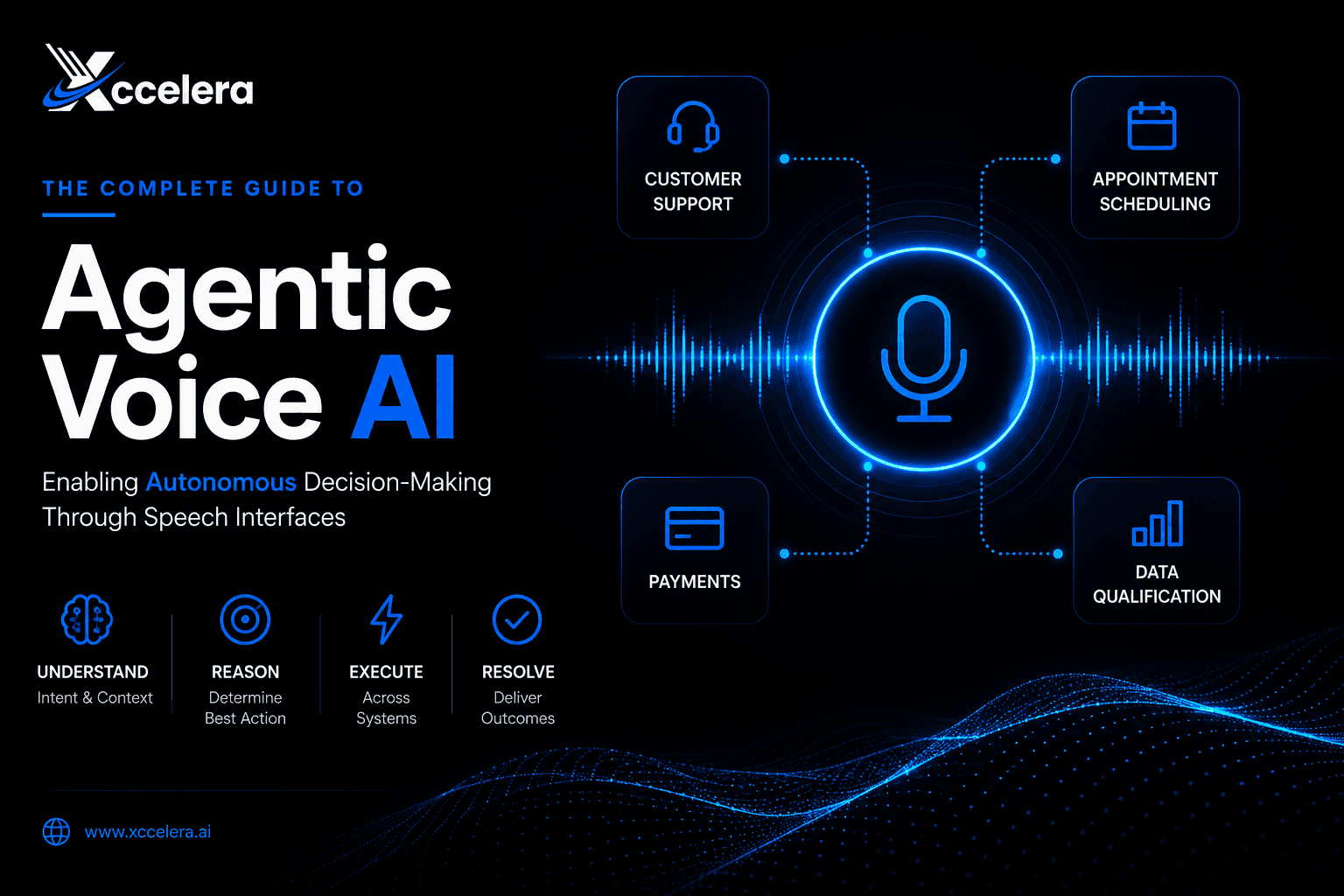
Agentic voice AI runs through a coordinated pipeline where automatic speech recognition converts audio into text, natural language understanding extracts intent and entities from that text, and a large language model reasoning layer determines what action the system should take.
This reasoning layer is the defining technical difference between standard voice agents and agentic voice AI, with the latter leveraging chain-of-thought reasoning and retrieval-augmented generation to handle requests that carry no pre-programmed resolution path.
Streaming architecture has become the production standard for enterprise deployments because it minimizes latency and enables natural interruption handling, both of which determine whether a voice agent performs reliably under real call conditions.
Memory, Orchestration, and Continuous Learning as Operational Infrastructure
Execution accuracy depends on what the system remembers and what it can reach. Enterprise-grade voice agents in 2026 maintain contextual memory across sessions, recalling prior interaction history, user access levels, and unresolved items to sustain continuity without repeating authentication steps or restarting context.
Orchestration layers connect the reasoning engine to CRM platforms, ERPs, scheduling systems, and internal databases through secure AI agent integration, translating spoken commands into precise backend queries.
Leading platforms have introduced performance-based feedback loops where dialogue flows adjust automatically using live call data, which means voice agent accuracy compounds over time rather than degrading through static scripting.
Where Agentic Voice AI Fits and Breaks in Real Business Operations
Not every enterprise workflow is compatible with autonomous voice execution. Deployment success depends on how well the operational environment maps to what agentic voice systems can reliably handle, and where control gaps create risk instead of efficiency.
The Workflow Conditions That Produce Consistent Voice AI Returns
Agentic voice AI performs strongest in structured, high-volume workflows where decisions follow repeatable logic. Customer support automation, appointment scheduling, payment collection, and lead qualification share a common characteristic: the decision criteria are definable, the data sources are accessible, and resolution can be confirmed within a single interaction.
Industry data shows that enterprises deploying voice AI in these environments reduce average handle time measurably while maintaining consistent resolution quality across thousands of simultaneous interactions. The system does not tire, does not deviate from approved protocols, and does not require supervision on every call. That consistency is where the financial case for agentic voice deployment is clearest.
Where Autonomous Voice Execution Breaks Down Without Governance Controls
Failure follows predictably when agentic voice AI is deployed into ambiguous or compliance-bound interactions without structured escalation paths. Legal discussions, complex clinical decisions, multi-party negotiations, and exception-heavy service scenarios require judgment that reasoning engines cannot reliably reproduce under current architectures.
Without observability layers that flag low-confidence decisions and route them to human oversight, autonomous execution in these environments produces errors that carry regulatory and reputational consequences.
Voice data itself introduces compliance obligations distinct from text-based systems. GDPR, HIPAA, and TCPA each impose specific requirements around consent capture, data retention, and audit trail generation for voice interactions.
Enterprises that deploy without embedding these controls into the pipeline architecture expose themselves to enforcement risk that no operational efficiency gain can offset.
Decision Loops: How Voice Agents Move from Commands to Autonomous Actions
The operational value of agentic voice AI sits inside its decision loop architecture. Understanding how spoken input travels from detection to execution is what separates enterprises that deploy strategically from those that treat voice AI as an advanced IVR replacement.
How the Speech-to-Intent-to-Action Pipeline Processes Enterprise Requests in Real Time
When a caller speaks, the system does not simply transcribe and match. The pipeline captures audio, converts it to structured text, extracts intent and contextual entities, passes that structure to a reasoning engine that evaluates available actions against live system data, selects the appropriate response, and triggers the corresponding backend operation, all within milliseconds.
Multi-step task chaining extends this further. A single spoken request can initiate a sequence where the system queries a database, updates a record, sends a confirmation, and logs the interaction without human involvement at any stage.
Real-time decision validation mechanisms run parallel to execution, checking that the action falls within defined governance boundaries before the system commits. This event-driven architecture is what distinguishes agentic voice from AI automation tools that require human confirmation between steps.
Why Continuous Feedback Loops Determine Long-Term Execution Quality
A decision loop that does not learn degrades. Agentic voice systems that lack structured feedback pipelines accumulate drift as call patterns shift, language evolves, and business rules change.
Production-grade deployments capture interaction outcomes, measure resolution accuracy, and feed that data back into model refinement cycles. Over time this produces compounding accuracy gains that static systems cannot replicate.
Enterprises that treat feedback loop architecture as a deployment afterthought consistently report higher failure rates in the twelve months following initial rollout.
Enterprise Adoption: From Voice Assistants to Revenue-Driving Autonomous Systems
The gap between a voice pilot and a production system that moves revenue is wider than most enterprise technology roadmaps account for. Closing that gap requires a specific integration sequence, not just a more capable model.
Why CRM and ERP Integration Depth Determines Whether Voice AI Reaches Production Scale
Voice agents that cannot access live customer records operate on incomplete information. The containment rate, the percentage of calls resolved without human transfer. Drops sharply when the voice system is disconnected from the data the caller’s issue actually depends on.
Enterprises that achieve strong production outcomes connect voice agents directly to CRM systems, billing platforms, scheduling tools, and internal knowledge bases before scaling call volume. This integration depth allows the agent to retrieve account history, verify identity, update records, and confirm outcomes within the same interaction.
Research across enterprise deployments indicates that organizations using integrated agentic voice systems. Operational cost reductions between thirty-five and fifty percent relative to human-led equivalents in comparable workflows.
How Agentic Voice Systems Shift From Cost Tools to Revenue Contributors
Beyond deflection, agentic voice AI is being positioned as an outbound revenue channel. Autonomous voice agents handling lead qualification, payment plan negotiation, and renewal outreach operate at a scale and consistency that human teams cannot match. Conversion rates improve when outreach follows precise timing logic tied to CRM signals rather than agent availability.
Xccelera’s agentic deployment architecture enables enterprises to embed voice agents directly into revenue workflows, connecting speech interfaces. The same orchestration layer that governs internal automation, ensuring voice operates as a production system rather than a standalone tool.
The Strategic Future: Voice as the Primary Interface for Autonomous Enterprises
Voice is not competing with other enterprise interfaces. It is consolidating them. The trajectory of agentic voice AI points toward a single conversational layer through which employees, customers, and systems interact with enterprise infrastructure simultaneously.
How Multimodal Architecture Expands What Voice-First Enterprises Can Execute
The next phase of enterprise voice AI combines speech with visual, textual, and sensor inputs into unified agentic systems. Multimodal architectures allow voice to initiate workflows that complete across channels. A spoken request that triggers a document update, a calendar change, and an email confirmation without the caller switching interfaces.
Industry projections place the voice AI market at 47.5 billion dollars by 2034. Reflecting enterprise recognition that voice is becoming foundational infrastructure rather than an additional channel. Enterprises that architect voice as a system interface now will determine what autonomous enterprise operations look like
Human-Agent Collaboration as the Governance Model for Autonomous Voice at Scale
Full autonomy is not the destination. Sustainable agentic voice deployment defines precisely where human judgment remains in the loop and builds escalation architecture. The enterprises gaining competitive advantage through voice-first strategy are not those removing humans from operations entirely. They are those using agentic voice AI to redirect human capacity toward decisions that require experience, accountability, and contextual authority