LibX Case Study: How a Fintech Team Cleared 22 CVEs and Opened Clean PRs in 45 Minutes
A mid-size automated CVE remediation fintech pipeline case study — a fintech engineering team faced 22 open CVEs across its Python and JavaScript stack weeks before a SOC 2 Type 2 audit window opened. With limited headcount and a fixed deadline, manual triage was not a viable option. This case study walks through how an…
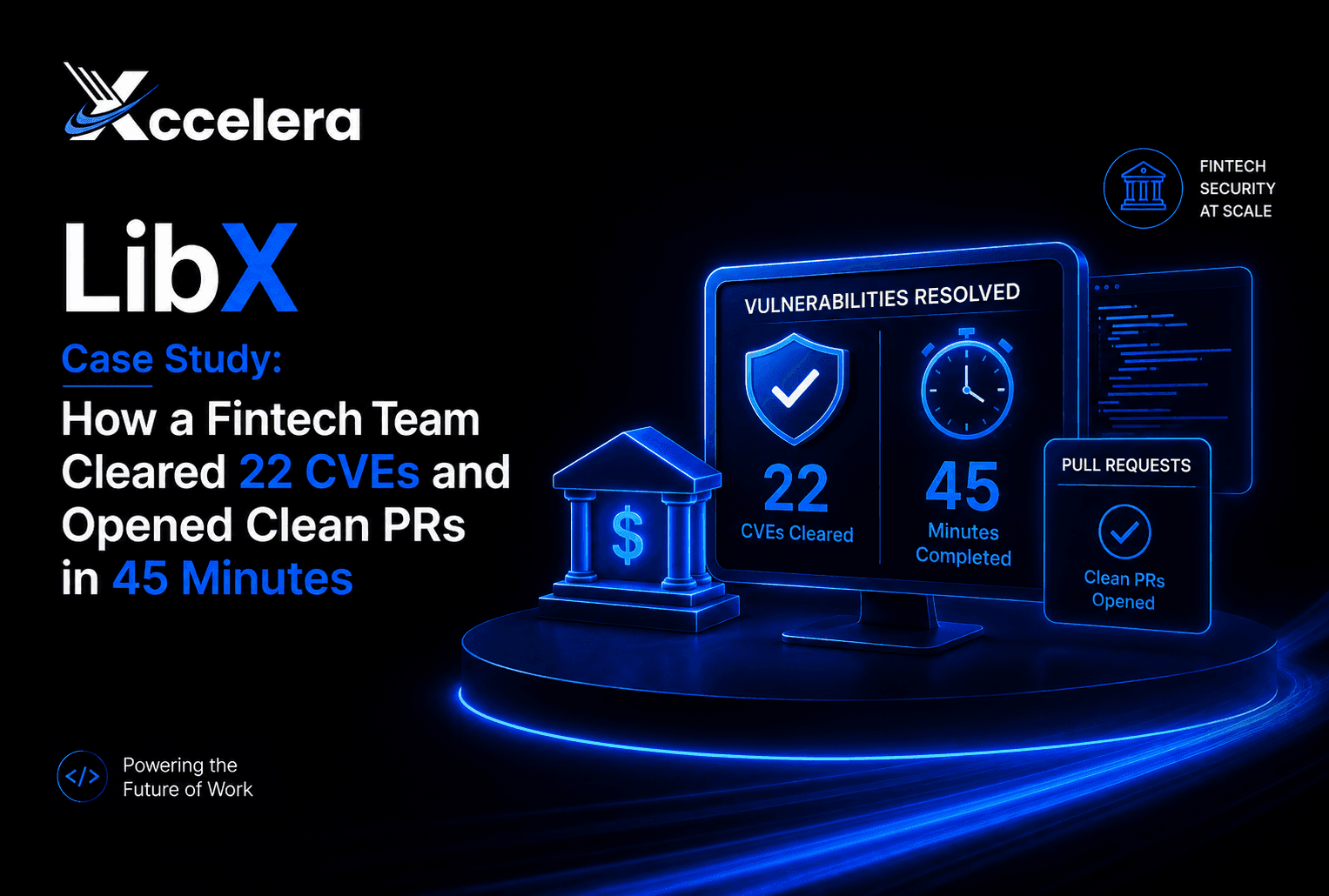
A mid-size automated CVE remediation fintech pipeline case study — a fintech engineering team faced 22 open CVEs across its Python and JavaScript stack weeks before a SOC 2 Type 2 audit window opened. With limited headcount and a fixed deadline, manual triage was not a viable option. This case study walks through how an automated remediation pipeline scanned, patched, tested, and opened ready-to-merge pull requests for every flagged dependency in under an hour — and, moreover, what that speed means for compliance teams operating under CC7.1 and CC7.2 expectations.
The 45-Minute Mandate: Why a Fintech Engineering Team Turned to Automated Remediation
The compliance calendar does not wait for sprint planning. SOC 2 Type 2 audits evaluate whether security controls operated effectively over a defined period, and vulnerability management sits squarely inside the Security trust criteria that every audit must address. Furthermore, auditors increasingly expect documented evidence of scanning frequency and remediation timelines, not just a clean snapshot on audit day.
For this fintech team, the audit window arrived with 22 open CVEs spanning backend Python services and a JavaScript-heavy frontend. Severity ranged from moderate to critical, and several involved transitive dependencies buried three layers deep in the package tree. As a result, the security lead estimated manual remediation, including dependency research, patch testing, and PR review, would consume close to two full sprints across three engineers. That timeline put the audit readiness date at serious risk.
Rather than pulling engineers off feature work, therefore, the team piloted a dry-run scan against the affected repositories first. The dry run surfaced the full vulnerability map without touching production branches, giving the security lead a clear picture of scope before committing to a live remediation run. This approach is consistent with how leading agentic AI solutions handle pre-flight validation — surface the full impact before executing any change.
Inside the Pipeline: How LibX Scanned, Patched, and Validated 22 CVEs
The remediation run executed as a 17-step automated sequence. Each repository was scanned against OSV, NVD, and GitHub Security Advisory data simultaneously, which matters because no single feed covers every disclosure path. Recent industry analysis shows advisory data has become more granular, with combined CWE classifications now common, making automated triage considerably more accurate than it was even a year earlier.
Patching Beyond Version Bumps
A simple version bump rarely resolves a CVE cleanly in a production codebase. Breaking changes in major version jumps frequently require code-level adjustments, not just a manifest edit. Consequently, the pipeline’s AI patching layer identified where upgraded dependencies broke existing function signatures or deprecated APIs, then rewrote the affected calling code to match the new interface. This is precisely the kind of nuanced, context-aware fix that distinguishes AI-powered remediation from traditional automated tooling.
For teams building on AI-powered software development practices, this level of automated code rewriting represents a meaningful shift: security remediation is no longer a separate workstream that competes with feature delivery.
Test Resolution Without Manual Intervention
After each patch, the pipeline re-ran the project’s existing test suite. Failures triggered an automated diagnostic pass that distinguished between failures caused by the dependency upgrade itself versus pre-existing flaky tests. For this specific run, 19 of the 22 patches passed on the first test cycle. The remaining three required a second automated correction pass before tests cleared, a process that completed within the same 45-minute window, thanks to parallel execution across repositories.
From Scan to Merge: The Anatomy of a Ready-to-Merge Pull Request
A pull request is not “ready to merge” simply because it compiles. For an engineering team under compliance pressure, a usable PR needs to satisfy three conditions: passing tests, a clear changelog explaining what changed and why, and a commit history that an auditor can trace months later.
What Each PR Contained
Every generated PR included the dependency name, the CVE identifier it resolved, the CVSS severity score, the specific version jump, and a summary of any code changes made to accommodate breaking changes. This level of detail meant reviewers spent minutes – not hours, confirming each change before approval. In practice, this is the difference between a PR that accelerates compliance and one that merely shifts manual work downstream.
Handling Transitive Conflicts
Three of the 22 CVEs lived in transitive dependencies – packages pulled in indirectly by direct dependencies the team had not chosen themselves. Resolving these required either a direct dependency upgrade to pull in a patched transitive version, or an override pin where the upstream maintainer had not yet released a fix. Notably, the pipeline selected the override pin approach for one case and flagged it explicitly in the PR description, giving the security team a documented exception rather than a silent workaround. This kind of transparent audit trail is what separates production-grade tooling from simple dependency scanners, a distinction explored further in Xccelera’s guide to securing AI agents.
Reviewer Experience
Engineers reported that reviewing all 22 PRs took under two hours combined, compared to an estimated 40 hours for manual research and patching across the same scope. Merge velocity matters here not just for developer time, but because every day a known CVE remains unpatched in a regulated environment is a day of documented exposure. That exposure compounds, both as security risk and as evidence against the team’s CC7.2 posture in the audit record.
The Compliance Dividend: Mapping Remediation Speed to SOC 2 Trust Criteria
Speed alone does not satisfy an auditor. What satisfies an auditor is evidence, and that is precisely where the 45-minute remediation run produced an unexpected secondary benefit.
Timestamped Evidence for CC7.1 and CC7.2
SOC 2 does not explicitly mandate a specific scanning cadence, but CC7.1 and CC7.2 expect organizations to identify and monitor changes that introduce new weaknesses, with documented remediation timelines as supporting evidence. Accordingly, each of the 22 PRs carried a timestamp showing when the vulnerability was identified, when the patch was generated, and when tests confirmed the fix worked. That chain became part of the audit evidence package without any additional documentation work from the compliance team.
For teams in regulated verticals like fintech and healthcare, this kind of automated evidence generation closes the gap between what auditors expect and what security teams can realistically produce on a recurring basis.
Continuous Versus Point-in-Time
Most organizations preparing for SOC 2 still treat vulnerability scanning as a pre-audit cleanup exercise rather than a continuous practice. Industry guidance increasingly frames this as a significant gap, since auditors look for evidence of ongoing monitoring across the audit period, not a single clean scan taken days before the assessment. According to the AICPA’s SOC 2 guidance, effective monitoring controls must demonstrate consistency over time, not just at point of review. By running the pipeline on a recurring schedule rather than as a one-time event, the fintech team shifted from point-in-time remediation to continuous evidence generation, which is the posture auditors are now trained to look for.
Why Agentic Remediation Is Becoming the Industry Default for Regulated Software Teams
The pace of CVE disclosure has outgrown the pace of manual patching across fintech, healthcare, and SaaS alike. As a consequence, platform vendors are responding by embedding agent-based remediation directly into developer workflows rather than treating it as a separate security tool bolted on afterward. Recent vendor announcements describe combining contextual vulnerability analysis with autonomous, policy-driven fixes that resolve issues as code is written, shifting security from a reactive afterthought to an integrated part of the development loop.
Regulated industries are adopting this pattern fastest, and the reasoning is straightforward. A healthcare SaaS provider under HIPAA, or a fintech platform under SOC 2 and PCI DSS, carries audit obligations that compound the cost of slow remediation. Every open CVE is both a security risk and a compliance liability. Teams that once relied on Dependabot-style alerts, which surface vulnerabilities but leave patching, testing, and PR creation to humans, are now layering automated remediation on top to close that final gap between detection and resolution. This broader shift is part of why agentic AI is moving from pilot to production across regulated software teams, a trend examined in depth in Xccelera’s analysis of agentic AI platforms vs. traditional development.
Moreover, according to Gartner’s 2024 Hype Cycle for Application Security, automated vulnerability remediation is moving toward mainstream adoption, driven specifically by compliance pressure in regulated industries. That trajectory aligns directly with what this fintech team experienced in practice.
How Xccelera’s LibX Brings This Outcome to Engineering and Compliance Teams
The outcome described in this case study, 22 CVEs resolved with tested, documented, ready-to-merge pull requests in 45 minutes — is the standard operating result of Xccelera’s LibX platform. LibX runs the same 17-step pipeline across Python and JavaScript repositories, scanning OSV, NVD, and GitHub Security Advisory sources before patching breaking changes with AI and resolving test failures automatically.
For engineering leaders, LibX removes the multi-sprint tax that vulnerability backlogs typically impose. For compliance and security teams preparing for SOC 2, PCI DSS, HIPAA, or ISO 27001 audits, the platform’s real-time dashboard and full audit trail turn remediation activity into ready-made evidence. Additionally, dry-run mode lets teams preview the full scope of changes before any code is touched, giving CTOs and VPs of Engineering the confidence to approve automated remediation without surprises.
Organizations across fintech, healthcare, e-commerce, and enterprise software can evaluate this approach directly through xccelera.ai, where LibX is positioned as the bridge between open source dependency risk and audit-ready compliance posture. Teams exploring how automated dependency management fits into a broader DevSecOps for secure development strategy will find that LibX integrates naturally at the pipeline level, without requiring changes to existing CI/CD infrastructure. To see the full picture of Xccelera’s product portfolio, including how LibX, ApiX, and FrontendX work together


