XOra June 2026: How AI Voice Calling Is Transforming Outbound Sales at Enterprise Scale
Enterprise outbound sales is running out of runway on the human-only model. SDR teams are expensive, inconsistent, and physically capped at the volume modern pipeline demands. AI voice agents have moved from pilot programs into production infrastructure, and the organizations deploying them at scale are pulling ahead. XOra, Xccelera’s enterprise Voice Agent, represents what that…
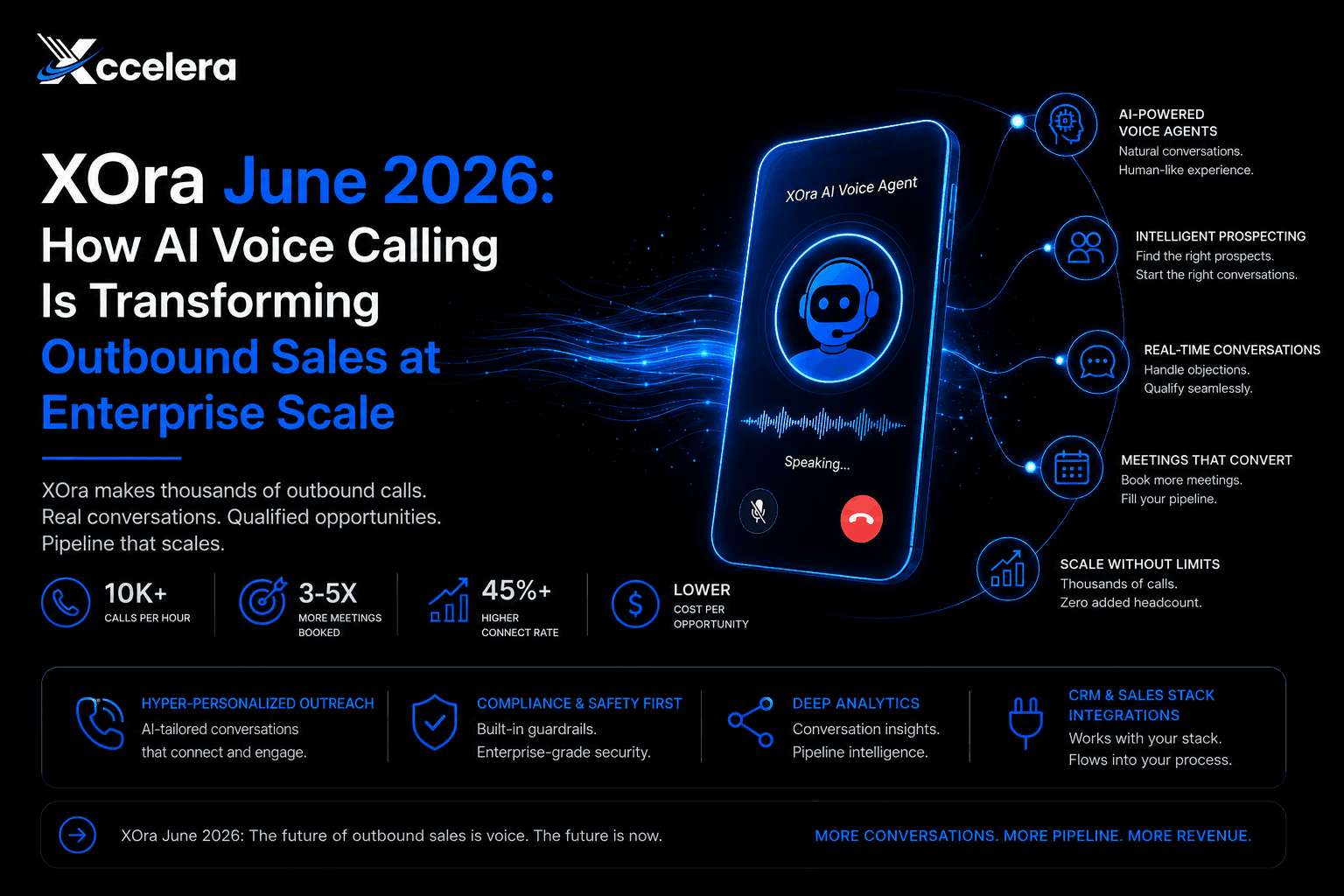
Enterprise outbound sales is running out of runway on the human-only model. SDR teams are expensive, inconsistent, and physically capped at the volume modern pipeline demands. AI voice agents have moved from pilot programs into production infrastructure, and the organizations deploying them at scale are pulling ahead. XOra, Xccelera’s enterprise Voice Agent, represents what that shift looks like when it is engineered correctly: sub-second latency, real-time CRM execution, multi-language support, and a compliance architecture built for regulated outbound environments.
The Outbound Sales Model Is Broken. AI Voice Is the Fix.
Every enterprise sales leader understands the math problem hiding inside a human SDR program. A median SDR in the US carries an OTE north of $85,000. That same rep makes 40 to 80 dials per day, reaches a fraction of those contacts, and qualifies fewer still. The pipeline output per dollar of labor cost is, therefore, structurally inefficient at any meaningful scale.
Why Traditional Systems Fail to Solve It
Legacy auto-dialers and IVR systems addressed volume without addressing intelligence. They could place more calls but could not handle context, objections, or qualification logic. As a result, the outcome was high call rates paired with poor conversion, which burned prospect lists and damaged sender reputation simultaneously.
The shift to AI voice agents changes the equation entirely. As of Q1 2026, between 28 and 34 percent of mid-market and enterprise B2B sales teams have deployed at least one AI voice agent for outbound prospecting, up from 11 percent in 2024. That adoption curve is not driven by novelty.
It is driven by numbers: pipeline teams that automate initial outreach and qualification remove the highest-friction, lowest-yield activity from their SDR workload while running concurrent call volumes that human teams cannot replicate. This is precisely why AI automation has become a strategic priority rather than an experimental investment for enterprise sales organizations.
How Enterprise AI Voice Agents Actually Execute a Sales Call
The architecture powering a production-grade AI voice call operates across four interdependent layers. Understanding this stack is, consequently, what separates informed buyers from teams that deploy underpowered tools and wonder why results disappoint.
The Four-Layer Execution Stack
Automatic Speech Recognition (ASR): The agent listens to the prospect in real time. Whisper-class ASR systems transcribe spoken audio into structured text with high accuracy across accents and background noise environments.
LLM Intent Extraction: The transcribed input passes to a large language model that identifies intent, sentiment, and required response logic. This is where context from previous call segments, CRM history, and pre-loaded qualification criteria gets applied dynamically.
Neural Text-to-Speech (TTS): The generated response converts back to natural-sounding voice output. Premium neural TTS systems are now rated “natural or very natural” by 61 percent of listeners in blind tests, compared to 34 percent for standard TTS.
Live CRM Execution: While the conversation continues, the system writes outcomes, updates lead scores, logs transcripts, and triggers next-step workflows in the connected CRM — without waiting for the call to end.
The critical performance variable across this stack is latency. Sub-800ms end-to-speech response time is the threshold for conversational naturalness. Above 900ms, dead air creates friction that prospects interpret as system confusion. Only approximately 30 percent of deployments currently achieve sub-800ms consistently, which makes latency a genuine enterprise differentiator, not a marketing specification. This technical depth is also what distinguishes purpose-built AI agent integration from off-the-shelf dialer bolt-ons.
The Numbers Behind AI Voice Calling in 2026
The market data in 2026 validates what early adopters demonstrated in 2024 and 2025. The global AI voice agent market crossed $4.8 billion in 2026, expanding at a 38 percent CAGR. Furthermore, over 65 percent of enterprise contact centers have deployed or are actively piloting conversational voice AI, per Forrester Research’s 2025 enterprise AI adoption report.
Performance Metrics That Are Driving Adoption
The performance metrics at the deployment level are equally compelling. AI-personalized outbound calls achieved 36 percent higher meeting conversion rates compared to generic outreach, based on Outreach’s 2025 Sales Execution dataset. Additionally, businesses automating outbound calling report a 3x improvement in agent productivity. The average enterprise payback period for a voice agent deployment sits at 2.8 months, according to IDC’s 2025 AI ROI study, and 91 percent of companies that have used AI voice agents for 12 or more months report they would increase that investment.
Critically, 73 percent of sales leaders said they plan to increase AI calling investment in 2026. Only 8 percent plan to reduce it. That asymmetry signals a clear transition point: organizations still evaluating are no longer operating from curiosity. They are, instead, operating from competitive pressure.
Compliance Is the Enterprise Battleground for AI Voice
Deploying AI voice for outbound sales is not a plug-in decision. It is, above all, a legal architecture decision. The regulatory environment governing AI-generated voice calls tightened substantially in 2025 and 2026, and the penalty exposure for non-compliance has no aggregate cap.
What the 2026 Regulatory Framework Requires
The FCC’s February 2024 ruling classified AI-generated voice as an “artificial voice” under the Telephone Consumer Protection Act (TCPA). That classification means prior express written consent is required for marketing calls to US cell phones, with penalties running from $500 to $1,500 per call. A 10,000-call outbound campaign without proper consent documentation creates up to $15 million in potential exposure.
The FCC’s one-to-one consent rule, effective January 27, 2026, eliminated the shared consent loophole. Blanket lead-list consent forms that covered multiple sellers are now functionally invalid. Each seller must, therefore, obtain individual, documented consent tied to specific metadata: date, source URL, and the product or service named on the consent form.
High-Profile Settlements That Define the Stakes
The settlement record in 2026 makes the stakes concrete. Gen Digital, parent of Norton and LifeLock, agreed to a $9.95 million settlement in January 2026 for prerecorded voice calls placed to non-customers. Hy Cite Enterprises settled for $4.75 million over a similar fact pattern in early 2026.
Any enterprise outbound program without real-time opt-out propagation, DNC list integration, and per-call consent auditability is not a sales program. It is, ultimately, a liability accumulation engine. Teams building compliant programs from the ground up should also evaluate how contact center transformation through AI conversational agents incorporates these compliance requirements by design.
CRM Integration and Sales Intelligence at Call Scale
The operational value of AI voice calling extends well beyond the call itself. Moreover, the post-call data layer is where outbound programs generate compounding intelligence that improves targeting, scripting, and forecast accuracy over time.
What Bidirectional CRM Integration Enables
Platforms with native Salesforce, HubSpot, and Microsoft Dynamics integrations write call outcomes, disposition codes, transcript summaries, and lead scores directly to contact records during or immediately after the call. That eliminates the data entry lag that distorts pipeline reporting in human SDR programs, where CRM hygiene depends on rep discipline rather than system architecture.
Conversation analytics built on call transcript data surface objection patterns across campaigns, enabling sales leaders to refine qualification scripts, adjust ICP targeting, and coach human reps on the objection categories where AI agents consistently lose. This feedback loop, in turn, turns call volume into institutional learning. According to McKinsey’s 2025 State of AI in Sales report, organizations that integrate AI-generated call intelligence into their CRM workflows achieve 22 percent higher forecast accuracy compared to those relying on manual entry.
Consent Metadata as a CRM Architecture Requirement
The consent metadata requirements under 2026 TCPA rules create an additional CRM architecture dependency. Legacy CRM systems were not built for forensic consent provenance. Enterprise deployments now require consent capture fields tied to each contact record that log source URL, timestamp, specific seller identification, and opt-out events — with real-time propagation across all downstream communication systems. Organizations that also manage AI-driven outbound optimization at scale have found that integrating consent architecture early significantly reduces compliance retrofit costs.
XOra: Xccelera’s Enterprise Voice Agent for Outbound Sales at Scale
XOra is Xccelera’s production-ready Voice Agent, purpose-built for enterprise outbound sales and customer engagement programs that require autonomous execution at scale — without sacrificing compliance, accuracy, or conversational quality.
What XOra Delivers in Production
XOra operates across the full voice call pipeline: speech input routes through Whisper-class ASR for accurate real-time transcription. LLM inference extracts intent and drives response logic, and neural TTS delivers sub-second voice output with noise cancellation active throughout. Memory-driven context allows XOra to carry information across call stages and, where configured, across follow-up interactions — removing the jarring reset that characterizes lower-tier systems.
CRM and ticketing auto-sync operates in real time. Qualification outcomes, transcript records, and next-step triggers write to connected systems during the call, not after a manual review cycle. Multi-language support extends reach across international sales motions without requiring separate deployments per market.
How XOra Fits Into Enterprise Deployment
XOra is designed to operate within the compliance architecture that enterprise outbound programs now require, with opt-out handling, disclosure logic, and audit trail generation built into the deployment framework. For organizations exploring broader autonomous AI capabilities. XOra fits naturally within multi-agent systems architectures where voice agents coordinate with backend qualification, scheduling, and CRM agents in a unified pipeline.
For organizations that have reached the structural ceiling of human-only outbound, XOra removes the headcount constraint while preserving the conversation quality that prospects expect. Xccelera deploys XOra in production environments under its standard timeline of under 7 weeks from engagement to live operation.