60% Customer Satisfaction Improvement: The Agent Experience Advantage
Customer satisfaction has stalled across industries despite heavy investment in customer experience platforms, automation layers, and omnichannel redesign. Most organizations optimize customer touchpoints while ignoring the internal service engine that determines resolution speed, accuracy, and consistency. As a result, incremental CX tweaks fail to move performance metrics in a meaningful way. A 60% customer satisfaction…

Customer satisfaction has stalled across industries despite heavy investment in customer experience platforms, automation layers, and omnichannel redesign. Most organizations optimize customer touchpoints while ignoring the internal service engine that determines resolution speed, accuracy, and consistency. As a result, incremental CX tweaks fail to move performance metrics in a meaningful way.
A 60% customer satisfaction improvement becomes realistic only when leadership shifts focus from customer interface design to agent experience architecture. When agents operate with intelligent assistance, reduced workflow friction, and contextual decision support, service outcomes improve systematically rather than sporadically.
How Agent Experience Shapes Customer Satisfaction
Customer satisfaction improves or declines based on the environment in which agents operate, not on their intent or capability. Agent experience directly determines response clarity, resolution speed, and interaction confidence.
Core Impact Areas
Tool Integration Determines Resolution Speed
When agents work within unified systems that surface customer history, policies, and recommendations in one interface, interactions become faster and more accurate. Fragmentation slows even the most capable professionals.
Workflow Design Influences Consistency
Structured, intelligent workflows guide agents through complex scenarios without increasing cognitive load. Clear process architecture ensures uniform service quality across teams and shifts.
Knowledge Accessibility Drives Confidence
Real time access to contextual knowledge reduces hesitation and escalation. Agents who trust their information deliver clearer, more decisive responses.
Decision Support Enhances Quality
Embedded AI suggestions and contextual prompts improve first contact resolution while reducing manual lookup effort. This directly lowers customer effort and increases satisfaction.
Performance Metrics Shape Behavior
Balanced KPIs that align speed with quality enable agents to focus on meaningful resolution rather than rushed ticket closure.
Customer satisfaction is therefore a reflection of agent enablement. When organizations strengthen agent experience, customer perception improves as a structural outcome rather than an accidental result.
Agent Experience Defined: Operational Value Architecture
Agent experience is the structural environment that determines how effectively service professionals translate intent into outcomes. It is not employee happiness or engagement rhetoric. It is the measurable architecture of tools, workflows, intelligence layers, and governance that enables high quality resolution at scale.
Architectural Components
Unified Service Interface
A consolidated workspace that integrates CRM data, communication channels, case history, and policy guidance into a single operational view reduces context switching and accelerates resolution accuracy.
Intelligent Workflow Orchestration
Dynamic routing, escalation logic, and guided case progression ensure that complexity is handled systematically rather than relying on individual improvisation.
Embedded Knowledge Systems
Context aware knowledge retrieval surfaces relevant articles, scripts, and compliance guidance automatically during live interactions, strengthening response precision.
AI Augmented Decision Support
Predictive suggestions, next best action prompts, and automated summarization reduce cognitive load while improving first contact resolution rates.
Feedback and Performance Visibility
Real time dashboards aligned with balanced KPIs allow agents to understand quality, speed, and satisfaction impact without conflicting incentives.
When agent experience is engineered as an operational system, customer satisfaction becomes a predictable output of structured enablement rather than a variable outcome dependent on individual effort alone.
AI and Automation: The Agent Experience Multiplier
AI and automation elevate agent experience by removing friction, compressing decision time, and standardizing execution quality across service teams. The objective is not replacement. The objective is augmentation that amplifies human capability.
Acceleration Mechanisms
Real Time Assistance
AI copilots analyze live conversations, recommend responses, surface policy guidance, and retrieve contextual knowledge instantly. This shortens handle time while preserving accuracy.
Automated Case Summarization
Interaction transcripts, call notes, and follow up summaries are generated automatically, reducing manual documentation effort and freeing agents to focus on resolution quality.
Predictive Routing and Prioritization
Intelligent triage assigns cases based on skill alignment, urgency, and historical resolution patterns, improving first contact resolution rates.
Workflow Automation
Repetitive backend tasks such as data entry, status updates, and compliance checks are automated, lowering cognitive strain and reducing human error.
Continuous Learning Loops
AI systems analyze satisfaction data and resolution patterns to refine prompts, routing logic, and knowledge recommendations over time.
When AI augments agent experience systematically, customer satisfaction improvements scale consistently rather than depending on isolated high performers. This multiplier effect creates the foundation required to achieve substantial performance gains.
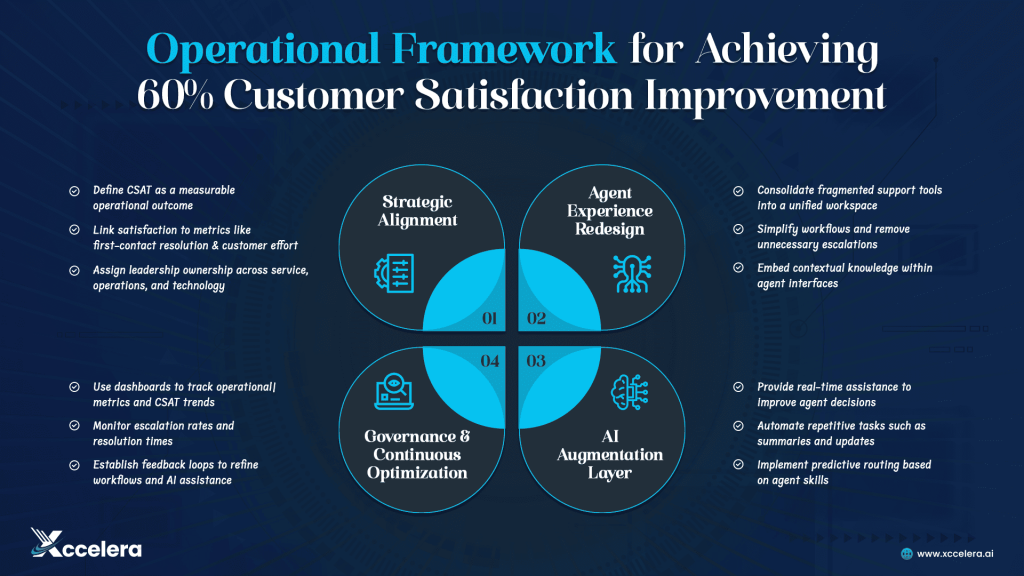
Operational Framework for Achieving 60% Customer Satisfaction Improvement
Customer satisfaction accelerates when agent experience transformation follows a structured execution model rather than ad hoc optimization.
Phase 1: Strategic Alignment
- Define satisfaction as an operational outcome tied to first contact resolution and customer effort.
- Translate CSAT targets into measurable workflow metrics.
- Assign executive ownership across service, operations, and technology functions.
Phase 2: Agent Experience Redesign
- Consolidate fragmented tools into a unified agent workspace.
- Simplify workflows to remove unnecessary approvals and escalation loops.
- Embed contextual knowledge and guidance directly into live interaction environments.
Phase 3: AI Augmentation Layer
- Deploy real time assistance that enhances decision quality without replacing human judgment.
- Automate repetitive backend tasks such as summarization and status updates.
- Introduce predictive routing aligned with skill based case allocation.
Phase 4: Governance and Continuous Optimization
- Implement performance dashboards linking operational metrics with satisfaction trends.
- Monitor escalation frequency, resolution variance, and knowledge latency.
- Establish feedback loops that refine workflows and AI prompts over time.
When executed through these structured phases, agent experience becomes a measurable performance engine. The resulting customer satisfaction improvement is systematic, scalable, and operationally sustainable rather than dependent on isolated excellence.
Conclusion: The Agent Experience Advantage
A 60% customer satisfaction improvement is not a marketing claim. It is the outcome of operational discipline. When organizations stop treating customer experience as a front end redesign exercise and start engineering agent experience as a performance system, satisfaction metrics shift structurally.
Agents do not need motivation campaigns. They need unified tools, intelligent workflows, and AI augmentation that reduces friction. When enablement improves, clarity improves. When clarity improves, resolution quality rises. When resolution quality rises, customer satisfaction follows.
The advantage does not come from replacing agents. It comes from empowering them through architecture that converts capability into consistent outcomes.