Data Governance for Agentic Systems: Why It’s Now a Board-Level Priority
Autonomous AI agents now touch sensitive data, execute transactions, and act without direct human review. Agentic AI governance has shifted from a technical afterthought to a board-level mandate. Regulators, auditors, and shareholders now demand proof that automated action stays accountable, secure, and compliant at every step of execution. Boards face direct exposure when audit trails,…
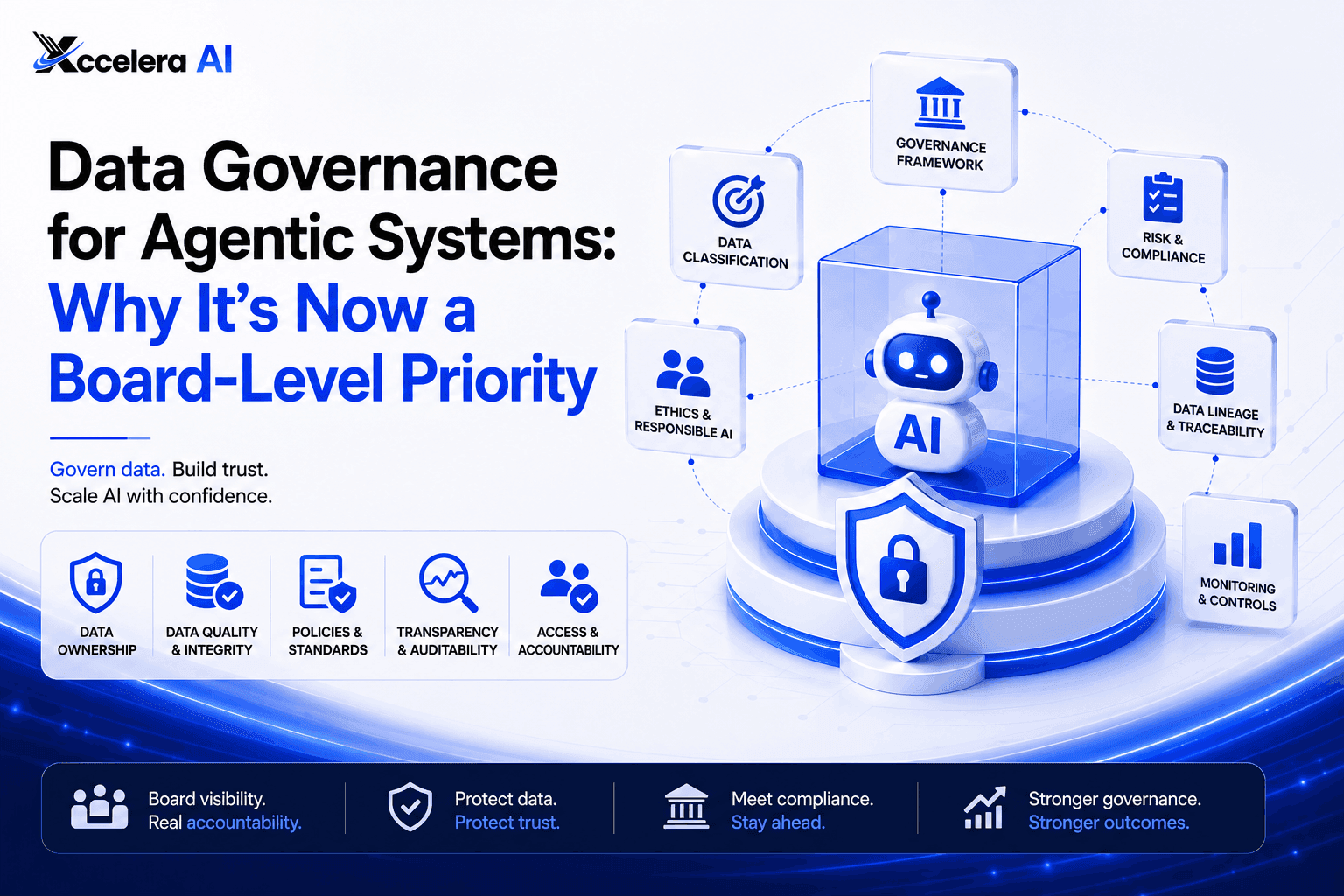
Autonomous AI agents now touch sensitive data, execute transactions, and act without direct human review. Agentic AI governance has shifted from a technical afterthought to a board-level mandate.
Regulators, auditors, and shareholders now demand proof that automated action stays accountable, secure, and compliant at every step of execution. Boards face direct exposure when audit trails, access permissions, and regulatory obligations are left ungoverned.
Enterprises that treat governance as a design requirement, not a retrofit, scale AI agents safely. Meanwhile, those that delay face compliance failures, budget overruns, and reputational damage that surface only after deployment.
AI Agent Data Governance Gaps Exposed by Autonomous Systems
Most enterprise governance frameworks were built around a simple assumption. A human requests access, a team reviews the request, and an annual audit checks for violations.
Autonomous AI agents break that assumption completely. They query databases thousands of times a day, chain decisions across systems, and act without waiting for approval.
Traditional data governance never anticipated a non-human actor operating at this speed and scale. As a result, a widening gap now separates how fast organizations deploy agents from how well they can govern them.
Data classification policies written for human users do not translate cleanly to agents that read, combine, and act on information in ways no policy document anticipated. According to Grant Thornton’s 2026 AI Impact Survey, 78 percent of executives lack confidence they could pass an independent AI governance audit within 90 days.
That imbalance is not a rounding error. It is a structural risk sitting quietly inside the automation that leadership approved for its efficiency gains. Closing this gap requires rebuilding AI agent data governance around principles where visibility, accountability, and control operate continuously rather than periodically.
Board-Level Stakes in Agentic AI Governance
Boards can no longer treat AI oversight as a technology committee issue. Autonomous agents create exposure that reaches straight into fiduciary duty. Directors who delegate this entirely to engineering teams are accepting risk they cannot see.
Directors now face direct accountability for several distinct categories of exposure:
- Financial exposure — ungoverned agents can trigger transactions or spending decisions with no ceiling in place, turning a configuration error into a material line item
- Regulatory liability — non-compliance tied to automated decision-making can carry penalties reaching into the millions, and ignorance of an agent’s behavior is not a defense
- Reputational risk — an agent acting outside its intended scope can damage customer trust faster than a legacy system failure, because the action looks deliberate even when it is not
- Shareholder scrutiny — investors increasingly ask whether governance keeps pace with automation, and that question is starting to appear in proxy statements
- Operational continuity — agents without clear escalation paths can halt critical workflows the moment they hit unexpected conditions
Each of these risks sits above the technical layer. They belong on the board agenda, reviewed on a fixed cadence, not buried inside an IT roadmap that surfaces once a year.
Audit Trails and Accountability in Multi-Agent Systems
The Attribution Problem
When one agent delegates a task to another, responsibility can blur fast. If Agent A asks Agent B to update a customer record, and that update violates policy, someone still has to answer for it.
Legal analysis on this question keeps reaching the same conclusion across multiple jurisdictions. Autonomy changes how a decision gets made, but it does not remove human accountability for the outcome. Every delegation between agents needs a clear, timestamped record of who authorized the action and why.
Tamper-Evident Logging
Standard application logs are not enough to satisfy this standard. They confirm that an API call happened, but not what the agent was reasoning through when it made the call.
A credible audit trail captures the system prompt version, the context retrieved, every tool call, and the final output, stored in a write-once format that resists alteration.
Cryptographic signatures on each log batch, combined with periodic integrity checks, keep the record defensible under scrutiny. Without that detail, a compliance team cannot reconstruct what happened during an incident.
Access Control and Permission Boundaries for AI Agents
Human access models assume stable roles and periodic reviews. AI agents break that assumption because they act at machine speed and often need permissions that shift with context.
Applying identical rules to every agent, regardless of autonomy level, tends to create two failure modes. Locked-down agents cannot do useful work, while over-permissioned agents can touch far more data than any task requires.
Enterprises correcting for this are moving toward RBAC for AI agents that treats each agent as a first-class identity, distinct from the humans who deployed it.
| Governance Dimension | Human Access Model | Agentic Access Model |
|---|---|---|
| Identity | Individual employee credential | Machine identity issued per agent |
| Review Cycle | Periodic, quarterly or annual | Continuous, evaluated in real time |
| Permission Scope | Role-based and broad | Task-scoped, minimal, and temporary |
| Oversight Trigger | Manager approval | Policy engine plus human-in-the-loop gate |
| Failure Signal | Periodic access log review | Real-time anomaly detection |
This shift mirrors the identity risks flagged in OWASP’s Top 10 for Agentic Applications, where excessive agency and identity spoofing rank among the leading threat categories.
Regulatory Pressure Reshaping Agentic AI Compliance
Regulatory frameworks built for static software are giving way to rules written specifically for autonomous systems. Enterprise leaders should track five developments closely:
- Cross-border obligations — compliance now follows where the action lands, not where the agent was built or trained
- Logging mandates — regulators increasingly require retained, retrievable records of agent decisions
- Human oversight requirements — high-risk use cases require a documented point where a human can intervene
- Sector-specific rules — financial services, healthcare, and critical infrastructure face added compliance layers
- Incident reporting — serious failures involving automated decision systems increasingly require formal disclosure
Under NIST’s AI Risk Management Framework, enterprises that build these requirements into agent design now avoid a costly retrofit later. The cost of adding compliance controls after deployment is far higher than designing them in from the start.
Cost and Risk Controls Across Agent Deployments
Governance failures are not only about data exposure. Unchecked agents can also create financial risk that catches finance teams off guard, sometimes within a single billing cycle.
Several well-known enterprises have discovered this the hard way, exhausting entire annual AI budgets within months once agents moved from pilot to production. Token consumption scales with agent autonomy, not with headcount. A single misconfigured retry loop can generate an outsized bill before anyone notices the trend.
Responsible teams pair AI risk management with financial governance from day one, rather than treating cost as a problem to solve after the fact.
Per-agent spending ceilings, real-time cost attribution by team and workflow, and automatic circuit breakers that pause runaway workflows all belong in the same control plane as security and compliance. Treating cost as a governance dimension keeps agentic AI programs sustainable as they scale.
Governance-by-Design Architecture for Enterprise AI Systems
Build Governance Into the Architecture, Not Around It
Retrofitting governance onto an agent already in production is far harder than designing it from the start. An enterprise AI governance framework built for agentic systems treats identity, permission scope, and guardrails as core design requirements, not add-on middleware.
Controls need to be observable, testable, and enforced at the point where an agent takes action, not documented after the fact in a policy binder.
Close the Loop With Continuous Oversight
Static, one-time approval does not hold up once an agent starts operating continuously across dozens of workflows. Enterprises that close the governance gap pair build-time controls with deployment checks and runtime enforcement.
Every layer, from code to production, must answer the same question. Is this agent still operating within its approved scope, right now, not just at launch? That continuous answer separates a governed agent program from a liability waiting to surface.
A Governed Path to Scaling Agentic AI
Closing the agentic AI governance gap requires infrastructure built for it from day one, not bolted on after an incident forces the issue.
Xccelera’s AI Agent Lifecycle Management Platform embeds role-based access, human-in-the-loop approval gates, full version history, and tamper-resistant audit trails directly into every agent it generates. Governance is never an afterthought bolted on late in the deployment cycle.
Enterprises gain cost visibility before committing to a deployment, and a defensible, audit-ready compliance posture from the very first release. That combination turns governance from a blocker into a genuine competitive advantage.
Learn more about how Xccelera builds governed AI agents at xccelera.ai.