Why Audit-Ready Autonomous Agents Are Now a Procurement Requirement
Enterprise AI procurement now gates on governance, not just capability. Audit-ready AI agents require built-in guardrails, audit trails, version-controlled policies, and observability from day one. They cannot be retrofitted after a compliance review. This piece examines why lifecycle management, traceability, and contractual audit rights have become the deciding factors in vendor selection, and what enterprises…
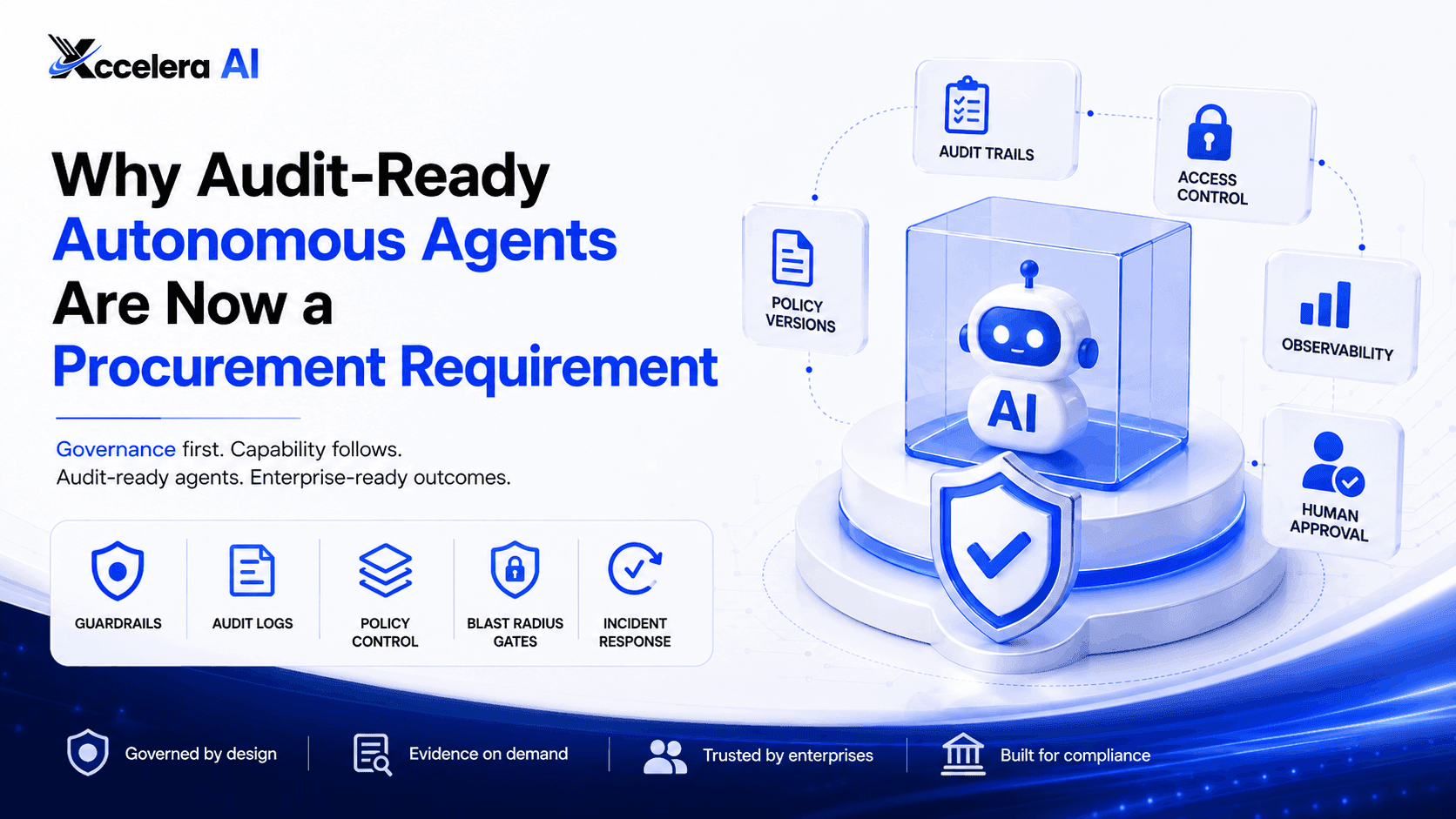
Enterprise AI procurement now gates on governance, not just capability. Audit-ready AI agents require built-in guardrails, audit trails, version-controlled policies, and observability from day one.
They cannot be retrofitted after a compliance review. This piece examines why lifecycle management, traceability, and contractual audit rights have become the deciding factors in vendor selection, and what enterprises should demand before signing.
Audit Readiness as the New AI Procurement Standard
From Capability Demos to Evidence Packages
Procurement committees in 2026 score AI agent vendors on documentation as heavily as on functionality. Teams that once led with a live demo now lead with a compliance binder.
The EU AI Act’s full enforcement window opened August 2, 2026. Organizations deploying agents that influence hiring, lending, healthcare, or legal decisions now face fines reaching €35 million or 7 percent of global turnover. That threat has reordered vendor shortlists overnight.
Why This Shift Sticks
This is not a temporary compliance scramble. Teams that stay audit-ready do not scramble when a regulator calls. Instead, they pull the relevant evidence package from a dashboard and hand it over.
That outcome requires governance built into the architecture from day one, rather than added after an audit is scheduled. Enterprises now treat audit-ready AI agents as a baseline procurement filter, not a premium feature.
The Governance Gap in Autonomous Agent Deployments
Legislative movement is widening the gap between agents built for pilots and agents built for production. Senator Mark Warner’s draft AI AGENT Act would require providers of custodial user agents to register with the FTC before accessing interfaces on large online platforms.
The draft defines these agents as software authorized to act on a user’s behalf in a transparent, documented, limited, and revocable way. Agents lacking that documented accountability trail face exclusion from entire platform ecosystems, not just individual customer contracts.
Most agent deployments still cannot answer basic accountability questions. Who approved this action? What data did the agent access? Which policy governed the decision? Enterprises evaluating audit-ready AI agents now treat these three questions as non-negotiable procurement gates.
Core Components of an Audit-Ready Agent Architecture
The Five Compounding Layers
Audit readiness is not a single control. A production agent needs guardrails, audit logs, version-controlled policies, blast-radius gates, and a documented incident response process.
A production agent missing any of the five layers will fail the first external audit, the first incident, or the first procurement review.
| Layer | Function | Procurement Signal |
|---|---|---|
| Guardrails | Blocks unsafe or out-of-scope actions | Demonstrates runtime safety |
| Audit logs | Records every decision and action | Enables evidence retrieval |
| Version-controlled policies | Tracks changes to agent rules | Shows governed change management |
| Blast-radius gates | Limits scope of autonomous action | Contains failure impact |
| Incident response process | Documents recovery procedure | Confirms operational maturity |
Building for Composability, Not Retrofitting
Vendors who treat these five layers as add-ons consistently lose to vendors who build them in from the architecture stage. Buyers can tell the difference within the first technical review.
Lifecycle Management as the Foundation of Agent Accountability
Governance failures rarely originate in the model. Instead, they originate in the absence of lifecycle discipline around it. Organizations that launched pilots in 2025 with minimal audit trail infrastructure are now rebuilding the permission and logging architecture they skipped during the rush to demonstrate capability.
Audit trails have become the specific line item that stalls procurement. Enterprise procurement committees and legal teams require complete, queryable records of every agent action. Deployments that cannot produce this documentation cannot pass enterprise security review.
Lifecycle management, covering creation, approval, deployment, and retirement of every agent, gives enterprises a structural answer to that requirement, rather than a bolted-on log file.
Compliance Frameworks Shaping Enterprise Agent Procurement
Buyers increasingly negotiate contract language before they negotiate price. Audit rights, meaning the contractual right to inspect model and data handling on reasonable notice, now sit alongside clauses covering no training on customer data, guaranteed data exit, and a kill switch that stops a misbehaving agent at the control-plane layer.
Legal review has effectively become a parallel procurement track. Most of the risks buried in these clauses are security and legal problems that surface during procurement only because no other function is checking for them. Vendors offering audit-ready AI agents with these clauses pre-negotiated move through legal review measurably faster.
Observability, Logging, and Traceability in Agent Systems
Beyond Traditional Monitoring
Standard application monitoring was never built for autonomous decision chains. Traces reveal the exact step where an agent diverged, whether from a tool error, a misinterpreted instruction, or an unexpected reasoning branch. Logs, meanwhile, expose the internal transitions that preceded failure, including faulty assumptions or stale context.
Continuous, Not Point-in-Time, Oversight
Because agents act without constant human input, oversight has to run continuously rather than at fixed checkpoints. It cannot depend solely on design-time controls; instead, it must occur continuously and retroactively.
Traceable actions let teams confirm the agent followed approved policies, respected access constraints, and avoided prohibited operations. Observability, in practical procurement terms, is the mechanism that turns a black-box agent into an auditable one.
Vendor Evaluation Criteria for Audit-Ready Agentic AI
Enterprise RFPs have gotten specific, and generic assurances no longer pass review. Every strong RFP answer references the framework it supports, whether OWASP, NIST, ISO 42001, EU AI Act, or CSA AICM. Procurement teams score each answer as demonstrable through a live demo, an audit log export, or a runbook, rather than a verbal assurance.
Identity and access controls draw particular scrutiny. Strong vendor answers describe per-agent workload identity that is capability-scoped and time-bounded, with revocation handled atomically across the control plane, rather than identity borrowed from the end user’s own token. Vendors unable to answer these questions with artifacts, not assurances, are increasingly filtered out before the pilot stage.
Building Governed Agent Ecosystems for the Enterprise
Audit-ready AI agents are no longer a differentiator reserved for regulated industries. They have become the baseline expectation across procurement functions of every size.
As a result, engineering leaders evaluating agent platforms now weigh governance architecture as heavily as raw model capability. Legal teams review agent contracts with the same rigor once reserved for core infrastructure vendors.
In practice, that means the agents that scale past pilot stage are the ones built with accountability designed in from day one, not added after the first audit request arrives.
Xccelera’s AI Agent Lifecycle Management Platform builds this accountability into every agent it generates. It pairs production-grade code with six layers of embedded security guardrails, full audit trails, human-in-the-loop approval gates, and role-based governance from the first line.
Learn more at xccelera.ai.