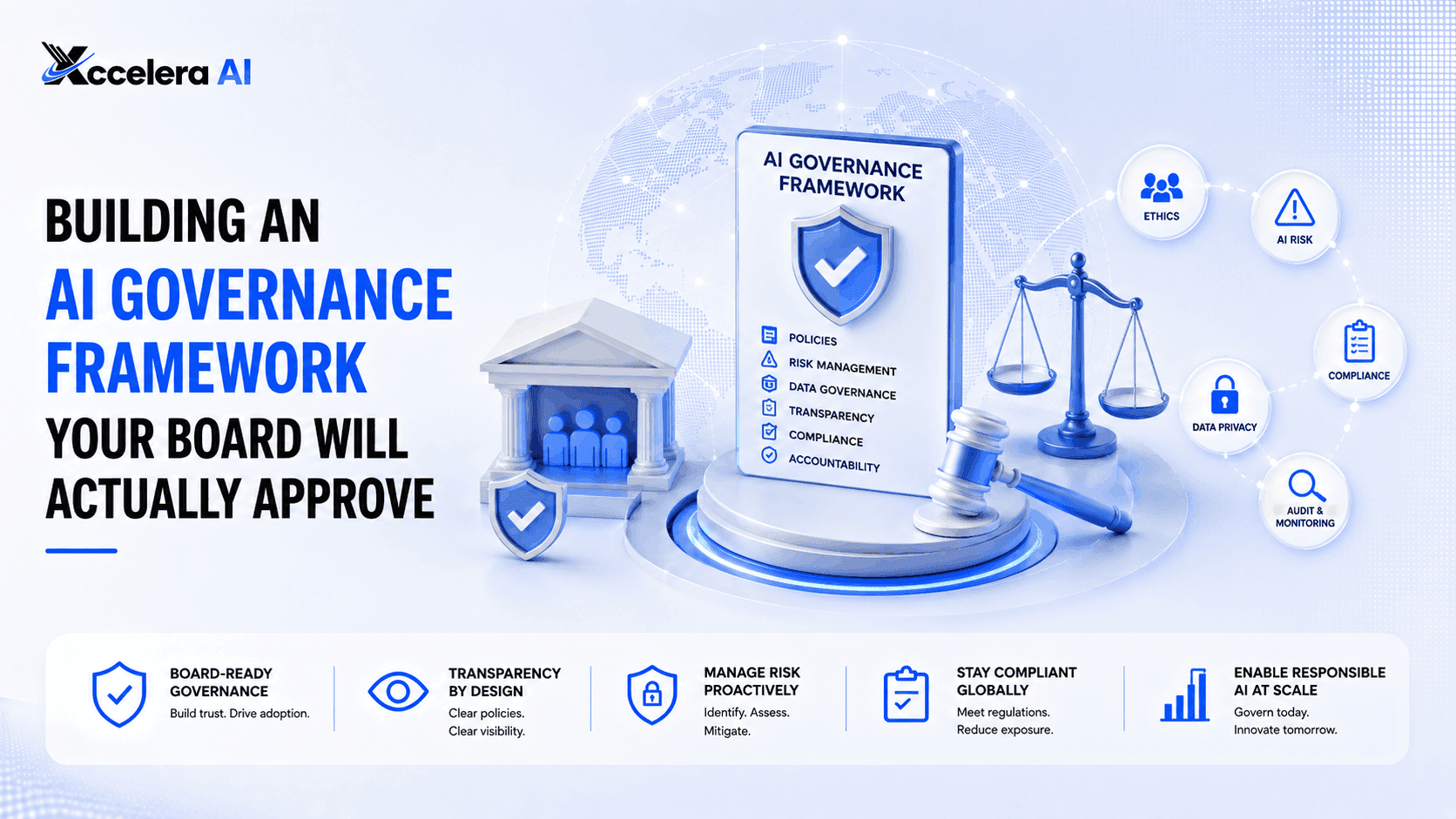
Building an AI Governance Framework Your Board Will Actually Approve
Every board conversation about artificial intelligence now ends with the same question. Who is accountable when something goes wrong? An AI governance framework answers that question before regulators, auditors, or customers ask it first. Enterprises that scaled AI adoption without formal oversight are now retrofitting controls under deadline pressure. Boards are no longer satisfied with…
Every board conversation about artificial intelligence now ends with the same question. Who is accountable when something goes wrong?
An AI governance framework answers that question before regulators, auditors, or customers ask it first. Enterprises that scaled AI adoption without formal oversight are now retrofitting controls under deadline pressure.
Boards are no longer satisfied with vendor assurances alone. Directors want documented decision rights, risk classifications, and a governance structure that holds up under scrutiny. Building one that actually gets approved requires more than a policy document. It requires operational controls that engineering, legal, and security teams can execute without slowing the business down.
The Board’s New AI Accountability Problem
Boards used to treat AI oversight as a technology committee matter. That has changed. Directors now carry personal exposure when AI systems make consequential decisions without documented controls, and regulatory deadlines have compressed the timeline for action.
Why Directors Are Asking Harder Questions
Most enterprises still lack a mature governance structure, even as AI moves deeper into production workflows. In fact, Grant Thornton’s 2026 AI Impact Survey found 78 percent of executives lack strong confidence they could pass an independent AI governance audit within 90 days.
Boards increasingly demand evidence, not intentions. That means a classified system inventory, named decision owners, and a reporting cadence they can act on. This shift turns governance from a compliance artifact into a strategic asset the business can point to under scrutiny.
The Cost of Waiting
Organizations without a formal framework tend to discover gaps reactively, usually after an incident or a customer security questionnaire. Retrofitting governance under pressure costs more than building it deliberately. It also rarely satisfies a skeptical board on the first pass.
Building Blocks of an Enterprise AI Governance Framework
A credible AI governance framework rests on a small number of durable components, rather than a sprawling policy binder:
- A classified inventory of every AI system in production, including who owns it and what data it touches
- Documented decision rights that specify who can approve which risk tier without escalation
- Technical controls mapped to each risk level, not a single blanket policy
- An audit trail that survives regulator, insurer, and customer review
- A board reporting cadence that turns governance into a recurring discipline, not a one-time filing
Enterprises that treat these as a connected system, rather than five separate initiatives, move through approval cycles faster. They also defend their AI program with far less friction.
Closing the Governance Gap in AI-Generated Code
AI-generated code now makes up a substantial share of what enterprises ship. Yet it has quietly become one of the largest blind spots in AI governance programs. Independent security research on AI-generated code from public repositories consistently finds meaningfully higher defect rates than in hand-written code, with overly broad permissions and missing input validation among the most common issues.
The core problem is not that the code fails outright. Instead, it passes surface-level review because it looks syntactically correct. As a result, developers apply less scrutiny to it than to code they wrote themselves, and vulnerabilities move into production faster than review processes can catch them.
Governance frameworks that stop at model policy and skip the backend code layer leave this exposure completely unaddressed.
Mapping AI Risk Tiers to Approval Authority
Not every AI system carries the same risk. Treating them identically either slows down low-risk work or under-scrutinizes high-risk work. A tiered model solves both problems at once.
| Risk Tier | Example Use Case | Approval Authority |
|---|---|---|
| Low | Internal drafting tools, content suggestions | Team lead, standard review |
| Moderate | Customer-facing chat, workflow automation | Business unit + governance lead |
| High | Automated decisions affecting customers or finances | Governance committee + legal |
| Critical | Backend code generation, infrastructure changes | CISO, governance committee, board visibility |
This structure gives low-risk work a fast path. Meanwhile, it ensures the systems with the widest blast radius, including AI-generated backend code, get the scrutiny their risk profile demands.
Converting Governance Policy Into Enforceable Controls
A policy document does not stop a vulnerable deployment. Enforced controls do. Translating governance policy into operational reality follows a consistent sequence across mature programs:
- Assign a named owner and risk tier to every AI system before it reaches production
- Require a security review tier based on risk level, regardless of who or what authored the code
- Extend existing SecDevOps tooling to cover AI-generated and agent-modified code specifically
- Build monitoring that flags privilege escalation and permission scope creep automatically
- Route any control failure back to the governance committee, not just to the engineering team
Skipping any one of these steps tends to produce a governance framework that looks complete on paper. However, it breaks down at the point where AI actually touches production systems, a gap OWASP’s Top 10 for Agentic Applications flags repeatedly.
Building Audit-Ready AI Reporting for the Board
Boards do not need every technical detail. Instead, they need a report that proves the framework is functioning, not just documented.
Effective reporting tracks a small number of indicators consistently:
- Systems added to the inventory
- Approvals granted by risk tier
- Control failures caught before deployment
- Time to remediate identified issues
Presented quarterly, this turns governance from a static policy into a visible operating discipline the board can question and trust. It also gives legal and compliance teams a defensible record when regulators or enterprise customers request evidence of oversight. NIST’s AI Risk Management Framework offers a widely referenced structure for building exactly this kind of continuous, measurable oversight.
Governance at the Backend: Securing Where AI Actually Writes Code
Governance frameworks often stop at the model and application layer, leaving the backend code generation process itself outside the controls. That gap matters, because backend systems carry the credentials, data access, and infrastructure permissions that create the highest blast radius when something goes wrong.
Closing it requires governance controls built directly into the code generation workflow: permission scoping enforced by default, dependency and vulnerability checks running before code reaches review, and full traceability from generated code back to the system and owner responsible for it.
Treating backend code generation as a governed process, not an unmonitored productivity tool, is what separates a framework that satisfies a board from one that only satisfies an audit checklist.
Scaling AI Governance Without Slowing the Business
The programs that scale successfully share one trait. Governance and delivery speed get designed together, rather than traded off against each other.
Fast approval paths for low-risk systems free up scrutiny for the systems that actually warrant it. Automated controls catch issues before they reach a human reviewer, which keeps the governance committee focused on judgment calls rather than routine checks.
As AI adoption expands across more of the software delivery lifecycle, the enterprises that built governance as infrastructure, rather than paperwork, are the ones still moving quickly a year later. That is the framework a board will approve on the first pass, and keep approving as AI’s footprint keeps growing.
Building Governance Into the Code Itself
Enterprises building this kind of governance need backend code generation that treats security and permission scoping as defaults, not afterthoughts.
Xccelera’s AI Backend Code Generation Engine embeds governance controls directly into how backend code gets written, closing the exact gap boards are asking about.
Learn more at xccelera.ai.