The Monitoring & Evidence Agent Layer: How Xccelera Validates Every Output Before Production
Unvalidated AI output is the single greatest operational risk in enterprise agentic deployment. As autonomous agents move from pilots into production, organizations that cannot verify and govern every output in real time face regulatory exposure and silent failures. These failures surface only after damage is done. Xccelera’s Monitoring and Evidence Agent layer closes that gap…
Unvalidated AI output is the single greatest operational risk in enterprise agentic deployment. As autonomous agents move from pilots into production, organizations that cannot verify and govern every output in real time face regulatory exposure and silent failures. These failures surface only after damage is done. Xccelera’s Monitoring and Evidence Agent layer closes that gap before a single unverified output reaches production.
The Output Problem Nobody Talks About
Every enterprise conversation about AI agents in 2025 and 2026 centers on deployment velocity, cost reduction, and workflow automation. Almost none center on what happens when the agent is wrong and nobody catches it. This blind spot is, consequently, where the most significant operational risks accumulate.
The Scale of the Problem
AI hallucinations cost businesses $67.4 billion globally in 2024. Analysts project that figure to exceed $112 billion in 2025 as agentic adoption accelerates. The number breaks down into direct financial losses, operational cleanup costs, and reputational damage that compounds over time.
Beyond the headline figure, the average AI user spends 4.3 hours per week verifying AI outputs. That verification tax runs approximately $14,200 per employee annually. For a 500-person enterprise, that amounts to $7.1 million spent annually checking the AI’s work instead of acting on it. This overhead is precisely what purpose-built agentic AI solutions are designed to eliminate through systematic output governance rather than manual spot-checking.
The confidence paradox makes this considerably worse. MIT researchers confirmed in 2025 that AI models use 34% more confident language when generating incorrect information. The system sounds most certain precisely when it is most wrong. In agentic workflows, one output becomes the next input, so a confident error does not stay local. Instead, it propagates through the chain, degrading every downstream decision until the final output carries structural corruption from an error nobody detected at the source.
What Production Exposes That Pilots Hide
Pilots run on curated inputs and supervised environments. Production, by contrast, runs on live enterprise data, unstructured inputs, and zero tolerance for failure at scale. The 88% failure rate of custom enterprise AI projects is not a model quality problem. It is a deployment governance problem. Organizations that skip output validation in the pilot phase discover in production that retrofitting it costs more than the failures it was meant to prevent.
Why Monitoring AI Agents Is Structurally Different
Traditional application monitoring suits deterministic systems. A server is up or down. An API returns a status code. A database query either executes or fails. Every outcome is binary and traceable. AI agent monitoring, however, operates in an entirely different paradigm and demands a fundamentally different approach.
The Probabilistic Output Problem
AI agents generate probabilistic outputs across dynamic, multi-step tool chains. An agent can execute correctly at step one, incorporate a retrieval error at step two, and pass that error as grounded context into step three. The final output is fluent, confident, and factually wrong. No status code flags it. No exception is thrown. Every step shows successful execution in the log. The output is silent failure dressed as a completed task.
According to Braintrust’s 2026 analysis of AI agent observability, 79% of organizations have deployed AI agents. Most, however, cannot trace failures through multi-step workflows or measure output quality systematically. The monitoring tools that traditional software teams rely on cannot evaluate whether an agent’s reasoning chain was sound. Neither can they determine whether retrieved context was accurate or whether final outputs align with enterprise policy constraints. This gap receives detailed treatment in Xccelera’s guide to securing AI agents with identity, access control, and monitoring.
The Production Reality
Only 11% of AI agent pilots reach full production deployment. The organizations that succeed share one architectural commitment: they instrument the agent execution layer with dedicated observability before scaling, not after the first production incident forces it.
Cisco ThousandEyes published a 2025 analysis of AI agent monitoring in production environments demonstrating that continuous assertion-based monitoring is the only mechanism capable of detecting subtle performance degradations as models update. Periodic log reviews simply cannot perform this function. The timing variable is, therefore, the entire difference between prevention and remediation.
The Immutable Audit Trail Imperative
Regulatory frameworks are no longer aspirational guidance documents. Enterprises now treat them as enforcement instruments with defined evidence requirements that autonomous systems must satisfy before operating legally in regulated contexts.
What Regulators Now Require
The EU AI Act Article 10 explicitly mandates governance of data quality, provenance, and sensitivity before AI deployment. NIST launched the AI Agent Standards Initiative in February 2026 to establish security controls, identity governance, and risk management frameworks for autonomous agents. HIPAA requires compliance documentation retention for a minimum of six years. Additionally, PCI-DSS v4.0, NIST AI 600-1, and MITRE ATLAS all demand proof of controls and continuous monitoring of agent actions, tool invocations, and data access.
KPMG’s 2025 AI governance framework specifies six implementation requirements. Enterprises must maintain unique agent identifiers for attributability, immutable audit trails of agent interactions, ongoing threshold monitoring with alert mechanisms, multi-agent cascade failure prevention, fail-safe shutdown protocols, and fallback procedures for terminated agents. These requirements are not design suggestions. They represent the minimum viable governance architecture for regulated enterprise deployment.
The Identity Governance Gap
BigID’s 2026 analysis identifies a gap most enterprises have not yet confronted. AI agents now perform actions equivalent to privileged users, reading records, executing transactions, and interacting across systems. Most organizations have no visibility into which agents exist, what data those agents access, or what permissions they hold. An audit trail covering only the output layer, therefore, misses the entire upstream chain of data access that produced the output.
ISACA’s 2025 industry analysis frames this challenge directly: the audit function must answer why an action occurred, not simply who performed it. This distinction becomes especially critical when an AI system makes the decision autonomously rather than a human operator following a documented workflow. Without an immutable evidence layer covering inputs, tool calls, retrieved context, reasoning traces, and final outputs, that question has no defensible answer. This requirement proves especially acute for organizations operating custom AI agents across regulated workflows, where accountability chains must extend from the first tool invocation to the final delivered output.
Real-Time Surveillance vs Post-Hoc Review: Why Timing Is the Variable That Matters
The difference between catching a failure and discovering it after the fact is not a question of tooling sophistication. It is fundamentally a question of when the monitoring function runs.
The Continuous Posture Problem
Levo.ai’s 2026 analysis documents a structural reality that static governance approaches cannot address. Prompts change, teams add tools, and agent autonomy expands continuously in production environments. Compliance posture drifts not through deliberate misconfiguration but through incremental operational changes that each appear individually minor. Quarterly reviews cannot, therefore, detect drift that accumulates daily across hundreds of agent interactions.
The attack surface compounds this problem further. Bessemer Venture Partners’ March 2026 analysis confirmed that Model Context Protocol vulnerabilities, prompt injection attacks, and data exfiltration through AI agents are no longer theoretical risks. Engineers have documented these as active production incidents. Furthermore, Gartner projects 40% of enterprise applications will embed task-specific agents by the end of 2026, up from under 5% in 2025. The surface area requiring continuous surveillance is expanding faster than the governance frameworks covering it.
What Real-Time Surveillance Catches That Periodic Reviews Miss
The OWASP State of Agentic AI Security and Governance 2026 report documents confirmed production incidents, vendor advisories, or assigned CVEs across nearly every category in the OWASP Top 10 for Agentic Applications. Supply chain compromise and code execution categories carry the highest volume of disclosed incidents. These are not edge cases. They are consistent patterns in environments where teams monitor agent behavior only periodically.
Real-time output surveillance intercepts these patterns at the point of occurrence. A monitoring layer evaluates each output against defined accuracy, policy, and safety thresholds, blocking non-compliant outputs before they reach downstream systems or human decision-makers. This approach converts what would otherwise be a production incident into a flagged event with a defined response protocol. Moreover, this principle underpins how Xccelera’s multi-agent systems embed governance at each inter-agent boundary rather than applying it retrospectively at the workflow exit point.
The Evidence Agent Layer: Turning Every Output Into a Verifiable Record
An audit trail covering only the final output is not a true audit trail. It functions as a receipt without a transaction history. The Evidence Agent layer, by contrast, captures the full chain of execution from input context to final delivered result.
What the Evidence Layer Captures
Per-step provenance is the mechanism that makes output verification possible. Microsoft Research’s VeriTrail paper, published in early 2026, confirmed that hallucination detection in agentic workflows requires per-step provenance because errors propagate through chains. A single upstream planning hallucination cascades into downstream tool calls, and without a complete execution record, teams cannot trace those failures back to their source.
Dynatrace’s 2025 analysis of AI governance infrastructure identified the required components as end-to-end lineage of model and user interactions, retention controls aligned to the governing regulatory framework, and evidentiary records that remain audit-ready for the full required retention window. Immutable logging adds 5 to 10 milliseconds per call and approximately 15% monthly storage growth for high-volume deployments. That overhead represents the measurable cost of defensibility, and it is justified against the alternative of undetected output failures compounding silently across production workflows.
Source-Grounding as a Validation Mechanism
Agentman’s 2026 analysis confirms that contextual grounding through retrieval and source citations cuts hallucination rates 30% to 50% across enterprise use cases. On source-grounded summarization tasks specifically, hallucination rates drop below 2%. Rather than merely recording what an AI system outputs, the Evidence Agent links every output to the source context that grounded it. At the record level, this surfaces whether the output drew support from retrieved evidence or was generated without grounding. That distinction is, ultimately, the difference between a defensible output and a liability.
Evidence pipelines built for regulator-parseable formats remove the custom tooling requirement that makes compliance demonstrations expensive. When a regulator requests proof of what an agent did with specific data, the evidence layer produces a structured, timestamped, complete record without requiring forensic reconstruction from fragmented logs. For enterprises operating across digital transformation programs at scale, this capability removes one of the most significant governance blockers to autonomous agent expansion.
How Xccelera Deploys the Monitoring and Evidence Layer in Enterprise Environments
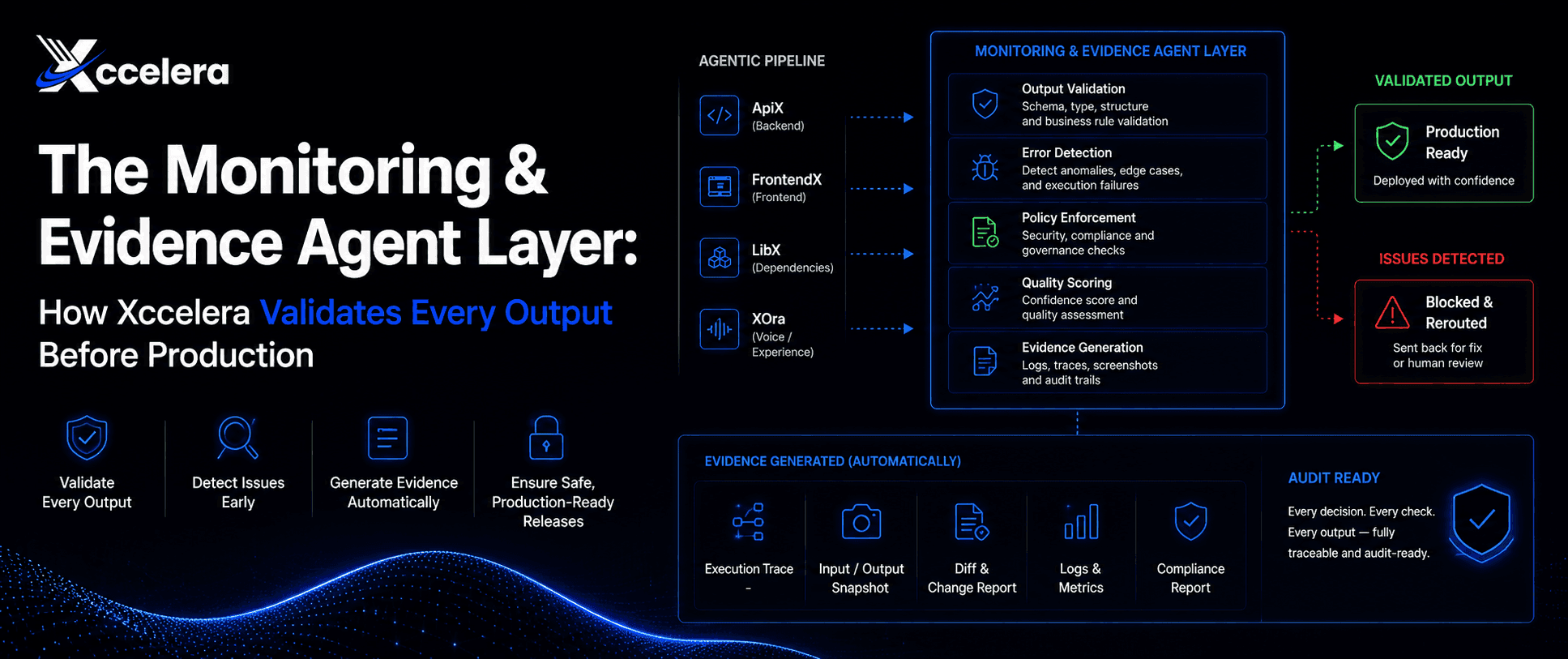
Production-grade agentic AI requires a governance stack that operates at the speed of the agents it governs. Xccelera deploys the Monitoring Agent and Evidence Agent as a coordinated layer sitting above the execution infrastructure and below the human review threshold. This structure validates every output before it reaches production without introducing latency that degrades deployment velocity.
The Architecture
The Monitoring Agent performs real-time output surveillance across active agentic workflows, evaluating outputs against accuracy thresholds, policy constraints, and safety parameters established during the deployment design phase. Anomalies trigger immediate flags for human review. Outputs falling outside defined tolerance bands are blocked before they propagate downstream.
Running in parallel, the Evidence Agent captures the full execution record for every workflow: input context, retrieved source material, tool invocations, model reasoning trace, and final output. Every record receives a timestamp and goes into immutable storage within the enterprise’s own environment.
Together, these two components answer the questions that regulators, audit committees, and legal teams require: what did the agent do, and why did it do it. Xccelera aligns this architecture against SOC 2, HIPAA, PCI-DSS, and EU AI Act requirements from the outset, building compliance into the production infrastructure rather than retrofitting it after the first audit finding. This governance-first approach also shapes how Xccelera’s AI agent consulting practice structures enterprise engagements from initial scoping through live deployment.
Proof Points That Matter
Xccelera delivers production-ready agentic systems in under 7 weeks from concept to live deployment. Enterprises deploying the Monitoring and Evidence layer report up to 35% reduction in operational costs tied to AI output remediation, verification overhead, and compliance preparation. Additionally, workforce productivity improves up to 40% when teams operate with validated AI outputs at the decision-making layer, eliminating the 4.3-hour weekly verification tax entirely.
The governance layer does not slow the agent stack. Rather, it makes the agent stack trustworthy enough to scale. Organizations deploying AI automation without output validation are not moving faster. They are accumulating liability at the velocity of their agents. Xccelera closes that gap before production, not after the incident that makes it impossible to ignore.