Service as Software: How Xccelera Replaces SaaS with Outcomes
Enterprise software spending rests on a flawed premise. Companies paid for access to features and trusted that adoption would follow. However, that trust broke down as AI agents began completing entire workflows without dashboards, logins, or seat counts. Service as Software now replaces that model. Consequently, vendors charge for resolved outcomes instead of granted access.…
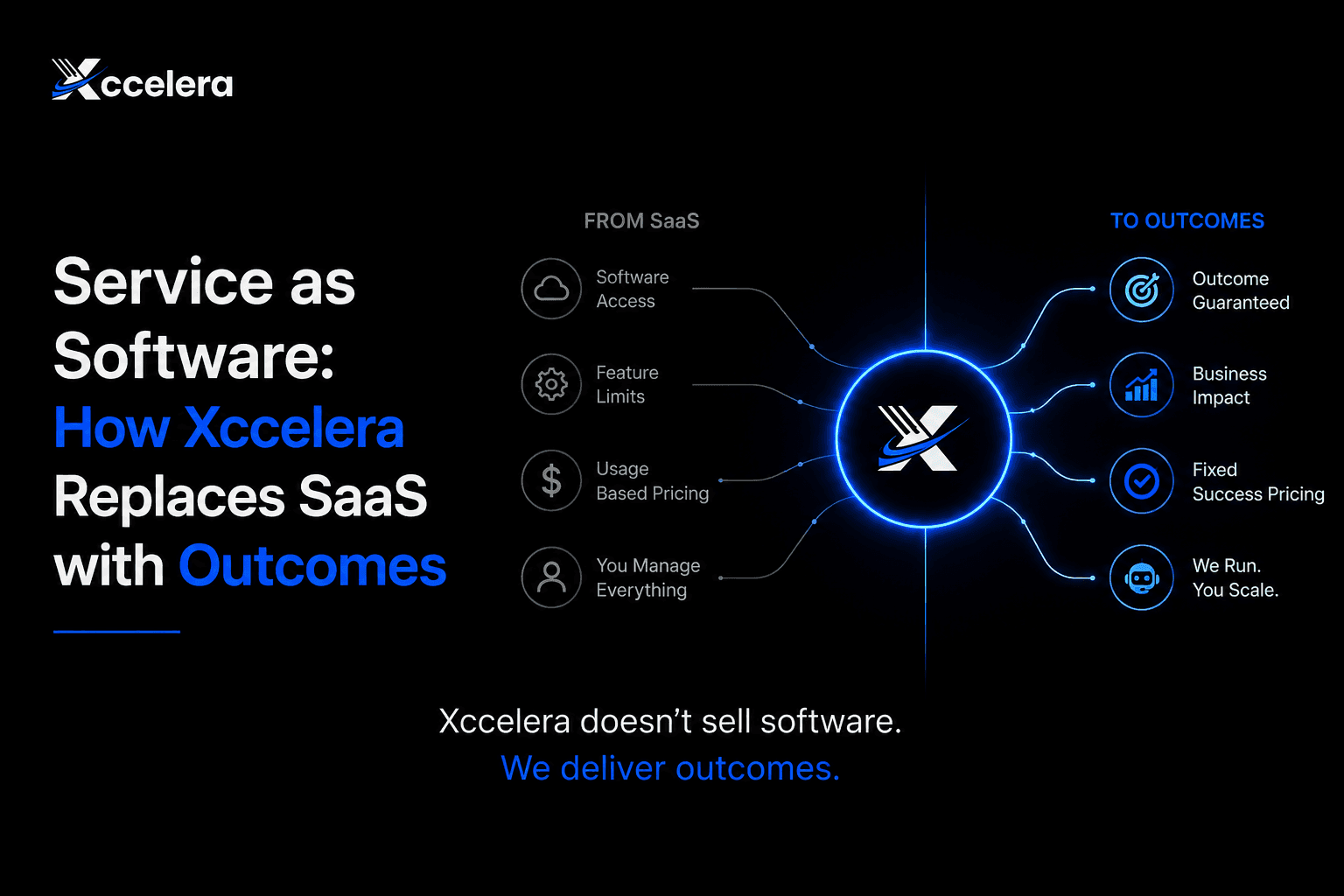
Enterprise software spending rests on a flawed premise. Companies paid for access to features and trusted that adoption would follow. However, that trust broke down as AI agents began completing entire workflows without dashboards, logins, or seat counts.
Service as Software now replaces that model. Consequently, vendors charge for resolved outcomes instead of granted access.
This shift forces CFOs, CTOs, and operations leaders to rethink procurement from the ground up. Xccelera builds the autonomous execution layer behind this transition through accelerators and agents that deliver completed work rather than licensed tools. As a result, vendor incentives align directly with measurable business results.
SaaS Was Never Built to Sell Outcomes
The per-seat licensing model emerged from a simple assumption. Software was a tool humans operated, so pricing followed the number of humans with access. That assumption held for two decades because no alternative existed.
Workflows required human judgment at every step. Therefore, software vendors had no mechanism to price the judgment itself, only the access to the interface supporting it.
That assumption collapsed in early 2026. Software stocks lost over a trillion dollars in market capitalization in a single week, according to Reuters, as investors recognized that AI agents could complete the work software was meant to support. Crucially, no human needed to sit in front of it.
The sell-off was triggered by the rapid pace of AI agent innovation. Meanwhile, the market kept betting on a massive shift in how work gets done, alongside the ongoing perception that AI threatens to replace software workflows.
The Mismatch Between Payment and Value
Enterprises had quietly tolerated this mismatch for years. In December 2024, Microsoft CEO Satya Nadella declared on the BG2 podcast that “SaaS is dead,” a comment that set off a shockwave across the technology industry.
The provocation stuck because every CFO had seen the same pattern internally:
- Licenses purchased for entire departments
- Utilization rates far below expectations
- Renewal conversations that focused on contract terms rather than delivered value
Today, enterprises spend tens, if not hundreds, of millions of dollars on SaaS software for core capabilities across front, middle, and back office workflows. Global SaaS spending is projected to rise from $318 billion in 2025 to $512 billion by 2028, according to Gartner. That spending trajectory no longer matches the trajectory of value delivered, and boards are starting to ask why.
What Service as Software Actually Means
Service as Software does not eliminate software. Instead, it changes what the customer is buying. Rather than purchasing a license to operate a tool, the enterprise purchases the completed result that the tool used to require a human to produce.
Service as Software delivers results instead of tools. In this model, the customer pays for outcomes, not features, dashboards, or workflows, and the software becomes invisible while the service becomes the product.
The interface that once defined enterprise software, the login screen, the dashboard, the report export, now disappears behind the result itself. For instance, a finance leader does not need to see a reconciliation workflow executed. Instead, they need the reconciliation completed and verified.
This does not mean legacy SaaS vanishes overnight. In fact, traditional enterprise software continues to grow as it becomes more intelligent, agentic, and outcome-focused. Established players are moving to become full-stack, end-to-end agentic platforms that can build, run, orchestrate, and govern agents across functions.
The market is therefore bifurcating between two groups: vendors who bolt agentic features onto existing seat-based products, and vendors architected from the outset to deliver outcomes directly. According to McKinsey, sophisticated workplace agents could make the traditional business software model obsolete altogether.
Outcome-Based Pricing Replaces the Per-Seat Model
The pricing mechanism is where this shift becomes concrete. Seat-based pricing dropped from 21 percent of companies to just 15 percent in a single year. Moreover, companies that stick with traditional per-seat pricing for AI products see 40 percent lower gross margins than competitors using outcome-based or usage-based models. That margin gap is not a rounding error; rather, it reflects a fundamental change in what buyers will pay for.
Concrete examples now anchor this trend in real contracts:
- Intercom charges $0.99 each time its Fin AI agent fully resolves a customer issue
- Zendesk launched outcome-based pricing for its AI agents at $1.50 per automated resolution on committed volume
Neither vendor charges for a failed attempt. The buyer pays only when the work is actually done.
This pricing logic extends well beyond customer support. Salesforce, ServiceNow, and SAP are all adopting outcome-based AI pricing models as the traditional per-seat SaaS model loses relevance. Notably, SAP CEO Christian Klein stated it would be foolish to still charge subscription-based pricing, since AI is now powerful enough to automate a large share of tasks. When a company that built its valuation on per-seat ERP licensing says that publicly, the shift moves from prediction to strategy.
Enterprises Are Already Building Their Way Out of SaaS
Procurement teams are not waiting for vendors to finish their pricing transitions. Instead, many are choosing to build internally rather than continue licensing point solutions that no longer justify their cost.
Thirty-five percent of enterprises have already replaced the functionality of at least one SaaS tool with a custom build, and 78 percent expect to build more of their own tools in 2026. That data point matters because it shows the displacement is not theoretical.
Operations leaders across engineering, finance, and IT are actively replacing subscriptions with internally generated, agent-built systems. A majority report doing so outside formal IT oversight, which signals how decentralized this shift has become.
Investors are reaching the same conclusion from a different angle. AI economics differ fundamentally from SaaS because every AI query incurs real compute costs. Consequently, companies see 50 to 60 percent gross margins, compared to 80 to 90 percent for traditional SaaS, according to a16z. Hybrid pricing models that combine a base subscription with usage or outcome tiers tend to win when buyers remain uncertain about future volume.
The Governance Gap Outcome-Based AI Still Has to Close
Outcome-based pricing is not without friction, and enterprise buyers should approach it with clear eyes. The central challenge is attribution: isolating exactly what an agent caused within a complex system of CRM data, routing logic, and downstream processes.
AI agent performance never lives in isolation. It depends on CRM systems, routing logic, agent training, and process design. Yet outcome-based pricing tries to treat this multi-variable system as a single-variable bill. This approach runs directly into the problem that outcomes cannot always be perfectly specified or attributed.
Therefore, enterprises that adopt outcome-based vendors without contractual clarity on what counts as a resolved outcome risk recurring disputes over invoices rather than recurring value.
Accounting and finance teams are catching up to this complexity as well. Because traditional per-seat or flat-fee pricing models may not adequately reflect delivered value, vendors increasingly adopt outcome-based pricing. Under this model, customers pay only when the agent successfully completes a defined task, such as resolving a customer service ticket or processing a specified data volume.
How Xccelera Delivers Service as Software for the Enterprise
Xccelera was built around this transition rather than retrofitted to fit it. Each accelerator in the portfolio is priced and delivered as a completed outcome, not a licensed seat.
- ApiX generates backend infrastructure, including database setup and full endpoint testing, with pricing tied directly to the run rather than the number of engineers who access it.
- FrontendX converts Figma designs into production-ready React applications under the same pay-per-run structure, eliminating the seat-based billing that traditional design-to-code platforms still rely on.
- LibX applies this same logic to security remediation. Instead of billing for dashboard access, it scans repositories for vulnerabilities, patches dependencies, resolves test failures, and opens merge-ready pull requests, with value measured in CVEs closed rather than licenses issued.
- XOra extends that principle into voice-driven support and sales, functioning as continuous digital labor rather than a seat-licensed call center tool.
As agents take over discrete units of work, such as resolving a support ticket, drafting a contract, or booking a meeting, the natural pricing unit becomes the outcome achieved. Gartner projects this shift will reach 40 percent of enterprise applications by the end of 2026.
This is the structural difference between bolting AI onto a SaaS product and building Service as Software from the foundation up. AI agents are doing to SaaS what SaaS once did to license-based software: changing the value perception so buyers now judge agents by the workflows they complete, not the access they are granted.
Xccelera positions enterprises on the correct side of that shift, replacing software that must be operated with outcomes that simply arrive. Explore the full accelerator and agent portfolio to see how this works in practice, or visit our blog for more insights on agentic transformation.


