Why the Best Engineering Teams in H1 2026 Replaced Sprint Boilerplate With AI Agents
In H1 2026, top engineering teams stopped writing boilerplate manually. Instead, AI agents now scaffold code, generate tests, and clear sprint backlogs autonomously. For engineering leaders, this shift is less about tooling and more about execution architecture. As a result, teams restructured around agentic workflows are shipping faster, with smaller pods and fewer coordination bottlenecks.…
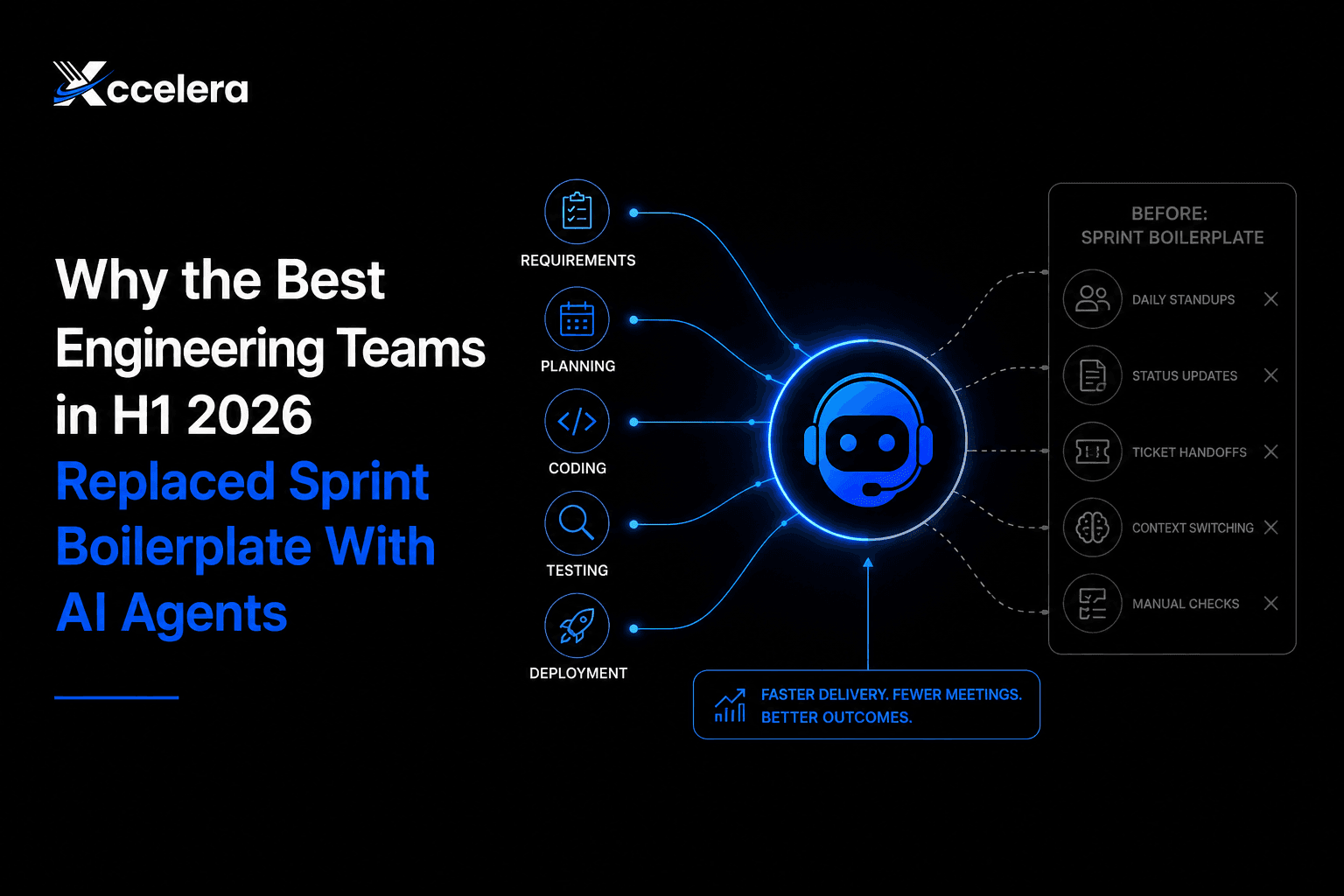
In H1 2026, top engineering teams stopped writing boilerplate manually. Instead, AI agents now scaffold code, generate tests, and clear sprint backlogs autonomously. For engineering leaders, this shift is less about tooling and more about execution architecture. As a result, teams restructured around agentic workflows are shipping faster, with smaller pods and fewer coordination bottlenecks.
The Boilerplate Bottleneck That Was Quietly Killing Sprint Velocity
For years, engineering leadership accepted a quiet inefficiency embedded inside every sprint. Developers spent significant portions of each cycle writing scaffolding code, setting up test files, generating API stubs, and documenting predictable functions. None of that work required creativity. Yet all of it consumed time.
The Cost Was Structural, Not Incidental
The problem was never individual developer speed. Rather, it was architecture. Sprint capacity designed around human throughput naturally allocated a ceiling to implementation volume, regardless of team skill level. Consequently, a two-week sprint became a container with a fixed ceiling, and boilerplate filled that container without generating strategic value.
Research from InteligenAI, published in March 2026, captured the core dynamic: AI now enables smaller, vertically integrated engineering pods to ship complete product features in 36-hour micro-cycles, work that previously required full sprints and multiple siloed teams, according to InteligenAI. That compression was not achievable by hiring more developers. Instead, it required removing the structural drag entirely.
The second compounding factor was coordination overhead. When developers spent their mornings on boilerplate, they arrived at architecture and design reviews later in the day with less cognitive bandwidth. Therefore, code reviews queued up, and PRs waited. The bottleneck was not a people problem; it was a workflow design problem. In H1 2026, the best engineering teams solved it by reassigning that entire category of work to AI coding agents.
What AI Agents Actually Do Inside a Modern Sprint
Four Autonomous Roles Agents Now Own
The practical mechanics of agent-assisted sprints have matured considerably since the early experimentation phase of 2024. By H1 2026, engineering teams assigned AI coding agents to four distinct sprint functions:
- Scaffolding and boilerplate generation — Agents receive a specification and generate the initial file structure, class definitions, routing setup, and configuration files without any developer intervention.
- Unit and integration test generation — Tests are produced concurrently with features, not after them. Agents build a feature, run tests, self-correct on failures, and iterate without a dedicated QA phase.
- Pull request drafting — Agents open draft PRs with descriptions, change summaries, and linked issue references. GitHub’s Copilot Coding Agent, generally available since September 2025, executes this asynchronously in the background via GitHub Actions.
- Documentation — Inline documentation and README updates are generated in parallel with code output, eliminating the documentation debt that accumulates across manual sprints.
The operational implication is significant. The Code, Test, and Iterate cycle now runs in minutes rather than days. Notably, a two-week sprint does not disappear under this model; it simply contains three to five times the feature surface it previously could, as reported by analysis of AI-first SDLC teams published in June 2026.
The Structural Shift: From Feature Factories to Specification-Led Teams
The most consequential outcome of agentic sprint adoption is not speed. Rather, it is an organizational redesign.
When agents handle first-draft code, the engineering role fundamentally changes. Developers who once wrote boilerplate now write specifications instead. The quality of a specification, its completeness, its clarity about edge cases, its architectural constraints, determines the quality of the agent’s output. Consequently, specification precision has become the highest-leverage skill on an AI-native engineering team.
Forrester described this transformation directly in 2026 research cited by Keyhole Software: engineers are becoming “AI Conductors,” focused on workflow orchestration and architectural validation rather than implementation throughput.
What This Demands From Engineering Leadership
Team structures are shrinking while output scales. JetBrains 2025 data shows 85% of developers regularly use AI tools, and Index.dev 2026 reports that AI now generates approximately 41% of all production code. Meanwhile, McKinsey data from 2025 found that companies with 80 to 100% developer AI adoption saw productivity gains exceeding 110%.
None of those numbers come from adding agents to existing team structures. Instead, they come from inverting the workflow entirely: agents write the first draft, while humans build the system that verifies it. Larridin CTO Ameya Kanitkar put it plainly in a 2026 FutureProofing.dev report: the bottleneck is no longer writing code. The new constraint is verification architecture.
Engineering leaders who recognized this early restructured their teams around that reality. Those who did not are still running the same sprint model with an AI plugin bolted on top.
Where Agentic Workflows Break: Governance, Drift, and the Quality Trap
Speed without governance creates a different class of problem.
Organizations that deployed AI coding tools without overhauling their review and governance processes saw a 41% increase in bug rates post-adoption, according to Keyhole Software’s 2026 vibe coding trends analysis. The cause is convention drift: agents making inconsistent architectural choices across files, sprints, and team members using different tools simultaneously.
AGENTS.md as the Governance Standard
By early 2026, AGENTS.md had emerged as the closest thing the industry has to a universal agent instruction format. It is now read natively by Claude Code, OpenAI Codex CLI, Cursor, Aider, Devin, GitHub Copilot, Gemini CLI, and Windsurf. Notably, Anthropic’s internal benchmarks show that AGENTS.md context can reduce wrong-pattern rewrites by 40 to 60%.
Without a structured instruction layer, agents produce syntactically correct code that quietly violates team conventions. As a result, code review cycles expand as humans catch the same drift repeatedly, and productivity gains reverse. With one, however, agents produce mergeable PRs faster, tribal knowledge that previously lived in Slack threads gets centralized, and behavior stays consistent regardless of which tool an engineer runs.
The distinction that separates high-performing teams from struggling ones in H1 2026 is not which agent tool they chose. It is whether they built the governance layer before scaling the automation.
The Enterprise Adoption Curve: What the Data Says About H1 2026
The adoption numbers from H1 2026 are not projections. They are measurements.
Deloitte’s 2026 Software Industry Outlook confirmed that Gartner projects 40% of enterprise applications will integrate task-specific AI agents by the end of 2026, up from under 5% in early 2025. That marks an 8x jump in a single year, and the engineering development function is among the earliest and most measurable adoption vectors.
McKinsey’s 2026 Global AI survey data shows 62% of organizations are experimenting with AI agents, with 23% already scaling agentic systems. The productivity differential between those two groups is not marginal. Controlled studies cited in a Harvard Data Science Review winter 2026 publication documented time savings of 13.6% to 55.8% across engineering functions, with the higher end concentrated in teams that redesigned workflows rather than simply deploying tools.
The agent-centric enterprise is not a future state. For the teams executing it in H1 2026, it is already the operating baseline. The real question for every engineering leader is not whether to adopt agentic workflows, but how far behind the adoption curve they can afford to fall.
How Xccelera Builds Agentic AI Into the Software Development Lifecycle
Xccelera designs and deploys production-ready Agentic AI systems built specifically for enterprise engineering environments. The goal is not to add an AI tool to an existing sprint process. Instead, it is to rebuild the execution layer so autonomous agents and human engineers operate as a coordinated delivery system from day one.
From Sprint Overhead to Autonomous Execution
Xccelera’s Agentic AI Services integrate directly into enterprise SDLC tooling, automating the scaffolding, testing, documentation, and deployment verification layers that currently consume sprint capacity. Engineering teams working with Xccelera move into specification-led workflows, where developers direct agent output rather than produce first-draft code manually. This approach achieves the productivity architecture that top-performing teams in H1 2026 built independently.
ApiX, Xccelera’s autonomous backend generation accelerator, extends this further. A single configuration input generates APIs, database setup, and tests across 100 or more endpoints without human supervision, with auto-correction on database errors and live endpoint testing built into every run.
Enterprise teams go live in under 7 weeks. The measurable outcomes Xccelera delivers include:
- Up to 40% improvement in workforce productivity
- Up to 35% reduction in operational costs
These outcomes align directly with what the 2026 adoption data shows is achievable, when agentic workflows are implemented with proper governance architecture rather than deployed as tooling alone.
Engineering leaders ready to move from experimentation to scaled agentic execution can explore Xccelera’s full accelerator and agent portfolio, or read more on the Xccelera blog.