Agent Orchestration at Scale: How Xccelera Sequences ApiX, FrontendX, LibX and XOra Without Human Intervention
Multi-agent AI orchestration at enterprise scale has fundamentally changed what autonomous software delivery looks like in 2026. Indeed, enterprise AI has moved well past the single-agent era. The gap between the two models is not incremental — it is architectural. In short, organizations that deploy isolated agents see modest, bounded gains. By contrast, those that…
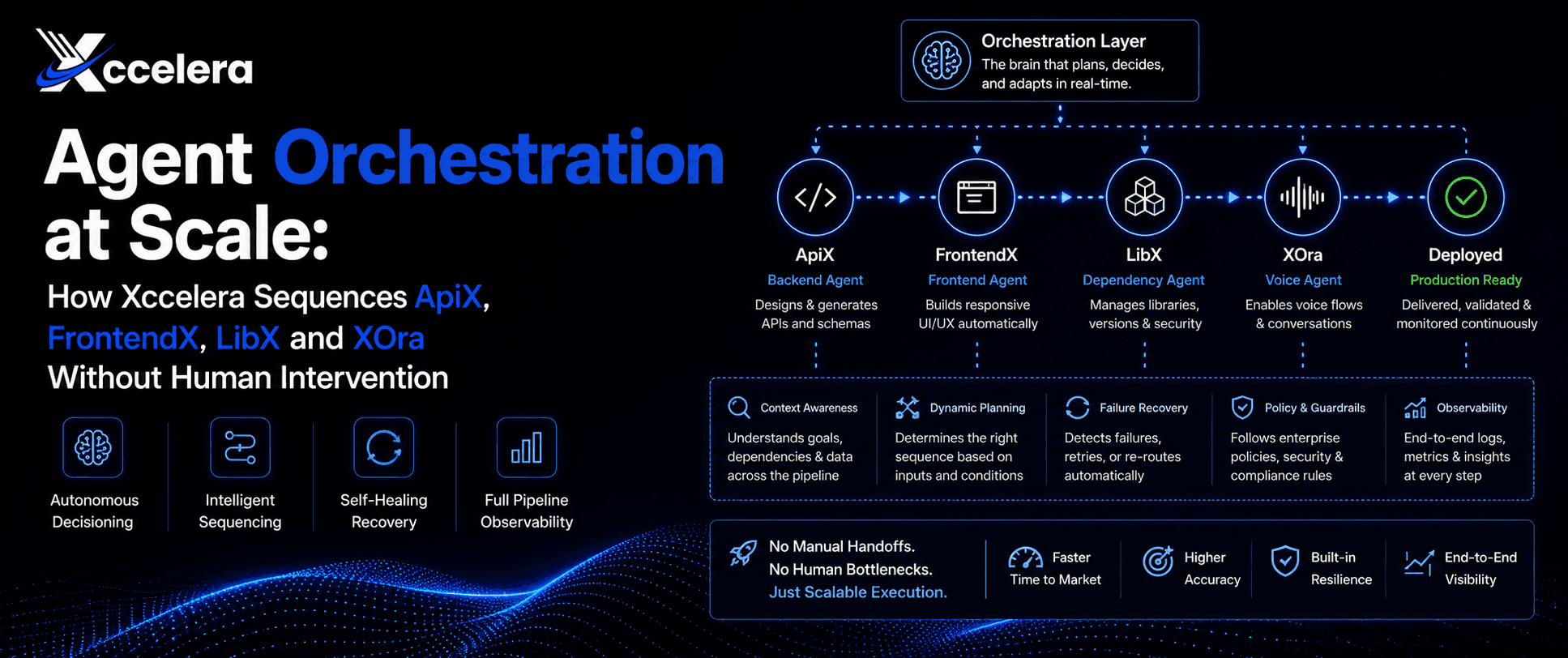
Multi-agent AI orchestration at enterprise scale has fundamentally changed what autonomous software delivery looks like in 2026. Indeed, enterprise AI has moved well past the single-agent era. The gap between the two models is not incremental — it is architectural. In short, organizations that deploy isolated agents see modest, bounded gains. By contrast, those that adopt multi-agent AI orchestration at enterprise scale see transformational outcomes across the full software delivery lifecycle. To that end, Xccelera sequences four purpose-built agents — ApiX, FrontendX, LibX, and XOra — into a zero-supervision delivery pipeline. Specifically, the pipeline runs from backend infrastructure through frontend build, security hardening, and live voice support, autonomously, end to end.
The Orchestration Imperative: Why Single Agents Cannot Deliver at Enterprise Scale
The Production Gap No One Advertises
As of March 2026, only 11 to 14 percent of enterprise AI agent pilots have reached production at scale. Strikingly, the remaining 86 to 89 percent fail before realizing durable value. In most cases, the primary causes are not model quality issues. Rather, they are governance gaps and integration brittleness. In addition, single agents struggle to maintain coherent context across multi-step workflows that touch multiple systems at once.
To illustrate, a single agent receives a prompt, reasons through a task, executes it, and returns a result. That architecture works well for contained, bounded tasks. However, it breaks down the moment a workflow requires sequential handoffs or shared state across tools. Similarly, dynamic task reassignment and failure recovery that preserves upstream outputs exceed its limits. These are precisely the conditions that define enterprise software delivery. That is why multi-agent AI orchestration at enterprise scale has become the critical differentiator between pilots and production. This transition is explored in depth in Xccelera’s analysis of how enterprises are turning AI hype into real systems.
What Orchestration Resolves
In contrast to single-agent deployments, orchestrated multi-agent systems assign specialized agents to specific execution domains. They also route outputs between agents, manage shared state, and resolve conflicts at handoff points. Furthermore, governance controls run at every stage. The distinction from single-agent deployment is therefore not a matter of degree — it is architectural. As a result, organizations that make this transition consistently report measurable gains in productivity, cycle time, and cost predictability that isolated agents simply cannot replicate.
How Agent Orchestration Actually Works: Sequencing, State, and Control Layers
Task Decomposition and Sequencing
Orchestration begins with planning units that decompose a high-level objective into subtasks. Next, each subtask routes to the agent with the appropriate execution capability. The orchestration layer then determines which agent acts first and what data it receives. It also defines what constitutes a valid output and what triggers each handoff. Finally, sequencing can be linear for dependent workflows or parallel for subtasks without shared-state conflicts.
Shared Context and Inter-Agent Communication
The Model Context Protocol (MCP) has emerged as the standard for connecting agents to tools and data sources. Building on that foundation, Google’s Agent-to-Agent (A2A) protocol arrived in April 2025. It enables agents to discover each other, understand capabilities, and delegate tasks. Crucially, both sides do not need to share identical frameworks. Moreover, each agent publishes a structured declaration of what it can do and what data formats it accepts. Consequently, when one agent needs to delegate downstream, it checks compatibility and initiates the handoff through that protocol layer.
Governance as Infrastructure
Governance in a multi-agent system is not a compliance checkbox applied after deployment. Instead, it functions as an embedded design principle from the outset. Policy units within the orchestration layer enforce rules about what each agent can access, modify, or trigger. In addition, audit logging captures every decision and output. Observability tools give operators visibility into agent reasoning. As a result, operators can trace outputs back to the specific inputs and steps that produced them. For a detailed treatment of governing AI agents in production, Xccelera’s practical checklist for securing AI agents covers identity, access control, and monitoring across agentic pipelines.
The Four-Agent Stack: ApiX, FrontendX, LibX, and XOra as Complementary Execution Layers
Most enterprise AI deployments treat individual agents as point solutions. The architectural reality, however, is quite different. A complete software product requires four distinct execution domains: backend infrastructure, frontend interface, security integrity, and customer-facing engagement. Moreover, each domain demands a different operational capability. No single agent architecture addresses all four without fundamental compromise. Together, therefore, these four layers form the foundation of multi-agent AI orchestration at enterprise scale as Xccelera delivers it.
First, ApiX operates in the backend execution domain. It receives a configuration payload and autonomously generates APIs, database setup, and over 100 tested endpoints. It also auto-probes for database errors, applies corrections, and validates every endpoint before delivery. Above all, no developer supervision is needed at any stage. Teams evaluating autonomous backend generation can explore ApiX in detail as a standalone capability.
Next, FrontendX operates in the frontend execution domain. It ingests Figma design files directly, extracting exact fonts, colors, spacing, and typography. It then converts those specifications into a fully working React application with complete routing and build validation. Additionally, FrontendX detects and corrects compile errors automatically. As a result, nothing broken ever passes downstream.
Following that, LibX operates in the security execution domain. It scans connected GitHub repositories for CVEs across OSV, NVD, and GHSA databases. It also upgrades vulnerable dependencies and patches breaking code changes through AI-driven analysis. Furthermore, LibX auto-resolves test failures introduced by upgrades and produces a ready-to-merge pull request. Crucially, the entire remediation cycle runs across a 17-step automated pipeline.
Finally, XOra operates in the customer engagement domain. It deploys as a 24/7 voice agent that processes speech through Whisper-class ASR and extracts intent via LLM reasoning. It then executes against business logic through live API and database connections. In addition, XOra generates neural TTS responses at sub-second latency and auto-syncs every interaction to CRM and ticketing systems.
Taken together, these four agents are architecturally non-redundant. Specifically, the output of each becomes a direct input or operational dependency for the next stage. That is precisely what makes the pipeline coherent rather than merely sequential.
Sequencing Without Supervision: How the ApiX-to-XOra Pipeline Executes
The pipeline begins the moment a team submits a configuration payload to ApiX. From that point forward, no human checkpoint is needed between stages. This is what multi-agent AI orchestration at enterprise scale enables in practice: a continuous, governed execution chain from configuration input to deployed, supported product.
Stage 1 to Stage 2: Backend to Frontend
To start, ApiX generates the backend layer autonomously. It produces tested API endpoints and validated database configurations. Next, FrontendX ingests the corresponding Figma design specifications. It generates the React frontend and automatically links all routes to the backend endpoints ApiX produced. Notably, the handoff does not need a developer to manually map API contracts to frontend calls. Instead, the agents operate against a shared structural context, which makes the connection deterministic.
Stage 2 to Stage 3: Frontend to Security
Once the codebase is assembled, LibX initiates its CVE scanning pipeline across the full dependency tree. Importantly, vulnerabilities identified before deployment cost a fraction of what post-production remediation costs. This is supported by NIST’s analysis of the relative cost of fixing bugs across the SDLC. Subsequently, LibX patches dependencies and resolves any resulting test failures. It then delivers a ready-to-merge PR for engineering review. Consequently, remediation work that previously consumed engineering days now executes in minutes.
Stage 3 to Stage 4: Secure Codebase to Live Voice Support
After security validation, XOra deploys against the hardened codebase. It provides immediate customer-facing support coverage from day one. Moreover, every voice interaction is logged, intent-mapped, and synced to CRM systems automatically. As a result, the pipeline moves from a configuration input to a deployed, supported, security-cleared product. Throughout this process, no human intervention occurs between execution stages. This capability sits at the core of Xccelera’s agentic AI solution offering.
Failure Handling in a Zero-Supervision Pipeline: How Each Agent Self-Corrects
Autonomous pipelines without embedded self-correction are operationally fragile. In fact, error cascades rank among the top causes of production failure in multi-agent systems. Governance gaps and poor observability compound the risk further. Accordingly, each agent in the pipeline carries its own correction logic. That layered architecture is ultimately what makes zero-supervision execution viable at scale.
Agent-Level Error Containment
ApiX auto-probes database connections during generation. When it detects errors, it applies corrections and falls back to Postgres or SQLite based on the configuration context. As a result, the pipeline does not halt, and no escalation to a developer is needed. Similarly, FrontendX detects compile errors in the generated React application before delivering output. Rather than passing a broken build downstream, it applies targeted fixes and revalidates. Therefore, the output that reaches the next stage is always a passing build.
In addition, LibX resolves test failures introduced by dependency upgrades. The upgrade cycle does not complete until tests pass. If an upgrade breaks a test suite, LibX patches the breaking change and reruns tests. The PR opens only when the result is green. Meanwhile, XOra handles degraded input conditions through noise cancellation and intent fallback. When speech input is ambiguous or low-confidence, the agent routes to a clarification response rather than executing against an incorrect intent.
Ultimately, this layered self-correction architecture means failures stay contained at the agent that encounters them. The pipeline does not cascade a partial failure into a downstream agent operating on corrupt inputs. That property is essential for enterprise trust in autonomous execution. The broader principle is elaborated in Xccelera’s comparison of agentic platforms vs. traditional development, which examines how self-correction and observability differentiate production-ready systems from prototype-grade tooling.
Cost Architecture of Autonomous Agent Pipelines vs Traditional Development
Autonomous agent pipelines restructure cost in ways that traditional development budgets do not anticipate. Notably, the shift is not just in magnitude. It is in the nature of the cost model itself.
Per-Run vs Labor-Based Expenditure
A single ApiX run generates a backend with over 100 tested endpoints. The cost ranges from $0.20 to $9.00 depending on project scale. By comparison, the equivalent human engagement costs between $200 and $5,000 per project. That figure also excludes iteration cycles, review time, and testing overhead. Similarly, FrontendX converts a Figma design to a production-ready React application at a per-run cost well below what manual conversion requires in engineering hours.
Security Remediation Economics
LibX eliminates the remediation cycle that previously consumed multiple engineering days per CVE incident. In environments subject to SOC 2, PCI-DSS, HIPAA, or ISO 27001, security debt carries audit risk that compounds over time. Reducing remediation from days to minutes is therefore not simply an efficiency metric. Above all, it is a risk reduction mechanism with direct financial implications for regulated teams.
Support Staffing Displacement
XOra provides 24/7 Tier-1 support coverage that scales with volume without adding headcount. A human Tier-1 support operation scales its cost linearly with call volume. XOra’s cost structure, however, does not follow that pattern. For high-volume environments, the annualized cost difference is substantial. As Deloitte’s 2026 AI enterprise adoption analysis notes, only 12 percent of enterprises pursuing basic automation expect ROI within three years. The primary reason is that they have not yet moved to orchestrated pipelines. In contrast, those pipelines realize compounding efficiency across multiple execution stages at once.
Governance, Auditability, and Security in a Multi-Agent Autonomous System
Enterprise trust in a zero-supervision pipeline depends on one condition. Every decision the system makes must be traceable, auditable, and bounded by defined governance controls. Without that assurance, autonomous execution cannot meet the requirements of regulated industries or risk-conscious leadership teams.
Embedded Compliance by Design
LibX produces a full audit trail across its 17-step remediation pipeline. Specifically, every CVE identified, every dependency upgraded, every test result, and every patch applied is logged and attributable. For engineering teams in fintech, healthcare, SaaS, or e-commerce, active compliance requirements make this trail essential. In other words, it is not supplementary documentation. Rather, it is the evidence package that satisfies auditor requests without manual reconstruction.
CRM Sync as an Accountability Layer
XOra’s automatic CRM and ticket synchronization ensures every customer interaction is recorded, categorized, and linked to a resolution status. This data layer serves dual purposes. First, it provides the operational visibility that support managers require. Second, it creates the interaction record that compliance and quality assurance teams depend on for review and escalation workflows.
Governance Across the Full Stack
Across the full four-agent pipeline, governance operates as a design principle embedded at each execution layer. Importantly, it is not bolted on after deployment. Each agent operates within defined authorization boundaries. Every output clears validation before handoff. Each failure is logged and contained. Organizations subject to CISA and NSA joint guidance on agentic AI cybersecurity, issued in May 2026, will find this architecture addresses the core cybersecurity concerns those frameworks identify. Furthermore, teams scaling toward multi-agent systems will find Xccelera’s approach already aligned with the governance expectations regulators are beginning to codify.
Building Your Agentic Stack with Xccelera
The gap between enterprise AI ambition and enterprise AI production is, in most organizations, an orchestration problem. Individual agents already exist. The coordination layer, the handoff logic, the governance framework, and the self-correction mechanisms, however, do not come pre-assembled. In fact, those are the elements that make agents reliable at scale.
Xccelera delivers that assembled stack. ApiX, FrontendX, LibX, and XOra are production-ready autonomous agents built to operate in sequence, share context, self-correct, and deliver auditable outputs. Together, they cover a complete software delivery and customer engagement pipeline. As a result, organizations that have deployed isolated AI tools and found them insufficient now have a structured path forward through multi-agent AI orchestration at enterprise scale.
To get started, engineering teams, CTOs, and Directors can explore the full Xccelera agent portfolio and request a deployment consultation at xccelera.ai. For organizations evaluating coordinated agent deployments specifically, the multi-agent systems overview provides the architectural context to assess readiness and scope a production-grade rollout.


