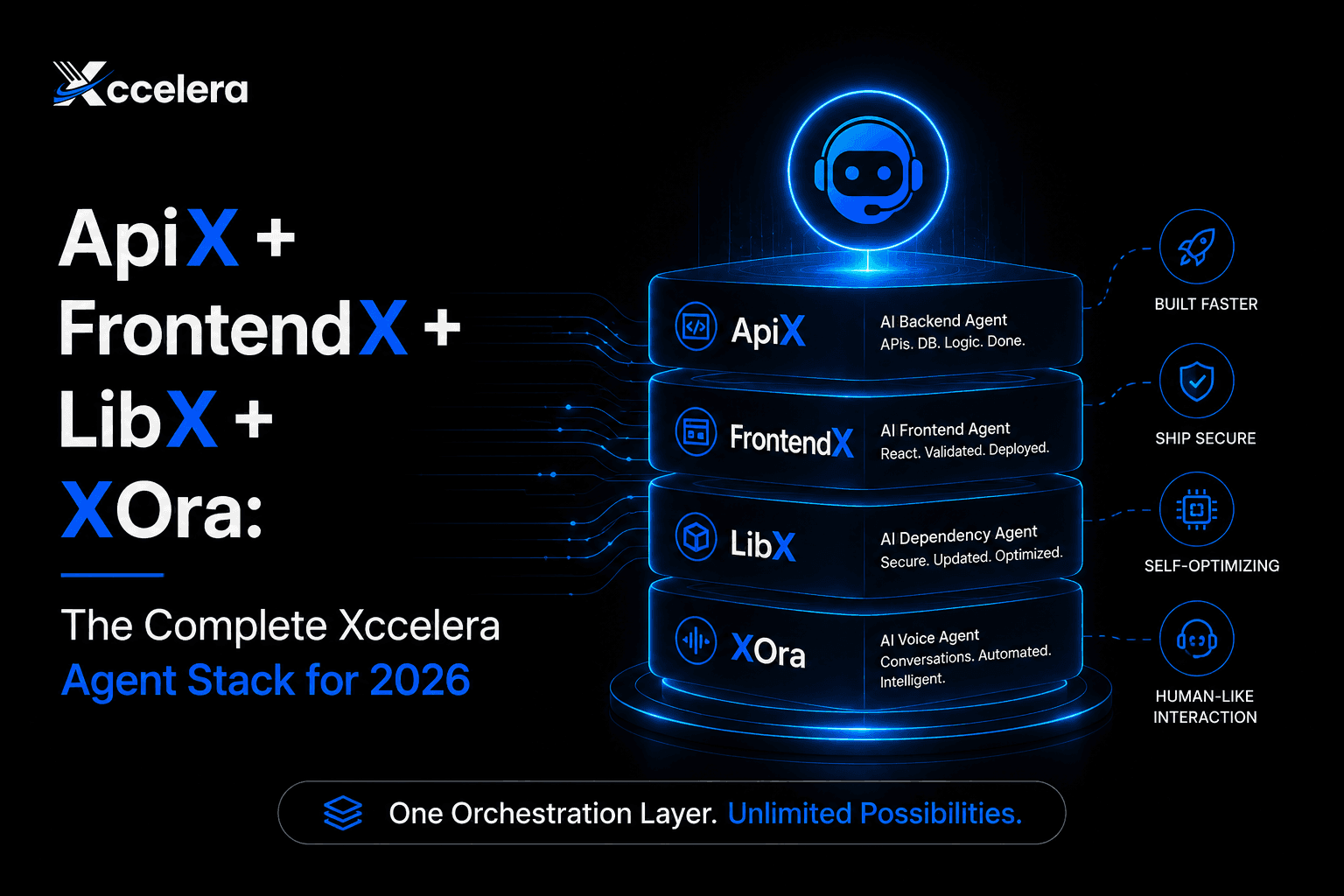
ApiX + FrontendX + LibX + XOra: The Complete Xccelera Agent Stack for 2026
Enterprise Teams Have Moved Past “Can AI Automate This?” In 2026, engineering and operations leaders no longer ask whether AI can automate software development. Instead, they ask which stack can do it without constant human supervision. Xccelera answers that question with four coordinated products that cover the complete development lifecycle. ApiX generates backends autonomously.…
Enterprise Teams Have Moved Past “Can AI Automate This?”
In 2026, engineering and operations leaders no longer ask whether AI can automate software development. Instead, they ask which stack can do it without constant human supervision.
Xccelera answers that question with four coordinated products that cover the complete development lifecycle. ApiX generates backends autonomously. FrontendX converts Figma designs into production React applications. LibX remediates security vulnerabilities through a 17-step agentic pipeline. XOra handles enterprise voice operations around the clock. Together, these four products form a single agentic layer built for leaders who need measurable output rather than isolated AI capability.
The Stack Problem No Single AI Tool Solves
Most enterprise AI deployments in 2026 share the same structural flaw: each tool solves for one layer and leaves the rest to humans.
One team adopts an AI code assistant for backend work. Another team finds a Figma plugin that generates React scaffolding. The security group runs a separate CVE scanner on a weekly cycle. Meanwhile, customer operations deploys a voice bot that can’t reach CRM records. Every tool works in isolation, so none of them talk to each other, and the handoff gaps between them quietly become the new bottleneck.
Why Point Solutions Fail at Scale
Gartner projects that 40% of enterprise applications will be integrated with task-specific AI agents by the end of 2026, up from less than 5% in 2025 (Gartner). That adoption curve sounds decisive, but the operational reality looks messier on the ground.
Capgemini’s research found that only 2% of organizations had deployed AI agents at scale, while 61% were still exploring deployment as of early 2026 (Capgemini. That gap between stated intent and actual production use points to a tooling architecture problem, not a readiness problem. Organizations aren’t short on ambition; they’re short on agents that ship complete, validated work instead of drafts that still need a human pass.
The Cost of Fragmentation
When backend generation, frontend assembly, security remediation, and voice operations each run on a separate toolchain, engineering leaders absorb coordination overhead that compounds with every sprint. Off-the-shelf generative models and basic API wrappers rarely satisfy enterprises that want to run their own operations at this level of complexity; they need infrastructure built to coordinate, not just generate.
A unified agent stack removes that coordination tax by covering every layer with an autonomous agent purpose-built for that domain. This is the structural bet behind Xccelera’s agentic software development approach.
ApiX: Autonomous Backend Generation Without Human Supervision
Traditional backend development moves through requirements gathering, schema design, endpoint scaffolding, manual testing, and iterative debugging. That cycle takes days to weeks per project regardless of how experienced the developer is. ApiX collapses the entire sequence into a single run.
How ApiX Works
A team posts a configuration payload, and ApiX generates the APIs, sets up the database, and autonomously tests over 100 endpoints without a developer touching the output. The agent runs on Claude Sonnet with prompt caching, so every prompt is pre-embedded and requires no manual prompt management between runs. When the database returns an error, ApiX corrects it automatically. When an endpoint fails testing, ApiX resolves the failure and re-runs validation before delivering the final output.
Pricing That Reflects Autonomous Output
ApiX operationalizes the shift from passive AI assistants to proactive AI agents through a pay-per-run model with no seat fees.
SMALL runs covering up to five endpoints complete in 5 to 15 minutes at $0.20 to $0.55 per run. MEDIUM runs covering 10 to 30 endpoints run at $0.90 to $2.10. LARGE runs handling 50 or more endpoints complete in 60 to 120 minutes at $3.00 to $9.00 per run.
At the LARGE tier, 500 runs cost roughly what a single freelance backend project costs, which makes ApiX the structurally cheaper option for any engineering organization running recurring backend generation at scale.
FrontendX: From Figma Design to Production React, Without a Developer
The design-to-code handoff has caused friction in frontend development for over a decade. Designers produce pixel-perfect Figma files. Developers then rebuild them from scratch, losing spacing precision, misreading typography scales, and wiring routes by hand. Teams in 2026 need a system that understands how Figma components, React components, design tokens, and an actual codebase fit together, and FrontendX was built for exactly that requirement.
Direct Figma Integration
FrontendX connects directly to Figma and extracts exact fonts, colors, spacing, and typography rather than interpreting screenshots or accepting manual design specs. The agent then generates complete React applications with routing already linked and build validation already run.
When compile errors surface, FrontendX resolves them autonomously before delivering output. No developer manages prompts. No one supervises the gap between the Figma file and the deployable React application.
The same SMALL, MEDIUM, and LARGE pricing tiers that apply to ApiX also apply to FrontendX, which makes the product directly comparable in cost structure to any frontend development resource currently on a team’s payroll.
LibX: AI-Driven Security Remediation Before Vulnerabilities Become Breaches
Security dependency management is where most engineering organizations fall behind quietly and expensively. A library receives a CVE designation. The security team logs it. Engineering triages it against sprint priorities. Weeks pass while the vulnerability sits in production.
That delay isn’t a fringe risk. Industry tracking shows the average time to remediate a critical vulnerability now exceeds 60 days, even as the median time to exploit a vulnerability has fallen to under 5 days (Security Boulevard). That asymmetry between exploit speed and patch speed is exactly the gap LibX closes through its 17-step agentic pipeline.
The 17-Step Pipeline
LibX scans GitHub repositories for CVEs using OSV, NVD, and GHSA simultaneously. It upgrades vulnerable dependencies, then patches any breaking code that the upgrade introduces through AI-driven code repair. When test failures emerge from the patched codebase, LibX resolves them autonomously.
The final output is a ready-to-merge GitHub pull request with a full audit trail documenting every change decision. Work that previously required an engineer spending days on dependency triage and patch validation now completes in minutes.
LibX supports Python and JavaScript codebases and includes a dry-run mode for teams that want to preview remediation impact before committing. A real-time dashboard gives security and engineering leaders continuous visibility into CVE exposure, remediation progress, and compliance posture.
For organizations operating under SOC 2, PCI-DSS, HIPAA, or ISO 27001 requirements, LibX converts a perpetually reactive security function into a continuously governed one, closing the exact remediation gap that keeps showing up in industry vulnerability data.
XOra: Enterprise Voice Operations Running Around the Clock
Voice remains the highest-volume support channel for most enterprises, and it’s simultaneously the most expensive channel to staff. Production voice AI deployments grew 340% year-over-year across more than 500 organizations, and the global voice AI agents market is projected to expand from $2.4 billion in 2024 to $47.5 billion by 2034 (Market.us via CompleteAITraining). XOra positions enterprise operations teams to capture that shift rather than play catch-up against it.
The XOra Pipeline
Every inbound call moves through a structured sequence. Speech converts through Whisper-class ASR, then LLM intent extraction identifies what the caller needs and maps it to the correct business logic layer. API and database calls execute in real time, neural TTS generates the response, and CRM and ticketing systems sync automatically before the call ends.
The entire sequence runs at sub-second latency with noise cancellation active and multi-language support enabled.
Where XOra Deploys
Tier-1 customer support deflection is the highest-volume use case. XOra handles password resets, account status checks, order lookups, and billing inquiries without human escalation.
IT helpdesk automation routes internal requests, logs tickets, and resolves common infrastructure queries at the same sub-second response standard. Scheduling and outbound sales workflows run through the same pipeline, and memory-driven context retention ensures that returning callers or prospects pick up the conversation rather than starting cold.
AI voice agents reduce Average Handle Time, increase First Contact Resolution, and provide 24/7 coverage without the operational complexity of traditional contact center staffing. XOra delivers that outcome without requiring organizations to build or maintain the underlying voice infrastructure themselves.
Why the Complete Stack Compounds Value Beyond Individual Agents
Each product in the stack justifies itself on its own. ApiX pays for itself against any backend development resource cost. FrontendX removes an entire translation layer from the engineering workflow. LibX eliminates the compliance risk window that manual dependency management leaves open. XOra converts a cost-center voice operation into a scalable, always-on customer layer.
The compounding effect appears once all four operate together. An organization running ApiX and FrontendX ships full-stack features without assembling a traditional engineering team around them. LibX then keeps that shipped codebase secure continuously rather than episodically, while XOra absorbs the operational volume the product generates at the customer-facing edge.
Because each agent delivers a complete, validated output rather than a draft that still needs review, the stack covers backend, frontend, security, and voice without handoff friction between any layer. That’s also the architecture pattern behind custom AI agent development more broadly — purpose-built agents that eliminate supervision overhead instead of adding to it.
The defining trend for 2026 treats agent cost optimization as a first-class architectural concern, with organizations building economic models into agent design rather than retrofitting cost controls after deployment. Xccelera’s accelerator-plus-agent architecture is built on exactly that principle: every product is priced on output, governed by autonomous validation, and scoped to eliminate the supervision overhead that makes AI tooling expensive at scale.
Engineering leaders, CTOs, and VPs of Product evaluating agentic AI infrastructure in 2026 face a choice between stacking point solutions and absorbing the coordination overhead that comes with them, or deploying a stack where that coordination is already solved.