Service as Software: Why Enterprises Are Buying Outcomes, Not Tools, in 2026
Enterprise software buying has quietly flipped. Budget owners no longer judge platforms by seat count or feature lists. Instead, they measure vendors by what actually gets resolved, closed, or delivered without a human in the loop. This shift is called Service as Software, and in 2026 it is rewriting how CTOs, VPs, and founders…
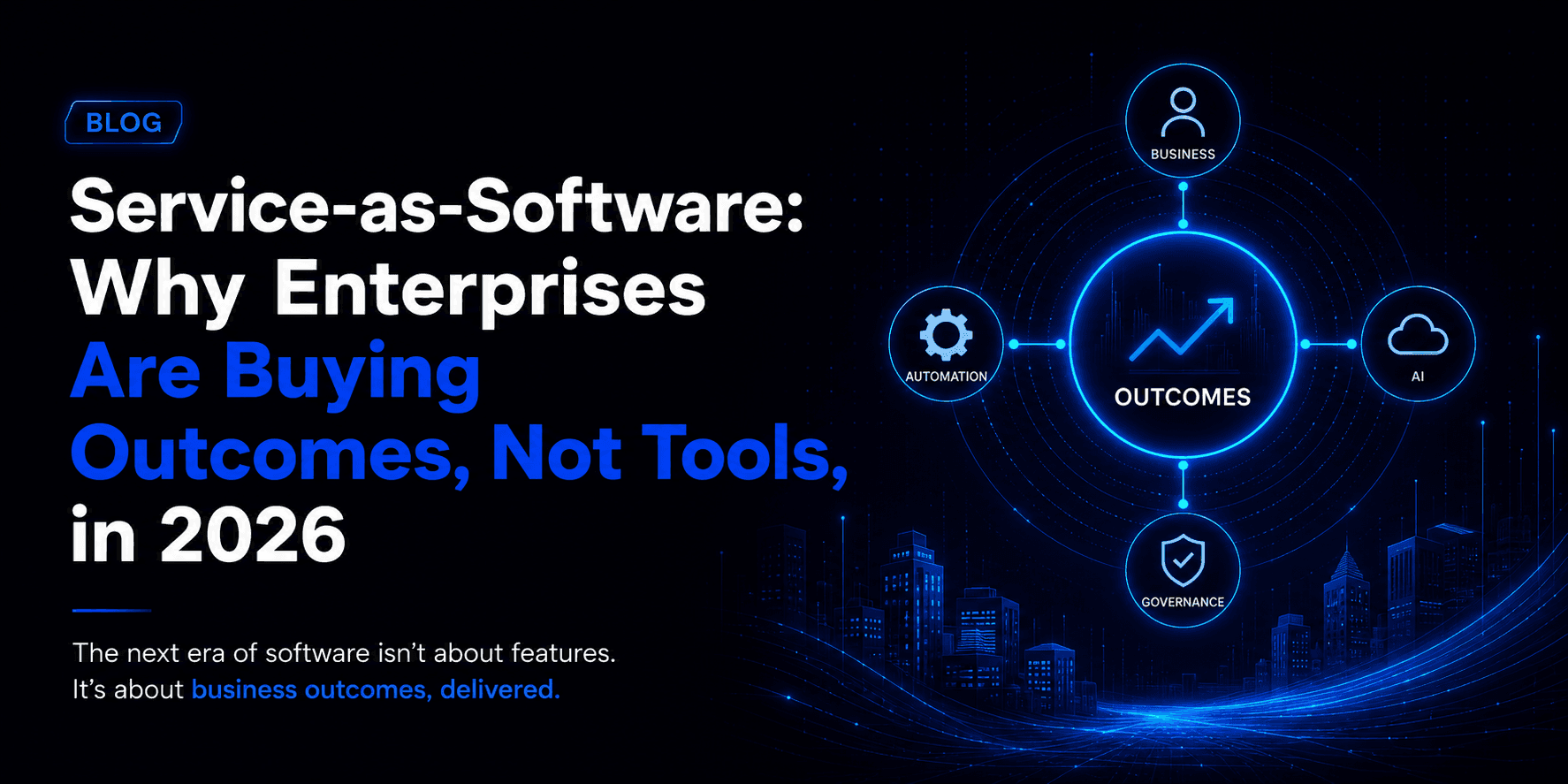
Enterprise software buying has quietly flipped. Budget owners no longer judge platforms by seat count or feature lists. Instead, they measure vendors by what actually gets resolved, closed, or delivered without a human in the loop.
This shift is called Service as Software, and in 2026 it is rewriting how CTOs, VPs, and founders decide who gets paid, and for what.
Why Buying Software No Longer Makes Sense in 2026
The End of the Standardized Stack
For two decades, enterprise software meant buying a standardized tool and adapting workflows to fit it. That logic is now breaking down quickly.
Generative and agentic systems make it fast and affordable to build tailored software. As a result, the old justification for buying a generic platform is disappearing. Consequently, the strategic question has changed. Leaders no longer ask which tool to purchase. They ask which workflows to own outright versus hand off entirely to an autonomous system, such as AI-powered software development pipelines that build and test systems automatically.
Ownership Questions Replace Tool Questions
This is not a preference shift; it is an economic one. When AI can generate, test, and deploy functional systems in days, building tailored software becomes cheaper than forcing a workflow into someone else’s product.
Therefore, leaders now choose among building, composing, or buying an outcome outright. Increasingly, buying the outcome wins. Procurement teams that once compared feature matrices now compare:
- Resolution rates
- Turnaround times
- The cost of a completed task versus a human doing the same work
From Seats to Outcomes: The Pricing Model Enterprises Now Demand
The Three-Stage Pricing Migration
Enterprise pricing has moved through three distinct eras. First, seat-based licensing dominated through the early 2020s, charging a fixed fee per user regardless of usage. Then, usage-based pricing followed as cloud economics matured, aligning cost with consumption.
Now, outcome-based pricing is emerging as the dominant frontier for agentic products. Under this model, a vendor gets paid only when a defined result happens — not simply when someone logs in or runs a query.
Real Vendors, Real Numbers
This shift is not theoretical; it is already playing out at scale. Salesforce, for instance, now offers consumption-based Agentforce pricing, including a pay-per-conversation option, positioning the product directly against the cost of a human agent handling the same interaction. However, that per-conversation model created real friction: buyers struggled to predict costs because a single query could trigger multiple backend actions, which is why Salesforce eventually layered in Flex Credits and per-user options to let customers self-select their preferred buying model.
Meanwhile, Zendesk charges customers only when a ticket is fully and verifiably resolved by AI, with zero charge on failed attempts. Intercom, similarly, built an entire category around per-resolution billing and generated meaningful revenue in its first year on that model alone.
These are not pilots. They are production pricing models running today, and they clearly signal where enterprise buyers are steering the broader market.
Hybrid Models as a Transitional Bridge
Not every vendor has moved fully to outcome billing, and that hesitation is deliberate rather than accidental. Many vendors instead combine a base subscription fee with a variable component tied to usage or performance.
This hybrid approach gives vendors predictable baseline revenue. At the same time, it shares risk with the buyer. As a result, it functions as a bridge for organizations not yet ready to accept full outcome-based exposure.
Service as Software in Action: Where Outcome-Based Models Are Winning
Providers Decoupling Growth From Headcount
Analysts tracking this shift call it Services-as-Software: the reinvention of labor-driven service delivery into software-like economics. Under this model, growth scales through platforms and AI agents instead of additional headcount.
Several service providers already demonstrate this in live engagements. They convert delivery labor into productized, AI-executed platforms. Consequently, they report margin gains that come directly from automation, not from utilization tricks or headcount cuts alone.
What Separates Pilots From Production
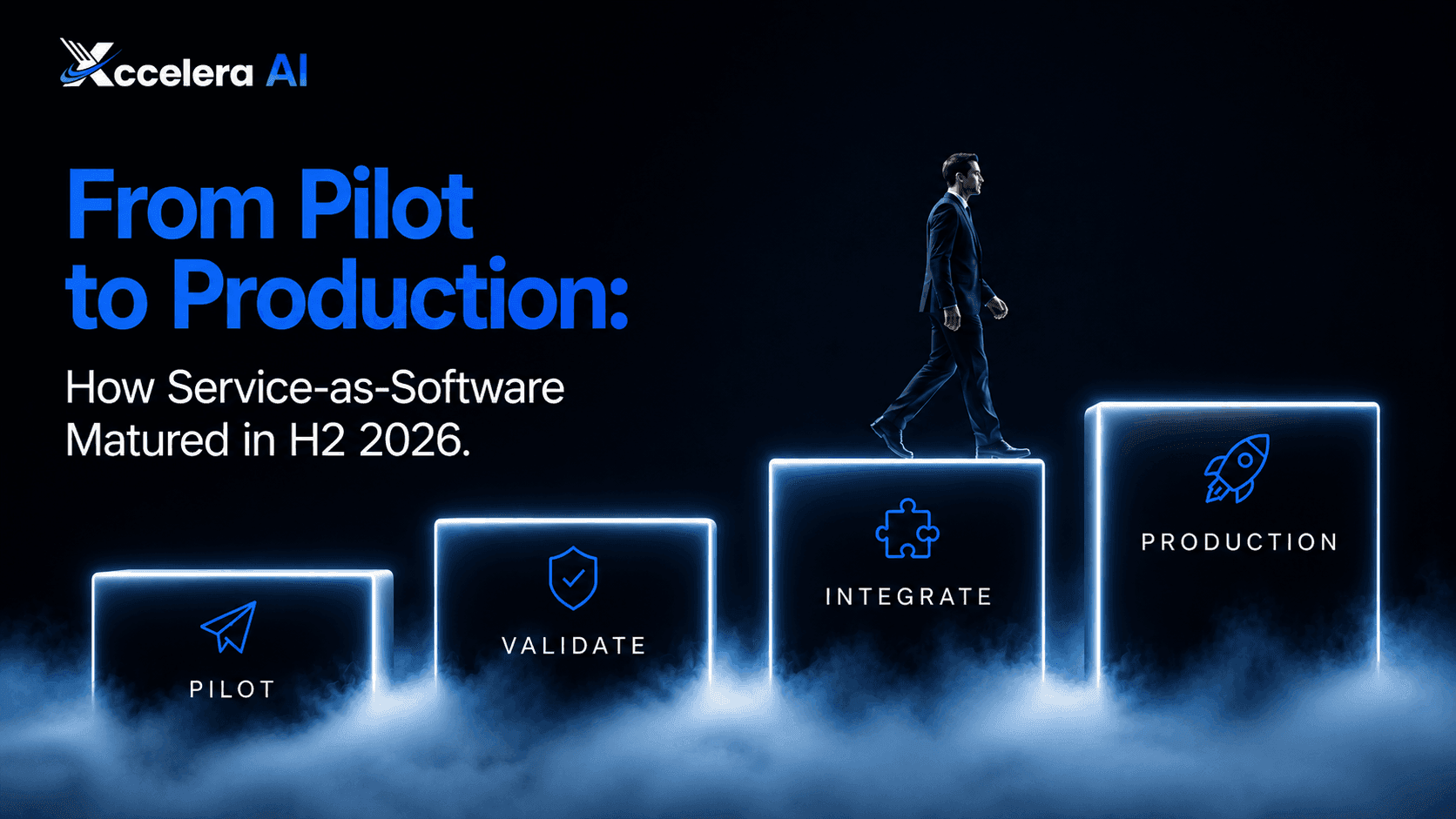
The gap between a pilot and a production deployment comes down to verifiable outcomes. Vendors that can prove a task was completed, a ticket closed, or a workflow ran end-to-end without escalation are the ones converting experiments into renewed contracts.
Before signing anything, enterprises evaluating Service as Software vendors should ask for that proof upfront — not after the first confusing invoice arrives.
The Governance and Risk Reality Behind Outcome-Based AI
The Gap Between Adoption and Oversight
Adoption of agentic AI has significantly outpaced governance readiness across most industries. According to McKinsey’s 2026 AI Trust Maturity Survey, only about 30% of organizations reach a mature governance level for strategy and agentic AI controls.
That gap is the single biggest reason analysts expect a large share of agentic AI projects to be shelved before reaching durable production value — Gartner projects that over 40% of agentic AI projects will be cancelled by 2027, regardless of how promising the pilot looked.
Regulatory Exposure Is Already Here
This is not a future problem to plan around later. Regulatory frameworks carrying real financial penalties are already active across multiple jurisdictions. Enterprises operating across borders face overlapping compliance obligations today, not in some hypothetical future cycle.
Any Service as Software vendor worth evaluating should show:
- Audit trails for every automated action
- Monitoring controls across agent behavior
- Human-in-the-loop checkpoints, especially for security-sensitive workflows like the ones covered in this practical checklist for securing AI agent identity and access
These should be baseline requirements, not premium add-ons reserved for enterprise-tier contracts.
What Enterprises Should Demand From Service as Software Vendors
Questions Before the Contract Is Signed
Not every outcome-based pitch protects the buyer, even when it sounds like it should. Some pricing structures quietly shift the value of efficiency gains toward the vendor rather than the enterprise that created them.
Before signing, decision-makers should demand:
- A precise definition of “outcome”
- Clarity on what happens when performance dips below agreed thresholds
- Firm confirmation that efficiency gains stay with the business, not the vendor’s margin
For a sense of how quickly “simple” outcome pricing can hide real costs, see this breakdown of Agentforce’s true first-year cost for mid-market buyers, which often runs far above the advertised per-conversation rate once implementation and data prerequisites are included.
Avoiding the Switching-Cost Trap
Free or discounted outcome-based pilots can look risk-free on paper. However, they quietly build switching costs that make it expensive to leave later.
Therefore, enterprises should treat pilot terms with the same scrutiny as long-term contracts. Sunk costs have a way of shifting negotiating leverage back to the vendor once the trial ends and the workflow is already rebuilt around their system.
How Xccelera Delivers Service as Software, Not Just Tools
Accelerators and Agents Built for Execution
Xccelera was built around this exact shift toward outcome-driven delivery. ApiX generates production-ready backend systems, including database setup and endpoint testing, on a pay-per-run basis with no seat fees attached.
FrontendX converts approved designs directly into working, route-tested React applications without a developer manually wiring each screen. LibX scans repositories, patches vulnerable dependencies, and opens ready-to-merge pull requests without waiting on manual triage.
XOra, meanwhile, handles live customer conversations end-to-end — from intent recognition through resolution — and syncs outcomes directly into CRM systems the moment a call ends, much like the workflows powering Xccelera’s Voice Agent and its ITSM Agent for IT incident resolution. None of these charge for access alone. They charge for execution, and only for execution that actually happens.
Where to Start
Enterprises evaluating Service as Software vendors should start with one bounded, high-friction workflow. That could be backend development, dependency security, or the kind of continuous validation covered under Xccelera’s quality engineering services.
From there, measure the result directly against what a human team would have delivered in the same window, at the same cost. Xccelera is built for that comparison, not for a longer procurement cycle.
Full details on the accelerator and agent portfolio are available at xccelera.ai.