Inside an AI Code Modernization Engine: A 4-Step Walkthrough From Legacy to Live
Manual legacy rewrites drag on for months, drain engineering budgets, and routinely miss undocumented business logic buried in decades-old code. An AI code modernization engine compresses that entire process into four structured steps. This walkthrough covers fetching and analyzing the source repository, configuring a modern target stack, running the conversion pipeline in real time, and…
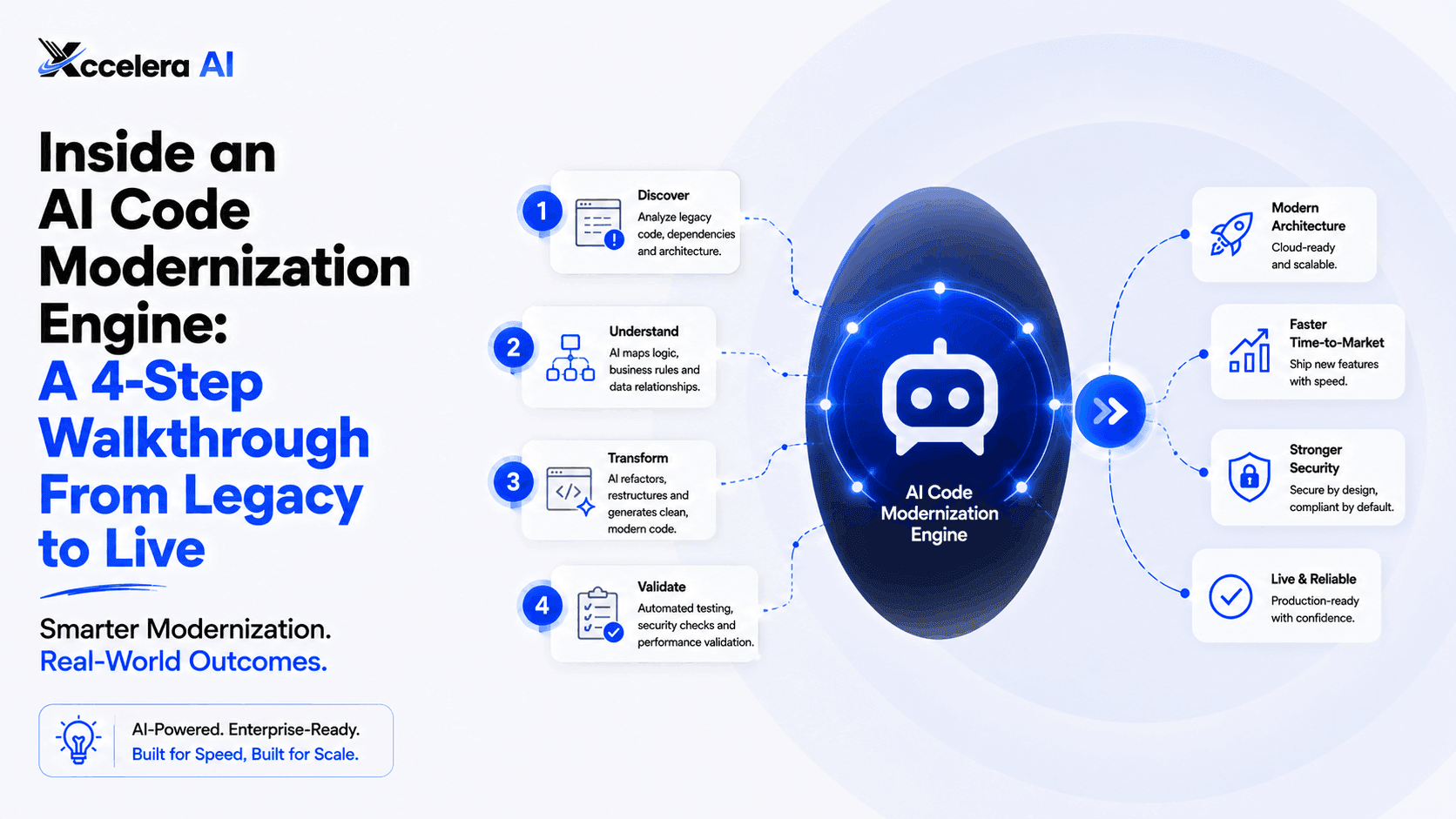
Manual legacy rewrites drag on for months, drain engineering budgets, and routinely miss undocumented business logic buried in decades-old code. An AI code modernization engine compresses that entire process into four structured steps.
This walkthrough covers fetching and analyzing the source repository, configuring a modern target stack, running the conversion pipeline in real time, and reviewing and publishing the final output. Enterprise teams get a faster, auditable path from legacy source to a live, production-ready deployment, without the risk profile of a manual, file-by-file rewrite.
The Real Cost of Manual Legacy Rewrites
Enterprise engineering teams know the pain of a legacy rewrite before it starts. The direct maintenance bill for a legacy estate already runs into hundreds of thousands of dollars annually, and that figure only counts what shows up on an infrastructure invoice. It excludes talent scarcity, productivity loss, and breach exposure sitting quietly on other budget lines.
An AI code modernization engine changes that math. Instead of a team of engineers spending months reading undocumented COBOL or aging .NET services line by line, AI-driven analysis compresses discovery and conversion into a fraction of the time.
Recent industry data puts the shift in stark terms: incremental, AI-powered modernization approaches now reach positive ROI in 12 to 14 months, compared to 36 to 48 months for a full manual rewrite.
The risk profile shifts too. Manual rewrites fail most often because teams misjudge how much undocumented business logic hides inside a monolith. A rewrite that used to take six months can now be completed in 8 to 12 weeks, with three AI-augmented engineers doing work that once required a team of eight.
Security compounds the urgency. Outdated systems carry measurably more vulnerabilities than modern equivalents, and every year a legacy system stays unpatched increases both breach probability and remediation cost. For CTOs weighing legacy code modernization AI adoption against the status quo, the numbers no longer favor waiting.
Inside the AI Code Modernization Engine Architecture
An AI code modernization engine is not a single script that translates syntax. Instead, it is an end-to-end platform that analyzes, converts, and publishes code, all from one interface. This distinguishes it from point tools that only handle one slice of the migration problem.
The architecture rests on three pillars. First, an analysis layer reads the entire source codebase and produces a written breakdown of structure, dependencies, and conversion strategy before a single line changes. Second, a conversion pipeline streams the actual translation in real time, processing files concurrently rather than one at a time. Third, a publishing layer pushes the converted output directly to a source control platform with no manual git setup required.
This matters because automated code conversion platforms that skip the analysis step tend to produce code that compiles but misses business logic. An engine built with analysis-first architecture avoids that trap by understanding intent before it rewrites anything.
| Legacy Source | Modern Target | Typical Use Case |
|---|---|---|
| COBOL (banking, mainframe) | Java Spring Boot (REST APIs, microservices) | Financial services core systems |
| HTML/Vanilla JS (static or jQuery-era) | React/Next.js (component-based UI) | Customer-facing web applications |
| .NET Framework (legacy Windows services) | Node.js/Python FastAPI (cloud-native backend) | Internal enterprise services |
| PHP/classic MVC (monolithic web apps) | Go/FastAPI (high-performance APIs) | High-traffic transactional systems |
Step One: Repository Fetch and Codebase Analysis
The first step in any AI-driven code migration determines whether everything after it succeeds. The engine connects directly to a GitHub, GitLab, or Bitbucket repository, or accepts a ZIP upload for codebases not tied to a git host.
Once connected, the engine fetches every source file and identifies the existing tech stack. It then generates a detailed analysis document explaining the codebase’s structure, dependencies, and a recommended conversion strategy. This document gives engineering leaders visibility into what they are about to modernize before committing resources.
Why Analysis-First Beats Convert-First
Legacy modernization projects fail most often when teams skip structured discovery. As one 2026 industry guide on legacy code modernization put it, the safe path is incremental, not a big-bang rewrite. Teams should build characterization tests before touching architecture.
An engine that mirrors this discipline by analyzing before converting reduces the odds of losing business logic that only lived in the original code, undocumented and unexplained. Source files are stored securely once fetched, ready for the next stage. Nothing in the original repository changes at this point.
Step Two: Configuring the Target Stack
With analysis complete, engineering teams choose their destination technology. A capable legacy-to-modern code migration engine supports curated modern stacks such as Spring Boot, Next.js, FastAPI, Go, .NET 8, and Ruby on Rails, alongside the option to specify a custom target.
This step also determines whether the engine generates test suites alongside the converted code, a toggle that matters for teams who want validation baked into the output rather than bolted on afterward.
Target selection is not locked in permanently. Teams that change direction after seeing initial results can re-run the conversion against a new target without re-uploading the source, which matters when a CTO’s architectural preferences shift mid-project.
Step Three: The AI Conversion Pipeline in Motion
This is where codebase refactoring automation does its heaviest lifting. The engine streams the conversion in real time, giving engineering teams a live terminal log rather than a black box that returns results hours later.
Files convert concurrently, in parallel batches, which means large projects do not bottleneck behind a single-file queue. Progress bars and file counts update continuously, so a team lead can watch exactly what the AI is doing at any point in the process.
Handling the Details That Break Naive Conversions
Binary assets present a common failure point in automated migrations. Images, fonts, and other non-text files often break or corrupt during naive conversion attempts. A properly engineered pipeline preserves these assets with correct base64 encoding throughout, so the converted output matches the original in every dimension that matters.
This step is also where the compressed timeline becomes visible. McKinsey research found that harnessing generative AI can accelerate tech modernization timelines by 40 to 50 percent through automated code translation, dependency mapping, and documentation. The conversion pipeline is the stage where that acceleration is most apparent to the team watching it happen.
Step Four: Review, Validate, and Publish
Conversion output is only useful if a team can inspect it before it goes anywhere near production. The engine presents the full converted file tree, letting engineers browse the new codebase like an IDE, view any file’s content, and check line counts across the project.
Teams can download the converted output as a ZIP for offline review, or publish directly to GitHub, GitLab, or Bitbucket with a chosen branch name. The platform handles the commit and push through the relevant API directly, with no manual git commands required.
This closes the loop that started with fetch and analysis. What used to be a multi-month cycle of manual translation, testing, and staged rollout compresses into a workflow a single engineer can supervise end to end.
Post-Conversion Code Modification
Conversion is rarely the final step in a real migration. Requirements shift, edge cases surface during review, and teams need to adjust the converted codebase without hand-editing hundreds of files.
A mature AI code modernization engine handles this through natural language modification. An engineer describes a change, and the AI reads the full project and applies the change consistently. Common modification patterns include:
- Adding request validation logic across all controller or route files
- Injecting logging calls into every service layer file
- Generating a complete README with install, run, and environment setup instructions
- Scanning for and correcting compilation errors, missing imports, and type mismatches
- Renaming classes and updating every import reference across the codebase
Every modification saves automatically to the project. If the team is already published to a git host, the platform flags unpublished changes so the updated codebase pushes with a single click.
Security and Governance Across the Migration Pipeline
Enterprise buyers evaluating legacy code modernization AI platforms ask one question before any other: what happens to our credentials and source code during the process? Git tokens for GitHub, GitLab, and Bitbucket need to stay encrypted at rest and accessible only server-side. A frontend that touches raw credentials directly is a liability, not a feature.
Multi-user isolation matters just as much for teams operating at enterprise scale. Each user’s conversion jobs, tokens, and project history should remain fully isolated from every other user’s data.
Every conversion job should also persist as a retrievable record. Teams need the ability to revisit, re-convert, or re-publish any past project without starting discovery over, particularly when a compliance review months later asks what changed and why. Full traceability turns a modernization engine from a black box into an auditable system.
Choosing an AI Modernization Engine Built for Scale
Not every organization evaluating automated code conversion platforms has the same starting point. Enterprise modernization teams are typically migrating large Java or .NET monoliths to cloud-native stacks, while SaaS companies want a self-serve migration capability built into their own product.
Consulting and systems integration firms need to accelerate client engagements that used to demand large delivery teams, and internal development teams often inherit legacy code from an acquisition with no documentation attached.
The engine needs to work for both directions of modernization. For an existing legacy application, the platform should connect to the current repository, convert against a chosen modern target, and leave the production system completely untouched throughout. For greenfield migrations planned from scratch, the same engine should generate a converted baseline immediately.
Xccelera built its Legacy-to-Modern Code Migration Engine around exactly this discipline: analysis before conversion, transparency throughout the pipeline, and full auditability from the first fetch to the final publish.
For engineering leaders deciding between a multi-year manual rewrite and a compressed AI-driven path, that combination of speed and governance is the difference between a modernization program that stalls and one that ships. Learn more about how Xccelera approaches agentic AI transformation at xccelera.ai.