How a Global Bank Eliminated Vendor Lock-In While Scaling AI Agents Across 12 Business Units
A global bank scaling AI agents across 12 business units hit enterprise AI agent vendor lock-in early. It then re-architected around open standards, lifecycle governance, and vendor-agnostic infrastructure. This breakdown covers the risks, the hidden costs, and the framework that made the rollout repeatable. Enterprise AI agent vendor lock-in stalls more transformation programs than any…
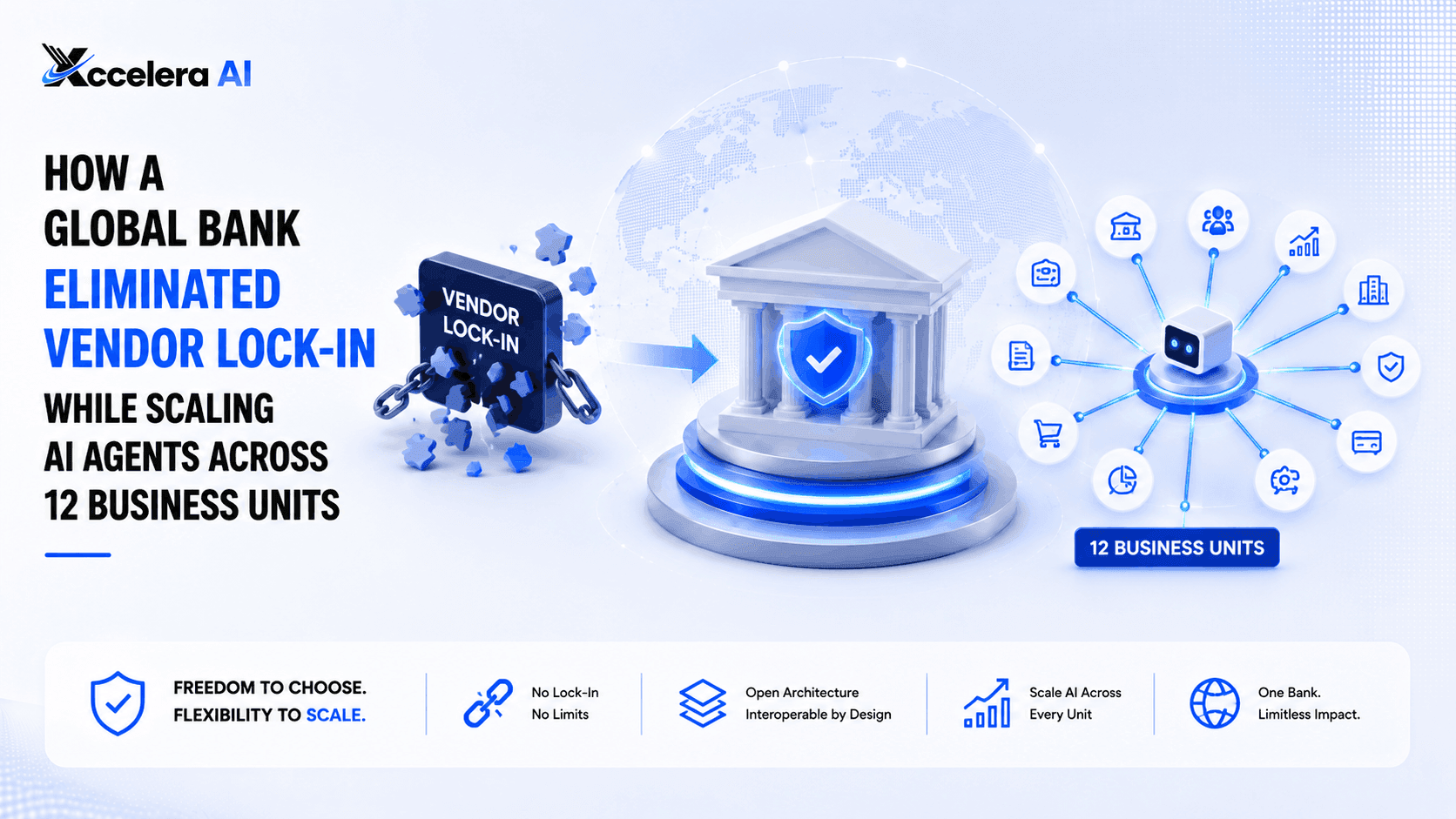
A global bank scaling AI agents across 12 business units hit enterprise AI agent vendor lock-in early. It then re-architected around open standards, lifecycle governance, and vendor-agnostic infrastructure.
This breakdown covers the risks, the hidden costs, and the framework that made the rollout repeatable.
Enterprise AI agent vendor lock-in stalls more transformation programs than any technical failure. A global bank rolling out agents across 12 business units learned this the hard way. It then built its way out of a dependency that had already started shaping decisions in three units before anyone named it.
Its playbook offers a template for any enterprise scaling AI agents across business units without surrendering control of its own architecture.
Vendor Lock-In Risk in Enterprise AI Agent Deployments
Enterprise AI agent vendor lock-in rarely announces itself at signing. Instead, it surfaces later, when a bank wants to swap models for cost reasons, migrate a knowledge base, or connect an agent to a newly acquired subsidiary’s systems.
Recent enterprise survey data from Zapier shows 81 percent of leaders now worry about AI vendor dependency. Nearly half report lock-in has already blocked them from adopting a better tool. Awareness has clearly outpaced preparedness.
Why the Gap Persists
Fewer than one in ten enterprise leaders believe they could switch their primary AI provider today without real operational disruption. Almost none have integrated governance across multiple agent vendors.
For a bank operating 12 business units, each with its own compliance posture and legacy stack, that gap compounds fast. A single proprietary orchestration layer adopted by one unit tends to become the default architecture for the other eleven, whether or not it actually fits their workflows.
The bank’s first unit to deploy agents, its retail lending team, picked a closed platform because it shipped the fastest pilot. Nine months later, the wealth management unit wanted a different model for a different regulatory environment. By then, the retail team’s platform choice had already become the informal enterprise standard. Reversing that default cost more than building it correctly the first time would have.
The Hidden Cost of Proprietary Agent Ecosystems at Scale
Proprietary AI ecosystem risk shows up first on the balance sheet, not in the architecture diagram. Closed platforms tie a bank to one model, one retrieval method, and one integration pattern.
Costs That Do Not Appear on the Vendor Invoice
The bank’s early pilots revealed three recurring cost drivers:
- Supervision overhead from models mismatched to task complexity, since a closed platform prevents routing simpler tasks to lower-cost models
- Migration friction when compliance teams needed to move a knowledge base out of a vendor’s proprietary retrieval layer
- Renegotiation weakness, since high switching costs gave the incumbent vendor leverage in every subsequent pricing conversation
Each of these costs compounds across business units instead of staying contained to a single deployment. By the time the bank tallied supervision hours, stalled migrations, and lost negotiating leverage across all three early pilots, the combined figure exceeded the platform licensing cost itself. That number became the internal case for rearchitecting before rolling out to the remaining nine units.
Multi-Business-Unit AI Agent Scaling Challenges
Scaling AI agents across business units is fundamentally a governance problem before it becomes a technical one. Analyst projections point to task-specific agents appearing in a large share of enterprise applications by year-end. Most governance functions have not kept pace with that velocity.
Where Multi-Unit Deployments Break Down
Three failure patterns showed up repeatedly as the bank expanded beyond its first three business units:
- Each unit selected agent tooling independently, producing 12 incompatible governance models instead of one
- Compliance reviews happened after deployment rather than during architecture selection, forcing costly rework
- No shared registry existed to track which agents had access to which systems or data
An agentic AI governance framework applied consistently across all 12 units closed this gap. It replaced ad hoc unit-level decisions with a single accountability structure. The bank’s central technology office took ownership of the framework itself, while each business unit retained control over its own use cases and data. This split let scaling happen in parallel, rather than in a slow, sequential rollout.
Vendor-Agnostic Architecture as an Agentic AI Standard
The bank’s decisive architectural move was adopting open interoperability standards, rather than committing to a single vendor’s orchestration layer. It relied on the Model Context Protocol, an open standard for connecting agents to external tools, data, and APIs, now stewarded by an independent foundation rather than any one company.
The Architectural Principle That Made This Work
The choice of foundation model and the choice of agent framework are not independent decisions. When agents run on a vendor’s proprietary orchestration layer, dependency compounds at every layer of the stack above it.
By separating the orchestration layer from any single model vendor, the bank gained the option to route each unit’s workload to whichever model fit its cost and accuracy requirements. Commercial lending, which handled the most sensitive documents, routed to a higher-accuracy model at a higher cost. Retail support, handling higher volume and lower-risk queries, routed to a faster, cheaper model. Neither decision required a new vendor contract.
Lifecycle Governance Across Distributed Agent Deployments
AI agent lifecycle management became the operational backbone connecting all 12 business units under one accountability model. This discipline covers an agent’s full working life, from planning and building through monitoring and eventual retirement.
| Lifecycle Stage | Business Unit Responsibility | Central Governance Responsibility |
|---|---|---|
| Onboarding | Define use case and data access needs | Approve scope and assign accountable owner |
| Deployment | Integrate agent into unit workflow | Enforce shared security and audit standards |
| Monitoring | Report performance and exceptions | Track behavior across all 12 units centrally |
| Decommissioning | Flag agents no longer in active use | Retire access and archive audit trail |
This shared structure let each business unit move quickly on its own timeline. Meanwhile, the bank maintained one consistent view of every agent in production. When an internal audit later asked for a full inventory of active agents, the central team produced it in an afternoon, instead of the weeks a manual survey would have taken.
Interoperability Requirements for Cross-Unit Agent Systems
AI agent interoperability determined whether an agent built for retail banking could be reused safely by wealth management or commercial lending. Enterprise IT has governed software, devices, and human identities for decades using onboarding, access review, and offboarding cycles. That same model translates directly to autonomous agents.
Applying an Identity Model to Non-Human Agents
- Every agent enters a formal onboarding workflow before touching production data
- Access recertification triggers automatically when an agent’s scope or capabilities change
- A structured offboarding process retires the agent and its credentials when a business unit no longer needs it
Treating agents as governed identities, rather than static software installs, gave the bank a repeatable way to extend proven agents to new units. A fraud-detection agent built for the retail banking unit, for example, reached commercial banking in weeks rather than months, because its onboarding record already documented exactly what data it touched.
A Risk Mitigation Framework for AI Agent Vendor Dependency
Reducing AI agent vendor dependency required a structured assessment, not a one-time architecture decision. A staged framework guided the bank’s rollout across its remaining business units.
The Checkpoints the Bank Applied to Every Unit
- Audit existing contracts for data portability and exit clauses before renewal
- Score each proposed tool against vendor-agnostic AI infrastructure requirements
- Require model-routing flexibility as a procurement condition, not an optional feature
- Negotiate explicit data export rights before signing, not after a dispute
- Test a full migration path in a non-production environment before go-live
Applying these checkpoints consistently across 12 units turned vendor risk management into a standard procurement gate. No business unit could sign a new agent contract without clearing all five checkpoints first.
Building Long-Term Resilience in Agentic AI Infrastructure
Enterprise AI scalability depends on infrastructure that survives a vendor’s pricing change, outage, or acquisition without disrupting the business units that depend on it.
What Resilient Infrastructure Looks Like in Practice
The bank’s finished architecture gave every business unit three guarantees: portable data with no proprietary export barriers, model routing that avoids dependency on any single provider, and a governance layer that applies uniformly regardless of which unit deployed the agent.
That combination let the bank scale from 3 to 12 business units in under a year, without repeating the lock-in mistakes of its earliest pilots. When one of its original model vendors announced a pricing restructure eight months into the rollout, the bank’s vendor-agnostic infrastructure absorbed the change with a routing update, not an emergency architecture review.
Building Agent Infrastructure That Stays Yours
Xccelera’s AI Agent Lifecycle Management Platform gives enterprises the governance, monitoring, and vendor-agnostic controls this bank built from scratch, without months of custom engineering.
It brings onboarding, access recertification, monitoring, and decommissioning under one accountability model. This is purpose-built for multi-business-unit AI deployment at banks and other large enterprises.
Every agent stays onboarded, audited, and portable across business units from day one. As a result, the next unit to deploy inherits a proven framework instead of starting over.