How Enterprises Move AI Agents from Brief to Deployment
Enterprise AI agent deployment fails without lifecycle discipline. This case study traces one build from executive brief to production. It shows how enterprise AI agent deployment can move from prototype to governed, revenue-ready system in weeks, not months. The Real Cost of Stalled AI Agent Deployments Most enterprise AI initiatives never reach production. Teams spend…
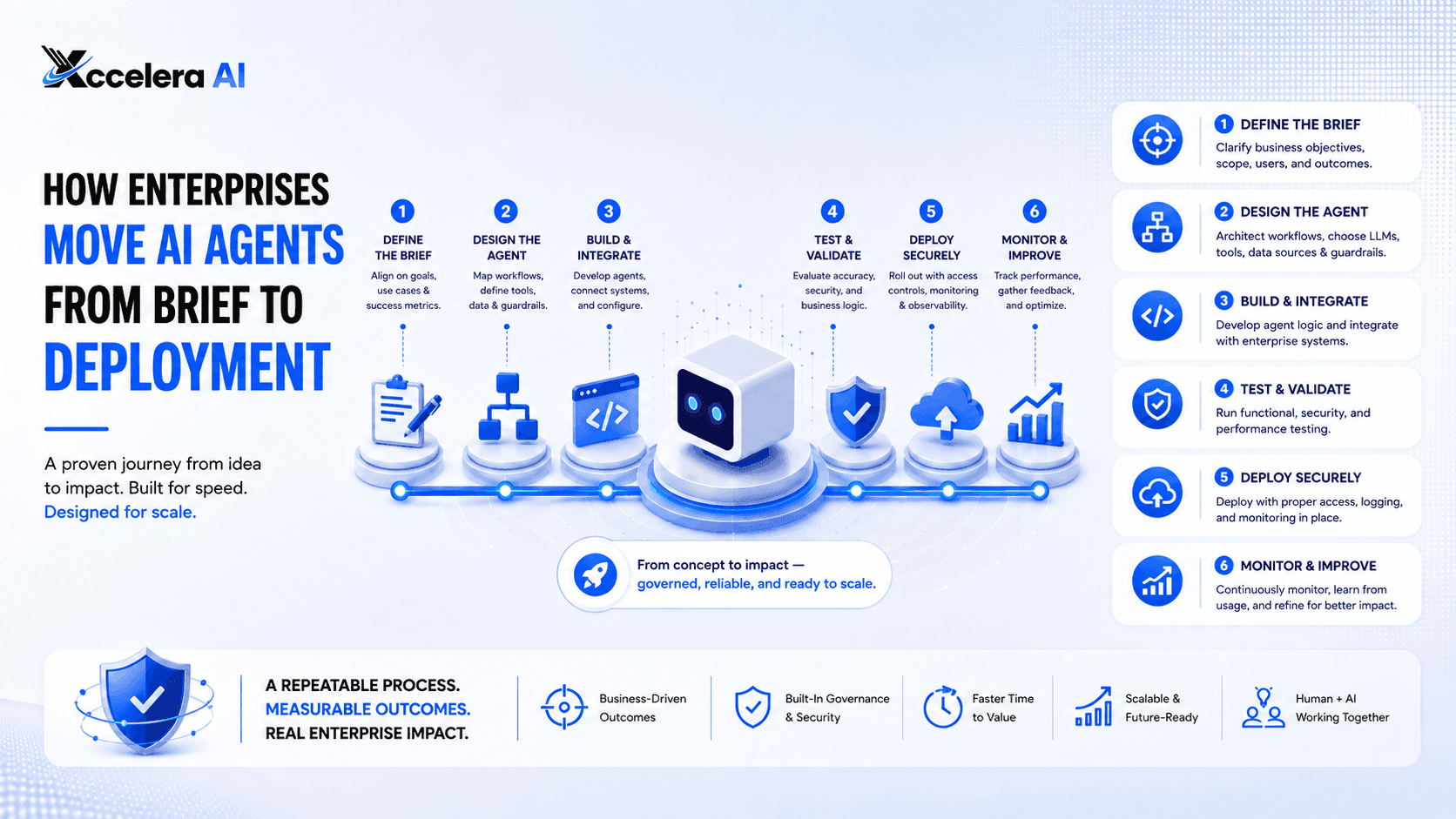
Enterprise AI agent deployment fails without lifecycle discipline. This case study traces one build from executive brief to production.
It shows how enterprise AI agent deployment can move from prototype to governed, revenue-ready system in weeks, not months.
The Real Cost of Stalled AI Agent Deployments
Most enterprise AI initiatives never reach production. Teams spend months writing infrastructure code before a single intelligent workflow goes live.
Engineering leaders report that 60 to 80 percent of build time gets consumed by boilerplate. Authentication, deployment pipelines, guardrail logic, and integration plumbing eat the schedule, and none of it touches the actual business problem.
The financial exposure compounds quickly. A prototype that took three months to build often needs another quarter of rework before it satisfies security review.
Meanwhile, competitors who solved for AI agent lifecycle management from day one are already running agents in production. They compound value with every release cycle. Recent industry data shows 88 percent of agent pilots never graduate to production at all, largely due to governance friction.
Boards no longer ask whether to deploy AI agents. Instead, they ask why deployment takes so long, and why the last three pilots stalled before launch.
This case study follows a real enterprise agentic AI deployment. It moves from the initial executive brief through to a live production agent, using structured lifecycle discipline instead of ad hoc engineering effort.
AI Agent Lifecycle Management as an Enterprise Discipline
AI agent lifecycle management treats agent development the way mature organizations treat any regulated software delivery process. It becomes a repeatable pipeline with checkpoints, not a one-off engineering sprint.
It covers requirement capture, architecture selection, code generation, guardrail injection, deployment, and ongoing governance and monitoring inside a single accountable workflow.
Three Shifts That Separate Lifecycle-Managed Builds
- Standardization replaces reinvention. Every agent follows the same architectural review, security baseline, and deployment checklist. Quality no longer depends on which engineer happens to own the project.
- Governance moves to day one. Approval gates, audit trails, and role-based access controls get built into the agent’s code. Nobody bolts them on after an incident forces the issue.
- Cost visibility precedes commitment. Finance and engineering see projected token spend, compute requirements, and storage costs before any resource gets provisioned.
Enterprises that adopt this discipline consistently report faster time to production. They also report fewer post-launch security remediations, since the guardrails were never an afterthought.
Scoping the Business Case: From Executive Brief to Enterprise Use Case
The case study begins with a familiar mandate from a mid-market financial services firm. Reduce first-response time on customer support tickets without adding headcount. The brief was two paragraphs long, and it named a business outcome rather than a technical specification.
Turning that brief into an enterprise use case required answering four questions before any code got written:
- What volume and complexity of requests will the agent actually handle
- Which existing systems, ticketing platforms, and knowledge bases must it integrate with
- What compliance requirements apply, given the regulated financial services context
- Where does human review remain mandatory, and where can the agent act autonomously
This scoping phase matters more than most engineering teams admit. A brief that skips compliance requirements produces an agent that must be rebuilt after legal review, not merely adjusted.
In this case, scoping surfaced a firm requirement: customer PII must never leave the system unmasked. Any escalation also had to include a structured evidence package for the human agent taking over. Both requirements shaped every architectural decision that followed.
Decision-makers often underestimate how much this early conversation saves downstream. Every question answered at the brief stage removes an assumption an engineer would otherwise bake into code. That assumption would otherwise surface only when legal, security, or compliance reviews the finished agent.
Structuring the Build: From Architecture to Working Agent
Once the use case was locked, the build followed a fixed sequence rather than improvised development. This sequencing is what separates production-ready AI agents from demo-ware that breaks under real traffic.
- Requirement capture in plain language, covering purpose, expected load, integrations, and compliance constraints
- Technology recommendation, matching requirements against the optimal LLM provider, agent framework, vector database, and orchestration pattern
- Blueprint generation, producing a full architectural specification for human review before any code exists
- API and schema generation, turning the approved blueprint into documented REST endpoints and schemas
- Knowledge base configuration, setting up document ingestion, chunking, embedding, and retrieval
For this support and triage use case, the recommendation engine selected a supervisor-worker orchestration pattern. One agent classified and routed tickets, while specialized sub-agents drafted responses and flagged compliance-sensitive language.
This kept the system modular. Adding a new ticket category later meant configuring a worker, not rebuilding the pipeline.
Governance and Validation Before Production Rollout
Enterprise agentic AI deployment fails audits more often on governance gaps than on model performance. The build phase is where those gaps get closed, not patched later.
Every agent generated for this deployment shipped with six safety layers active from the first request:
| Safety Layer | What It Enforces |
|---|---|
| PII Detection | Blocks email, phone, SSN, and credit card data from leaving unmasked |
| Prompt Injection Prevention | Detects instruction override attempts and rejects them before execution |
| Toxicity Filtering | Replaces harmful content with a filtered placeholder while the agent keeps running |
| Relevance Checking | Keeps requests inside the agent’s defined domain |
| Cost Controls | Enforces per-request and per-day token budgets |
| Rate Limiting | Throttles sensitive endpoints and blocks brute-force attempts |
This layered approach mirrors the risk categories flagged in OWASP’s Top 10 for Agentic Applications, which identifies prompt injection and excessive agency as leading threat vectors.
Before deployment, a designated approver reviewed the blueprint, the projected monthly cost, and the generated code itself. Only after explicit sign-off did the workflow proceed.
That single checkpoint caught a misconfigured escalation rule. It would have routed compliance-flagged tickets to the wrong queue — a fix that took minutes at the approval stage but would have taken weeks to unwind in production.
Scaling Deployment Across Enterprise Environments
Deployment is where AI agent orchestration either holds up under real traffic or collapses under it. The agent in this case study was packaged, containerized, and deployed automatically, with environment variables, secrets, and network policies configured rather than assembled by hand.
Enterprise deployment at scale typically requires attention to a consistent set of concerns:
- Automated provisioning across cloud targets, so the same agent runs on whichever infrastructure the enterprise already standardizes on
- Post-deployment health validation, confirming the agent is responsive and guardrails are active before real users touch it
- Brownfield compatibility, allowing the agent to plug into an existing codebase as a namespaced module rather than forcing a rewrite
- Version-controlled iteration, so future changes get proposed as reviewable pull requests instead of untracked hotfixes
For this deployment, health checks ran automatically once the agent went live. They confirmed response times and guardrail activation before ticket routing switched over from the legacy manual queue. The transition happened over a single weekend with zero unplanned downtime.
Enterprise agentic AI deployment rarely fails at the code level. Instead, it fails at the handoff between build and operations, when nobody owns the question of whether the agent is actually healthy in production. NIST’s AI Risk Management Framework similarly emphasizes continuous monitoring as a core pillar of trustworthy AI deployment, not a one-time launch gate.
Delivery Metrics That Prove ROI to the Board
Enterprises evaluating an agent lifecycle management platform want evidence, not promises. The metrics from this deployment illustrate what a disciplined lifecycle approach delivers, compared to the ad hoc timeline the firm experienced on a prior, abandoned agent project.
| Metric | Prior Ad Hoc Attempt | Lifecycle-Managed Build |
|---|---|---|
| Time to first working prototype | 11 weeks | 6 days |
| Time to production deployment | Never completed | 19 days |
| Security remediation items post-launch | 14 (estimated) | 0 at launch |
| Engineering hours on infrastructure boilerplate | Majority of project time | Near zero |
| First-response ticket time | Unchanged | Reduced by more than half |
These numbers shift the budget conversation. Instead of debating whether to invest in AI agents, boards start asking how quickly the next use case can get scoped. A board does not need to understand orchestration internals or guardrail architecture — it needs to see time to production compress from months to days, with governance intact rather than sacrificed for speed.
Building the Next Agent on a Governed Foundation
Xccelera built the AI Agent Lifecycle Management Platform behind this case study. It takes enterprise teams from a two-paragraph brief to a governed, production-deployed agent, without months of boilerplate engineering.
Every agent ships with built-in guardrails, human approval checkpoints, and full cost visibility before deployment. As a result, speed never comes at the expense of governance.


