Multi-Agent Orchestration: The Enterprise Control Plane for 2026
The enterprise AI race in 2026 is no longer about which model is smartest. It is about who has built the infrastructure to make intelligence act. Multi-agent orchestration is now the enterprise control plane, routing tasks, governing agents, and converting AI output into repeatable outcomes. Fewer than 10% of enterprises have crossed from pilot to…
The enterprise AI race in 2026 is no longer about which model is smartest. It is about who has built the infrastructure to make intelligence act. Multi-agent orchestration is now the enterprise control plane, routing tasks, governing agents, and converting AI output into repeatable outcomes. Fewer than 10% of enterprises have crossed from pilot to production. This article breaks down why, and what it takes to close that gap.
The Model Era Is Over. The Orchestration Era Has Begun.
The Intelligence Ceiling
For three years, enterprise AI investment followed a familiar script. Find the most capable model, deploy it against a high-visibility use case, measure accuracy, and report to the board. That approach worked when the goal was augmenting human decisions with machine-generated insight. It breaks completely the moment the goal shifts to replacing human execution with autonomous action.
What makes 2026 a turning point is not theoretical progress but operational readiness. Enterprises now have the architectures, governance models, and orchestration capabilities required to deploy AI agents in production environments without sacrificing control or accountability.
From Outputs to Outcomes
A single model, regardless of benchmark score, operates within a fixed context window and holds no persistent state between interactions. It generates answers. It does not execute decisions. For directors and operations leaders measuring success in throughput and cost-per-outcome, that distinction determines whether AI delivers ROI or remains a demonstration.
Enterprises deploying multi-agent architectures report three times faster task completion and 60% better accuracy on complex workflows compared to single-agent implementations.
The Orchestration Imperative
Gartner documented a 1,445% surge in multi-agent system inquiries from Q1 2024 to Q2 2025. This shift is production-critical, not experimental. These are not researchers exploring architecture theory. These are enterprise technology leaders who have exhausted the value ceiling of single-model deployments and are now engineering the coordination layer above them.
Organizations that deploy one smart agent per workflow will hit coordination bottlenecks, cost explosions, and brittle logic. Orchestration is not optional. It becomes the architecture.
Xccelera operates at this precise inflection point, partnering with enterprises to move from model deployment to orchestration architecture before the cost of inaction becomes the lesson.
What the Control Plane Actually Is (And Why Most Enterprises Get It Wrong)
Most enterprises approaching multi-agent AI make the same foundational error. They treat the orchestration layer as a connectivity problem, something handled by middleware, an API gateway, or an integration tool already sitting in their stack. That misread is expensive.
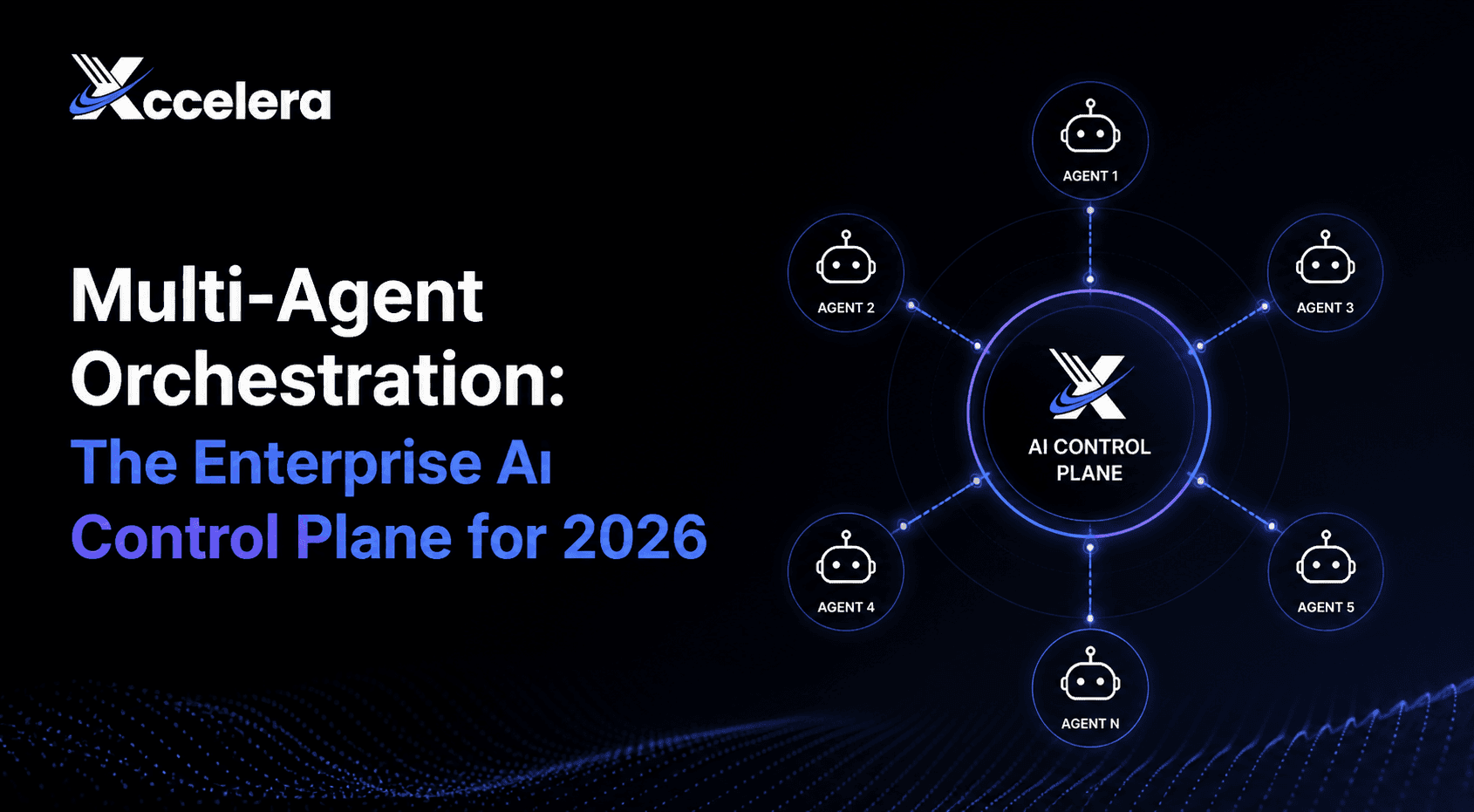
The orchestration layer is the control plane of a multi-agent system, transforming autonomous components into a coherent, goal-directed collective. Without it, even highly capable agents risk duplication of effort, logical inconsistency, or unbounded autonomy that diverges from the system’s objectives.
What that means operationally is that the control plane is not a pipe between systems. It is the decision layer that determines which agent receives which task, how much authority that agent holds, what context transfers at handoff, and when a human must step in. The orchestration layer routes tasks to the right agent or model, manages shared context and memory, coordinates tool and API calls, enforces guardrails, and decides when to escalate to humans. It turns a pile of models and prompts into a predictable workflow engine that you can monitor, test, and scale.
The enterprises getting this wrong are those treating orchestration as a feature to configure. The ones getting it right are those treating it as infrastructure to engineer. Orchestration is preferred for complex dependencies, when centralized rollback capability is needed, and for stable workflows. That distinction between configuration and engineering is where most pilots stall before reaching production.
The Four Failure Modes Killing Multi-Agent Deployments Before
They Scale
Forty percent of multi-agent pilots fail within six months of production deployment. The coordination complexity and cascading errors that seem manageable in pilots become existential threats at scale. The gap between demo and production is not a model quality problem. It is an architecture problem. These are the four failure modes responsible.
1. Context Collapse at Handoff Boundaries
When one agent passes a task to another, it must transfer the right context in the right format. A subagent that receives too little context will misinterpret its scope. One that receives the wrong context will act on incorrect assumptions. Neither failure surfaces as an obvious error; both surfaces as outputs that are subtly but consequentially wrong.
2. Coordination Deadlocks
Deadlocks are particularly dangerous because they mimic productivity. Unlike crashes, which are obvious, deadlocks consume resources invisibly, eroding efficiency and driving up costs while producing no output.
3. Token Cost Explosion
Every agent interaction burns tokens. In multi-agent chains, a single user request can trigger dozens of LLM calls simultaneously. What you tested with 100 demo queries now runs 10,000 times per day in production. Budgets that survived pilots rarely survive that math.
4. Governance Absence
A recent MIT report indicates that 95% of AI initiatives fail to reach production not because models lack capability, but because systems lack architectural robustness, governance structure, and integration depth. Agents without defined authority boundaries either over-escalate or overreach. Both outcomes destroy operational trust faster than any model failure.
Orchestration Patterns That Enterprise Architects Are Actually Deploying
Hierarchical Orchestration
A central orchestrator breaks high-level objectives into subtasks and delegates them to specialized subagents. This pattern dominates complex, cross-functional enterprise operations where a single coordination point must maintain visibility across the entire workflow. Microsoft’s healthcare implementations demonstrate this perfectly. A central orchestrator manages patient flow while specialized agents handle specific tasks autonomously, reducing hours of specialist preparation to automated workflows.
Supervisor-Worker Pattern
One orchestrator coordinates multiple domain-specific agents operating in parallel. This suits customer service and task routing environments where speed and specialization must coexist. Enterprises deploying multi-agent architectures using supervisor-worker coordination report three times faster task completion on complex workflows compared to single-agent implementations.
Pipeline and Sequential Processing
Agents execute in ordered stages, each passing structured output to the next. Financial reconciliation, compliance auditing, and content generation pipelines operate reliably under this model because task dependencies are fixed and predictable.
The Hybrid Architecture Winning in 2026
Pure orchestration and pure choreography each have limitations. The winning pattern uses high-level orchestrators for strategic coordination while allowing local mesh networks for tactical execution. This hybrid approach gives enterprise architects centralized control where governance demands it and distributed autonomy where throughput requires it.
Selecting the wrong pattern does not produce slightly suboptimal results. It produces systems that break under production load while appearing functional in every controlled test environment.
MCP and A2A: The Protocol Stack Powering Enterprise Agent Communication
Every multi-agent system runs on two fundamental communication problems. How does each agent connect to the tools and data it needs? And how do agents communicate structured work to each other? In 2026, two protocols have resolved both questions at enterprise scale, and understanding them is no longer optional for technology leaders.
MCP standardizes how agents connect to tools, APIs, and data sources. A2A handles agent-to-agent communication. Together, they are the two essential AI agent protocols in 2026, the foundation of the enterprise AI stack.
MCP functions as the universal adapter layer. Rather than building custom integrations for every system an agent must access, MCP standardizes how AI agents connect to external systems, data sources, and tools, eliminating the fragmented, custom integration approaches that previously bottlenecked production agent deployment. The adoption signal is unambiguous. As of 2026, MCP is not only a foundational protocol but also a thriving ecosystem with over 10,000 active public MCP servers, spanning from individual developer tools to Fortune 500 deployments.
A2A operates one layer above. It manages how agents delegate structured work to each other, track task lifecycle states, and maintain accountability across handoffs without requiring custom state management.
The strategic case for adopting both is direct. Companies with highly interoperable applications grew revenues approximately six times faster than their non-interoperable peers. Protocol standardization is not an engineering preference. It is a revenue architecture decision.
Governance Is Not the Brake. It Is the Engine.
Enterprise leaders treating governance as a compliance checkbox are operating on a framework that 2026 has already invalidated. The data is unambiguous on what happens to ungoverned agentic deployments.
- More than 40% of today’s agentic AI projects could be cancelled by 2027 due to unanticipated cost, complexity of scaling, or unexpected risks. The primary driver across cancelled projects is not model failure. It is governance absence.
- In 2026, governance enables scale. Enterprises that invest early in bounded autonomy, clear limits, escalation paths, and accountability will deploy agents into higher-value workflows sooner and more safely.
- A progressive autonomy spectrum is emerging based on task complexity, business domain, workflow design, and outcome criticality. The most advanced businesses are beginning to shift toward human-on-the-loop orchestration where humans supervise outcomes rather than approve every decision individually.
- Regulated industries face an additional layer. The EU AI Act mandates risk assessment, transparency measures, technical safeguards, and human oversight for agentic systems operating within European jurisdictions. Organizations without traceable decision paths will not pass that bar regardless of model performance.
- Multi-agent systems support built-in checks and balances. Critic agents can challenge assumptions. Validator agents can enforce constraints. Red-team agents can simulate failure modes. This layered approach improves reliability and aligns well with enterprise risk management practices.
Governance structured this way does not slow agent deployment. It is the mechanism that makes high-autonomy deployment survivable at scale.
Observability and Cost Control: The Hidden Infrastructure Battle
The Telemetry Problem Nobody Budgets For
Traditional software generates predictable telemetry. A request enters, hits a few services, returns a response. AI agent workloads operate on an entirely different scale. AI workloads generate 10 to 50 times more telemetry than traditional services. Prompt tokens, completion tokens, tool call traces, inter-agent message chains, and decision logs all require capture, storage, and analysis simultaneously.
The Bill That Arrives Three Months Later
Teams report that adding AI workload monitoring to existing setups has increased their observability bill by 40 to 200%, depending on volume and how many custom metrics they instrument. This is the infrastructure cost most enterprise AI business cases never model. The CFO question that surfaces consistently post-launch is not about model accuracy. It is about cost per workflow, per customer, per outcome.
What Forward-Thinking Teams Are Doing
A 2026 benchmark across enterprise AI teams found that organizations relying on custom orchestration layers spent up to 60% of AI engineering time on infrastructure maintenance rather than on building or improving workflows. A dedicated platform shifts that ratio.
The resolution is architectural, not reactive. Observability enables early detection of issues, smarter decisions, and continuous improvement, turning AI from a black box into a business engine organizations can trust. Building cost-aware telemetry pipelines from day one is not optional infrastructure. It is the difference between an AI investment that scales and one that quietly bankrupts its own budget.
Where Multi-Agent Orchestration Is Delivering Documented Enterprise ROI
The business case for multi-agent orchestration is no longer theoretical. Across industries, production deployments are generating outcomes that single-agent and single-model architectures demonstrably cannot match. The numbers below come from live enterprise environments, not controlled pilots.
The Wells Fargo deployment tells the story clearly. 35,000 bankers now access 1,700 procedures in 30 seconds instead of 10 minutes. That is not an efficiency improvement. That is a structural transformation of how institutional knowledge moves through an organization.
IBM’s latest research shows that multi-agent orchestration slashes handoffs by 45% and boosts decision speed by 3x. For operations leaders managing high-volume, time-sensitive workflows, those two metrics translate directly into competitive positioning, not just cost reduction.
At the platform level, Microsoft’s AI initiatives have demonstrated a 2.8x return on generative and agentic AI investments, with leading companies achieving up to 5x ROI. These returns are attributed to AI’s ability to enhance decision-making, automate operations, and improve customer experiences.
Across deployment categories, the pattern holds consistently. Organizations implementing enterprise automation strategies through orchestrated agent systems report 30 to 50% process time reductions and improved accuracy. Customer operations, financial reconciliation, HR onboarding, and supply chain execution are producing the strongest and most consistently documented returns.
The ROI is real. The variable is not whether orchestration delivers value. The variable is whether the architecture behind it is built to sustain that value beyond the first six months of production.
How Xccelera Builds Enterprise-Grade Multi-Agent Control Planes
The distance between a functioning multi-agent prototype and a production-grade orchestration system is where most enterprise AI investments stall. Xccelera’s work begins precisely at that boundary.
Architecture Aligned to Business Objectives
Xccelera does not begin with framework selection. Every orchestration engagement starts with mapping agent authority to business outcomes, defining what each agent is permitted to execute independently, what requires escalation, and what must involve human judgment. A subagent must know what it is allowed to do independently and when it must escalate. Without explicit boundaries, subagents either become overly cautious, interrupting frequently and defeating the purpose of delegation, or overreach, taking actions the organization never sanctioned. Xccelera engineers those boundaries before a single agent goes live.
Governance Embedded at the Infrastructure Layer
Xccelera’s control plane architecture treats governance as infrastructure, not policy documentation. Audit trails, role-based access, escalation paths, and cost attribution are built into the execution layer from day one. PII redaction, prompt shielding, and data residency controls are table stakes in 2026. The evaluation question is whether they are enforced at the infrastructure level or depend on correct configuration by each implementation team. Xccelera enforces them at the infrastructure level, every time.
Closing the Pilot-to-Production Gap
Multi-agent orchestration provides the structure, visibility, and control necessary to move from experimental AI to reliable enterprise ecosystems. Xccelera delivers that structure with integration depth across enterprise systems, protocol-native MCP and A2A support, and observability pipelines built for production telemetry volumes, not demo environments.
The Autonomous Enterprise Is Not a Vision. It Is a Build Decision.
Every enterprise leadership team operating in 2026 faces the same structural question, even if it has not been framed this way yet: are we building the orchestration infrastructure that will define our operational ceiling for the next decade, or are we waiting for a better moment that the market will not provide?
Gartner predicts that by 2028, 33% of enterprise software applications will include agentic AI, up from less than 1% in 2024, with at least 15% of day-to-day work decisions being made autonomously through AI agents. That trajectory does not reward organizations that begin building in 2027.
The workforce dimension is equally consequential. In 2026, the most advanced businesses will begin laying the foundation of shifting toward human-on-the-loop orchestration, where human contributions include more creative prompting and guiding multi-agent systems while solving problems and taking strategic decisions efficiently. This is not workforce reduction. It is workforce reorientation toward higher-order judgment while agents absorb execution complexity.
2026 will not reward the most enthusiastic adopters. It will reward organizations that treat agentic AI as infrastructure, designed, governed, and constrained deliberately.
Xccelera exists to make that deliberate build possible. The control plane is not a future architecture. It is a present decision. Organizations that partner with Xccelera to engineer it now will not be catching up to competitors in 2028. They will be the ones being chased.