The Enterprise AI Shift: Why 2026 Marks the Structural Move to Agentic Systems
The year 2026 does not represent another chapter in enterprise AI adoption. It represents a structural break. Organizations that spent 2023 and 2024 running pilots and debating readiness are now watching competitors deploy agentic AI systems that autonomously execute workflows, coordinate across functions, and deliver measurable financial returns without proportional headcount growth. The data is…
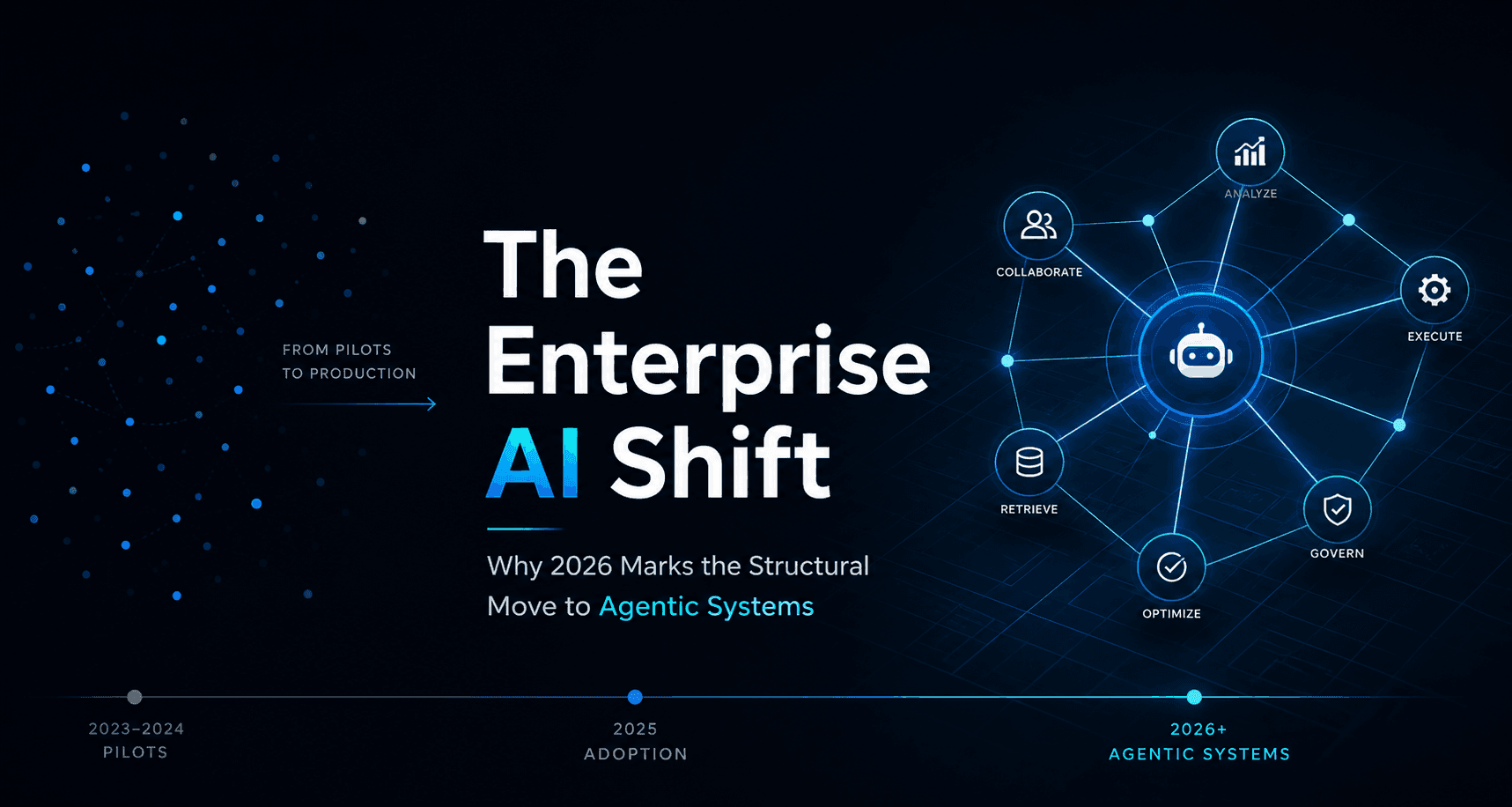
The year 2026 does not represent another chapter in enterprise AI adoption. It represents a structural break. Organizations that spent 2023 and 2024 running pilots and debating readiness are now watching competitors deploy agentic AI systems that autonomously execute workflows, coordinate across functions, and deliver measurable financial returns without proportional headcount growth. The data is no longer directional. It is conclusive. Agentic AI systems have moved from innovation labs into the operational core of forward-moving enterprises, and the window for a measured, low-urgency response has closed. For founders, directors, and decision-makers navigating this shift, Xccelera exists precisely at this intersection. As a venture studio and agentic AI accelerator, Xccelera bridges the gap between deployment ambition and production-grade execution, helping enterprises transform agentic AI from a strategic aspiration into a compounding operational advantage.
From Pilot Fatigue to Production Reality: What 2026 Data Actually Confirms
Enterprise AI has stopped being a roadmap item and started being an operational reality. Directors still running quarterly pilot reviews are not being cautious. They are falling behind.
More than 4 in 10 organizations now run agentic AI in full production. 91% of CXOs are increasing agentic budgets in 2026, with over half reallocating spend away from legacy vendors entirely.
Enterprise investment in AI agent ecosystems crossed $600 billion in 2026. Agentic systems are no longer peripheral assistants. They are embedded at the operational core.
Earlier AI waves were additive. Agentic AI systems are structural. They do not assist a process. They own it, end to end, without waiting for human initiation at every step.
Gartner projects task-specific agent integration across enterprise applications will jump from under 5% in 2025 to 40% by the end of 2026. 75% of companies will invest in agentic systems this year alone.
That is not a trend. That is a structural market reset. Xccelera partners with the enterprises moving into that 40% and not the ones watching it happen.
The 79-vs-11 Problem: Adoption Without Production Is Not a Strategy
79% adopted. 11% in production. The gap between these two numbers is where most enterprise AI strategies go to die.
MIT research puts it plainly: 95% of AI pilots never scale. Only 5% deliver measurable profit impact. The model is not the problem. Fragmented workflows, legacy infrastructure, and siloed data are.
The 12% who cross into production share one trait. They treated agentic deployment as a business transformation decision, not an IT procurement exercise. Infrastructure before rollout. Governance before pilots. Direct business ownership before a single agent went live.
The financial case for urgency: U.S. enterprises in production are reporting 192% average ROI. Three times the return of traditional automation. Every quarter outside production is a quarter that returns compounds exclusively for competitors.
Adoption without production is not a strategy. It is a liability dressed in innovative language.
The Architecture Reckoning: Why Agentic AI Systems Demand a New Enterprise Stack
Legacy enterprise architecture was built for a world where software executed instructions. Agentic AI operates in a world where software makes them. That distinction collapses every assumption traditional IT infrastructure was designed around.
Why Legacy Architecture Fails Agentic Systems
- Built for stability and discrete change cycles, not continuous autonomous evolution
- Static blueprints cannot support real-time cross-system coordination
- Approval layers and batch workflows create bottlenecks agents cannot operate within
- Siloed data prevents agents from maintaining contextual awareness across functions
What the New Enterprise Stack Actually Requires
- Model abstraction layers enabling multi-model routing without vendor dependency
- Vector databases and graph-based relationships forming the retrieval backbone
- Persistent memory systems maintaining continuity across long-running workflows
- Agent orchestration infrastructure as a core platform layer, not an add-on
The Defining Shift
By 2026, competitive advantage is architecture-driven, not model-driven. Foundation models have become interchangeable. The stack surrounding them is where differentiation lives. Enterprises still treating architecture as an IT consideration rather than a strategic one are making a default choice, and that default is already costing them.
Multi-Agent Orchestration Is Not a Feature. It Is the Foundation.
Single-agent systems hit a ceiling fast. Real enterprise workflows demand more. Research, delegation, validation, iteration across functions simultaneously. That is not a single-agent problem. That is an orchestration problem.
Where Single Agents Fall Short
- Handle discrete tasks but collapse under multi-step enterprise workflows
- Cannot maintain shared state across departments and systems
- No mechanism for conflict resolution when outputs contradict each other
- Local optimization by isolated agents damages broader business outcomes
What Orchestration Actually Delivers
- Dynamic role allocation assigning tasks to the most capable agent in real time
- Conflict resolution preventing agents from overriding each other’s outputs
- Shared memory preserving institutional knowledge across the entire agent network
- Centralized governance, monitoring, and compliance enforcement across all agents
The Infrastructure Standard Emerging in 2026
Two protocols are defining interoperability at the agentic layer. The Model Context Protocol standardizes how agents access external tools and data. The Agent-to-Agent protocol governs peer coordination and delegation between agents. Together they form the communication substrate that scalable multi-agent execution depends on.
Forrester finds 56% of organizations improve scalability when orchestration frameworks are implemented. Organizations treating orchestration as optional are not running lean. They are accumulating coordination failures that surface catastrophically at scale.
The ROI Calculus: What Enterprises Crossing the Production Threshold Are Reporting
The financial case for agentic AI in production is no longer speculative. It is reported, benchmarked, and increasingly auditable across industries.
What Production-Grade Deployment Is Actually Returning
| Metric | Reported Outcome |
| Average ROI | 171% globally, 192% for U.S. enterprises |
| ROI timeline | 74% of executives achieve it within year one |
| Cost reduction | Up to 70% through automated agentic workflows |
| EBITDA impact | 20-40% margin improvement in AI-centric operations |
| Productivity | 39% of executives report productivity doubling |
Where Returns Concentrate
- Finance and internal audit: end-to-end workflow automation
- Supply chain: real-time coordination and demand sensing
- Customer experience: 68% of interactions managed autonomously by 2028
- HR and IT: reduced decision latency and consistent execution at scale
The Compounding Advantage
Returns do not distribute evenly. They concentrate inside the 11% running agents in production. Organizations still in the pilot phase are not neutral. They are actively falling behind while competitors compound operational advantage quarter over quarter.
The enterprises extracting transformative value share one common thread. They stopped measuring AI success by capability and started measuring it by delivery.
Autonomous Workflows and the Decoupling of Output from Headcount
The assumption that enterprise output scales with headcount is no longer valid. Agentic AI has broken that relationship permanently, and the financial models most boards are still working from have not priced that in.
What This Means for the P&L
- Operational capacity no longer requires proportional workforce expansion
- Agentic systems absorb coordination, execution, and monitoring without additional hire
- Cost structures built around headcount growth are becoming a competitive disadvantage
- Organizations running lean AI-empowered teams are outproducing traditionally staffed ones
The Strategic Decision on the Table
Directors and founders face a direct choice. Continue scaling through people and process overhead, or redesign organizational capacity around agentic execution. The first path compounds cost. The second compound capability.
The Boardroom Reality
McKinsey data shows AI-centric organizations achieving 20-40% operating cost reductions and 12-14 point EBITDA margin increases. Those numbers are not coming from better software. They are coming from a fundamental redesign of how work gets authorized, executed, and measured at the organizational level.
Governance Is Not a Guardrail. It Is the Growth Engine.
Every major enterprise AI failure of the past two years traces back to the same root cause. Not a bad model. Not a failed integration. A governance vacuum that nobody owned until something went wrong.
In 2026, that vacuum has consequences that extend well beyond internal risk committees.
The Regulatory Reality Landing on U.S. Executive Desks
The EU AI Act entered full enforcement for high-risk systems in 2026, carrying penalties of up to €35 million or 7% of global annual turnover. U.S. enterprises operating across borders are not exempt. Boards that treated AI governance as a compliance checkbox are now treating it as a financial exposure.
What Mature Governance Actually Unlocks
Organizations with formal governance frameworks are not moving slower. They are moving faster, with less failure, and with greater stakeholder confidence at every level. The data is direct: enterprises with governance infrastructure in place before deployment deploy more agents, sustain them longer, and extract compounding returns that ungoverned deployments consistently fail to reach.
60% of enterprises currently lack formal agentic governance frameworks. That gap is not a sign of agility. It is a sign of exposure.
The Tiered Governance Advantage
Leading organizations are implementing risk-tiered governance models. Low-risk agents move fast through automated checks. High-risk agents receive appropriate scrutiny without slowing the broader deployment roadmap. Governance by design, embedded into development workflows rather than bolted on afterward, is what separates enterprises scaling confidently from those firefighting constantly.
The executives winning this transition are not the ones asking whether governance slows innovation. They are the ones who stopped asking that question entirely.
The Data Readiness Imperative
Agentic AI is only as intelligent as the data feeding it. That statement sounds obvious. The enterprise reality behind it is anything but.
An agent working from stale, inconsistent, or siloed data does not just underperform. It makes autonomous decisions at scale based on a version of the business that no longer exists. The downstream consequences of that compound faster than any human-executed error chain ever could.
The Data Problems Blocking Production
- 48% of enterprises cite insufficient or poor quality data as their top AI challenge
- Unstructured data gaps are causing agents to produce unreliable, ungoverned outputs
- Privacy and security constraints are blocking access to the most operationally valuable enterprise data
- Semantic layers are absent in most stacks, forcing agents to generate rather than reason over structured data
What Data Readiness Actually Demands
Real-time data freshness is non-negotiable for trustworthy agentic decision-making. Vector databases, structured connectors, and graph-based relationships form the retrieval foundation agents depend on. Without persistent, accurate, and accessible data architecture, agentic deployment does not fail slowly. It fails loudly, at the worst possible moment, inside a live business process.
The Executive Takeaway
Data readiness is not a prerequisite that the technology team resolves before handing off to the business. It is a strategic infrastructure decision that belongs on the same agenda as the deployment decision itself. Directors approving agentic AI investment without auditing data architecture are approving a foundation they have not inspected.
The Vendor Lock-In Trap Enterprises Are Walking Into
The most consequential architecture decision most enterprises are making in 2026 is not the one they know they are making. It is the default one being made for them by whichever vendor had the best sales cycle.
Proprietary orchestration layers compound lock-in at every level of the stack. The foundation model choice and the agent framework choice are not independent decisions. When agents run on a vendor’s proprietary orchestration infrastructure, switching costs multiply faster than the value being extracted.
Where Lock-In Compounds
- Proprietary orchestration layers tie agent logic to a single vendor ecosystem
- Data pipelines built around vendor-specific formats create migration barriers
- Vendor partnerships with system integrators are accelerating deployment but deepening dependency
- Enterprises without a defined architecture strategy are defaulting into lock-in by inaction
What the Smartest Enterprises Are Doing Differently
- Designing for modularity and interoperability from day one
- Separating foundation model selection from orchestration layer decisions
- Demanding open standards compliance before any vendor commitment
- Evaluating vendors on governance posture and architectural flexibility, not just model performance
The Question Every Director Should Be Asking
Vendor selection in 2026 is a five-year architectural commitment disguised as a procurement decision. Every major AI vendor is now partnered with the same consulting firms advising your organization. Those relationships are not neutral.
Directors who defined their architectural principles before entering vendor conversations are building durable advantages. Directors who let the best demo drive the decision are building someone else’s competitive moat at their own expense.
A vendor whose orchestration layer cannot be replaced without rebuilding everything is not a partner. It is a ceiling with a subscription fee
Why Founders and Directors Cannot Delegate This Decision Downward
There is a version of this story where the CTO handles it. Where the AI committee produces a framework. Where the technology team runs the evaluation and surfaces a recommendation six months from now.
That version ends badly.
For the first time in enterprise technology history, business leaders have surpassed CIOs and CTOs as the dominant AI decision-making group. Line-of-business leaders now represent 46% of AI adoption decisions, outpacing both technology and infrastructure leadership. That shift did not happen because boards mandated it. It happened because the stakes outgrew the IT department.
Agentic AI decisions touch organizational structure, workforce accountability, competitive positioning, and capital allocation simultaneously. No technology leader owns all four of those dimensions. Only the founder or director does.
The Velocity Paradox Sitting on Every Executive Agenda
The pressure to scale agentic AI fast enough to stay competitive is real. So is the risk of scaling without the operating model to support it. 89% of organizations still operate inside industrial-age structures while deploying next-generation autonomous systems into them. That mismatch does not resolve at the technology layer. It resolves at the leadership layer.
The enterprises pulling ahead are not the ones with the most sophisticated AI teams. They are the ones where the person with full organizational authority made a direct, informed, and irreversible commitment to agentic infrastructure before the competitive window closed.
That decision cannot be delegated. It can only be made or avoided.
Xccelera and the Agentic Enterprise: Bridging Ambition and Execution
Most enterprises arrive at the agentic AI conversation with a clear ambition and an unclear path. The technology is selected. The budget is approved. The pilot is announced. And then the organization collides with the exact infrastructure, governance, and deployment gaps this article has mapped from the first section to this one.
That collision is not a technology failure. It is a structural one. And it is precisely where Xccelera operates.
What Xccelera Brings to the Production Gap
Xccelera’s venture studio and accelerator model is built around one operational reality: the distance between agentic AI ambition and production-grade execution is not closed by better models or bigger budgets. It is closed by deployment architecture, governance infrastructure, and organizational alignment executed in the right sequence by people who have done it before.
Where Xccelera Focuses
- Closing the 79-vs-11 production gap for enterprises ready to move beyond pilot dependency
- Building autonomous digital workforces tailored to specific operational and competitive contexts
- Designing multi-agent orchestration frameworks that scale without compounding governance risk
- Positioning founders and directors to lead the agentic transition with full organizational authority
The Xccelera Difference
In a market flooded with AI vendors selling capability and consultants selling frameworks, Xccelera delivers execution. Not a roadmap to production. Production itself.
Xccelera’s accelerator model is built around one reality. The gap between agentic AI ambition and operational returns is not a technology problem. It is a structural one. Governance, infrastructure, and deployment sequencing executed in the right order by people who have done it before.
The structural shift to agentic systems has arrived. The only question remaining is whether your organization is inside it or watching it from the outside.