Outcome-Based Pricing for Enterprise Software: The Service-as-Software Shift Explained
Enterprise software pricing is shifting away from per-seat subscriptions toward outcome-based pricing and Service-as-Software models. Consequently, vendors now get paid for verified results instead of user licenses. AI agents are accelerating this transition by generating auditable completion signals that make outcome billing possible at scale. For CTOs, VPs, and founders evaluating vendor contracts in 2026,…
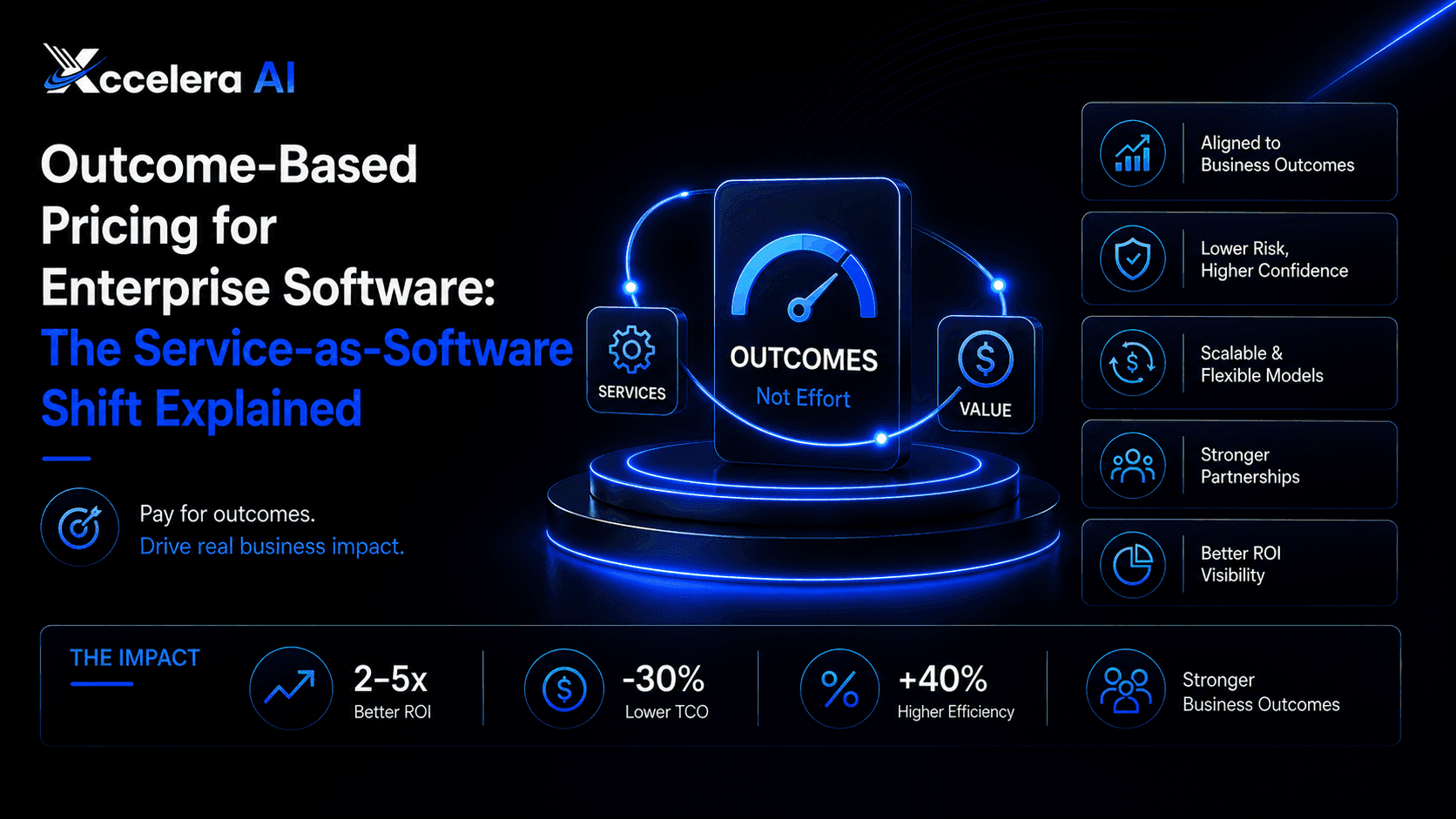
Enterprise software pricing is shifting away from per-seat subscriptions toward outcome-based pricing and Service-as-Software models. Consequently, vendors now get paid for verified results instead of user licenses. AI agents are accelerating this transition by generating auditable completion signals that make outcome billing possible at scale.
For CTOs, VPs, and founders evaluating vendor contracts in 2026, understanding how outcome-based pricing works — and where it breaks down — has become essential to protecting budgets and negotiating leverage.
Why Per-Seat Pricing Is Breaking in the Enterprise AI Era
Per-seat pricing was built for a world where software required a human at every desk to generate value. That assumption no longer holds. Seat-based adoption dropped sharply as AI agents began automating tasks that once required entire departments. This decline is well documented: Gartner predicts that by 2030, at least 40% of enterprise SaaS spend will shift toward usage-, agent-, or outcome-based pricing, with seat-based vendor revenue share declining from 21% to 15%.
Companies running these agents are cutting headcount while producing far more output. Yet many vendors continue billing at the same per-user rate, regardless of how few humans actually log in.
The Margin Gap Vendors Cannot Ignore
Firms that stayed loyal to seat-based pricing for AI products now report notably lower gross margins than competitors using outcome or usage-based structures, along with higher churn. As one CIO.com industry analysis puts it, AI agents have decoupled labor from value, making per-seat pricing obsolete when one agent does work that previously required ten employees.
That gap has turned pricing model choice into a board-level conversation rather than a back-office decision. Consequently, vendors are racing to restructure contracts before the next renewal cycle.
What Outcome-Based Pricing Actually Means for Enterprise Buyers
Outcome-based pricing ties a vendor’s revenue directly to results delivered, rather than to seats provisioned or hours logged. Intercom charges for each successful resolution its Fin AI agent completes. Zendesk prices automated resolutions similarly, and Salesforce Agentforce bills per conversation.
Each model replaces an old question — how many people can access the software — with a new one: how much verified work did the software actually perform?
How Outcomes Get Defined and Measured
Defining an outcome sounds simple until contract negotiations begin. Vendors and buyers must agree in advance on what counts as a completed resolution or a delivered result. That definition has to survive audits, disputes, and edge cases.
For example, one detailed industry breakdown notes that Zendesk’s Automated Resolution pricing confirms a support ticket only counts as resolved by AI after 72 hours of inactivity, and buyers must contractually agree on that definition before signing. Contracts built around outcome pricing tend to be longer and more technical than traditional subscription agreements, precisely because so much rides on getting the definition right from day one.
The Service-as-Software Shift: From Subscriptions to Execution
Service-as-Software reframes enterprise software as an execution layer that performs work on its own, rather than a tool that waits for a human to operate it. This marks a meaningful departure from the SaaS model that dominated the last two decades, where value was measured in access and uptime.
Under Service-as-Software, value is measured in completed work. Pricing follows that shift naturally, since customers are effectively buying labor rather than licenses.
Market Momentum Behind the Category
Adoption data backs up the shift. As one 2026 pricing report confirms, Gartner projected that by 2025 over 30% of enterprise SaaS solutions would incorporate outcome-based components, up from roughly 15% in 2022. Some forecasts put 2026 adoption even higher.
Deloitte’s 2026 technology predictions reach a similar conclusion, describing this shift as a structural redefinition of the entire SaaS business model. This trajectory signals a durable category shift rather than a temporary pricing experiment. Therefore, enterprise buyers should plan procurement strategy accordingly. For a deeper look at how this pricing logic connects to broader Service-as-Software economics, see this related piece on the Service-as-Software pricing model and why outcomes replace seats and hours.
How AI Agents Make Outcome-Based Pricing Possible
Static software could never support true outcome billing, because it had no reliable way to prove what it actually accomplished. Autonomous agents change that equation. They complete tasks end to end and generate detailed telemetry along the way, from initiation through final resolution.
That telemetry becomes the evidentiary backbone of an outcome contract. As a result, it turns what used to be a trust-based promise into something closer to an auditable receipt. To see how this kind of measurable ROI plays out in practice, review this blueprint for maximizing ROI in agentic workflows.
Why Reliability Now Determines Billing Trust
An agent’s completion signal is only as good as its reliability. Vendors whose agents produce inconsistent or unverifiable results struggle to defend outcome-based invoices. Meanwhile, vendors with dependable execution build the billing trust needed to command premium outcome rates.
Reliability, in this new model, is not just an engineering metric — it is a direct input into revenue.
Real Enterprise Examples of Outcome-Based Pricing in 2026
The shift is no longer theoretical. Oracle’s fiscal Q4 2026 results signaled a pivot toward AI-driven commercial models, including token bundles and outcome-based pricing. This challenges the consumption-based orthodoxy that has defined cloud economics for over a decade.
HighRadius moved away from per-seat pricing entirely when it launched its outcome-based model, tying revenue directly to accounts receivable outcomes rather than user counts. Interestingly, Intercom’s Fin AI Agent, priced at $0.99 per resolution, scaled to eight-figure annual recurring revenue at a 393% annualized growth rate.
What These Moves Signal for Procurement Teams
When infrastructure giants like Oracle and specialized platforms like HighRadius both restructure around outcomes, procurement teams should treat that convergence as a signal, not a coincidence. Vendors across very different layers of the stack are independently concluding that outcome alignment sells better than access alone.
Buyers who understand this trend early gain real negotiating leverage during renewal conversations.
Where Outcome-Based Pricing Breaks Down: Attribution and Risk
Outcomes cannot always be cleanly attributed to a single vendor. Consider a CRM platform claiming credit for a sales increase. Market conditions, marketing spend, and sales strategy all contribute to that same number. Isolating the software’s specific share of the result is rarely straightforward.
This attribution problem sits at the center of nearly every dispute that arises under outcome-based contracts.
The Administrative Tax of Constant Reconciliation
Because outcomes cannot be perfectly specified, vendors and enterprises often end up in repeated cycles of reconciliation meetings and measurement debates. Legal, finance, procurement, and customer experience teams all get pulled into validating what the vendor’s system actually caused.
That administrative overhead can quietly erode the efficiency gains the pricing model was supposed to deliver in the first place.
Hybrid Pricing: The Practical Middle Ground for Enterprise Buyers
Pure outcome models rarely survive real contract negotiation, and pure seat-based models are losing ground fast. What has emerged instead is a hybrid structure that blends a predictable base subscription with usage allowances and outcome components layered on top.
Vendors including Adobe, Salesforce, and ServiceNow now offer exactly this kind of blended pricing. This gives buyers budget predictability while still rewarding demonstrated value. Indeed, 43% of SaaS companies now use hybrid pricing models, with adoption projected to reach 61% by the end of 2026.
Why Buyers Are Gravitating Toward Blended Contracts
Recent survey data shows fewer than one in five enterprise buyers still prefer classic per-user pricing. A much larger share favor consumption or outcome-linked structures instead.
Hybrid contracts capture the appeal of both worlds. They give finance teams a floor they can budget against, while still letting vendors capture upside when their software drives measurable results — exactly the balance most enterprise buyers say they want.
Building Internal Readiness: Finance, Legal, and Procurement Alignment
Adopting an outcome-based or hybrid contract is not just a vendor decision. It requires enterprises to build new internal muscle before signing anything. Finance teams need FinOps discipline capable of tracking variable AI costs, since outcome billing can swing month to month based on volume and performance.
What Legal and Procurement Need to Prepare
Legal teams need to review measurement clauses line by line. The definition of a billable outcome effectively sets the ceiling on vendor revenue and the floor on customer risk.
Procurement’s role expands too, shifting from simple license negotiation toward ongoing vendor performance evaluation. Enterprises that skip this internal preparation tend to discover measurement disputes only after the first invoice arrives.
How Enterprise Buyers Should Evaluate Vendor Contracts
Not every outcome-based proposal deserves a signature. Buyers should confirm the vendor:
- Genuinely controls the work being priced
- Can prove results with real, auditable data
- Can predict the likely range of outcomes
- Prices against something the customer already measures internally
When those four conditions hold, outcome pricing tends to work well. When they do not, the contract usually shifts risk onto the buyer instead of sharing it.
Red Flags Worth Walking Away From
Watch for vendors who cannot explain their measurement methodology in plain language. Similarly, be wary of vendors who resist independent audit rights or build in automatic price escalators without corresponding performance guarantees.
A well-structured outcome contract should feel like a shared bet on results. It should never operate as a one-sided hedge that only protects the vendor’s revenue.
How Xccelera Builds Outcome-Aligned Agentic Systems
Xccelera designs agentic AI systems built for this new economic reality from the ground up. Rather than retrofitting outcome billing onto tools designed for a seat-based era, Xccelera’s architecture generates the audit trails and completion telemetry that outcome pricing actually requires.
This gives enterprise buyers verifiable proof of work rather than promises. That foundation supports the Service-as-Software model directly, since pricing can scale with real execution instead of provisioned access. Products like ApiX and LibX already operate on this pay-per-run, completion-verified logic.
For enterprises evaluating how to move from static software toward autonomous, outcome-ready systems, Xccelera’s agentic AI portfolio offers a practical starting point grounded in transparency and measurable results. Learn more about how Xccelera approaches agentic AI architecture at xccelera.ai.