Why CTOs Are Restructuring Engineering Around an Agentic SDLC
Enterprise engineering leaders are rebuilding the software development lifecycle around autonomous execution instead of human sequencing. Consequently, the Agentic SDLC is replacing delivery models built for human-only throughput. This shift pushes CTO responsibilities away from hands-on coding and toward governance and architecture. Smaller, senior engineering teams are becoming the norm as agents absorb implementation work.…
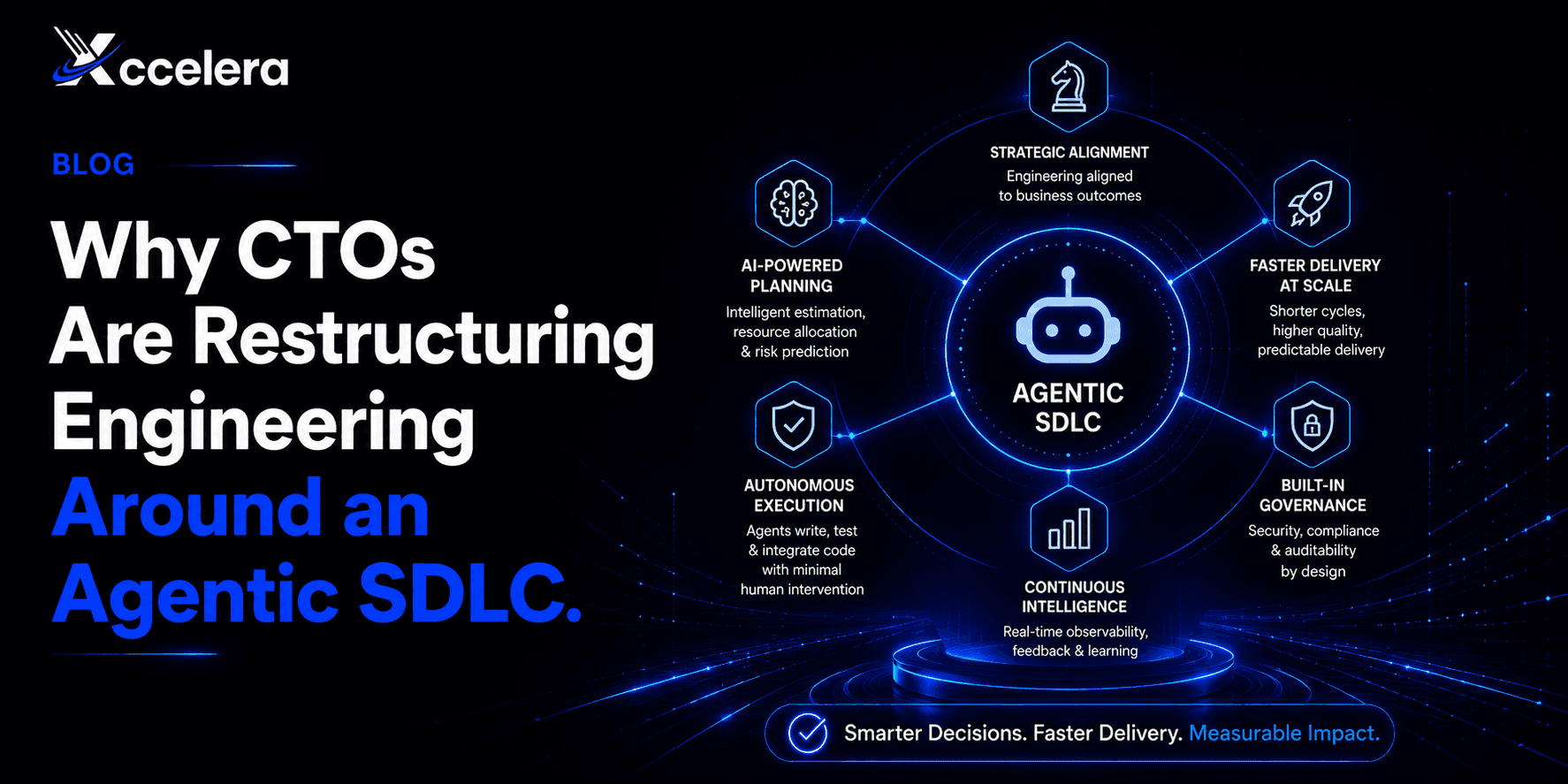
Enterprise engineering leaders are rebuilding the software development lifecycle around autonomous execution instead of human sequencing. Consequently, the Agentic SDLC is replacing delivery models built for human-only throughput. This shift pushes CTO responsibilities away from hands-on coding and toward governance and architecture.
Smaller, senior engineering teams are becoming the norm as agents absorb implementation work. Meanwhile, autonomous execution platforms are turning that shift into deployable enterprise infrastructure.
Why the Traditional SDLC Was Never Built for This
A Model Built on a Single Constraint
For decades, the software development lifecycle was engineered around one unspoken assumption: only a human could write, test, and ship code. This constraint shaped nearly every ritual of modern engineering.
Sprints existed to timebox human capacity, not machine throughput. Sequential handoffs between design, development, and QA existed because one team genuinely had to finish before another could start. Testing followed coding because writing both simultaneously was too expensive for a person to manage alone.
None of this was arbitrary. It was a rational response to human bandwidth limits, and it worked well for thirty years. However, an Agentic SDLC did not exist yet, because no execution layer could operate independently of a person at the keyboard.
What Breaks When Execution Stops Being Human-Only
That constraint no longer holds. As a result, CTOs are watching the old scaffolding buckle in real time. Once agents can plan, implement, and validate work across multiple steps without constant supervision, sequential structure starts to look like friction rather than sound process.
Backlog decomposition, dependency mapping, and even first-draft code reviews can now happen continuously instead of in scheduled batches. Consequently, engineering leaders who keep teams locked into a human-paced cadence are not preserving discipline — they are leaving throughput on the table.
Indeed, one 2026 industry guide confirms this shift directly: <cite index=”51-1″>the agentic SDLC is a software development lifecycle organized around autonomous AI task execution because agents can complete multi-step development work between defined human review checkpoints</cite>. That distinction separates a genuine Agentic SDLC transition from a surface-level tooling upgrade.
What an Agentic SDLC Actually Looks Like in Practice
Agents That Pursue Goals, Not Just Prompts
Agentic AI in software engineering has moved past the copilot phase. An Agentic SDLC is not a rebranding of copilots and autocomplete. Rather, it is a distinct delivery model. Agents pursue multi-step goals across planning, coding, testing, review, deployment, and operations, while a human sets intent and validates outcomes.
This differs meaningfully from AI-assisted coding, where a developer prompts a tool and reviews one suggestion at a time. As one analysis puts it, <cite index=”53-1″>agentic development means the AI pursues a goal across multiple steps without a human directing each one — it plans, executes, evaluates its own output, loops, and hands off a completed artifact at the end</cite>.
In an agentic SDLC, planning agents run feasibility analysis before a standup even happens. Coding agents implement features and open pull requests with reasoning attached. Testing agents expand coverage against a shifting codebase without being asked line by line.
Where Human Judgment Still Belongs
None of this eliminates engineering judgment. If anything, it concentrates that judgment where it matters most. Humans still define what “done” means and still set the guardrails an agent operates inside.
Quality gates replace line-by-line manual review as the mechanism that keeps agent-generated code trustworthy at speed. Therefore, the developer’s role shifts from writing every line to specifying precisely what must be true when the agent finishes.
From Code Reviewers to System Architects: The CTO Role Is Changing
Curators, Not Creators
As agents absorb more implementation work, the CTO’s core value moves toward designing the system agents operate within. This is not a minor adjustment — it redefines where engineering leadership adds value inside an Agentic SDLC.
The CTO of 2026 spends considerably less time reviewing individual pull requests. Instead, they spend more time defining architecture, objectives, and boundaries that determine whether a fleet of agents produces something coherent. Systems thinking becomes the core skill, replacing syntax fluency.
Delegate, Review, Own
Practically, this plays out as a simple operating rhythm: delegate the implementation, review the output rigorously, and own the outcome regardless of who or what produced the first draft.
That ownership matters more than it sounds. When an agent ships a regression, accountability stays with the organization that designed the guardrails around it — not with the tool. This is precisely why CTO engineering strategy in 2026 increasingly centers on validation infrastructure rather than production velocity alone.
Governance Becomes the New Engineering Bottleneck
Review Speed Can No Longer Keep Pace
When agents generate code faster than any human review process was designed to handle, review itself becomes the constraint. This is the uncomfortable truth many engineering leaders discover once their Agentic SDLC pilots succeed.
In fact, this “verification tax” is already a documented industry pattern. As one guide notes, <cite index=”53-1″>AI-generated code arrives faster, in larger batches, and the review process buckles under the volume — DORA’s 2024 Accelerate State of DevOps Report calls this the “verification tax,” where time saved writing code gets re-spent auditing it</cite>.
Building Guardrails Before Scaling
A handful of practical guardrails have emerged as the baseline for organizations serious about scaling autonomous coding agents responsibly:
- Auditable reasoning trails so every agent decision can be traced and explained
- Scoped permissions that limit what an agent can touch without authorization
- Approval gates for changes crossing a defined risk threshold
- Rollback paths that assume failure will happen and plan for it
- Semantic monitoring that flags drift between what was requested and what shipped
Organizations that treat these guardrails as an afterthought tend to see pilots stall once agent activity scales past a single team. Architecture, not clever prompting, determines whether an Agentic SDLC scales well. For a deeper framework on locking down agent permissions and monitoring, see this practical checklist for AI agent identity, access control, and monitoring.
Smaller, Senior, AI-Native: How Team Structures Are Shifting
The Shrinking, Senior-Heavy Team
Inside a working Agentic SDLC, headcount models built for human-only throughput are quietly becoming obsolete. A smaller team of senior engineers, each orchestrating multiple agents in parallel, is increasingly outshipping a larger team organized around one engineer per feature.
The metrics look different too. Instead of measuring output in lines of code or tickets closed, leading organizations track merged PR quality, mean time to resolution, and safe rollback frequency. These numbers correlate with durable delivery rather than surface-level activity.
Spec-Driven Development as the New Highest-Value Skill
The most valuable skill inside an AI-native development pipeline is no longer typing speed. Instead, it is writing precise specifications an agent can execute against without ambiguity. Teams that skip this step get fast output that drifts from what was actually needed.
Memory management matters just as much. Agents without persistent task context forget decisions across sessions, forcing the same clarifying conversations to repeat. As one recent report on the field observes, <cite index=”47-1″>agentic systems operate in loops: they reason about the task, use tools such as the file system, terminal, and git, observe outcomes, and iterate</cite> — which is precisely why living specs and stored architectural decisions matter so much.
Teams that treat specs, tests, and architectural decisions as living documents — stored alongside the code itself — make an Agentic SDLC repeatable across a whole organization. For a broader look at how this operating model scales beyond a single pilot, see why enterprise AI orchestration is becoming the new competitive moat and this blueprint for maximizing ROI in agentic workflows.
How Xccelera Helps CTOs Operationalize the Agentic SDLC
Autonomous Execution as Infrastructure
Restructuring engineering around an Agentic SDLC takes more than adopting a new coding assistant. It requires orchestration, governance, and autonomous execution built directly into the delivery pipeline — not bolted onto the side of it.
Xccelera’s accelerators were built around exactly this principle. ApiX generates backend systems, database configurations, and fully tested endpoints autonomously from a single configuration input. It auto-corrects errors and validates every endpoint after generation, rather than waiting for a human to catch them later.
FrontendX applies the same autonomous approach to interface development, converting Figma designs directly into working React applications with routing and build validation already handled. Together, these accelerators give engineering teams a working example of full-stack autonomous delivery once the guardrails are built correctly. You can explore how this fits into Xccelera’s broader product engineering approach.
Starting the Transition
Governance follows the same logic. LibX runs a seventeen-step automated pipeline that scans repositories for vulnerabilities, patches breaking dependencies, resolves test failures, and opens ready-to-merge pull requests. This gives security and compliance teams the auditable trail an Agentic SDLC demands at scale.
For CTOs evaluating where to begin, the practical starting point is rarely a full lifecycle overhaul on day one. Instead, it is picking one high-friction stage — backend generation, frontend delivery, or dependency security — and proving the governance model works before expanding further.
Xccelera builds that starting point into products engineering teams can deploy directly, rather than theorize about. More detail on the full accelerator and agent portfolio is available at xccelera.ai.


