The Service-as-Software Pricing Model: How Outcomes Replace Seats and Hours
Seat-based software pricing built the SaaS industry for two decades. However, agentic AI is now breaking that model apart. Consequently, enterprises want to pay for completed work, not logins. This article covers the shift toward the Service-as-Software pricing model. It also explains why hybrid structures are winning the middle ground. Finally, it outlines what…
Seat-based software pricing built the SaaS industry for two decades. However, agentic AI is now breaking that model apart. Consequently, enterprises want to pay for completed work, not logins.
This article covers the shift toward the Service-as-Software pricing model. It also explains why hybrid structures are winning the middle ground. Finally, it outlines what CFOs must track before signing an outcome-based contract in 2026.
Why the Seat-Based Software Model Is Breaking Down
For twenty years, software valuations rested on one simple metric: how many people logged in. That metric is now unraveling. Autonomous agents complete work without ever occupying a seat. As a result, CFOs and procurement teams are questioning why they should keep paying for access nobody uses.
Two Decades Built on the Login
For roughly twenty years, enterprise software companies grew by optimizing around seats. Vendors would add users, expand annual recurring revenue, and raise the multiple. This model powered the rise of Salesforce, ServiceNow, and hundreds of software-as-a-service companies. Their valuations rested on predictable per-user subscriptions.
Consequently, finance teams learned to budget by headcount, not by output. Procurement teams built entire approval workflows around adding or removing licenses. Meanwhile, vendors built entire sales organizations around expanding seat count year over year.
The Agentic Break
That logic is now fracturing. Autonomous agents draft contracts, reconcile invoices, generate marketing copy, and triage support tickets. They do all this without tying activity to a named employee. As a result, the link between headcount and software revenue is weakening.
Therefore, a per-user license no longer reflects the value a company actually receives. The rise of the agentic AI workforce has decoupled labor from value. Finance leaders are pushing vendors toward contracts with genuine accountability instead of a flat access fee.
Meanwhile, procurement teams keep asking a harder question: why pay for a seat nobody needs to sit in anymore? Some vendors respond defensively. They hold onto legacy licensing even as their own product reduces the humans required to use it. Buyers notice this contradiction quickly.
What Outcome-Based Pricing Actually Means
Once access stops being valuable, vendors need a new unit to charge against. Outcome-based pricing answers this directly by tying payment to a completed result. However, the model only works where that result can be measured cleanly.
Paying for Results, Not Access
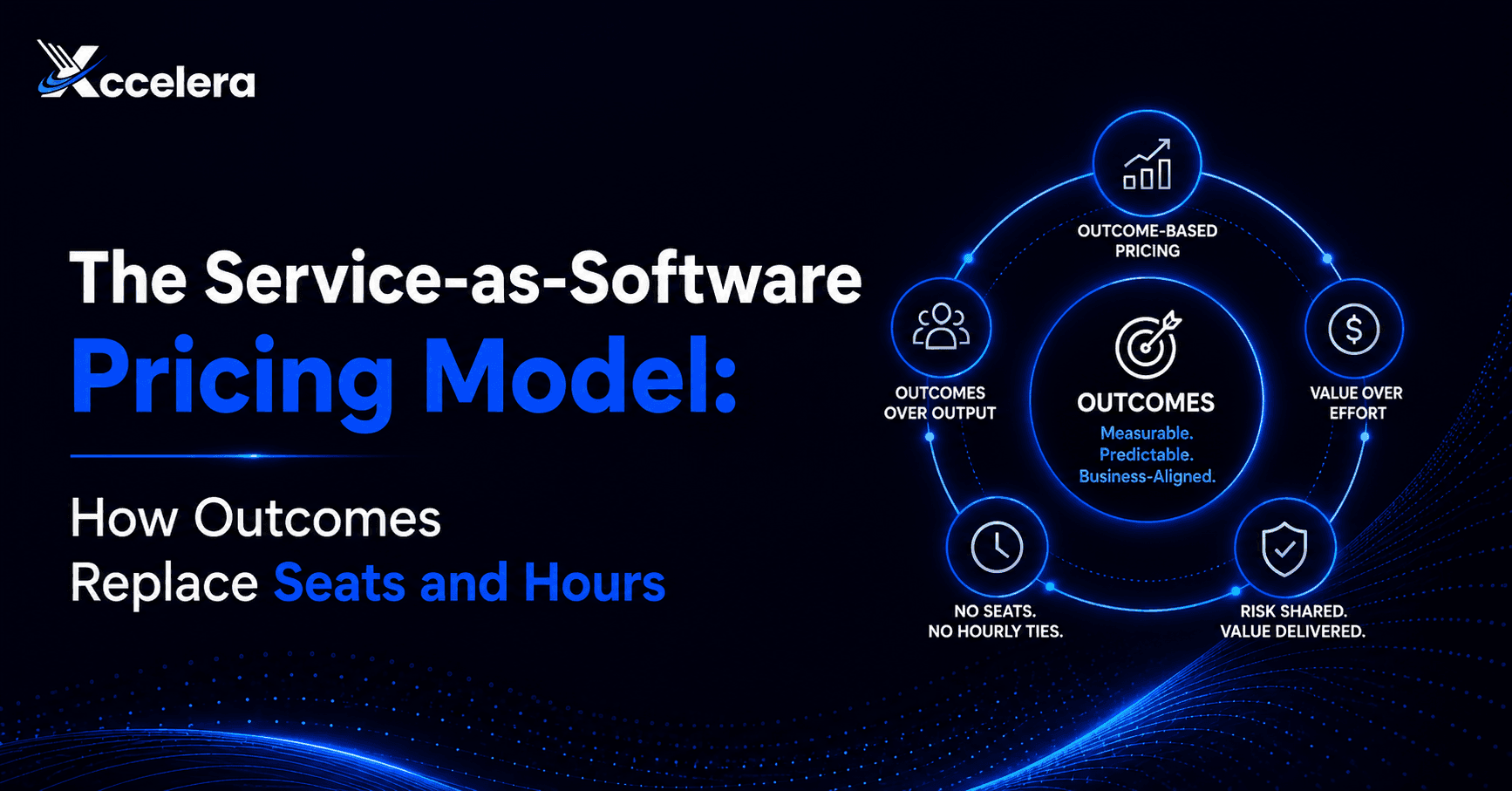
Outcome-based pricing charges customers for delivered results rather than logins or consumption. It ties payment to a measurable business result — revenue generated, costs saved, or hours recovered — rather than usage or seats.
Under a true Service-as-Software pricing model, the vendor absorbs more risk. The buyer only pays when promised work actually happens. This marks a sharp departure from older seat-based pricing vs. outcome pricing debates, which centered on convenience rather than accountability.
Why Most Categories Are Not There Yet
However, few products are ready for this shift. Successful outcome-based pricing requires:
- Clear links between services and measurable benefits
- Defined timelines for delivery and evaluation
- Stakeholder alignment across finance, product, and procurement
- Consensus on metrics and pricing approaches
Additionally, buyers can be tempted to underreport results to lower their bill. This complicates trust between vendor and customer. Consequently, outcome-based AI pricing models appear first in workflows where success is easy to define. They arrive slower in categories where value is diffuse.
In fact, building the tracking infrastructure to defend an outcome claim often costs more than building the product feature itself. This is precisely why many vendors delay the move, even when customers request it.
Real Companies Already Charging for Outcomes
Theory matters only once someone proves it works with real revenue. A small set of vendors across customer support and fraud prevention have already built outcome pricing into their business model.
Support and Fraud Prevention Lead the Way
A handful of vendors have proven this model at scale. Intercom’s Fin started at a small fee per resolved conversation. It then grew from one million to over one hundred million dollars in annual recurring revenue, backed by a performance guarantee. Notably, one industry analysis confirms that <cite index=”28-1″>Intercom Fin charges $0.99 per resolved customer interaction</cite>, illustrating how granular true outcome billing can get.
Similarly, Sierra AI takes the model further. It charges only when its agent resolves an issue without human intervention, reaching over one hundred fifty million dollars in annual recurring revenue from that position alone. Both examples show buyers accept a results-only contract when the vendor is confident enough to price that way.
Fraud Prevention as an Early Proof Point
Outside customer support, fraud prevention offers another working example. These vendors guarantee approved transactions. They only charge when a transaction is confirmed fraud-free, letting buyers directly quantify savings against the fee.
This pattern explains why pay-per-outcome enterprise software succeeds fastest in high-volume, measurable workflows. It also explains why the model still struggles where success cannot be reduced to a single number. Each example shares a common thread: the outcome is countable, disputable, and auditable within days — not quarters.
Why Hybrid Pricing Is Becoming the Default
Pure outcome pricing makes a compelling case study. Yet it is not what most of the market is actually buying today. The data instead points toward something messier: a blended structure that keeps predictability while making room for the new.
The Market Is Not Choosing Pure Outcomes
Despite the appeal of outcome pricing, most companies are not adopting it as their primary model. Hybrid pricing blends a predictable base subscription with variable consumption on top. Recent research confirms this trend clearly: <cite index=”36-1″>according to Kyle Poyar’s 2026 State of B2B Monetization survey of over 230 software companies, 37% use hybrid as their primary structure, the most common option by far</cite>.
Interestingly, the same research reveals a striking contradiction among leadership teams. As one analysis notes, <cite index=”36-1″>a Cruxy survey of 300 SaaS CEOs in April 2026 found 97% plan to retire seat-based pricing within two years, yet 94% said seat-based pricing currently aligns with their product’s value</cite>. This tension shows just how unsettled the market remains.
Credits as the Middle Ground
Credit-based systems are emerging as a practical bridge. They sit between seat-based access and pure outcome pricing. According to one 2026 pricing index, <cite index=”36-1″>credit models became the defining pricing innovation of 2025, with companies using them growing 126% year-on-year</cite>.
This is why the shift from SaaS to Service-as-Software rarely happens overnight. Instead, it happens through blended contracts. These slowly move budget away from headcount and toward usage and results, giving both vendor and buyer room to adjust.
The CFO Lens: Trust, Measurement, and Revenue Recognition
Every pricing innovation eventually lands on a finance team’s desk. Outcome-based contracts raise questions beyond negotiation. How a company books this revenue — and defends that treatment to an auditor — now shapes which pricing models survive procurement.
A New Accounting Problem
Finance leaders evaluating these contracts face a genuinely new question. The distinction between a promise of access and a promise of delivery makes a major difference in how revenue is booked. Under current guidance, <cite index=”17-1″>revenue recognition depends on the contract, the performance obligations in the contract, and the transaction price, and when those obligations are satisfied</cite>.
A stand-ready obligation to provide software access is treated differently than an obligation to deliver a specific completed outcome. Getting that classification wrong can distort reported revenue for an entire fiscal year. Indeed, <cite index=”21-1″>usage-based revenue billed per API call, per active user, or per transaction falls under variable consideration rules, which must be estimated conservatively when a significant revenue reversal could otherwise occur</cite>.
Building Measurement Buyers Can Trust
Therefore, vendors moving toward outcome-based pricing need robust tracking systems first. Clear timelines, agreed metrics, and transparent reporting are not optional extras. They convert a promising pricing pitch into a signed, defensible enterprise contract.
Without that infrastructure, even a fair outcome-based offer can stall in procurement for months. CFOs increasingly demand this rigor. One 2026 industry survey found that <cite index=”32-1″>64% of SaaS finance executives cited unpredictability as their top worry with value-based pricing models</cite>, which is exactly why measurement infrastructure matters so much.
How Agentic AI Is Rewriting the Buying Calculus
None of this happens in isolation from the technology driving it. As agents take on more actual work, buyer evaluation criteria shift away from headcount entirely.
From Headcount to Output
Enterprise buyers are shifting their evaluation criteria alongside their vendors. Instead of charging per user, vendors increasingly experiment with pricing tied to:
- Tokens consumed during agent execution
- Workflows executed end to end
- Transactions processed across systems
- Measurable business outcomes delivered
This represents a structural recalibration of SaaS economics, not its demise. Usage-based enterprise contracts now compete directly with legacy per-seat deals for the same budget line.
A Recalibration, Not a Collapse
Even so, per-seat pricing is not disappearing entirely. Many enterprises still value the simplicity of user-based licensing. What is changing is the center of gravity. As AI agent pricing models mature, buyers increasingly expect part of every contract to scale with delivered work.
Vendors that ignore this shift risk losing renewal conversations to competitors who have already adapted. For a deeper look at how enterprises are restructuring their AI operating models around this shift, see this analysis of multi-agent orchestration as the enterprise control plane for 2026.
How Xccelera Builds Pricing Around Outcomes, Not Seats
Everything above points toward one conclusion: pricing has to match how work actually gets done. Xccelera built its accelerator products around this principle from the start.
Pay-Per-Run, Not Pay-Per-Login
Xccelera applies this same logic across its accelerator products. ApiX and FrontendX use pay-per-run pricing tied to completed backend and frontend builds. Consequently, enterprises pay for a finished, tested deliverable rather than a monthly seat.
LibX follows the same principle in security remediation. It charges for completed dependency upgrades and merge-ready pull requests rather than a dashboard subscription. This approach cuts remediation timelines from days to minutes without adding license overhead.
Aligning Vendor Incentive With Customer Success
This structure removes the conflict of interest that has haunted traditional SaaS pricing models. Under legacy licensing, a vendor profits even when a customer’s team barely uses the product.
By pricing around delivered outcomes, Xccelera keeps its incentives aligned directly with client results. This is the entire premise behind the Service-as-Software pricing model. For a broader view of why this shift is accelerating across the enterprise, read more on why enterprise AI orchestration is becoming the new competitive moat, or explore Xccelera’s approach to AI consulting and development.
Learn more about how these accelerators are priced at xccelera.ai.