LibX vs Snyk vs Dependabot in June 2026: The AI Advantage Is Now Impossible to Ignore
Security teams comparing Snyk, Dependabot, and AI-driven remediation platforms in 2026 face a clear choice between free GitHub-native scanning, deep proprietary vulnerability intelligence, and full autonomous patching. Detection speed, fix automation, and audit readiness separate these tools sharply, and manual triage still slows teams down even with strong scanning engines. An AI-first remediation layer, therefore,…
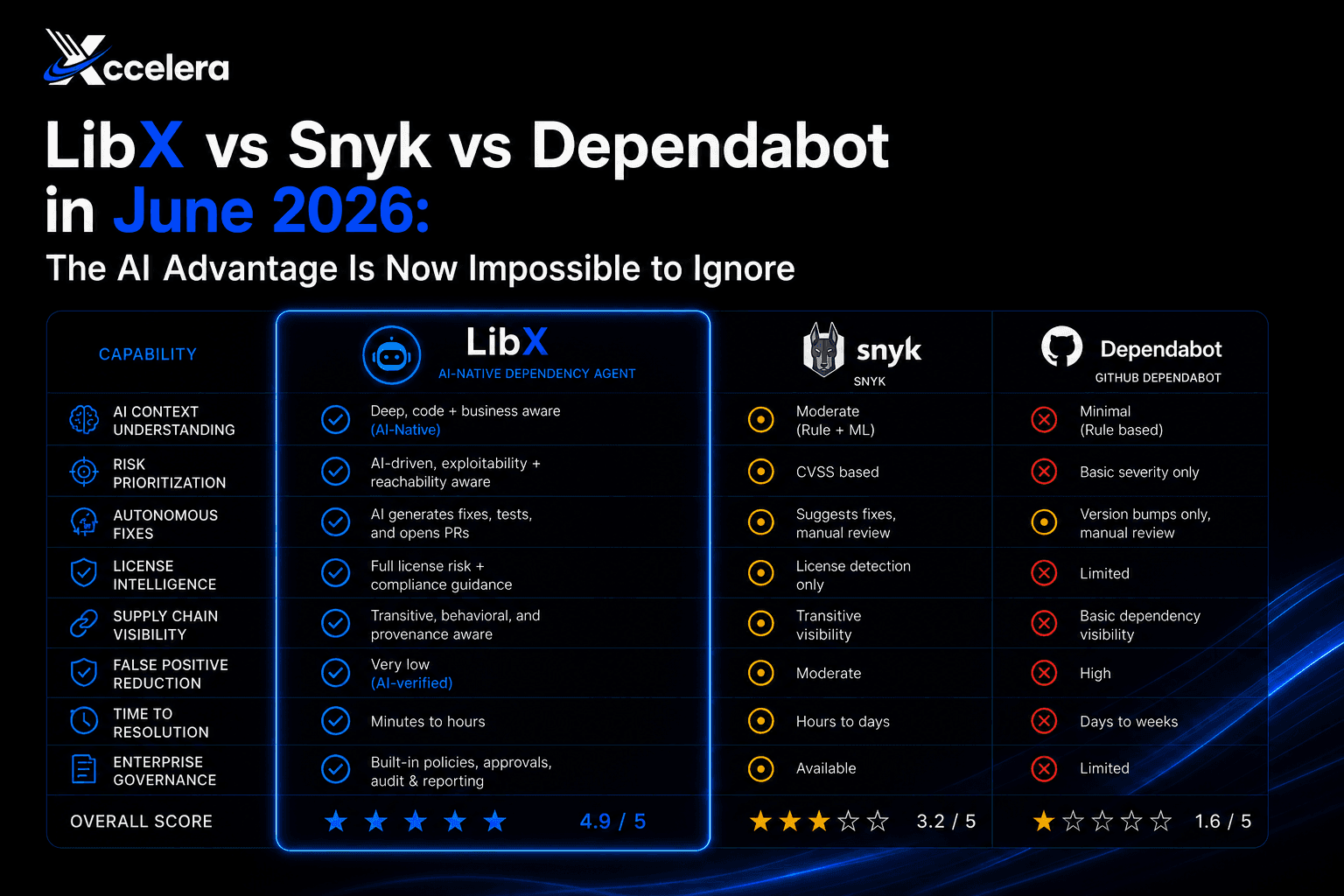
Security teams comparing Snyk, Dependabot, and AI-driven remediation platforms in 2026 face a clear choice between free GitHub-native scanning, deep proprietary vulnerability intelligence, and full autonomous patching. Detection speed, fix automation, and audit readiness separate these tools sharply, and manual triage still slows teams down even with strong scanning engines. An AI-first remediation layer, therefore, changes the security debt equation for fintech, healthcare, and SaaS engineering organizations managing dependencies at scale.
Dependabot in 2026: Free Coverage, But Where Does It Stop
Dependabot remains the default starting point for teams managing dependencies on GitHub, and for good reason. It relies on the GitHub Advisory Database, which contains 28,000 reviewed advisories, and GitHub reviews each advisory before it triggers an alert — which, in turn, reduces false positives compared to raw NVD feeds.
Dependabot creates security update pull requests that bump packages to the minimum patched version with release notes and compatibility scores, and it also offers version update PRs on a configurable schedule to keep all dependencies current, not just the vulnerable ones. Grouped updates bundle multiple changes into a single PR, which helps reduce noise on busy repositories with dozens of active dependencies.
Where Dependabot’s Coverage Ends
The limitation surfaces once a team needs more than alerting. Dependabot never looks at your actual source code, which means it cannot tell a team whether a flagged vulnerability is actually reachable in the application. A flagged CVE in a transitive dependency that the application never actually calls still generates the same PR, the same alert, and the same review burden as a genuinely exploitable issue.
For a small team with limited budget, this tradeoff is acceptable because free coverage with some noise beats no coverage at all. For a compliance-driven organization managing hundreds of repositories, however, that noise compounds into a backlog that obscures the issues that actually matter — a pattern explored further in Xccelera’s guide to securing AI agents with identity, access control, and monitoring.
Snyk’s Depth Advantage: Proprietary Database and Reachability Analysis
Snyk approaches the problem from a different angle, prioritizing depth of detection over breadth of free coverage. Snyk maintains a proprietary vulnerability database that the company says is three times larger than the next largest public database, and its security research team has personally disclosed over 3,400 vulnerabilities.
For JavaScript specifically, Snyk reports disclosing 92 percent of vulnerabilities before the National Vulnerability Database lists them, and on average Snyk detects vulnerabilities 47 days faster than competing databases. For a fast-moving JavaScript ecosystem where new packages and transitive dependencies multiply weekly, that 47-day lead time can mean the difference between patching proactively and reacting to an exploit already circulating in the wild.
Reachability and Platform Coverage
AI-assisted reachability analysis reduces false positives by confirming whether code actually invokes the vulnerable function, and this capability extends across Java, JavaScript, and Python codebases. This shifts the review conversation from “is this CVE real” to “does this CVE affect us,” which is a meaningfully different and faster conversation for a security team triaging dozens of alerts per week.
Snyk also includes license scanning covering SPDX identifiers, flags copyleft or unknown licenses, and supports SBOM export in both CycloneDX and SPDX formats — capabilities Dependabot does not offer.
Where the Value Tradeoff Lands
This depth carries a cost structure that smaller engineering teams often cannot justify, particularly once usage scales past free-tier test limits. As a result, many organizations end up running both tools side by side, using Dependabot for baseline coverage on lower-priority repositories and reserving Snyk’s deeper analysis for production systems handling sensitive data. Neither tool, however, was designed to eliminate the review step that follows detection.
The Shared Blind Spot: Why Both Tools Still Need Human Triage
Detection speed and remediation speed are not the same thing, and this distinction is where both platforms run into friction regardless of how good their scanning engines are.
Snyk resolves the full transitive dependency tree and adds reachability analysis, while Dependabot resolves transitive dependencies where the ecosystem’s lockfiles allow it but performs no reachability analysis and treats every CVE match as equal priority — which, consequently, produces more noise on large projects.
The Hidden Cost of Manual Validation
Once a fix PR lands, an engineer still has to review it, run the test suite, resolve any breaking changes introduced by the version bump, and merge it. When no upgrade is available, Snyk maintains its own patches — targeted code changes that fix the vulnerability without bumping the version — which is useful when an upgrade would introduce breaking changes, but applying and validating that patch still falls to the engineering team.
A major version bump on a core library can break a build in ways that take an engineer hours to diagnose, even when the underlying security fix itself was a single line change. Multiply this across dozens of repositories and hundreds of dependencies, and the queue of open security PRs grows faster than most teams can clear it, regardless of how accurate the original detection was. This is precisely the bottleneck that agentic AI solutions are increasingly being deployed to eliminate.
What an Autonomous Remediation Pipeline Changes
The next evolution in this space removes the manual step entirely. Instead of generating a PR and waiting for a human to validate it, an autonomous pipeline completes the full cycle on its own, treating the pull request as the final output rather than the starting point of a review process.
The Four-Stage Shift
- Scanning across multiple vulnerability sources rather than relying on a single advisory database, reducing blind spots between overlapping CVE feeds.
- Generating the dependency upgrade automatically, including full transitive resolution across the dependency tree.
- Patching breaking code changes introduced by the upgrade using AI rather than flagging them for a human to diagnose manually.
- Resolving test failures that result from the upgrade before the PR is ever opened, so the code that lands in review has already passed its own validation.
Why This Matters for Compliance Teams
For teams already weighing depth versus convenience, the addition of a dry-run mode and a full audit trail changes the calculation entirely, since every step of the remediation becomes reviewable evidence rather than an assumption.
A pull request that arrives already tested and ready to merge, therefore, changes the security backlog from a queue of pending decisions into a queue of approvals — a fundamentally different workload for an engineering team to manage week over week. This shift mirrors the broader industry move toward generative-driven development, where AI handles execution and humans handle approval.
Choosing the Right Layer for Fintech, Healthcare, and SaaS
Industries operating under SOC 2, PCI-DSS, HIPAA, and ISO 27001 frameworks cannot treat vulnerability management as a background task. Audit cycles require documented evidence of remediation timelines, and security leadership needs visibility into open exposure across every repository in real time — not a quarterly snapshot pulled together manually before an audit deadline.
For teams where early detection of zero-day dependency vulnerabilities matters — financial services, healthcare, and SaaS platforms handling sensitive data — database depth is significant. However, depth without a fast remediation path simply produces a longer list of known issues rather than a shorter one.
A real-time dashboard that shows open CVEs, in-progress remediations, and completed patches gives CTOs and VPs of Engineering a single view of security debt across Python and JavaScript codebases without needing to query each repository individually. For organizations preparing for SOC 2 renewal or a HIPAA audit, that dashboard becomes the evidence trail itself, removing the need to reconstruct remediation history from scattered PR logs across dozens of repositories.
This audit-readiness requirement parallels what Xccelera’s checklist on identity, access control, and monitoring for AI agents outlines for broader agentic deployments. Industry-wide, OWASP’s Dependency-Check project documentation similarly emphasizes that detection alone is insufficient without a structured remediation and audit workflow.
How LibX Closes the Gap Between Detection and Resolution
Xccelera built LibX to address exactly the gap described above. LibX scans GitHub repositories for CVEs using OSV, NVD, and GHSA simultaneously, then runs a 17-step automated pipeline that upgrades vulnerable dependencies, patches breaking code introduced by those upgrades using AI, and resolves resulting test failures before opening a pull request.
The output is a ready-to-merge PR rather than a flagged advisory awaiting triage. LibX supports both Python and JavaScript, includes dry-run mode for teams that want to preview changes before execution, and provides a real-time dashboard alongside a full audit trail suited to SOC 2, PCI-DSS, HIPAA, and ISO 27001 environments.
For engineering leadership managing security debt across fintech, healthcare, e-commerce, and enterprise software stacks, LibX converts a remediation cycle that traditionally takes days into one that completes in minutes. Organizations already using Snyk or Dependabot for detection can, consequently, layer LibX in as the resolution engine — closing the gap between identifying a vulnerability and shipping the fix.