8 Real-World AI Agents You Can Build on Our Agent Builder
Most AI agent pilots never reach production. In fact, research shows the majority stall on missing guardrails, unclear ownership, and integration that breaks the moment it touches a real system. This piece walks through eight AI agent examples enterprises are actually shipping in 2026, across support, engineering, finance, HR, DevOps, and data. It also covers…
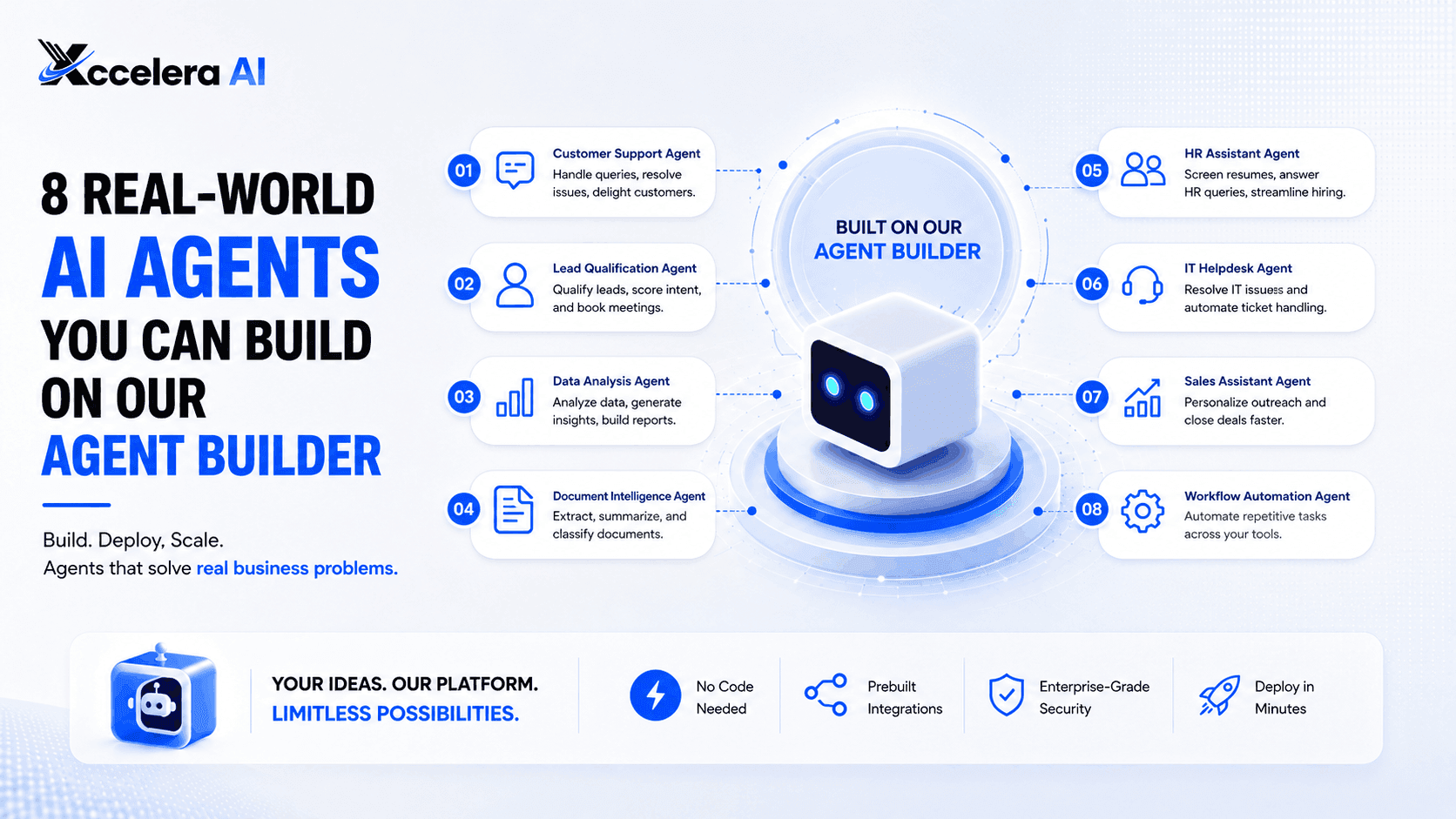
Most AI agent pilots never reach production. In fact, research shows the majority stall on missing guardrails, unclear ownership, and integration that breaks the moment it touches a real system.
This piece walks through eight AI agent examples enterprises are actually shipping in 2026, across support, engineering, finance, HR, DevOps, and data. It also covers what separates the ones that scale from the ones that stay stuck in a demo environment.
What Makes an AI Agent “Production-Ready” in the Enterprise?
Enterprise teams do not lack AI agent ideas. Instead, they lack a repeatable way to turn those ideas into something that survives contact with production traffic, sensitive data, and an audit committee.
A pilot that impresses a demo room rarely impresses a security review. The gap shows up in three places every time:
- Governance — who approved this agent to act on customer data, and who can prove it later
- Reliability — does the agent behave the same way on attempt 500 as it did on attempt 5
- Ownership — if the vendor disappears tomorrow, does the code still belong to the team that built it
Most failed agent projects do not fail because the underlying model was weak. Rather, they fail because nobody built the scaffolding around it. As a result, enterprise buyers should ask a different question before funding another AI agent example. Instead of “can it work in a demo,” ask “can it pass a security review on day one.”
For example, a support agent that routes tickets correctly in testing but has no rate limiting, no PII detection, and no audit trail is not production-ready. It is a liability wearing a working prototype’s clothes. Enterprises that get this right treat governance, security, and version control as part of the agent itself, not as a checklist added after deployment.
Lifecycle Management: The Deciding Factor in Whether AI Agents Scale
The teams that consistently ship working AI agent examples are not the ones with the biggest model budgets. Instead, they treat agent creation, security, deployment, and iteration as one continuous process, rather than five disconnected tools stitched together after the fact.
An AI Agent Lifecycle Management Platform handles that whole arc in one place. Agent creation starts with a guided wizard and a blueprint generator, so teams design an agent’s logic before a single line of code exists.
From there, a live, browser-based code editor lets engineers review and adjust the generated code directly, with full version history attached. In practice, that means every change is tracked, and every rollback is possible. No agent ships as a black box.
That is the difference between an AI agent example that survives a compliance audit and one that gets pulled the week after launch.
8 Real-World AI Agent Examples Enterprises Are Building Now
These are not hypothetical use cases. They are the AI agent examples showing up across enterprise engineering roadmaps right now, organized by the function that owns them.
Customer Ops: Support & Triage Agents
These support agents route, classify, and respond to customer inquiries using a company’s existing knowledge base. Human agents step in only when a case genuinely needs judgment, not for every routine password reset or shipping question.
Engineering: Code Review Agents
Automated pull request review surfaces security vulnerabilities, test coverage gaps, and style violations before a human reviewer opens the file. That said, the agent flags issues; it does not replace the engineer’s final call.
Research: Document Analysis Agents
These agents ingest contracts, reports, and PDFs, then answer natural-language questions and cross-reference sources. Output arrives structured, so downstream systems can consume it without manual reformatting.
Sales: Meeting Scheduler & Prep Agents
Coordinating availability, pulling CRM data into a pre-meeting brief, and sending contextual follow-ups used to eat a rep’s morning. Now, an agent handles the routine version of that work without a human in the loop.
Finance: Fraud Investigation Agents
Multi-agent pipelines correlate transaction signals, check them against rule sets, and escalate anomalies with a structured evidence package, similar to the approach Xccelera applies in fintech fraud detection. The human investigator gets a head start instead of a blank spreadsheet.
Internal Tools: HR & Policy Agents
Employees ask benefits or policy questions in plain language. The agent retrieves answers from internal handbooks and policy documents instantly, which cuts the ticket queue for HR teams significantly.
DevOps: Incident Response Agents
When systems degrade, these agents monitor alerts, correlate logs, and diagnose probable root causes. They draft an incident report automatically, giving the on-call engineer a running start instead of a cold open.
Data: Analytics & Reporting Agents
These agents translate natural-language questions into database queries and generate visualization-ready datasets. Scheduled reports go out without an analyst manually pulling numbers every Monday morning.
AI Agent Use Case Comparison at a Glance
The eight AI agent examples above map cleanly to a function, a trigger, and a business outcome. That structure makes it easier to see where an enterprise should start.
| Function | Agent Type | Primary Trigger | Business Outcome |
|---|---|---|---|
| Customer Ops | Support & Triage | Inbound ticket | Faster resolution, lower ticket volume |
| Engineering | Code Review | Pull request opened | Fewer defects reaching production |
| Research | Document Analysis | New document uploaded | Faster, structured insight extraction |
| Sales | Meeting Scheduler & Prep | Meeting requested | Higher rep capacity, richer prep |
| Finance | Fraud Investigation | Anomalous transaction | Faster escalation with evidence |
| Internal Tools | HR & Policy | Employee question | Reduced HR ticket load |
| DevOps | Incident Response | Alert triggered | Faster root-cause diagnosis |
| Data | Analytics & Reporting | Scheduled or on-demand query | Reports without analyst bottleneck |
Common Challenges in Enterprise AI Agent Deployment
Even well-scoped AI agent examples run into the same handful of obstacles once they leave the sandbox. Data readiness is usually first. An agent is only as good as the systems it can actually query, and many enterprises discover their data is scattered, stale, or locked behind permissions nobody remembers granting.
Integration brittleness follows close behind. Agents that connect cleanly to a CRM in a demo often break the moment they meet a legacy system with undocumented quirks.
Ownership of generated code creates a third problem. If an agent’s code lives entirely inside a vendor’s proprietary runtime, the enterprise has traded one bottleneck for another.
Unpredictable per-conversation pricing compounds the risk further, since costs that looked reasonable in a pilot can spike unpredictably at production volume. This pattern matches broader industry findings: Gartner projects that more than 40 percent of agentic AI projects will be canceled by the end of 2027 due to escalating costs and unclear ROI.
Solving Deployment Gaps With a Lifecycle Management Approach
An AI Agent Lifecycle Management Platform addresses each of those challenges directly, not as an afterthought bolted onto existing tooling.
- Cost visibility before commitment. Every deployment comes with a detailed cost estimate covering expected LLM spend, compute, and storage, so approvers make an informed decision instead of a guess.
- Brownfield integration. Teams connect an existing repository, and the platform adds AI capabilities as a clean, namespaced module that respects existing code conventions, with no rewrite required.
- RBAC and audit trails by default. Admin, Developer, and Viewer permissions, plus human-in-the-loop approval gates, are foundational rather than optional add-ons.
- Code ownership without lock-in. Generated code is production-quality and lives in the enterprise’s own GitHub repositories, with no proprietary runtime holding it hostage.
This approach directly counters the governance gaps that OWASP’s Top 10 for Agentic Applications flags as the leading cause of agentic security incidents.
Building AI Agent Examples That Actually Ship
Xccelera built its AI Agent Lifecycle Management Platform because most agent projects do not fail on intelligence — they fail on infrastructure.
Governance, security, and code ownership need to exist before an agent ever reaches production, not after an incident forces the question.
Every use case in this piece, from support triage to fraud investigation, points to the same conclusion. The enterprises pulling ahead are the ones treating the full agent lifecycle as one governed process.
Explore the full builder and use case library at xccelera.ai.


