A 10-Step Walkthrough From Idea to Deployed Agent
Enterprise leaders are deploying AI agents faster than they can govern them. AI agent lifecycle management gives structure to that growth, turning experimental pilots into auditable, production-grade systems. This ten-step walkthrough traces the full path from defining an agent’s purpose to retiring it responsibly. It is built for decision-makers who need agents that scale without…
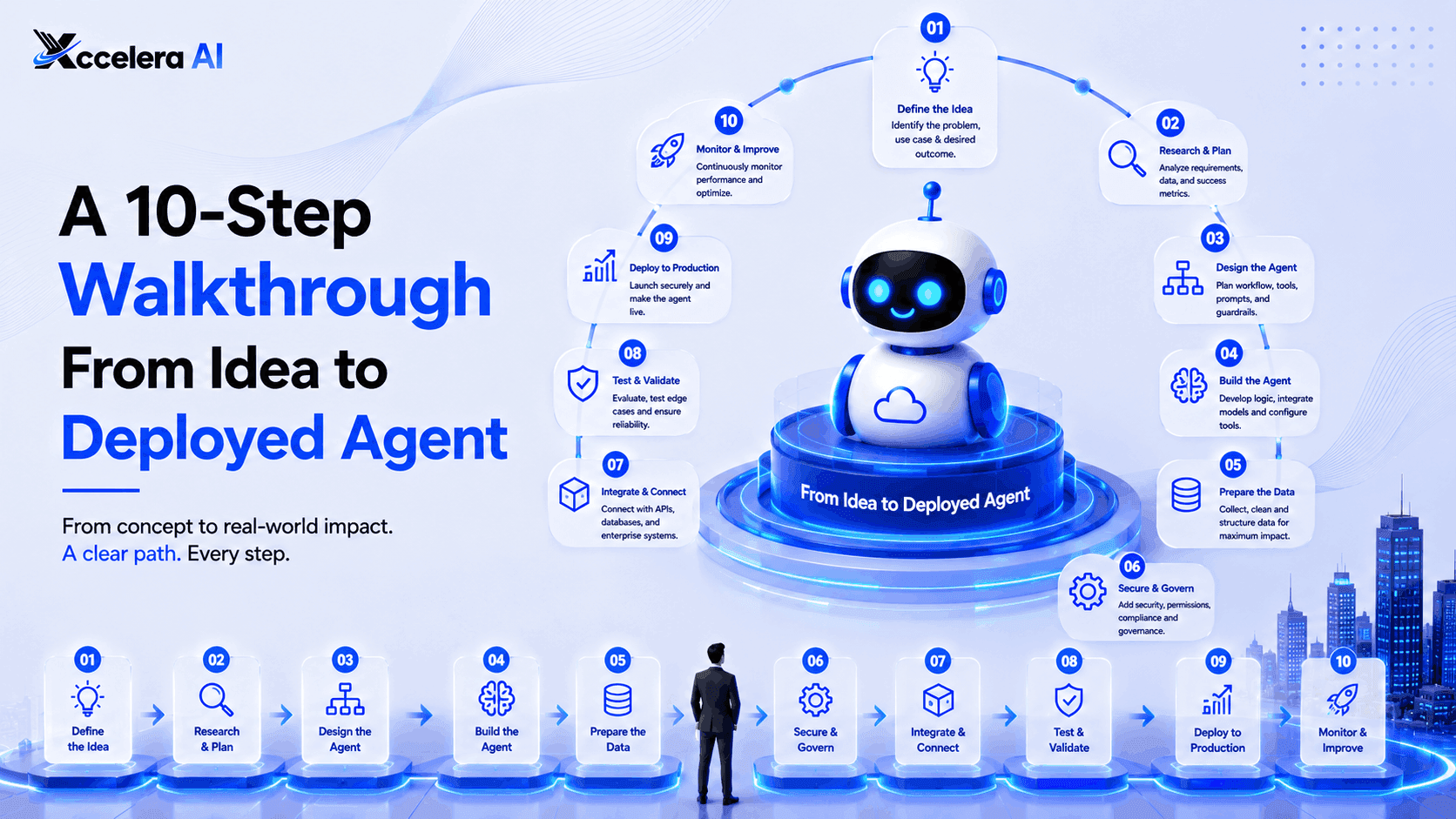
Enterprise leaders are deploying AI agents faster than they can govern them. AI agent lifecycle management gives structure to that growth, turning experimental pilots into auditable, production-grade systems.
This ten-step walkthrough traces the full path from defining an agent’s purpose to retiring it responsibly. It is built for decision-makers who need agents that scale without becoming liabilities.
Step 1: Define AI Agent Lifecycle Management Goals and Boundaries
Every reliable agent starts with a decision, not a prompt. Before any code gets written, leadership teams must define what the agent should accomplish. They must also decide what it must never do, and which systems it can touch.
AI agent lifecycle management treats this step as the foundation, not a formality. Skipping it is the single biggest reason pilots stall before reaching production.
A narrow, well-bounded agent stays cheaper to govern than one built without limits from day one.
What the Charter Must Define
- A written scope statement covering purpose, permitted actions, and explicit prohibitions
- A named business owner accountable for outcomes, not just IT
- Success metrics tied to business impact, not task completion alone
- Escalation rules for situations outside the agent’s authority
You can skip goal-boundary language for narrower internal tools. However, for anything customer-facing or handling sensitive data, this step is non-negotiable.
Step 2: Scope the Agent’s Permissions and Guardrails
Once the charter is set, the next decision involves access. An agent should only reach the systems, data, and actions its job actually requires, nothing more.
Over-permissioned agents create the fastest route to a security incident. A single prompt manipulation or reasoning error can trigger real-world consequences at machine speed, as the OWASP Top 10 for Agentic Applications makes clear.
Treating each agent as a distinct digital identity, rather than a shared service account, matters here. This approach gives security teams the ability to trace every action back to a specific agent, version, and owner. Xccelera’s practical checklist for AI agent identity and access control breaks this process down further.
Building the Permission Model
Least-privilege access should apply by default, expanding only when a business case justifies it. Role-based policies limit what tools an agent can call.
Provisioning workflows require security sign-off before an agent goes live. Meanwhile, continuous behavioral tracking flags unusual API calls before they compound into larger failures.
Step 3: Select the Orchestration Architecture
Architecture decisions made here directly affect operational complexity and cost at every later stage. Sequential, hierarchical, and parallel structures each fit different workloads.
Choosing wrong means expensive rework once the agent is already handling live traffic.
| Architecture Type | Best Fit | Governance Complexity |
|---|---|---|
| Sequential | Single-purpose, linear tasks | Low |
| Hierarchical | Specialized sub-agents under one controller | Medium |
| Parallel / Multi-Agent | High-volume, cross-functional workflows | High |
Leadership teams should match architecture to the actual workflow complexity rather than defaulting to the most sophisticated option available.
Step 4: Design State Management and Control Flows
Building the agent means selecting a framework and designing how it tracks state across a task. It also means defining the control flow that governs movement between reasoning, decision-making, and action.
Explicit control flows, rather than open-ended reasoning loops, keep agent behavior auditable and testable.
Core Design Priorities
- Deterministic control flow between reasoning and action steps
- State persistence that survives interruptions and retries
- Clear handoff points between agent and human reviewer
- Version-controlled prompt and policy definitions
Teams that skip explicit control flow design often discover the gap too late. By then, an agent has already compounded a small reasoning error into a larger operational failure.
Step 5: Connect Tools, Data Sources, and Integrations
An agent is only as useful as what it can reach. Connecting the right tools and data sources, in the right order, turns a reasoning engine into something that actually moves work forward.
- Map every system the agent needs — CRM, ticketing, internal databases — before writing integration code
- Prioritize pre-built connectors over custom integrations wherever available
- Validate each connection independently before chaining them together
- Document data flow direction for every integration, since audits require this later
- Test integrations under failure conditions, not just the happy path
Rushing this stage to hit a demo date is the most common reason integrations break once real usage begins.
Step 6: Build In Governance and Compliance Controls
Governance cannot be retrofitted cheaply. Enterprises that treat compliance as a launch-day checklist item, rather than a design constraint, end up spending far more fixing gaps after deployment.
Identity-first governance, where every agent carries a verifiable identity and traceable action log, has become the baseline expectation for regulated industries. NIST’s AI Risk Management Framework offers a widely referenced structure for building these controls in from the start.
Audit trails, role-based access, and PII redaction all need to exist before an agent touches production data — not after a compliance review flags the gap.
Organizations that connect governance to existing identity and security infrastructure, rather than building a parallel system for agents, tend to move faster once regulators or auditors get involved.
Step 7: Validate the Agent in a Sandbox Environment
Production is not the place to discover an agent’s failure modes. Sandbox validation exists to surface those failures somewhere safe, before an agent ever touches a real customer or a live system.
| Validation Layer | What It Catches |
|---|---|
| Intent testing | Misaligned understanding of user requests |
| Adversarial testing | Prompt injection and manipulation attempts |
| Simulation testing | Multi-step task failures under realistic load |
| Canary rollout | Real-world edge cases at limited exposure |
A staged rollout, starting with a small percentage of low-risk traffic, catches problems while the blast radius is still small.
Step 8: Deploy to Production With Monitoring in Place
Deployment should never be the finish line. The moment an agent goes live, it needs monitoring infrastructure already running, not bolted on afterward once something goes wrong.
What Should Be Live at Launch
- Real-time monitoring of usage patterns and behavior anomalies
- Rollback capability that can pull an agent from production instantly
- A defined owner responsible for responding to alerts
- Clear internal communication about what the agent does and does not handle
Executive sponsors who showcase early wins internally tend to see faster adoption. Teams that deploy quietly and hope for organic uptake usually see the opposite.
Step 9: Track Performance Through Observability and Registries
You cannot govern what you cannot inventory. A centralized agent registry becomes the single source of truth once an organization runs more than a handful of agents. It should track every production agent’s owner, permissions, model version, and last review date.
- Register every agent before it reaches production, no exceptions
- Track model version, prompt version, and connected tools per agent
- Log every tool call and decision for traceability
- Review each agent’s performance against its original success metrics on a fixed cadence
- Flag agents operating outside their documented scope for immediate review
Without this discipline, organizations accumulate shadow agents that nobody can fully account for.
Step 10: Retrain, Retire, or Scale the Agent
The lifecycle does not end at deployment; instead, it loops back to the beginning. Performance baselines set during rollout should be reviewed regularly. Agents get retrained, re-prompted, or restructured as business needs shift or failure patterns emerge.
Deciding the Agent’s Next Phase
- Retrain when performance drifts but the use case still holds
- Restructure when the original architecture no longer fits growing complexity
- Retire when the business process it supports has changed entirely
- Scale when performance and governance metrics both clear the bar for wider rollout
Organizations that manage this stage systematically end up with agents that improve with experience. Otherwise, systems quietly drift from their original purpose.
Bringing AI Agent Lifecycle Management Into Practice
Enterprise AI agent lifecycle management does not stay theoretical for long. Once the goals, architecture, and governance decisions above are set, execution speed decides whether a project becomes a working system or a stalled pilot.
Xccelera built its AI Agent Lifecycle Management Platform around exactly this gap. It generates production-quality agent code with role-based access control, human approval gates, six layers of built-in guardrails, and full audit trails from the first commit — across any major LLM provider, with no vendor lock-in.
Teams that once spent months on infrastructure now move from blueprint to deployed agent in hours.


