The AI Agent Development Timeline Problem, and How Enterprises Fix It
Enterprise leaders keep asking the same question. Why does the AI agent development timeline drag on so long? A promising demo often turns into a production system nobody trusts yet. The honest answer rarely involves the model itself. Instead, integration debt, compliance reviews, and missing governance quietly consume the months between prototype and launch. This…
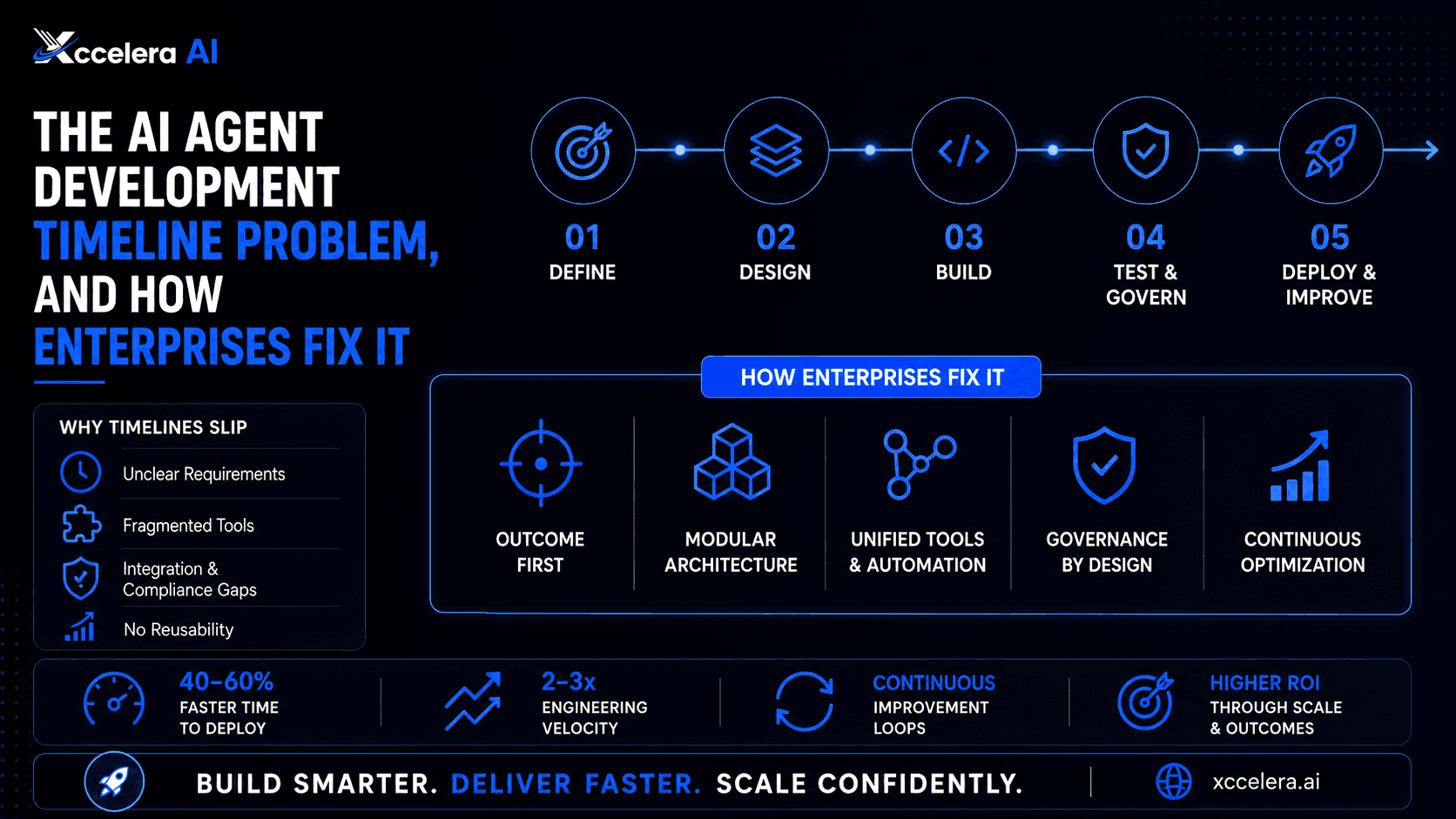
Enterprise leaders keep asking the same question. Why does the AI agent development timeline drag on so long? A promising demo often turns into a production system nobody trusts yet.
The honest answer rarely involves the model itself. Instead, integration debt, compliance reviews, and missing governance quietly consume the months between prototype and launch.
This breakdown shows where that timeline actually goes. It compares build versus buy with real numbers. It also explains how the right orchestration layer turns a six-month slog into a matter of weeks, without cutting corners on security.
The Real Reasons Behind a Slow AI Agent Development Timeline
The Prototype Trap
A working demo convinces almost everyone in the room. It answers questions, calls a tool, and looks production-ready within a single sprint. That confidence, however, is misleading.
A demo runs on clean inputs and a forgiving audience. Production, by contrast, runs on messy data, many concurrent users, and zero tolerance for silent failure.
Consequently, teams that judge success by the demo underestimate the AI agent development timeline by months. The gap between these two states is where the real engineering work actually lives.
Where the Timeline Estimate Breaks
Most enterprise AI agent development plans assume steady progress from prototype to launch. Reality, though, moves in stages instead.
Each stage — from tool integration to reliability testing — adds weeks that rarely appear in the original estimate. A true agent plans, calls tools, and recovers from errors. It behaves nothing like a scripted chatbot, and planning should reflect that difference from day one.
Where Enterprise AI Agent Development Actually Stalls
Delays rarely trace back to the model itself. As a result, leadership often looks in the wrong place when a project slips.
The Integration and Compliance Bottleneck
Connecting an agent to legacy systems, internal APIs, and audit rules takes far more time than training or prompt design. Meanwhile, compliance teams need clear decision logs before they approve a launch.
That review cycle alone can add several weeks. In practice, four forces drive most delays:
- Legacy system integration and undocumented internal APIs
- Compliance and audit trail requirements specific to regulated industries
- Edge case handling and reliability testing under real traffic
- Talent scarcity, since specialized agentic AI implementation skills remain limited
The Compounding Effect of Skills Gaps
Engineers who understand orchestration, memory, and tool calling at production scale are still rare. That scarcity forces internal teams to learn on the job, which stretches an already tight timeline even further.
Hiring does not solve this quickly either. Specialized agentic engineers typically ask for long notice periods and high salaries.
Most organizations end up training existing staff mid-project instead of waiting for a new hire. According to Gartner, unclear business value and inadequate risk controls remain the leading causes of stalled agentic projects. That training curve alone can add six to eight weeks before a team ships its first reliable release.
Build vs Buy AI Agents: The Real Timeline Difference
The build-versus-buy decision changes the entire delivery timeline. Notably, the gap is larger than most roadmaps admit.
| Approach | Typical Timeline | Relative Cost | Governance Control |
|---|---|---|---|
| Custom build | 6 to 12 months | High, ongoing engineering spend | Full control, self-managed |
| Managed platform | Days to a few weeks | Predictable, usage-based | Built in, vendor-supported |
| Hybrid approach | 4 to 8 weeks | Moderate | Shared, configurable |
Speed becomes the deciding factor once competitors start shipping agentic features first. That said, hybrid approaches are gaining ground.
They let internal teams keep control of the logic that sets them apart. Meanwhile, they outsource the plain plumbing work that used to eat most AI agent development services budgets.
Where Most AI Agent Projects Stall Between Demo and Production
A working prototype creates false confidence, yet production readiness demands far more than that confidence can cover. Teams demo successfully, then discover monitoring, rollback, and governance were never built.
Governance Gaps Nobody Budgeted For
Production agents need monitoring for drift, cost, and unexpected tool calls. Few internal teams have built this kind of oversight before, so they build it for the first time under deadline pressure.
This is one reason more than 40 percent of agentic projects reportedly get shelved before launch, according to McKinsey’s State of AI research.
The Hidden Cost of a Stalled Project
Every month spent rebuilding governance from scratch is a month engineers do not spend on differentiating work. This hidden cost rarely appears in the original AI agent development cost estimate, yet it often outweighs the direct engineering spend.
Leadership typically budgets for model usage and integration hours. Then a stalled launch lets a competitor ship first, and that surprise carries a real revenue cost. It never shows up as a line item in the original project plan. Research from NIST’s AI Risk Management Framework underscores why building governance in from the start, rather than retrofitting it, saves both time and money.
Cutting AI Agent Development Time With Orchestration Platforms
Purpose-built orchestration platforms compress the timeline. They handle coordination as a managed layer instead of a custom build.
Capabilities Handled Out of the Box
Multi-agent orchestration platforms manage memory, tool routing, and error recovery automatically. Engineering teams, therefore, do not need to rebuild that layer from scratch.
This shifts effort toward the roughly 20 percent of workflow logic that actually differentiates the business. As Forbes reports, operational friction — not model quality — remains the biggest barrier to enterprise-wide scaling.
Hybrid Patterns Enterprises Use Today
Enterprises increasingly combine a managed orchestration layer with custom logic for their own workflows. This pattern shortens time to production while keeping the parts that create an edge under direct internal control.
Custom work still adds real value where the workflow touches proprietary data or a regulated process unique to the business. Teams that adopt this pattern in 2026 report a clear shift: engineers spend far less time on plumbing and far more time refining the decisions the agent makes. That is the work customers actually notice. Recent industry data compiled from Gartner, McKinsey, and IDC shows this shift accelerating across nearly every sector in 2026.
How Xccelera Shortens the AI Agent Development Timeline
Xccelera built its AI Agent Creation and Orchestration Platform around one problem. Enterprises do not need another framework to learn — they need coordination, memory, and governance handled for them.
The platform manages agent orchestration and tool integration as a managed service. This removes the months most teams spend rebuilding infrastructure that already exists elsewhere.
Governance ships built in, not bolted on after a compliance review flags a gap. Audit trails, monitoring, and rollback controls come configured from day one. As a result, the review cycle that normally adds weeks to enterprise AI agent development shrinks to days instead.
For teams comparing AI agent development services, this difference matters. Governance by default, not governance as an afterthought, is usually what separates a six-month build from a production launch measured in weeks.